
 Worksheets
SS 1st semester review
Total questions: 88
Worksheet time: 1hrs 6mins
What were some achievements of the Paleolithic Age?
agriculture and the wheel
controlling fire, oral language, stone tools
written language and cave drawings
advanced tools and weaponry
What were some new achievements of the Neolithic Age?
controlling fire and simple stone tools
oral language, cave art
Agriculture, advanced tools, weaving, and cities
The Mona Lisa
During which Stone Age time period were people nomadic?
Paleolithic
Neolithic
During which Stone Age period did people live in permanent houses?
Neolithic
Paleolithic
What are people called who moved from place to place in search of food?
poachers
farmers
herders
hunter gatherers
What is prehistory?
before people existed
before writing existed
before typing existed
before spoken language existed
Paleolithic people moved from place to place in search of food. This is why they are called ______.
farmers
settlers
nomads
immigrants

How many years between the Rosetta stone being carved and the last hieroglyphic writing?
Same side: -
opp. sides: +
1000 years
100 years
500 years
200 years
Most early settlements started in ________ because of the fertile soil & access to water
river valleys
Africa
the desert

Who was known for creating the worlds first empire
Sargon
Alexander the Great
Hammurabi
Gilgamesh

Hammurabi’s code of law was most accurately known to be:
Strict and harsh
easy going and helpful
fun and exciting
boring and weird

What was the purpose of Hammurabi’s code
To make all caste equal
Justice for all
To get rich
To go worship
What did the earliest civilizations have in common?
They grew corn.
They built ziggurats.
They were monotheistic.
They originated near rivers.
How did the sail impact the Mesopotamians?
They were able to remain isolated from other cultures.
They were able to trade over long distances.
They were able to grow more crops.
They were able to build a powerful navy.
The end of the Stone Age (around 10,000-12,000 years ago) witnessed the change from hunter-gatherer societies to agricultural societies. This led to the rise of civilization. One of the societal changes that occurred at this time was that people
began to interact and trade with distant societies.
migrated south ahead of advancing glaciers.
relied more on meat than plants for their diets.
began to farm and live in permanent settlements.
What is the name of the earliest known writing system, which was developed in Mesopotamia?
papyrus
calligraphy
cuneiform
hieroglyphics
Match the following
A Mesopotamian pyramid with a temple on the top.
Ziggurat
A set of laws that apply to everyone under a government.
Code of Law
An area of very good soil from the Persian Gulf to the Mediterranean Sea
Fertile Crescent
Place the labels on the pyramid correctly
Slaves
Priest
King
Merchants
Farmers
Select the names of the two rivers that run through Mesopotamia.
Nile
Tigris
Yellow
Euphrates
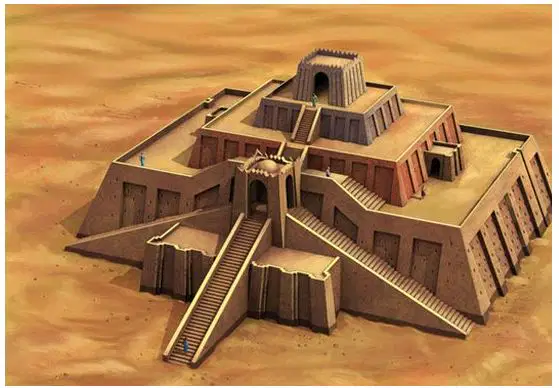
What is the purpose of this building?
tomb
temple
palace
fortress
Why is the Code of Hammurabi significant to the history of human civilization?
It was the first example of pictographic writing.
It was the first written code of laws.
It was the first example of human writing.
It was the first written religion.
What was King Sargon’s greatest historical achievement?
He established the first known empire.
He united warring Babylonian tribes.
He commissioned the construction of ziggurats.
He had sewage and drainage systems built throughout Babylonia.
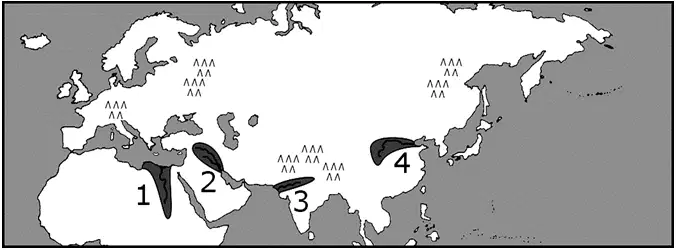
Which number correctly identifies the location of the Mesopotamian civilization known as Sumer?
1
2
3
4
Why did Mesopotamian farmers rely on annual flooding?
The floods left behind silt that helped crops grow.
The floods left behind gold used for making money.
Flooding made it easier to travel upstream.
Flooding made it easier to transport goods.
What continent is Egypt located in?
Asia
Africa
North America
Australia
Why were pharaohs buried with their possessions?
They didn't want anyone else to have them
They thought they could use them in the afterlife
They wanted them to stay safe
They wanted their family to have access to them
What type of religion did the ancient Egyptians believe in?
monotheism
polytheism
Judaism
Hinduism
This pharaoh was significant for his well preserved tomb which taught us a lot about how Egyptians mummified their dead.
Ramses
Tutmose II
Tutankhamen
Hatshepsut
This pharaoh was significant for her trade routes?
Ramses
Tutmose II
Tutankhamen
Hatshepsut
This pharaoh was significant for his military conquests.
Ramses
Tutmose II
Tutankhamen
Hatshepsut
This was what Hierolgyphics were written on.
clay tablets
paper
papyrus
typewriter
Which ancient form of writing is best defined as being composed of pictographs?
Arabic
Cuneiform
Greek
Hieroglyphics
What do you think allowed for the cultural diffusion between Egypt and Nubia?
their locations along the Nile River
their similar beliefs
their languages
their desires to have power
What is cultural diffusion?
the spread of the beliefs and social activities of one culture to another
changing your culture to be more like someone else's
getting rid of your culture because you like someone else's better
Shaduf

What is located in the circled area of the map?
Mediterranean Sea
Upper Egypt
Thebes
Nile Delta

Name the body of water circled in the picture.
Mediterranean Sea
Persian Gulf
Red Sea
Nile River

Which region of Egypt is circle on the map?
Upper Egypt
Lower Egypt

What large body of water is circled in purple on the map?
Mediterranean Sea
Persian Gulf
Red Sea
Nile Delta
What direction does the Nile River flow?
North to South
South to North
East to West
West to East

Which number correctly identifies the location of ancient Israel
1
2
3
4

which number correctly identifies the Jordan River?
1
2
3
4
which number correctly identifies the Sinai Peninsula?
5
2
3
4
which number correctly identifies the Dead Sea?
5
2
3
4
What geographical feature is a natural barrier between India and China
Ganges River
Indus River
Indian Ocean
Himalayan Mountains
India is located in
Africa
Asia
North America
Europe
Select all the answers the describe the advancements of the Harappan Civilization
built buildings with bricks
had sanitation systems
monotheistic religion
roads arranged in grid systems
How did monsoons help the Indus River Valley civilizations?
They brought rain that caused flooding which brought silt to improve soil.
They brought rain that caused flooding that caused damage.
The winds prevented rain storms
The winds brought cool temperatures
The set of rules that Buddhists follow are
The Ten Commandments
The Four Noble Truths
Hammurabi's Code
The Ramayana
How did Buddhism Start?
Siddhartha read the Tripitaka and thought...hmm I should make a religion
Siddhartha read the Vedas and became enlightened.
Siddhartha had really good Karma.
Siddhartha studied human suffering and became enlightened.
The sum of ones actions and what caste a person will be born into in the next life is determined by
Karma
Dharma
Reincarnation
Morals
Your level in the caste system is determined by
Birthday
Location
eye color
Job

Which two major religions began in India?
Christianity
Buddhism
Hinduism
Islam

What is karma?
The idea that the soul needs good energy to have the power the reincarnate
The force of the universe that requires people to be nice to each other
The force generated by a person's actions that determines how the person will be reborn in the next life
The idea that what goes around comes around

Who was Siddhartha Gautama?
The Founder of Hinduism
The Founder of Buddhism
A Buddhist monk who spread Buddhism
Buddhist Deity of Creation

Caste System
Hinduism
Buddhism
Both

4 noble truths and 8 fold path
Greed causes suffering
Hinduism
Buddhism
Both
What is the correct chronological order of the b.c. ancient china dynasties discussed in class?
Han, Ming, Lee, Chang
Shang, Zhou, Qin, Han
Zhou, Qing, Sumer, Harappa
Laozi, Confucius, Buddha, Mulan
Civilization in Ancient China settled and started cultivating rice along what river?
Indus River
Tigris River
Nile River
Huang He / Yellow River
The first Chinese writing system was created with characters to represent words during which Chinese dynasty?
Ming
Shang
Qin
Han
During the Qin Dynasty, the ruler Shi Huang-di began construction of the..
Great Wall
Pyramid of Giza
Ziggurat Temple
Fleet of Zheng he
During the han dynasty, they traded with the roman empire becoming very wealthy and powerful because of what main export?
Cotton
Wheat
Silk
Gold
What Ancient Chinese emperor commissioned the building of thousands of terracotta warriors to help protect him in the after life?
Shi Huang-di
Ramses the Great
Chandragupta I
Qin Shang ZHou
Which of the following are innovations by the Ancient Chinese?
Paper, Silk, Wheelbarrow
Planned cities, papyrus, wheel
Sailboat, Mummification, Sanskrit
Hieroglyphs, gunpowder, number 0
Confucianism focused on
Following the vedas of hinduism
The yin and yang
worshipping more than one god
Respecting rulers and elders
Label the major bodies of water.
Huang He (Yellow) River
Chang Jiang (Yangtzee) River
The ancient Chinese were able to flourish independently, and without much interference from outsiders due to...
their reputation and strength as a military power
the outsiders not wanting what the Chinese had
their geography providing many natural barriers
their rivers being very difficult to navigate
What religion spread along the silk road?
Daoism
Buddhism
Hinduism
Christianity

Respect for one's parents and elders.
Daoism
Legalism
Great Wall
Filial Piety

A group of rulers from the same family.
loess
philosophy
dynasty
seismograph

China's earliest written records that often told predictions for the future.
filial piety
oracle bones
Daoism
dynasty
Match the following philosophy with its definition
Confucianism
The ideas and teachings of Confucius
Daoism
A philosophy that emphasizes living in harmony with the Dao
Legalism
A belief that people must be controlled with a strong leader & legal system
What is the highest mountain range?
Himalayan Mountians
Andes Mountains
Great Wall of China
Rocky Mountains
The Han dynasty used what method to select civil servants based on their skills
Job Interviews
Civil Service Exams
mid terms
eye exams
Which dynasty made laws and taxes uniform and standardized weights & measurements?
Han
Qin
Shang
Zhou

