
 Worksheets
Mid Year Science DA Review 25-26
Total questions: 90
Worksheet time: 1hrs 25mins


Michael Scott is creating a model for Science to explain Earth and the Sun and why the length of day and night change throughout the year. What would be the most important feature to add to the model, and why?
Michael should show the Earth upright on its axis as it revolves around the sun to show different amounts of light hitting the Earth changes as it revolves
Michael should show the Sun revolving around the Earth to show the Earth receiving different amounts of light hitting the Earth.
Michael should show the Earth tilted on its axis to show the Earth receiving the same amount of light hitting it as it revolves around the sun.
Michael should show the Earth tilted on its axis as it goes around the Sun so that the amount of light hitting the Earth changes as it moves into different positions around the sun.
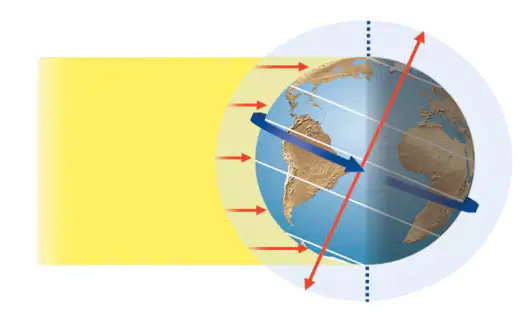
The model below shows the Earth in one of its positions as it moves around the Sun.
Which explanation is supported by this model?
It is winter in the Southern Hemisphere, and because of this, they have longer days and shorter nights.
It is summer in the picture, and both Hemispheres have the same length of day and night.
It is summer in The Southern Hemisphere, and they are experiencing longer days and shorter nights.
It is summer in the Northern Hemisphere, and they have longer days and shorter nights.
Pam creates wants to show how night and day change throughout the year. She takes a globe and a large yellow ball and walks around the large yellow ball while spinning to show night and day. What should Pam also include in her model?
Pam should spin the globe fast during some parts of the orbit and slow during other parts to show that we have longer days during summer and shorter days during other parts of the year.
Pam should show the tilt to show how the earth is tilted toward the sun during the day and away from the sun at night.
Pam should show the tilt to explain why winter days are shorter and summer days are longer.
Pam should show the Earth spinning faster in the east and slower in the west.
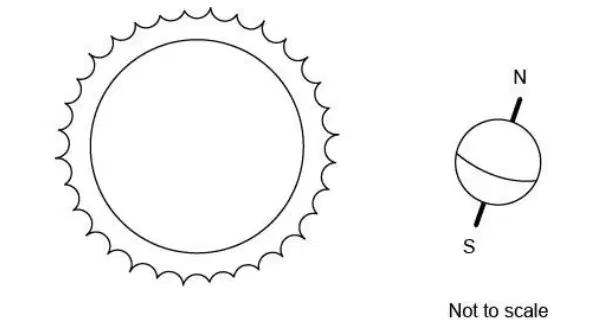
The picture is modeling Earth during part of its orbit around the Sun.
Why don’t all parts of the Earth have day and night at the same time?
The sun revolves around the Earth, so it can only shine on one side of the Earth at a time.
As Earth rotates, only one side of the Earth is facing the sun. The side facing the sun experiences day, while the side that faces away from the sun experiences night.
All parts of Earth are not experiencing day and night at the same time due to Earth's tilt.
The moon revolves around the Earth and blocks the sun's rays on certain parts of the Earth.
How could you develop a model to show why the length of daytime is different in the months?
You could get two balls to represent the sun and the Earth and show Earth is tilted toward the sun more in the summer than in the winter.
You could get two balls to represent and the sun and the Earth and show how the sun can only be shinning on one side of the Earth at a time.
You could get two balls to represent the sun and the Earth and show Earth is tilted toward the sun less in the summer than in the winter.
You could get two balls and show how the Earth spins faster in June than it does in December.
A student is creating a model of the Earth and the Sun to explain why the length of day and night change throughout the year. Which of the following will be the MOST important feature to add to the model and why?
The Earth should make a perfect circle around the Sun so that the Sun’s light hits all surfaces equally.
The Earth should make an elliptical orbit around the Sun so that the Sun is at different distances throughout the year.
The Earth should be tilted on its axis as it goes around the Sun so that the amount of light hitting the Earth varies depending on the tilt.
The Earth should be placed upright on its axis as it goes around the Sun so that it shows the Earth slowing its rotation.

All parts of the Earth do not have day and night at the same time. Why does this happen?
Earth revolves around the Sun on an axis, and it is a day only.
The Sun revolves around Earth, and it can only shine on half of Earth at one time.
Earth rotates on its axis, and only the part of Earth facing the Sun experiences day.
The moon revolves around Earth and blocks the Sun from certain parts of Earth at different times.

Which explanation is supported by this model?
The part of the Earth that is receiving direct sunlight is experiencing night.
The part of the Earth that is receiving direct sunlight is experiencing day.
The part of the Earth that is receiving direct sunlight is experiencing spring.
The part of the Earth that is receiving direct sunlight is experiencing fall

Dwight created a model of the phases of the moon.
Which statement is TRUE based on his model?
Dwight's model shows how each moon phase appears when viewed from the moon.
Dwight's model shows how the moon phases takes precisely one and a half days.
Dwight's model shows that the moon's phases always appear half-lit, with the other side of the moon not illuminated.
Dwight's models show why the moon is visible during the day and the night.
Which argument regarding the earth’s tilt, the earth’s orbit, and the seasonson Earth is CORRECT?
The Earth’s orbit and the Earth’s tilt cause the seasons on Earth.
The Earth’s orbit and the seasons on Earth cause the Earth’s tilt.
The Earth’s tilt and the seasons on Earth cause the Earth’s orbit.
The Earth’s tilt, the seasons on Earth, and the Earth’s orbit are not related.
Use the information to answer the following question.
A student wrote the argument to explain why we experience different seasons on Earth:
We experience seasons on Earth because the Earth is tilted on its axis. The Hemisphere experiencing summer is tilted toward the sun and receives more direct sunlight. The Hemisphere experiencing winter is tilted away from the sun and receives more indirect sunlight.
Which of the following is a way that the student’s argument can be improved?
The student should not say that the tilt of the Earth causes the seasons.
The student should not say that direct and indirect sunlight causes the seasons.
The student should add the Earth’s orbit around the sun to the argument.
The student should add the Earth’s distance from the moon to the argument.
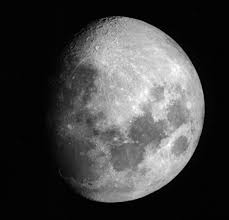
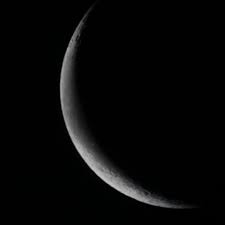
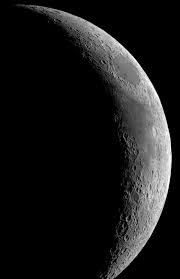
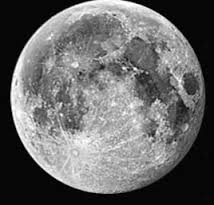
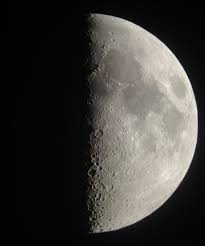
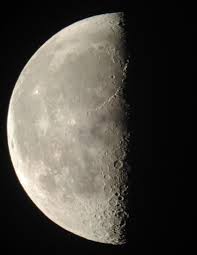


The moon is a _____.
Satellite
Star
Planet
Moon
Other Planet
It takes the moon ABOUT how long to go through its phases
a year
a day
a month
a week
The earth and moon both ______ around the sun
revolve
drive
rotate
dance
Light
bright wave lengths that can move through solid objects
a form of energy that can travel through space and be seen by the human eye
a form of energy that can move through objects
a form of energy that cannot be seen by the human eye
transparent
a parent of light
not completely clear, but clear enough to let rays of light to pass through
not able to be seen through
clear enough to be seen though
opaque
a parent of light
not completely clear, but clear enough to let rays of light to pass through
not able to be seen through
clear enough to be seen though
translucent
a parent of light
not completely clear, but clear enough to let rays of light to pass through
not able to be seen through
clear enough to be seen though
desk
translucent
opaque
transparent
light
hand lens
translucent
opaque
transparent
light
wax paper
translucent
opaque
transparent
light
plastic bag
translucent
opaque
transparent
light
tinted windshield
translucent
opaque
transparent
light
dog
translucent
opaque
transparent
light


A student wants to see what kind of material the light cover is. What should she do?
Research to see if the company who made the light cover lists the information on their website
Interview the workers who installed the light
Shine a flashlight through the cover while looking on the other side and observe how much light comes through the material
Turn off the lights and see if she can see through the cover
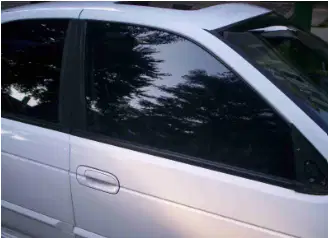
Jose has been learning about how light reacts to different materials. His aunt came over and he notices the windows on her car. What experiment could he plan to determine if the windows are transparent, translucent, or opaque?
He could shine a laser through the windows as he looks through the window to see if light passes through
He could look to see if he could look through the window
He could shine a flashlight through the window while looking through the window and observe how much light comes through the material
He could shine a flashlight through the window while looking on the other side of the window and observe how much light comes through the material
frosted glass
light
opaque
translucent
transparent
Which of the following materials would most likely be used to make a window that allows privacy while still letting some light through?
Wood
Frosted glass
Metal
Clear glass
Which property of light is demonstrated when it passes through a prism and creates a spectrum of colors?
Reflection
Refraction
Diffusion
Absorption
Three students wanted to investigate sound and vibrations with the same materials. One student flicked a string every 10 seconds, one student flicked a string every 5 seconds, and another student flicked a string every 2 seconds. What will the students observe?
Speed does not impact vibrations or sound.
The string was the highest-pitched sound when vibrating the fastest.
The string was the highest-pitched sound when vibrating the slowest.
All three sounds will sound the same, but the vibrations will speed up when flicked more.
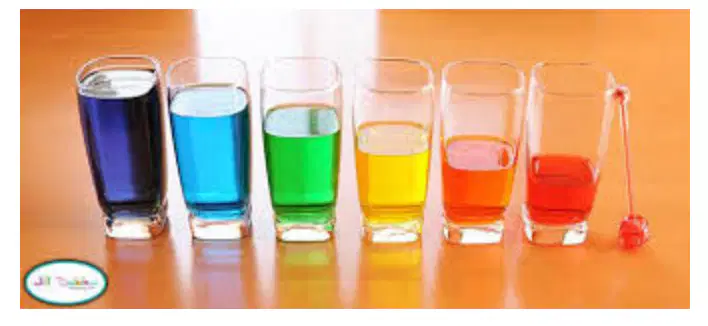
A student fills different glasses of water with different amounts of water to investigate sound.
What will happen when the student taps the glasses?
All of the glasses of water will produce different sounds, but there is no way of knowing what type of sound they will make until you hit all glasses and make observations.
The glass with the most water will have the lowest pitch sound since vibrations slow down to travel through the most water.
All glasses of water will produce the same sound since the vibrations are traveling through the same type of liquid.
All glasses of water will produce the same sound since the vibrations are traveling through the same type of liquid.
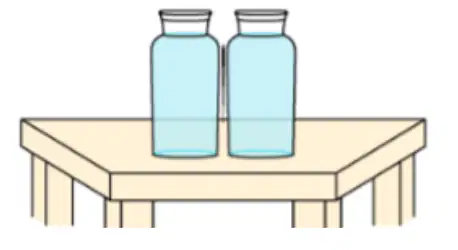
Liz is creating a device that uses sound waves to communicate yes or no answers to her friend’s questions. She fills two glass bottles with the same amount of water. The picture shows her device.
She will tap each bottle once with a spoon to create two different sounds. One bottle will produce a high pitch sound when tapped with the spoon, and the other bottle will make a low pitch sound. She explains to her friend that the lower pitch means “no” and the higher pitch means “yes.”
Will her device be able to communicate the yes or no messages using different pitches?
Yes, she will be able to create different pitches of sound because both bottles are filled with water all the way to the top.
Yes, she will be able to create different pitches of sound if she hits one bottle lightly and the other bottle very hard.
No, she cannot produce any sound at all because the jars are filled with water.
No, she will not be able to produce different pitches. When tapped with the spoon, both bottles will have the same pitch because the water levels are the same.
Students are going camping and are creating a signal sound to use whenever they want their friends to come find them. Which of the following can the students do?
The students should use mirrors to reflect light across the campsite.
The students should create a campfire to send smoke signals.
The students should use flashlights and point them at the sky.
The students should use whistles made out of clay.
What is similar about how all three of these devices will be used to communicate?
Only students 1 and 2 created a device to communicate with sound.
They are all created in order to speak to one person to another.
They will all produce vibrations, which will result in a sound.
They are all created in order to communicate with light.

Which statements correctly describe the sounds the birds are making? Choose all the correct answers.
Both birds' sounds have the same pitch because they have the same frequency and wavelength.
Bird A's sound has a higher pitch than Bird B's sound.
Bird B's sound is louder because it has a higher amplitude.
Bird A's sound is louder because it has a lower amplitude.
A place where no sound exists is...
in the air
under water
space
all of the above
Explain why vibrations are needed for the production of sound.
Vibrations create energy that turns into sound.
Vibrations disturb the air, creating sound waves.
Vibrations increase the temperature which produces sound.
Vibrations reflect sound waves off surfaces.
Which of these is a way to communicate without sound?
whispering
sign language
shouting
Jonathan conducted an experiment where he hit a drum. When the drum was struck, salt flew into the air. What is the best reasoning for this?
Vibrating objects make sound.
Movement does not require energy.
Sound can change into wind energy.
Vibrating objects do not change their pitch or volume.
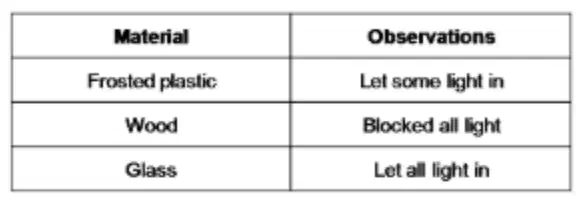
Jonathan wants to build a doghouse for his new puppy, who will live in the backyard. He uses a flashlight to test the following materials: frosted plastic, wood, and glass. He wants to ensure his material will keep his puppy shaded and cool during the day. Below are his observations from his flashlight test.
Which of the following materials should be used to keep his puppy as cool as possible during the day?
He should use wood because it blocks all light from coming in, and this will keep the doghouse cool
He should use a combination of all three materials to allow different amounts of light in to keep the doghouse cool.
He should use frosted plastic so there is some light that can come in to keep the doghouse cool, but not too cold
He should use glass because it allows all light to come in, therefore, there will be no blocked light, so it will remain cool in the doghouse.
Students want to explore how light interacts with different materials. Which of the following investigations would BEST allow students to see how light interacts with different types of materials to classify them
Take three different types of flashlights to see the amount of light that shines through a piece of construction paper.
Take three different types of flashlights to see the brightness of light when turned on in a dark classroom.
Take three different types of materials such as: cardboard, wood, and a thick blanket to see the amount of light that shines through it when placed under a flashlight.
Take three different types of materials such as: aluminum foil, plastic wrap, and white paper to see the amount of light that shines through it when placed under a flashlight.
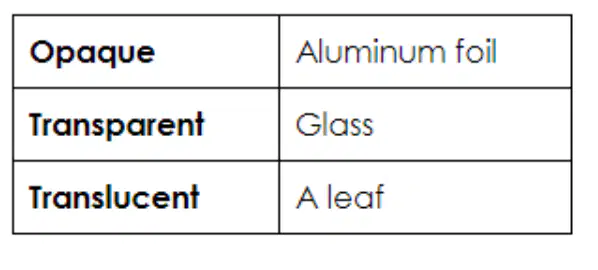
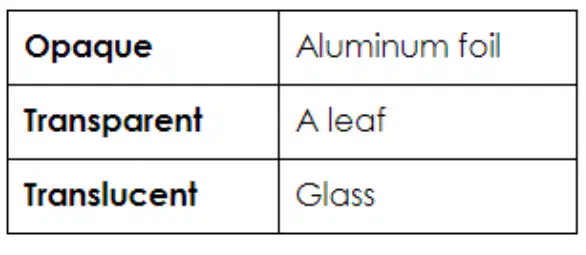
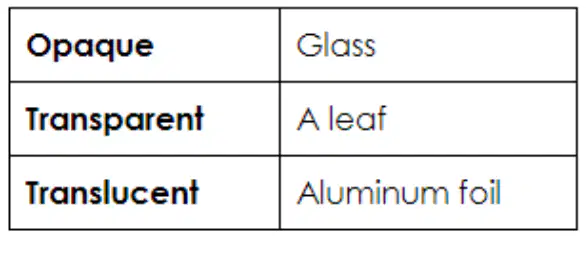
Students conducted an experiment to classify different types of materials as opaque, transparent, or translucent. Which of the following charts correctly classifies the materials?

A student is planning an investigation to answer the following question: How can I use two mirrors to make a beam of light hit a certain target? Here is his plan for the investigation:
Step 1 - Place a target on the wall across from me:
Step 2 - Place two mirrors around the targets like this:
Step 3 - Shine a laser pointer at mirror #1. The light will reflect to mirror #2, and then to the target.
How would you help this student refine/improve his investigation to hit the target?
The student should increase the size of his target.
The student should decrease the size of his target.
The student should change the position of the mirrors.
The student should use a flashlight instead of a laser pointer.
A student is planning an investigation to answer this question: How will a mirror reflect light that strikes it at different angles? As she investigates this question, what should she change in each trial to answer this question?
The type of light
The type of mirror
The location of the mirror
The location of the light she shines on the mirror
A student is planning an investigation to determine why we can see our reflection in some materials and not others. Which of the following investigations can the student perform to see the difference?
The student should look in mirrors at different angles.
The student should compare different types of mirrors.
The student should look at the same piece of glass during the night and daytime.
The student should look into different substances with smooth and rough surfaces.
Four students are planning investigations about how light is affected by different objects.
Student #1 is investigating how light interacts with paper.
Student #2 is investigating how light interacts with aluminum foil.
Student #3 is investigating how light interacts with eyeglasses.
Student #4 is investigating how light interacts with water.
How many of these investigations will cause light to be refracted?
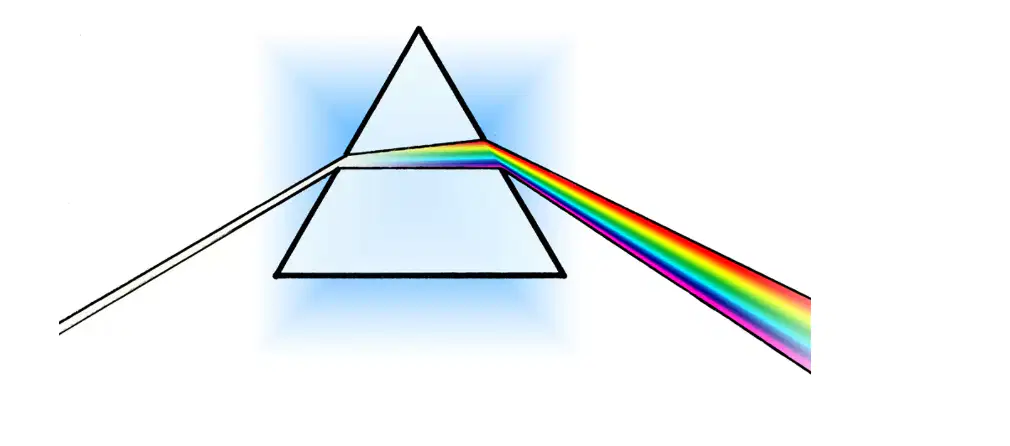
Erika has found a prism in her dad’s office. She takes it outside to play. As she does, sunlight hits the prism.
Explain what happens as the sunlight passes through the prism.
The sunlight bends as soon as it goes through the prism since it is a different medium.
The sunlight bounces back from the prism to Erica’s hand since the prism is reflective.
The sunlight continues to go straight through the prism since light travels in straight lines.
The sunlight stops traveling the moment it reaches the prism since different media make the sunlight stop moving
A student in the cafeteria brings a large clear plastic cup filled with water. The student places a bright pink straw in the water. What observations can the students at the table make about the straw once it touches the water?
The straw will appear broken because light travels through air differently than water.
The water bends the straw. Once the student takes the straw out of the water, the straw will still be bent.
The light from the straw will bounce back to the students’ eyes so it will appear that there is no straw in the water.
The straw will go in the water and there will be no difference in how light affects the water and air that the straw is in.
Three students wanted to investigate sound and vibrations with the same materials. One student flicked a string every 10 seconds, one student flicked a string every 5 seconds, and another student flicked a string every 2 seconds. What will the students observe?
Speed does not impact vibrations or sound.
The string was the highest-pitched sound when vibrating the fastest.
The string was the highest-pitched sound when vibrating the slowest.
All three sounds will sound the same, but the vibrations will speed up when flicked more.
A student fills different glasses of water with different amounts of water to investigate sound.
What will happen when the student taps the glasses?
All of the glasses of water will produce different sounds, but there is no way of knowing what type of sound they will make until you hit all glasses and make observations.
The glass with the most water will have the lowest pitch sound since vibrations slow down to travel through the most water.
All glasses of water will produce the same sound since the vibrations are traveling through the same type of liquid.
All glasses of water will produce the same sound since the vibrations are traveling through the same type of liquid.
Liz is creating a device that uses sound waves to communicate yes or no answers to her friend’s questions. She fills two glass bottles with the same amount of water. The picture shows her device.
She will tap each bottle once with a spoon to create two different sounds. One bottle will produce a high pitch sound when tapped with the spoon, and the other bottle will make a low pitch sound. She explains to her friend that the lower pitch means “no” and the higher pitch means “yes.”
Will her device be able to communicate the yes or no messages using different pitches?
Yes, she will be able to create different pitches of sound because both bottles are filled with water all the way to the top.
Yes, she will be able to create different pitches of sound if she hits one bottle lightly and the other bottle very hard.
No, she cannot produce any sound at all because the jars are filled with water.
No, she will not be able to produce different pitches. When tapped with the spoon, both bottles will have the same pitch because the water levels are the same.
Students are going camping and are creating a signal sound to use whenever they want their friends to come find them. Which of the following can the students do?
The students should use mirrors to reflect light across the campsite.
The students should create a campfire to send smoke signals.
The students should use flashlights and point them at the sky.
The students should use whistles made out of clay.
What is similar about how all three of these devices will be used to communicate?
Only students 1 and 2 created a device to communicate with sound.
They are all created in order to speak to one person to another.
They will all produce vibrations, which will result in a sound.
They are all created in order to communicate with light.

The picture shows a child standing in a swimming pool. Why does the lower part of the child appear so much different in size from the upper part? (5.6C)
The light rays that travel through water and then into air are refracted.
The light rays that travel through water and then into air are enlarged.
The light rays that travel through air and then into water are reflected.
The light rays that travel through air and then into water are reduced.

A mirror can (a) light, but not (b) it. A black hoodie will (c) a lot of the light that hits it.

A triangular glass bar that separates white light into the colors of the rainbow
lens
prism
shadow
circuit

A light wave bouncing off of a windshield visor is an example of:
Reflection
Refraction
Absorption
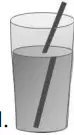
Why does the straw appear to be broken?
The light rays that travel through the water and into the air are reflected.
The light rays are magnified.
The light rays are absorbed by the water.
The light rays that travel through the water and into the air are refracted.


