
NEW
Font size
 Worksheets
Human Body Test Part 1 Version B
Total questions: 36
Worksheet time: 18mins
Vocabulary: Choose the correct definition of mechanical digestion.
A muscular contraction that moves food through the digestive tract.
A type of digestion that involves the use of enzymes to break down food.
A type of digestion that involves the tearing, ripping, and grinding of food.
What food becomes after mechanical and chemical digestion occurs in the mouth.
What food becomes when mechanical and chemical digestion occurs in the stomach.
Vocabulary: Choose the correct definition of chemical digestion.
A type of digestion that involves the tearing, ripping, and grinding of food.
A digestive helper made in the liver and stored in the gallbladder to break down fat.
A type of digestion that involves the use of enzymes to break down food.
The waste product created by the digestive system.
Is the amount of energy released by digestion.
Vocabulary: Choose the correct definition of bolus.
What food becomes after mechanical and chemical digestion occurs in the mouth.
What food becomes when mechanical and chemical digestion occurs in the stomach.
A muscular contraction that moves food through the digestive tract.
Is the amount of energy released by digestion.
The process by which heterotrophs break down food into smaller molecules.
Vocabulary: Choose the correct definition of chyme.
What food becomes when mechanical and chemical digestion occurs in the stomach.
What food becomes after mechanical and chemical digestion occurs in the mouth.
A muscular contraction that moves food through the digestive tract.
The waste product created by the digestive system.
Is the amount of energy released by digestion.
Vocabulary: Choose the correct definition of peristalsis.
A muscular contraction that moves food through the digestive tract.
A type of digestion that involves the tearing, ripping, and grinding of food.
Is the amount of energy released by digestion.
What food becomes when mechanical and chemical digestion occurs in the stomach.
A digestive helper made in the liver and stored in the gallbladder to break down fat.
Vocabulary: Choose the correct definition of Calorie.
Is the amount of energy released by digestion.
The process by which heterotrophs break down food into smaller molecules.
The waste product created by the digestive system.
A muscular contraction that moves food through the digestive tract.
A type of digestion that involves the use of enzymes to break down food.
Vocabulary: Choose the correct definition of digestion.
The process by which heterotrophs break down food into smaller molecules.
Is the amount of energy released by digestion.
What food becomes after mechanical and chemical digestion occurs in the mouth.
A digestive helper made in the liver and stored in the gallbladder to break down fat.
A muscular contraction that moves food through the digestive tract.
Vocabulary: Choose the correct definition of feces.
The waste product created by the digestive system.
A muscular contraction that moves food through the digestive tract.
What food becomes when mechanical and chemical digestion occurs in the stomach.
Is the amount of energy released by digestion.
A type of digestion that involves the use of enzymes to break down food.
Vocabulary: Choose the correct definition of bile.
A digestive helper made in the liver and stored in the gallbladder to break down fat.
The process by which heterotrophs break down food into smaller molecules.
A muscular contraction that moves food through the digestive tract.
What food becomes after mechanical and chemical digestion occurs in the mouth.
The waste product created by the digestive system.
Content Knowledge. Choose the one correct answer: Why do we need to break down the foods that we eat?
So it can fit into our stomachs.
So our bodies can use the nutrients from the food.
So that our body's enzymes have something to do.
Content Knowledge. Choose the one correct answer: Chewing is an example of what type of digestion?
Dental
Mechanical
Chemical
Content Knowledge. Choose the one correct answer: What is the main function of villi?
They move food from the stomach to the small intestine.
They absorb nutrients into the bloodstream.
They move food from the small intestine to the large intestine.
Content Knowledge. Choose the one correct answer: What is the correct order of organization?
tissues-cells-organs-organ systems-organism
cell-tissue-organs-organ systems-organism
organism-cells-tissues-organ systems-organism
Content Knowledge. Choose the one correct answer: What is the function of the epiglottis?
To prevent food from going from the small intestine into the stomach.
To prevent food from getting into the trachea.
To prevent food from getting into the esophagus.
Content Knowledge. Choose the one correct answer: Why are the liver, gallbladder, appendix, and pancreas considered accessory organs to the digestive system?
Because they just move food from one place to another and don't actually digest anything.
Because they are not organs. They are just large tissues.
Because food never directly goes into these organs. They just produce something that helps break down food.
Content Knowledge. Choose the one correct answer: The _____ is the basic unit for life.
Molecule
Cell
Organelle
Content Knowledge. Mark true or false: Villi decreases the surface area of the small intestine.
True
False
Content Knowledge. Mark true or false: The digestive system produces two types of waste products: feces and urine.
True
False
Which statement best defines homeostasis and gives an example of how your body maintains it?
Keeping external conditions constant; drinking water when it rains
Maintaining stable internal conditions; sweating to cool the body during exercise
Speeding up body processes; running to warm up cold air
Changing internal conditions randomly; blinking to keep light out
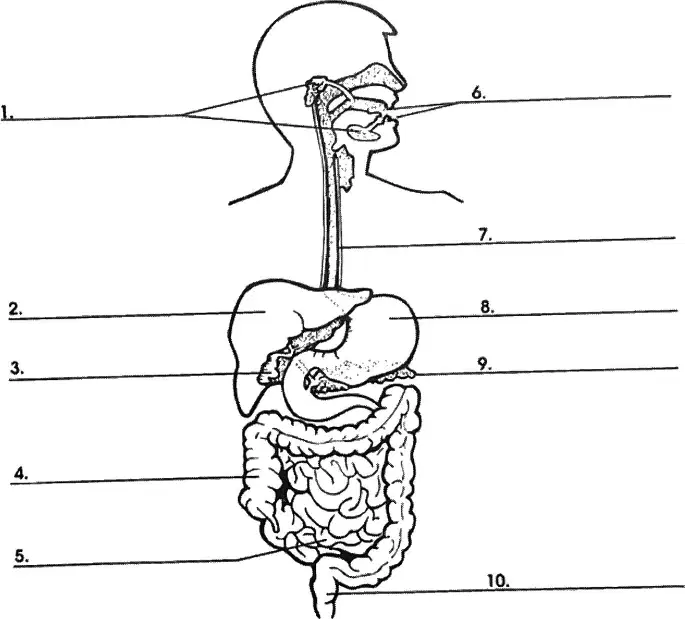
Label the key parts of the digestive system on the diagram below. Which structure is labeled 1?
Mouth
Salivary glands
Esophagus
Liver
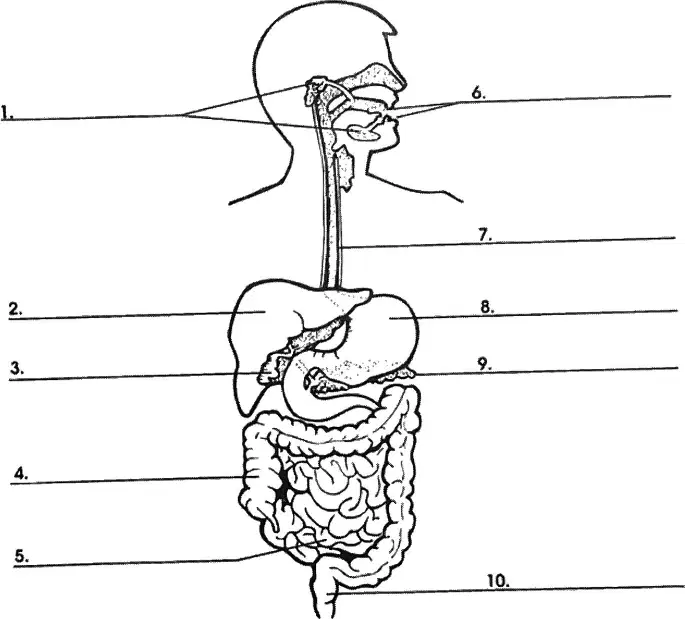
Label the key parts of the digestive system on the diagram below. Which structure is labeled 2?
Liver
Pancreas
Stomach
Gallbladder
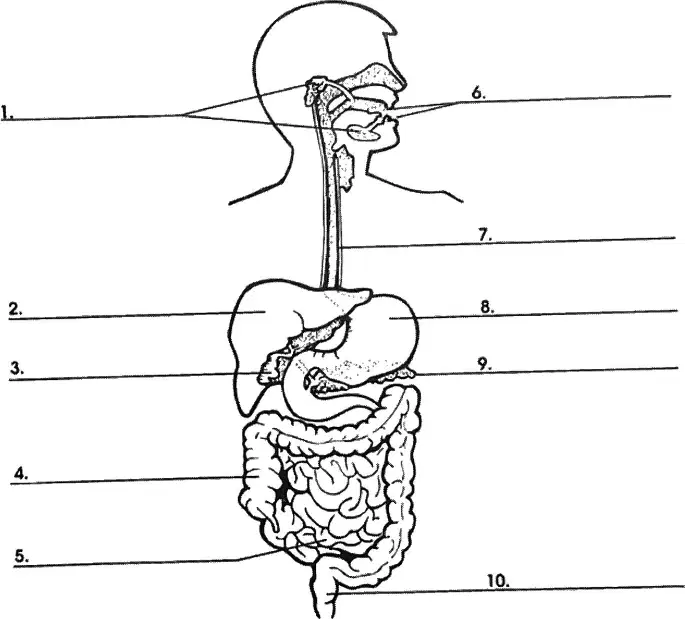
Label the key parts of the digestive system on the diagram below. Which structure is labeled 3?
Pancreas
Gallbladder
Rectum
Large intestine
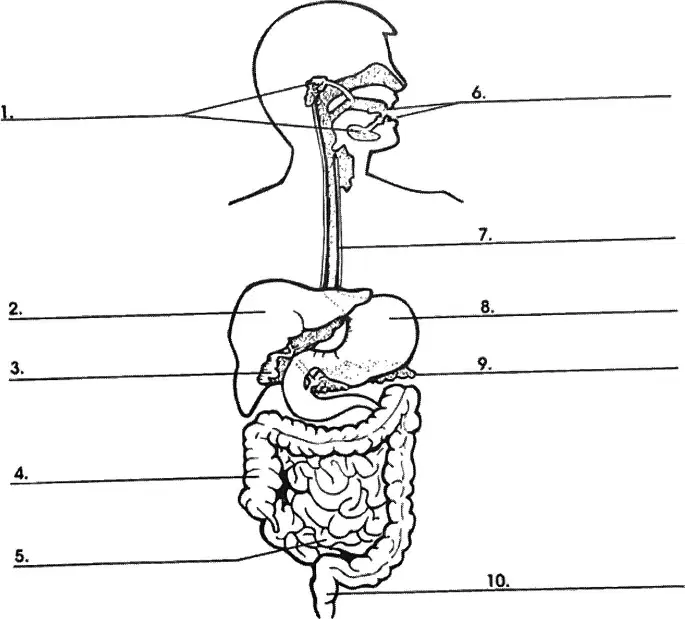
Label the key parts of the digestive system on the diagram below. Which structure is labeled 4?
Small intestine
Large intestine
Esophagus
Mouth
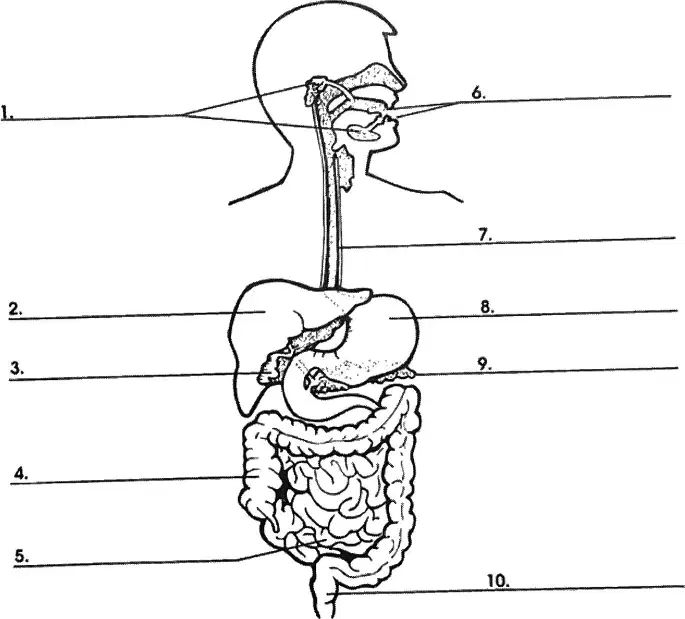
Label the key parts of the digestive system on the diagram below. Which structure is labeled 5?
Small intestine
Rectum
Esophagus
Salivary glands
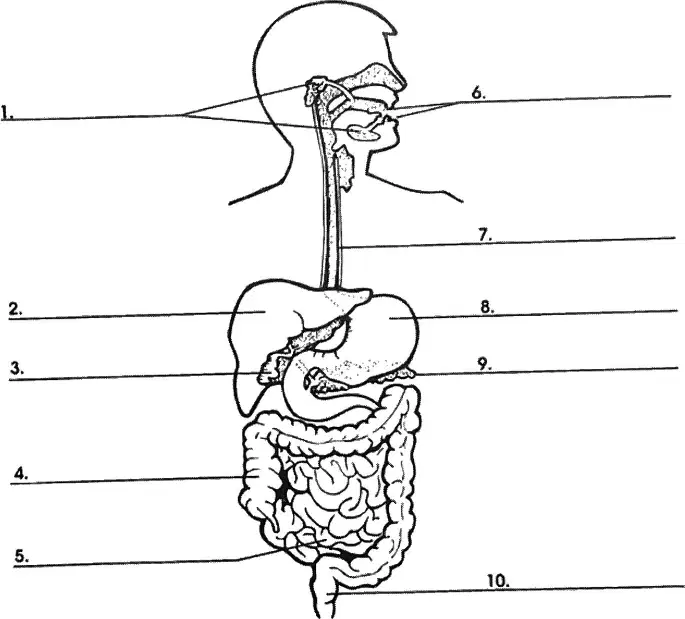
Label the key parts of the digestive system on the diagram below. Which structure is labeled 6?
Mouth
Esophagus
Salivary glands
Stomach
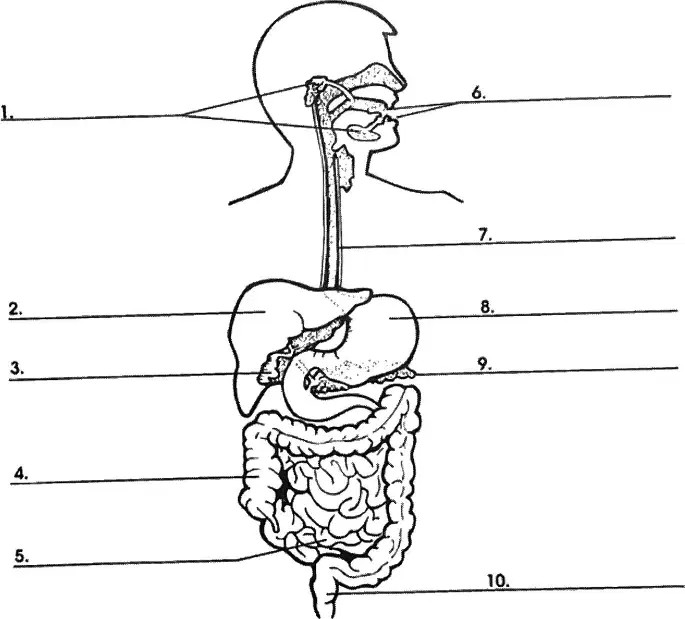
Label the key parts of the digestive system on the diagram below. Which structure is labeled 7?
Esophagus
Liver
Pancreas
Large intestine
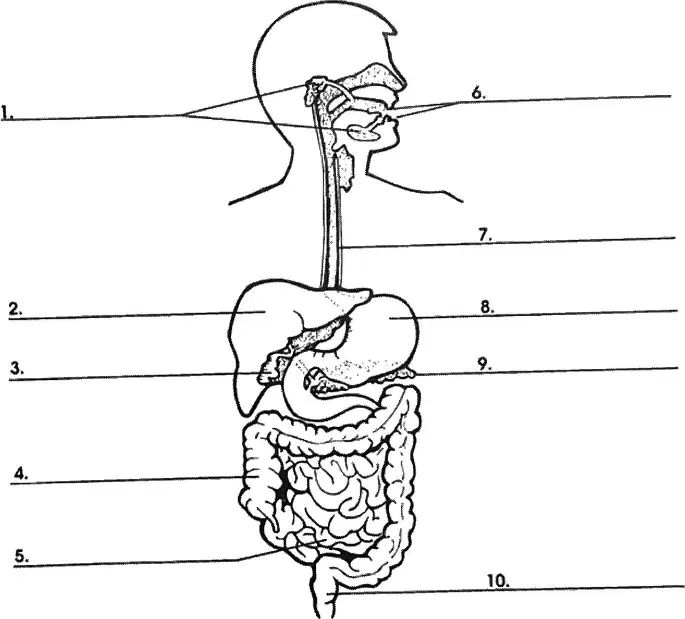
Label the key parts of the digestive system on the diagram below. Which structure is labeled 8?
Stomach
Pancreas
Small intestine
Gallbladder
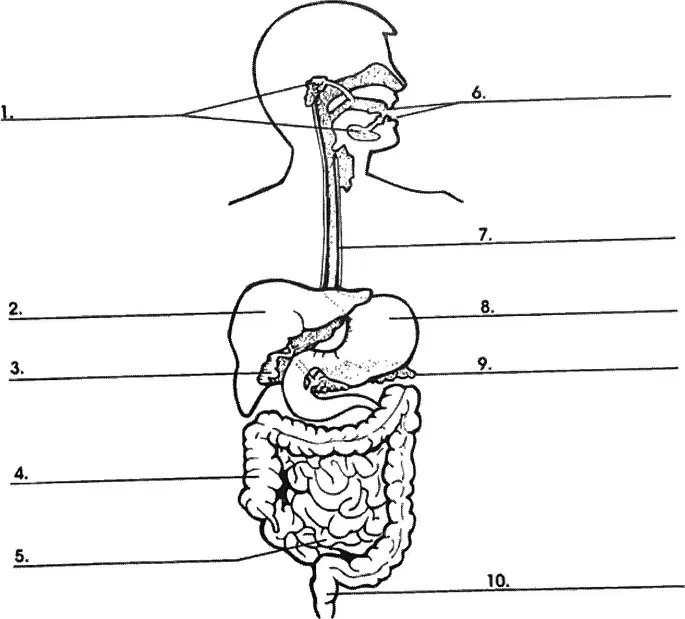
Label the key parts of the digestive system on the diagram below. Which structure is labeled 9?
Pancreas
Liver
Esophagus
Rectum
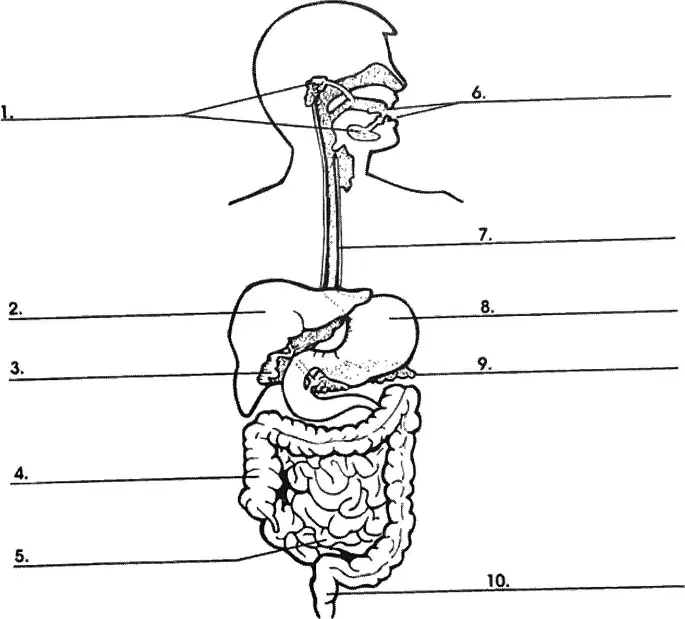
Label the key parts of the digestive system on the diagram below. Which structure is labeled 10?
Rectum
Gallbladder
Mouth
Salivary glands
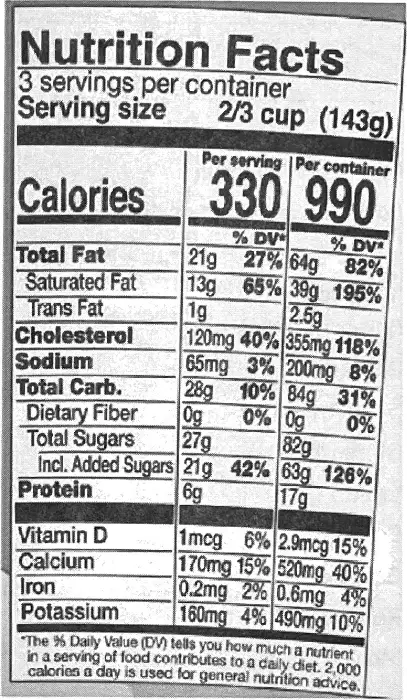
Use the Nutrition Facts information: 3 servings per container; Serving size 2/3 cup (143g); Calories 330 per serving; Total Fat 21g; Saturated Fat 13g; Cholesterol 120mg; Sodium 65mg; Total Carbohydrate 28g; Total Sugars 27g (Includes 21g Added Sugars); Protein 6g. What is the serving size?
1 cup (240g)
2/3 cup (143g)
1/2 cup (100g)
3/4 cup (170g)
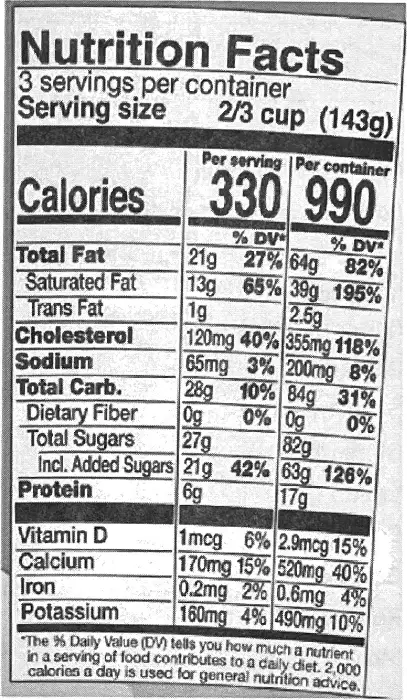
Use the Nutrition Facts information: 3 servings per container; Serving size 2/3 cup (143g); Calories 330 per serving; Total Fat 21g; Saturated Fat 13g; Cholesterol 120mg; Sodium 65mg; Total Carbohydrate 28g; Total Sugars 27g (Includes 21g Added Sugars); Protein 6g. How many calories are there per serving?
230
330
90
990
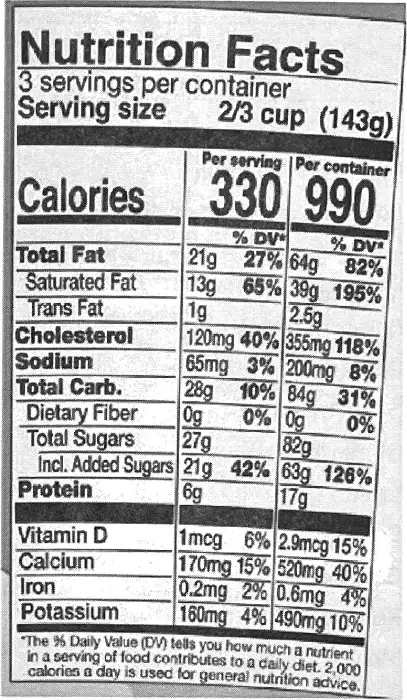
Use the Nutrition Facts information: 3 servings per container; Serving size 2/3 cup (143g); Calories 330 per serving; Total Fat 21g; Saturated Fat 13g; Cholesterol 120mg; Sodium 65mg; Total Carbohydrate 28g; Total Sugars 27g (Includes 21g Added Sugars); Protein 6g. How many total grams of fat are there per serving?
13g
21g
28g
6g
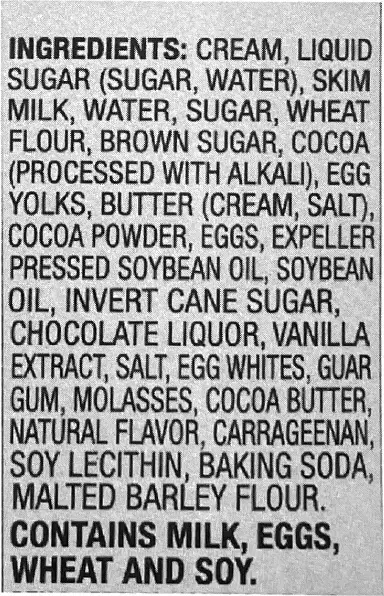
Use the following Ingredients List: INGREDIENTS: CREAM, LIQUID SUGAR (SUGAR, WATER), SKIM MILK, WATER, SUGAR, WHEAT FLOUR, BROWN SUGAR, COCOA (PROCESSED WITH ALKALI), EGG YOLKS, BUTTER (CREAM, SALT), COCOA POWDER, EGGS, EXPELLER PRESSED SOYBEAN OIL, SOYBEAN OIL, INVERT CANE SUGAR, CHOCOLATE LIQUOR, VANILLA EXTRACT, SALT, EGG WHITES, GUAR GUM, MOLASSES, COCOA BUTTER, NATURAL FLAVOR, CARRAGEENAN, SOY LECITHIN, BAKING SODA, MALTED BARLEY FLOUR. CONTAINS MILK, EGGS, WHEAT AND SOY. What ingredient is present in the greatest amount in this product?
Cream
Sugar
Cocoa powder
Skim milk
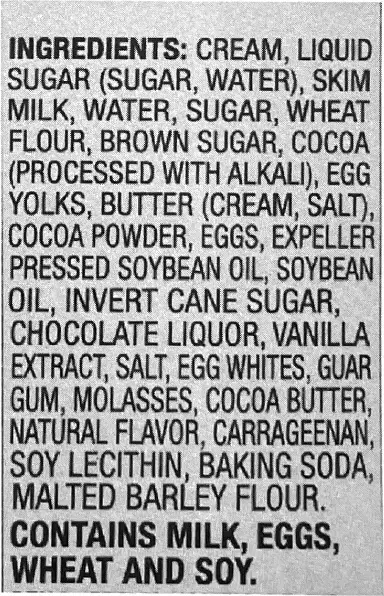
Use the following Ingredients List: INGREDIENTS: CREAM, LIQUID SUGAR (SUGAR, WATER), SKIM MILK, WATER, SUGAR, WHEAT FLOUR, BROWN SUGAR, COCOA (PROCESSED WITH ALKALI), EGG YOLKS, BUTTER (CREAM, SALT), COCOA POWDER, EGGS, EXPELLER PRESSED SOYBEAN OIL, SOYBEAN OIL, INVERT CANE SUGAR, CHOCOLATE LIQUOR, VANILLA EXTRACT, SALT, EGG WHITES, GUAR GUM, MOLASSES, COCOA BUTTER, NATURAL FLAVOR, CARRAGEENAN, SOY LECITHIN, BAKING SODA, MALTED BARLEY FLOUR. CONTAINS MILK, EGGS, WHEAT AND SOY. How can you identify the possible allergens in this ingredients list?
Look for the CONTAINS statement at the end of the list
Check the Percent Daily Value column on the Nutrition Facts
Count how many times the word sugar appears
Identify ingredients printed in italics
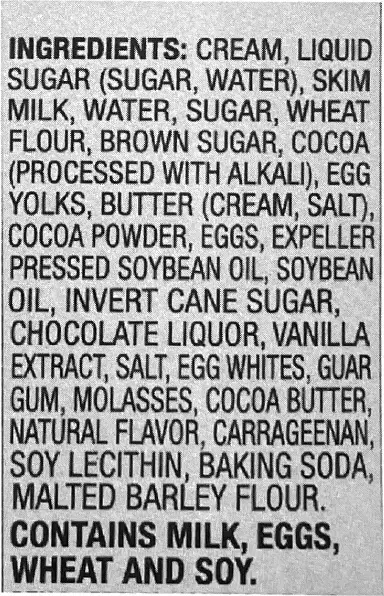
Use the following Ingredients List: INGREDIENTS: CREAM, LIQUID SUGAR (SUGAR, WATER), SKIM MILK, WATER, SUGAR, WHEAT FLOUR, BROWN SUGAR, COCOA (PROCESSED WITH ALKALI), EGG YOLKS, BUTTER (CREAM, SALT), COCOA POWDER, EGGS, EXPELLER PRESSED SOYBEAN OIL, SOYBEAN OIL, INVERT CANE SUGAR, CHOCOLATE LIQUOR, VANILLA EXTRACT, SALT, EGG WHITES, GUAR GUM, MOLASSES, COCOA BUTTER, NATURAL FLAVOR, CARRAGEENAN, SOY LECITHIN, BAKING SODA, MALTED BARLEY FLOUR. CONTAINS MILK, EGGS, WHEAT AND SOY. What does the phrase (sugar, water) after the words Liquid sugar indicate?
It lists the ingredients that make up the liquid sugar
It gives the percentage of sugar and water in the product
It marks optional ingredients that can be left out
It warns that liquid sugar is an allergen
Which statement best explains how your body uses osmosis and diffusion during digestion?
Nutrients move from the small intestine into the bloodstream by diffusion, while water moves across intestinal membranes by osmosis to balance concentrations
The stomach pumps nutrients into the blood using active transport that requires energy, and osmosis is not involved
Osmosis moves proteins from the blood into the stomach against the concentration gradient during digestion
Diffusion pushes water into intestinal cells and requires energy to occur

