
 Worksheets
Performance Management Final Exams
Total questions: 77
Worksheet time: 1hrs 15mins
Which statement best describes an organization’s vision?
It guides daily operations and clarifies who is served
It is the actionable plan connecting mission and vision
It prioritizes initiatives and allocates key resources
It describes the long-term aspiration and future state
A company wants to answer “How will we get there?” Which term should it focus on?
Strategy, outlining an actionable plan to progress
Mission, defining core purpose and existence
Vision, inspiring stakeholders around a goal
Values, listing cultural norms and behaviors
Which is a primary benefit of performance management?
It increases marketing spend without planning
It aligns individual efforts with company goals
It replaces the need for succession planning
It eliminates all training requirements entirely
Which mechanism in Goal Theory explains why challenging goals increase the use of a person’s full skill set?
They narrow attention to priorities
They enable easier task completion
They stimulate sustained effort
They challenge knowledge and skills
A team receives weekly feedback comparing actual behavior to expected standards and adjusts actions accordingly. Which theory best describes this approach?
Expectancy Theory of motivation
Social Cognitive Theory of modeling
Control Theory with feedback loops
Goal Theory by Latham and Locke
An employee doubts their ability to master a new tool, and performance declines. Strengthening which concept would most likely improve outcomes?
Task difficulty alignment
Managerial oversight intensity
Self-efficacy belief
External performance rewards
A manager wants goals that both direct attention and raise effort. Which goal characteristic will most likely produce these effects?
Broad and easy objectives
Specific and challenging goals
Short-term and minimal aims
Flexible and vague targets
Which statement best captures Reinforcement Theory in performance management?
Motivation rises when outcomes are seen as personally valuable
Intrinsic satisfaction reduces the need for external rewards
Successes followed by rewards increase repeated behavior
People attribute results mainly to task difficulty and luck
Expectancy Theory suggests motivation increases when which condition is met?
Effort clearly links to outcomes valued by the individual
Role models demonstrate consistent high productivity
Rewards are always financial and externally controlled
Past performance guarantees future promotion opportunities
Self-efficacy Theory emphasizes which combined influence on future behavior?
Reinforcement principles and expectations about goals
Task difficulty overshadowing individual effort
Circumstances and luck shaping performance outcomes
Intrinsic interests replacing extrinsic motivators
Attribution Theory focuses on how people explain performance using which set of factors?
Training, technology, leadership, culture, strategy
Rewards, role models, expectations, reinforcement, goals
Autonomy, mastery, purpose, feedback, pay
Ability, effort, task difficulty, circumstances, luck
Role modelling motivates employees primarily through what mechanism?
Detailed procedures eliminating individual discretion
Inspiration from someone’s effective approach and results
Guaranteed bonuses tied to meeting fixed targets
Formal policies requiring imitation of senior staff
Which factor primarily concerns competence, motivation, support, and incentives for effective performance?
Manager influence through modeling and coaching
Colleague influence on team attitude effects
Learner influence on personal capability needs
Organizational influence via structures and systems
A team member’s negative attitude spreads and reduces another employee’s effort. Which influence is most directly at play, and what is the best strategic response?
Organizational influence; redesign hierarchy and policies
Learner influence; increase individual technical training
Manager influence; change formal appraisal ratings
Colleague influence; adjust peer norms and feedback
Which statement best captures the purpose of Management by Objectives (MBO) as described by John Humble?
Aligns profit goals with managers’ personal development
Enforces rigid targets regardless of team contribution
Focuses solely on tactical tasks within departments
Replaces performance reviews with informal check-ins
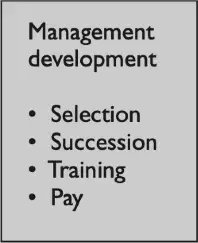
In the MBO cycle diagram, what is the correct sequence from planning to individual action?
Unit objectives → Strategic plan → Individual managers’ plans → Review and control
Tactical plans → Strategic plan → Review and control → Management development
Strategic plan → Tactical plans → Unit objectives → Individual managers’ plans
Management development → Strategic plan → Review and control → Tactical plans
A manager consistently misses agreed key results due to unclear performance standards. What is the most appropriate MBO action to address this?
Replace strategic planning with ad‑hoc task lists
Skip reviews to avoid discouraging the manager
Increase pay immediately to strengthen motivation
Clarify performance standards and secure the manager’s commitment
Which statement best distinguishes Performance Management from Performance Appraisal in terms of timing?
Conducted annually with fixed cycles
All year round with ongoing process
Quarterly with mid-year reviews
Biannual with scheduled checkpoints
Which characteristic aligns most closely with Management by Objectives?
Owned by HR for all staff
Forward looking joint process
Emphasis on quantified performance measures
Ratings used to determine merit
Which formula models performance as a multiplicative function of ability and motivation?
Performance equals motivation divided by ability
Performance equals ability times motivation
Performance equals motivation minus ability
Performance equals ability plus motivation
A team has high ability but near-zero motivation. What outcome best fits the multiplicative view of performance?
Effectively no meaningful performance
Moderately improved overall performance
Substantially increased overall performance
Slightly reduced overall performance
Which set of elements is emphasized in the AMO framework for performance?
Culture, Technology, People
Structure, Size, External environment
Ability, Effort, Organizational support
Ability, Motivation, Opportunity to participate
In the framework diagram, which activity directly focuses on identifying Key Result Areas (KRAs), KPIs, performance targets, and competencies?
Performance goal setting and role alignment
Developing capacity through learning interventions
Evaluating performance using scorecards and incidents
Monitoring performance metrics and timely feedback
A team notices lagging results mid-quarter. Based on the stages diagram, which step should they prioritize next to address gaps before formal rating?
Rating and rewarding recognized achievements
Planning with success metrics refinement
Monitoring with active tracking and feedback
Developing to address poor performance
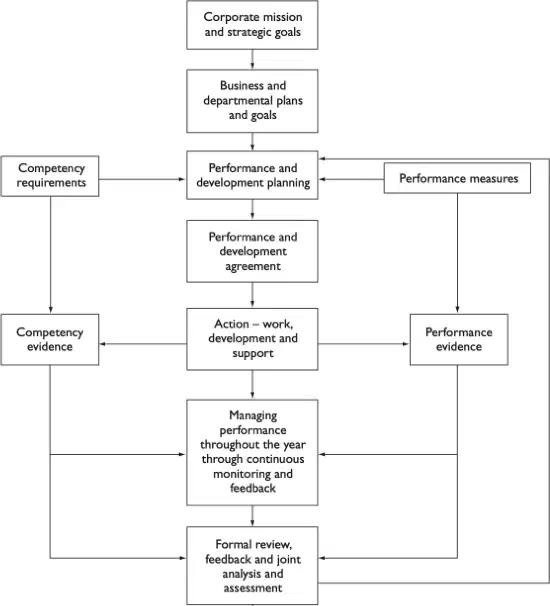
In the sequence diagram, which ordered pair best represents the flow immediately after performance and development planning?
Action work, development and support → Rating
Performance and development agreement → Action work
Managing performance with continuous monitoring → Competency requirements
Formal review, feedback and assessment → Financial reward
Which step comes first in a comprehensive performance management process?
Link organizational goals to mission and strategy
Regularly assess unit and individual performance
Reward achievement after goals are met
Measure progress on goal achievement
A team notices stalled progress mid-quarter. Which action best addresses this situation within the process?
Reward goal achievement with bonuses
Regularly give feedback to improve performance
Identify sub-goals for departments and workgroups
Link goals to mission and long-term strategy
Which stage in the performance management cycle primarily includes goal setting, performance agreements, feedback, assessment, and coaching?
Analysis and diagnosis stage
Implementation and briefing stage
Design and planning stage
Evaluation and survey stage
A manager notices uneven performance during the year. Which action aligns best with the key elements chain that emphasizes ongoing improvement rather than waiting for annual reviews?
Rely on the performance appraisal process
Start a new performance management policy
Initiate reward and recognition immediately
Provide continuous feedback and monitor progress
What are the best practices for linking performance to rewards and recognition?
Set clear goals
Ensure equity and fairness
Use transparent metrics
Create bias
Offer similar benefits for all employees regardless of performance
Why is it important to link performance with rewards and recognition?
To improve retention
To promote fairness
To divide the team
To drive motivation
To foster selfish culture
What are the methods the company can use to identify high potential, high performing employee?
Performance reviews
360-degree feedback
9-box talent grid
Play darts
Emails
What are the key traits of high performing, high potential employees?
Short tempered
Learning agility
Emotional intelligence
Resilience
Negative mindset
Kay is working at Z Company for 3 years with consistent exemplary performance. John was assigned as the new Manager of Kay. For Y2025, Kay was rated unsatisfactory by John because of initiative and drive by Kay in the performance of her tasks and ensuring the team's success is achieve. John doesn't want anybody to excel in the team but him. Hence, he rated Kay with unsatisfactory. Kay resigned because she cannot accept the rating given by John.What is/are the impact of John's action?
John is correct in rating Kay unsatisfactory because he is the leader and he should be the one who is the only person knowledgable in the team.
John is unfair in his rating because a leader should recognize exemplary work of subordinates working for the team's success
John's action may be construed as constructive dismissal forcing Kay to resign because of the unfair treatment of John
John should be rewarded for ensuring employees know where they stand in the organization
Kay may file a case in DOLE and claim for moral and/or exemplary damage/s
It supports ongoing professional growth and career development
(a)
It addresses and rectifies specific performance issues
(a)
What are the modern methods of performance appraisal?
Management by objectives
Behaviorally-anchored rating scale
360-degree feedback
720-degree feedback
Manager's rating only
It is the method used to evaluate and compare employee performance relative to peers, often by placing individuals into categories or ranks based on predefined criteria.
(a)
Type of performance ranking where the employees are rated on a percentile scale based on performance distribution
(a)
Type of performance raking method where the employees are ranked from to to bottom, often into fixed percentages
(a)
Type of performance rating method where evaluators mark presence/absence of behavior or traits
(a)
Type of performance rating method where it uses terms like "meets expectations" or "needs improvement"
(a)
Type pf performance rating method where employees are assessed of performance against defined competencies
(a)
(a) performance cycle type is best for long term goals and strategic planning
(a) Performance cycle type is best for agile teams and evolving priorities
(a) is the structured review where a manager assesses an employe's achievements, competencies, behaviors and overall contribution to the company
(a) focuses on improving the present and future performance of the team
(a) involves tracking and evaluating employee activities, behaviors and outcomes to ensure they meet expectations and contribute to organizational goals
(a) is a type of performance feedback that reinforces good behavior and achievements
(a) is a type of feedback that gathers inputs from peers, managers and customers
Performance management method that establishes clear, measurable objectives aligned with company strategy
(a)
Performance management method wherein employees reflect on their own performance and development needs
(a)
Performance management method wherein team members evaluate each other's contributions and collaboration
(a)
Performance management method which aligns individual goals with organizational objectives through collaboration
(a)
Performance management method which is best for organizational-level tracking
(a)
What does "T" means in SMARTER when creating the performance plan?
(a)
What does "S" means in SMARTER when creating the performance plan?
(a)
What does "A" mean in SMARTER when creating the performance plan?
(a)
In Balanced Scorecard, which perspective focuses in maximizing shareholder and financial value?
(a)
In Balanced Scorecard, which perspective focuses on optimizing operational efficiency and quality?
(a)
In Balanced Scorecard, which perspective focuses on innovation and employee development?
(a)
What are the KPIs in Clients perspective in balanced scorecard?
Return on investment (ROI)
Employee turnover rate
Employee engagement score
Training hours per employee
What are the KPIs in Finance perspective in balanced scorecard?
Customer satisfaction score
Return on investment (ROI)
Revenue growth rate
Operating income
Net promoter score (NPS)
What are the KPIs in Clients perspective in balanced scorecard?
Return on investment (ROI)
Customer satisfaction score
Net promoter Score (NPS)
Market share
Quality control measures
What are the KPIs in Internal perspective in balanced scorecard?
Process efficiency improvements
Inventory turnover
Quality control measures
Cash flow
Net profit margin
It's a performance management theory wherein the focus is on the attention on feedback as a means of shaping behaviour
(a)
It's a performance management theory wherein the motivation is only likely when a clearly perceived and usable relationships exists between performance and outcomes and the outcome is seen as a means of satisfying needs
(a)
What is the acceptable threshold of employee attrition rate, in general?
10-15%
15-20%
20-25%
25-30%
What is one goal of an employee after he has rendered exemplary performance in the company at the end of the year?
(a)
For Y2025, Anna was rated unsatisfactory because of poor performance for the entire year. What are the alternative measures the leader can take to have the performance of Anna on-track for Y2026?
Conduct coaching session
Enrol to performance improvement plan
Issue disciplinary action, Notice to Explain for proor performance
Give reward
Recognize the employee during townhall meeting
What would you do if a key client was extremely dissatisfied with a product or service you were responsible for, and how would you try to turn the situation around?
Suppose you're juggling multiple urgent deadlines and an executive gives you a high-priority task that conflicts with an existing commitment. How would you prioritize your tasks and communicate the situation?
How would you motivate a team that is resistant to recent changes in company procedures or experiencing low morale?
If an important project goal changed after significant progress had been made, how would you manage the necessary rework and adaptation?
Suppose you're juggling multiple urgent deadlines, all seemingly high-priority. How would you prioritize your tasks and communicate your plan?
Suppose you were asked to take on a project completely outside your area of expertise. How would you approach this situation and what steps would you take to ensure success?
Create your performance improvement plan with 3 identified areas of concern, 3 goals and 3 identified desired outcomes. Remember the SMART way of performance planning and be honest in the identification of areas of improvement, goals and desired outcomes.

