
NEW
Font size
 Worksheets
Lesson 38: Nucleic Acid and Gene
Total questions: 39
Worksheet time: 20mins
Nucleic acids are biomolecules that store genetic information. The types of nucleic acids are:
DNA and RNA
Proteins and Lipids
Carbohydrates and Fats
Enzymes and Hormones
Describe the structure of DNA with its double helix and the four types of nucleotides. How do nucleotides pair between the two strands according to the complementary principle?
DNA consists of a double helix structure with four types of nucleotides: adenine, thymine, cytosine, and guanine. Adenine pairs with thymine, and cytosine pairs with guanine according to the complementary principle.
DNA is a single-stranded molecule with three types of nucleotides: adenine, cytosine, and uracil. Adenine pairs with cytosine, and uracil pairs with guanine.
DNA consists of a triple helix structure with four types of nucleotides: adenine, thymine, cytosine, and uracil. Adenine pairs with uracil, and cytosine pairs with thymine.
DNA is a double helix structure with four types of nucleotides: adenine, thymine, cytosine, and guanine. Adenine pairs with cytosine, and thymine pairs with guanine.
The function of DNA in storing, preserving, and transmitting genetic information is:
To encode and pass genetic instructions from one generation to the next
To produce energy for cellular activities
To regulate the body's temperature
To transport oxygen throughout the body
A gene is defined as:
A segment of DNA that codes for a specific protein or trait.
A type of cell found in the human body.
A chemical that provides energy to cells.
A structure that protects the nucleus of a cell.
Explain why only four types of nucleotides can create the diversity of DNA molecules.
Because the sequence and arrangement of the four nucleotides allow for countless combinations.
Because DNA only needs four nucleotides to form a single type of molecule.
Because the four nucleotides are identical in structure and function.
Because having more than four nucleotides would make DNA unstable.
Summarize the characteristics that make genes and DNA useful in forensic applications such as blood relationship identification and criminal investigation.
Genes and DNA are unique to individuals, can be inherited, and provide identifiable markers for forensic analysis.
Genes and DNA are identical in all humans, making them unreliable for forensic applications.
Genes and DNA only determine physical appearance and are not useful for forensic investigations.
Genes and DNA change frequently, making them unsuitable for blood relationship identification.
1. Observe Figure 38.1 in the textbook and find information to complete the following sentences: – DNA is .......... molecules, up to .......... micrometers long, with a mass of up to .......... amu. – A DNA monomer is ......................., consisting of ....................... – DNA has a ....................... structure, consisting of ....................... antiparallel strands, coiled around ....................... – A DNA molecule has a diameter of .........., with a .......... helical turn, each helical turn corresponding to .......... pairs of nucleotides.
DNA is large molecules, up to 2 micrometers long, with a mass of up to several million amu. A DNA monomer is a nucleotide, consisting of a sugar, phosphate, and nitrogenous base. DNA has a double helix structure, consisting of two antiparallel strands, coiled around each other. A DNA molecule has a diameter of 2 nm, with a 3.4 nm helical turn, each helical turn corresponding to 10 pairs of nucleotides.
DNA is small molecules, up to 0.2 micrometers long, with a mass of up to several thousand amu. A DNA monomer is a peptide, consisting of amino acids. DNA has a single helix structure, consisting of one parallel strand, coiled around itself. A DNA molecule has a diameter of 20 nm, with a 1.4 nm helical turn, each helical turn corresponding to 5 pairs of nucleotides.
DNA is medium molecules, up to 20 micrometers long, with a mass of up to several billion amu. A DNA monomer is a carbohydrate, consisting of sugars and phosphates. DNA has a triple helix structure, consisting of three antiparallel strands, coiled around a protein. A DNA molecule has a diameter of 0.2 nm, with a 2.4 nm helical turn, each helical turn corresponding to 8 pairs of nucleotides.
DNA is complex molecules, up to 10 micrometers long, with a mass of up to several hundred thousand amu. A DNA monomer is a lipid, consisting of fatty acids and glycerol. DNA has a quadruple helix structure, consisting of four parallel strands, coiled around a carbohydrate. A DNA molecule has a diameter of 5 nm, with a 4.4 nm helical turn, each helical turn corresponding to 12 pairs of nucleotides.
Fill in the blanks with the appropriate terms from the following list: ribose, deoxyribose, adenine, thymine, cytosine, guanine, uracil, hydrogen bond, covalent bond.
Deoxyribose is the sugar in DNA, ribose is the sugar in RNA. Adenine pairs with thymine in DNA, and with uracil in RNA. Cytosine pairs with guanine. The bonds between base pairs are hydrogen bonds, while the bonds within the backbone are covalent bonds.
Ribose is the sugar in DNA, deoxyribose is the sugar in RNA. Adenine pairs with uracil in DNA, and with thymine in RNA. Cytosine pairs with adenine. The bonds between base pairs are covalent bonds, while the bonds within the backbone are hydrogen bonds.
Deoxyribose is the sugar in RNA, ribose is the sugar in DNA. Adenine pairs with cytosine in DNA, and with guanine in RNA. Thymine pairs with uracil. The bonds between base pairs are covalent bonds, while the bonds within the backbone are hydrogen bonds.
Ribose is the sugar in DNA, deoxyribose is the sugar in RNA. Adenine pairs with guanine in DNA, and with cytosine in RNA. Thymine pairs with uracil. The bonds between base pairs are hydrogen bonds, while the bonds within the backbone are covalent bonds.
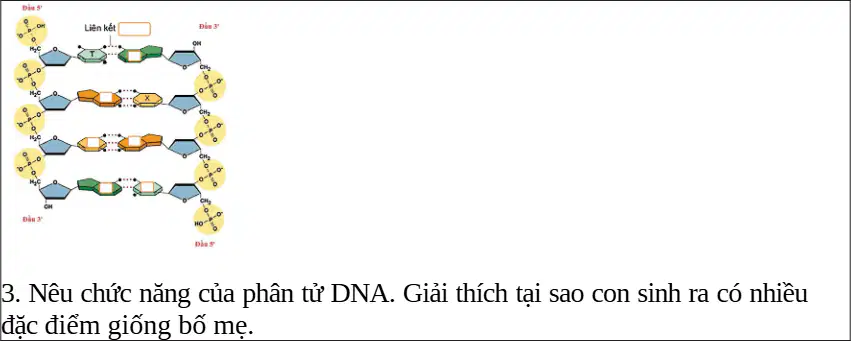
State the function of the DNA molecule. Explain why offspring often have many characteristics similar to their parents.
DNA stores genetic information and passes traits from parents to offspring, resulting in similar characteristics.
DNA provides energy for cells and determines the lifespan of offspring.
DNA controls only physical traits and does not affect inherited characteristics.
DNA is responsible for cell movement and does not influence inherited traits.
Observe Figures 38.2 and 38.3 in the textbook, find the information to complete the following sentences: - RNA is a ______ molecule, with a structure consisting of ______ strands.
single-stranded; one
double-stranded; two
triple-stranded; three
circular; multiple
Observe Figures 38.2 and 38.3 in the textbook, find the information to complete the following sentences: - RNA has a structure of ______, its subunit is ______, consisting of ______.
nucleotides; ribonucleotide; ribose, phosphate, and nitrogenous base
amino acids; polypeptide; peptide bonds, carboxyl group, and amino group
lipids; triglyceride; glycerol, fatty acids, and phosphate
monosaccharides; polysaccharide; glucose, fructose, and galactose
Based on structure and function, RNA is divided into ______ types, which are ______.
three; mRNA, tRNA, rRNA
two; mRNA, rRNA
four; mRNA, tRNA, rRNA, snRNA
five; mRNA, tRNA, rRNA, snRNA, miRNA
In the cell, RNA is synthesized from which structure?
DNA
Ribosome
Mitochondria
Golgi apparatus
Distinguish the types of RNA in terms of structure and function.
mRNA, tRNA, and rRNA differ in both structure and function within the cell.
All types of RNA have identical structures and functions.
tRNA and rRNA are only involved in DNA replication.
mRNA is the only type of RNA found in eukaryotic cells.
The structure of DNA and RNA can be compared as follows:
DNA is double-stranded and contains thymine; RNA is single-stranded and contains uracil.
DNA is single-stranded and contains uracil; RNA is double-stranded and contains thymine.
Both DNA and RNA are double-stranded and contain thymine.
Both DNA and RNA are single-stranded and contain uracil.
State the principle of complementarity between the two single strands of the DNA molecule. Determine the sequence of nucleotides on the complementary strand based on the template strand of DNA as follows: ...T – A – C – A – G – C – T – T – C – A... Fill in the complementary strand.
A – T – G – T – C – G – A – A – G – T
T – A – C – A – G – C – T – T – C – A
A – G – T – C – G – T – A – T – G – C
T – G – C – T – A – C – G – A – T – C
The most prominent difference between the structure of DNA and RNA is:
DNA contains deoxyribose sugar, while RNA contains ribose sugar.
DNA is single-stranded, while RNA is double-stranded.
DNA contains uracil, while RNA contains thymine.
DNA is found only in the cytoplasm, while RNA is found only in the nucleus.
Families can find their biological children based on which method, and can this method accurately identify and recognize each individual with high precision?
DNA analysis, which can accurately identify individuals with high precision.
Blood type matching, which is always precise.
Physical appearance comparison, which guarantees accuracy.
Birth certificate records, which never have errors.
What is nucleic acid?
Nucleic acid is a macromolecule found in living organisms, composed of elements C, H, O, N, P; nucleic acid is made up of many nucleotides. Nucleic acid is found in the nucleus, cytoplasm of living organisms, and in viruses. There are two types: DNA and RNA.
Nucleic acid is a type of carbohydrate found only in plants and is responsible for energy storage.
Nucleic acid is a lipid molecule that forms cell membranes and stores genetic information.
Nucleic acid is a protein that acts as an enzyme in metabolic reactions.
Name the types of nucleic acids.
DNA and RNA
Glucose and Fructose
Lipids and Proteins
Starch and Cellulose
Nucleic acid is found in which parts of a cell or organism?
Nucleic acid is found in the nucleus, cytoplasm, and in viruses.
Nucleic acid is found only in the cell wall.
Nucleic acid is found only in mitochondria.
Nucleic acid is found only in ribosomes.
Which elements make up nucleic acids?
C, H, O, N, P
C, H, O, S, P
C, H, O, N, S
C, H, O, N, Ca
State the function of DNA in living organisms.
DNA stores, preserves, and transmits genetic information.
DNA provides energy for cellular respiration.
DNA is responsible for muscle contraction.
DNA helps in the digestion of food.
DNA is a ________ with a length of hundreds of micrometers and a mass of up to millions or tens of millions of amu.
macromolecule
monomer
atom
ion
Which of the following are the four types of nucleotides found in DNA?
A. Adenine (A), Thymine (T), Cytosine (C), Guanine (G)
B. Adenine (A), Uracil (U), Cytosine (C), Guanine (G)
C. Thymine (T), Uracil (U), Cytosine (C), Guanine (G)
D. Adenine (A), Thymine (T), Uracil (U), Guanine (G)
Fill in the blank: DNA has a ___ structure, consisting of two antiparallel strands twisted around a common axis.
double helix
single strand
triple coil
quadruple sheet
On each DNA strand, nucleotides are linked together to form a polynucleotide chain in the 5' to 3' direction. Fill in the blank: Nucleotides in DNA are linked together by ________ bonds.
covalent
hydrogen
ionic
peptide
Between the two DNA strands, nucleotides are linked by hydrogen bonds according to the complementary base pairing rule. Which base pairs with adenine (A) in DNA?
Thymine (T)
Cytosine (C)
Guanine (G)
Uracil (U)
Fill in the blank: DNA has a diameter of ___, with each helical turn measuring 34 Å and corresponding to 10 nucleotide pairs.
20 Å
10 Å
34 Å
2 Å
DNA functions to store, preserve, and transmit genetic information.
True
False
Fill in the blank: RNA is a macromolecule but its size and mass are usually ___ than DNA.
smaller
larger
equal
more complex
Which of the following nucleotides is found in RNA but not in DNA?
Thymine (T)
Uracil (U)
Cytosine (C)
Guanine (G)
What is a gene?
A gene is a segment of DNA that has a specific function in heredity.
A gene is a type of protein found in the cell membrane.
A gene is a type of cell that transports oxygen.
A gene is a chemical that provides energy to the cell.
Which of the following is an achievement of gene technology in daily life, agriculture, or medicine?
Development of genetically modified crops for higher yield
Discovery of electricity
Invention of the steam engine
Creation of plastic materials
Explain why only four types of nucleotides can create the diversity of DNA molecules.
Because the sequence and arrangement of the four nucleotides allow for countless combinations.
Because DNA only needs four nucleotides to form a single type of molecule.
Because the four nucleotides are identical in structure and function.
Because more nucleotides would decrease genetic diversity.
An application of DNA analysis is in determining blood relationships or identifying criminals. Which of the following best describes this application?
DNA analysis can be used to match genetic material from crime scenes to suspects or establish family relationships.
DNA analysis is only used for studying extinct species.
DNA analysis is primarily used for food quality testing.
DNA analysis is used exclusively for plant breeding.
The specificity of a gene is determined by which of the following, and how is this specificity applied in practical situations?
The sequence of nucleotides in its DNA, which allows for targeted gene expression and genetic engineering applications.
The number of chromosomes in a cell, which determines the organism's complexity.
The amount of protein produced by the gene, which affects cell size.
The location of the gene on the chromosome, which determines its function.
Summarize the knowledge you have learned about DNA and RNA in the form of a mind map.
DNA and RNA are nucleic acids with distinct structures and functions; DNA stores genetic information, while RNA helps in protein synthesis.
DNA and RNA are both proteins that store energy in cells.
DNA and RNA are carbohydrates that provide structural support to cells.
DNA and RNA are lipids that regulate cell membrane permeability.
Which of the following best shows the application of gene technology in everyday life?
A picture of genetically modified crops in a supermarket
A photo of a traditional farm without any modern technology
An image of a natural forest untouched by humans
A drawing of a prehistoric animal

