
 Worksheets
Metal Core Wire and Welding Fundamentals Quiz
Total questions: 28
Worksheet time: 14mins
Since metal core wire does not contain flux ___ is required to protect the puddle from atmospheric contamination.
Oxygen
SAW flux
Nitrogen
External shielding gas
If the arc voltage, wire feed speed, and travel speed are held constant, decreasing the CTWD will ___.
Reduce current
Increase porosity
Reduces voltage
Increase current
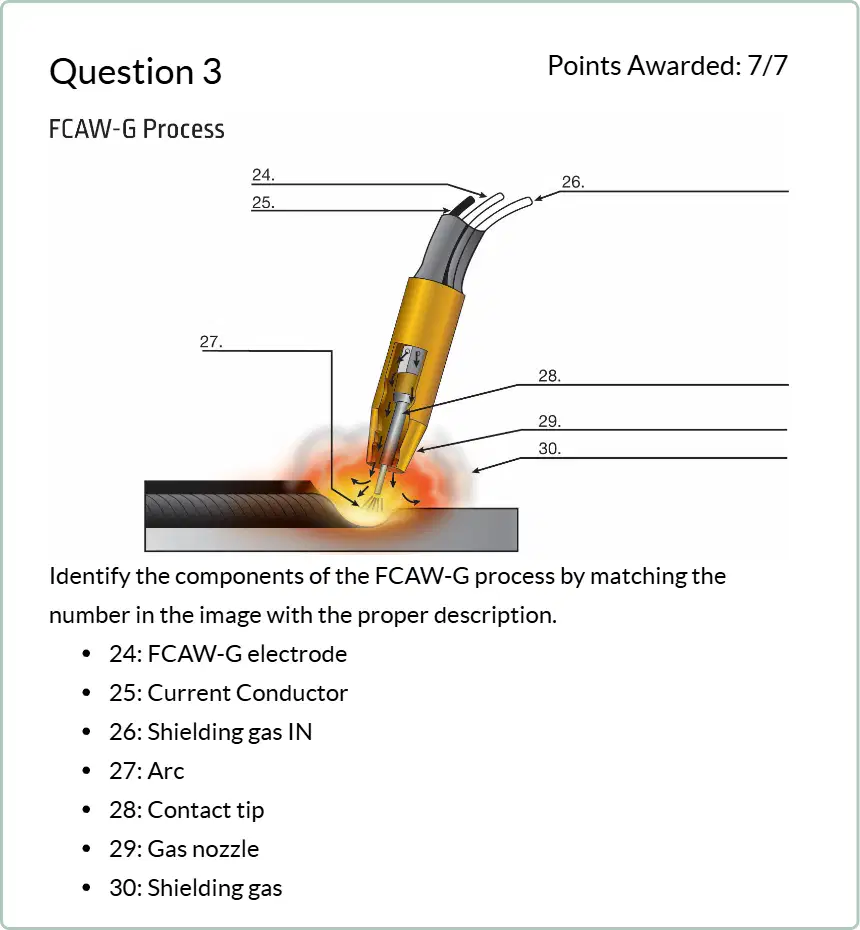
Which component in the FCAW-G process is responsible for carrying the electrical current to the electrode?
FCAW-G electrode
Current Conductor
Shielding gas IN
Gas nozzle
Which part of the FCAW-G process is labeled as the source of the protective atmosphere around the weld?
Shielding gas
Arc
Contact tip
FCAW-G electrode
FCAW-S electrodes do not require ____.
Power source
Work clamp
Additional shielding gas
Wire feeder
____ and ____ are alloying elements added to the FCAW electrodes to stabilize the arc.
Calcium, nickel
Potassium, sodium
Titanium, carbon
Silicon, molybdenum
If arc voltage, WFS and CTWD are held constant, too fast travel speed increases ___.
Deposition rate
Convexity of the bead
Burnthrough
Slag interference
Ability of metal to resist forces attempting to pull it apart or stretch it is called ___.
Ductility
Tensile strength
Brittleness
Shear strength
Commonly found on horizontal fillet welds where the lower toe of the weld does not fuse properly into the base metal is called a ___.
Overlap
Underfill
Porosity
Cracks
Welding with weave beads in the overhead position requires ___ electrode extension and ___ arc to help force the weld opposite of gravity.
Short, tight
Long, wide
Short, hot
Long, cold
Controlling heat input during welding, increased amperage can be offset by an increase in ___.
Travel speed
Voltage
Melting point
Grain size
___ has the highest rate of expansion when heated and shrinks more when cooled.
Copper
Aluminum
Steel
Cast iron
The most common type of mixed shielding gases used with FCAW-G in North America is ____.
75% Ar / 25% CO2
100% CO2
90% Ar / 10% CO2
80% Ar / 20% O2
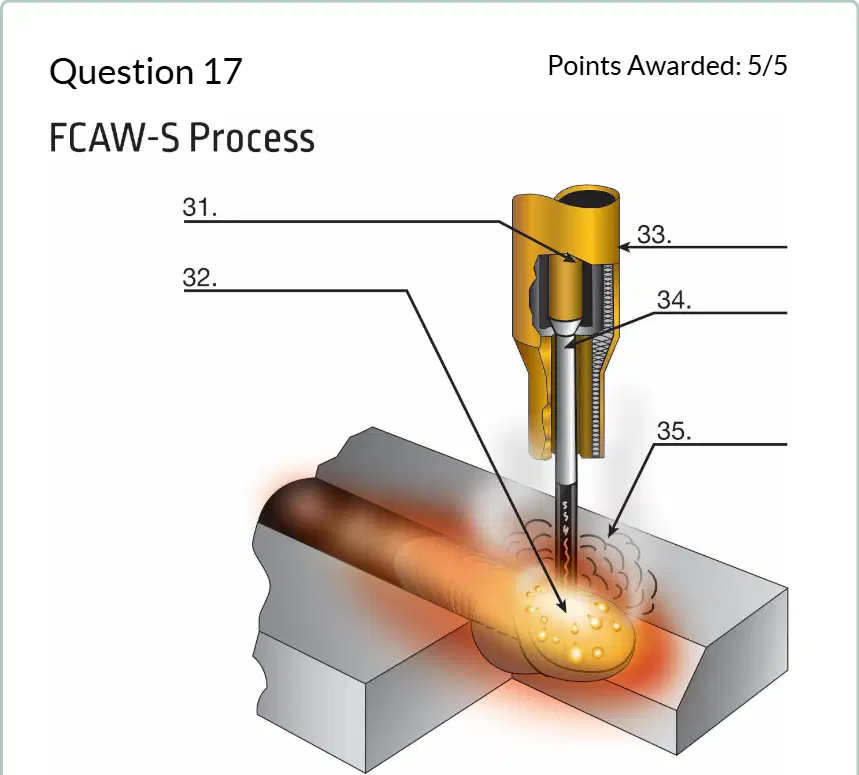
In the FCAW-S process diagram, which component is labeled as number 31?
Contact tip
Arc
Insulated guide
FCAW-S electrode
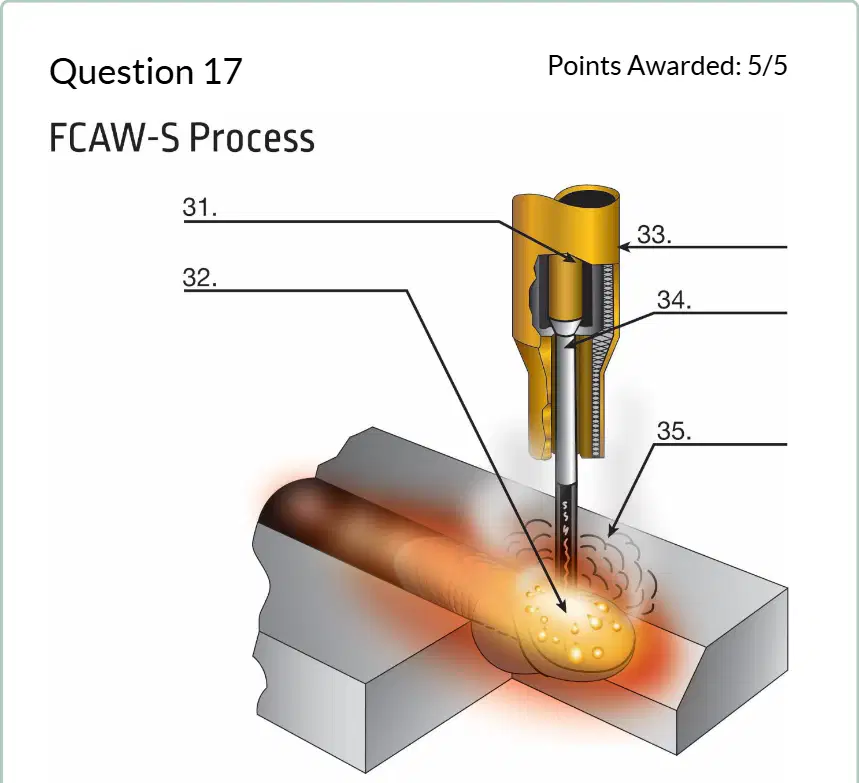
In the FCAW-S process, what does the number 32 in the diagram represent?
Arc
Contact tip
Insulated guide
FCAW-S electrode
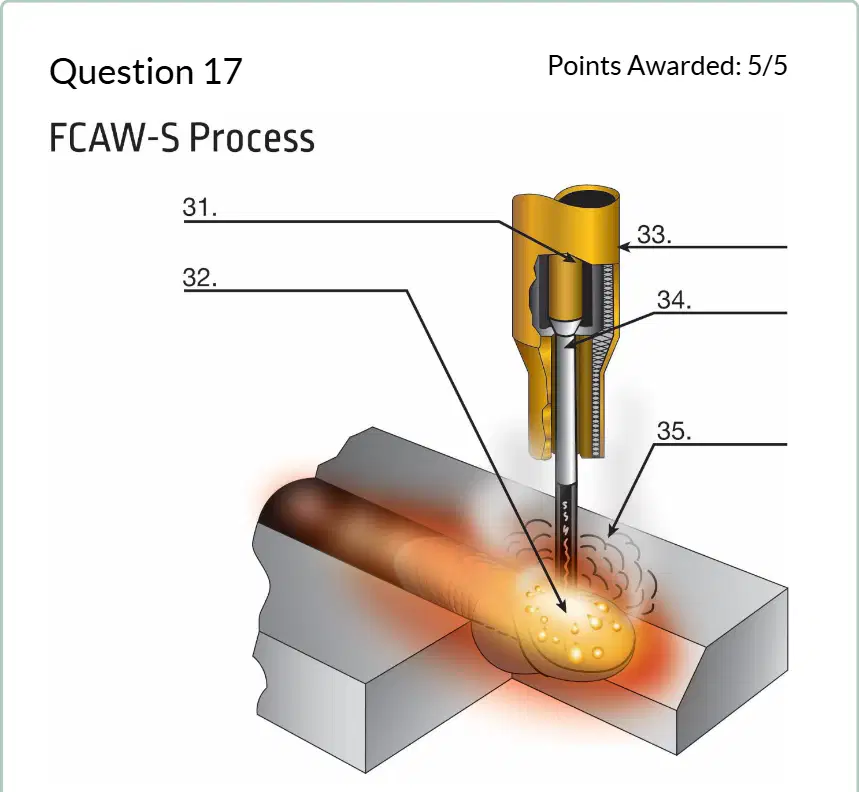
In the FCAW-S process, what is the function of the component labeled as number 34 in the diagram?
FCAW-S electrode
Contact tip
Arc
Insulated guide
Proper FCAW gun selection depends on which factors?
Use of compressed shielding gas
Type of welding
Level of current required
All of the above
The first step in cleaning the power source is to ____.
Unplug or lockout/tagout machine
Wipe down the exterior with a cloth
Check the voltage with a tester
Turn on the machine
An advantage to using FCAW-S versus FCAW-G is ____.
Portability
Higher cost
Less versatility
Requires shielding gas
Lower deposition rate
The addition of carbon increases the ___ and strength of steel.
Hardness
Ductility
Malleability
Elasticity
The process of softening a metal by heating it above the upper critical temperature is ____.
Latticing
Annealing
Tempering
Distortion
Gas-shielded electrodes use ____ polarity to ensure proper fusion.
DCEN
DCEA
DCEP
DCEV
____ will result in an increase in the number of Joules per inch of a weld in a completed weld.
Long arc length
Short arc length
Low welding speed
Low current
An advantage to using a FCAW-G electrode is ____.
Minimal spatter
Worm tracking
Protective slag
Smoke and fumes
The main difference between an E81T-X electrode and an E71T-X electrode is ____.
Welding position
Shielding gas
Tensile strength
Weld composition
For FCAW power sources, the output characteristics fall into two main categories: constant current (CC) and ____.
Wire feed speed
Constant amperage
Constant voltage
Contact tip-to-work distance
An E71T-X FCAW electrode will have a minimum of ___ psi tensile strength.
70,000
60,000
80,000
50,000
The rate at which heat flows through a metal is called ___.
Yield strength
Thermal conductivity
Thermal expansion
Heat treatment

