
Font size
 Worksheets
Weather's Engine: How Energy and Water Drive Earth's Storms
Total questions: 36
Worksheet time: 19mins
The sun transfers thermal energy to the Earth through the process known as ____________
Convection
Radiation
Convection
Evaporation
Fill in the blank: The Sun's energy travels to Earth _____________
as waves
by direct contact
in circular currents
by electricity
What is the process called when thermal energy is transferred through direct contact?
A) Radiation
B) Conduction
C) Convection
D) Evaporation
This is the most critical process for severe weather. When a pocket of air warms up through conduction, its particles speed up and spread out, making the air less dense than the surrounding cooler air. This lighter, warmer air is then pushed upwards by the denser, cooler air sinking around it. This continuous cycling of warm air rising and cool air sinking is called __________.
convection
radiation
evaporation
precipitation
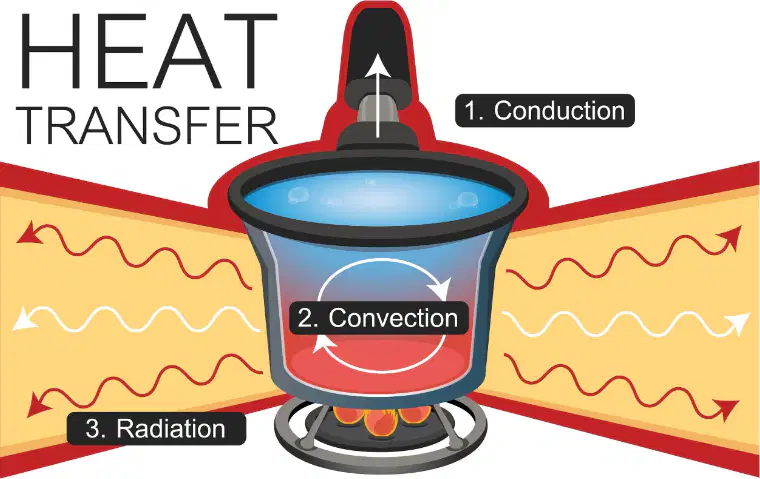
Refer to the diagram labeled 'HEAT TRANSFER' below. What is the correct description of what is happening at step 1?
Transfer of energy through direct contact
Transfer of energy through electromagnetic waves
Cycling of warm air rising and cool air sinking
Refer to the diagram labeled 'HEAT TRANSFER' below. What is the correct description of what is happening at step 2?
Transfer of energy through direct contact
Transfer of energy through electromagnetic waves
Cycling of warm air rising and cool air sinking
Refer to the diagram labeled 'HEAT TRANSFER' below. What is the correct description of what is happening at step 3?
Transfer of energy through direct contact
Transfer of energy through electromagnetic waves
Cycling of warm air rising and cool air sinking
Which process in the water cycle involves liquid water molecules gaining enough kinetic energy to become water vapor (gas)?
A) Condensation
B) Precipitation
C) Evaporation
D) Gravity
Fill in the blank: As a warm, moist air parcel rises, it moves into the higher atmosphere where temperatures are much colder. The air parcel ________, causing the water vapor particles to lose kinetic energy and slow down.
cools
warms
expands
condenses
The role of Cloud Condensation Nuclei (CCN) in the water cycle is:
to provide surfaces for water vapor to condense and form clouds
to absorb sunlight and increase evaporation
to prevent precipitation from occurring
to dissolve in water and increase its temperature
Precipitation occurs when water droplets or ice crystals within the cloud become too heavy for the storm's updraft to hold them up, and gravity causes them to fall to Earth.
True
False
Which of the following is required for hail to form in a storm cloud?
Strong updraft
warm temperatures
low humidity
weak winds
Fill in the blank: The cycle of hailstone formation continues, adding layer upon layer to the hailstone. A larger piece of hail is evidence of a ________ updraft.
stronger
weaker
slower
colder
The three main stages in the formation of a hailstone are:
Updraft carries water droplets into cold regions, droplets freeze and grow, hailstone falls when too heavy.
Condensation, evaporation, precipitation.
Cloud formation, lightning, rainfall.
Water vapor rises, cools, and forms snowflakes.
The three main stages in the formation of a hailstone are:
precipitation, condensation, evaporation
Condensation, evaporation, precipitation.
evaporation, condensation, precipitation
conduction, convection, radiation
Use the terms warm air, cool air, less dense, and more dense to explain why air parcels near the ground rise.
Warm air is less dense than the surrounding cooler air. Because the surrounding air is more dense, it sinks and pushes the less dense, warm air up, causing it to rise. This circular motion of warm air rising and cooler air sinking is known as convection.
Warm air is more dense than the surrounding cooler air. Because the surrounding air is less dense, it rises and pushes the more dense, warm air down, causing it to sink.
Cool air is less dense than the surrounding warm air. Because the warm air is more dense, it sinks and pushes the less dense, cool air up, causing it to rise.
Cool air is more dense than the surrounding warm air. Because the warm air is less dense, it sinks and pushes the more dense, cool air up, causing it to rise.
As a warm air parcel rises high into the atmosphere, what happens to its temperature? What condition must be met for the water vapor inside the air parcel to condense and form clouds?
As air moves upward, it cools. When the air is cooled enough, the water vapor can condense (change from gas to liquid) to form and collect around condensation nuclei in the atmosphere to form a cloud.
As air moves upward, it heats up. Water vapor condenses only when the air becomes warmer.
As air moves upward, its temperature remains constant. Water vapor condenses only at ground level.
As air moves upward, it cools. However, water vapor cannot condense in the atmosphere.
What role do Cloud Condensation Nuclei (CCN) play in cloud formation? Using the example from the unit, explain what a common source of CCN is for storms to form.
Water vapor condenses around condensation nuclei in the cloud. A common source of CCN over land is dirt, dust, pollen, and pollution.
CCN are responsible for breaking up clouds and preventing precipitation. A common source of CCN is ocean water.
CCN absorb sunlight and heat the atmosphere. A common source of CCN is volcanic ash only.
CCN dissolve in water vapor to form rain directly. A common source of CCN is only plant leaves.
Based on your knowledge of energy transfer, hurricanes can only form over warm water (and not cold water or land) because:
Warm water provides the energy needed for hurricanes to develop.
Cold water increases the strength of hurricanes.
Land supplies more moisture for hurricane formation than water.
Hurricanes can form anywhere regardless of temperature.
A hailstorm produces powerful winds because the rapid upward movement of air causes surrounding air to rush in and replace it, resulting in strong surface winds. What is the main cause of these powerful surface winds during a hailstorm?
The rapid upward movement of air causes surrounding air to rush in and replace it.
The sun heats the ground, creating strong winds.
Hailstones themselves generate wind as they fall.
Lightning strikes create bursts of wind.
The constant upward motion of air in a hurricane allows it to hold and produce heavy rain because:
it carries moisture high into the atmosphere, forming thick clouds and heavy precipitation.
it cools the air rapidly, causing the hurricane to weaken.
it prevents clouds from forming, resulting in less rain.
it pushes warm air downward, reducing rainfall.
Conduction is the process by which heat is transferred through direct contact. How does conduction play a critical role in the first step of creating a thunderstorm or hurricane?
Conduction warms the air at the Earth's surface, causing it to rise and start the storm formation process.
Conduction cools the upper atmosphere, preventing storm formation.
Conduction causes water vapor to condense directly into rain without cloud formation.
Conduction creates strong winds at high altitudes that initiate storms.
Convection is the most important mechanism of heat transfer for the vertical development of a powerful storm because:
warm air rises and cool air sinks, causing vertical movement of air masses
it only transfers heat through direct contact between molecules
it involves the transfer of heat through electromagnetic waves
it is the slowest method of heat transfer in the atmosphere
Radiation is defined as the transfer of energy through space, and its ultimate source of energy for all weather systems is:
The Sun
The Moon
The Earth's core
Ocean currents
The process by which a small ice pellet grows into a large piece of hail involves updrafts carrying the pellet upward, condensation adding layers of ice, and gravity eventually pulling the hailstone down. Which of the following best describes this process?
Updrafts lift the ice pellet, condensation adds layers, and gravity pulls it down as hail.
Condensation melts the ice pellet, gravity lifts it, and updrafts push it down.
Gravity causes the ice pellet to fall, updrafts melt it, and condensation evaporates it.
Updrafts and gravity both push the ice pellet down, while condensation removes layers.
The size of a hailstone is related to the strength of the storm's updraft in which way?
Stronger updrafts produce larger hailstones.
Weaker updrafts produce larger hailstones.
Updraft strength does not affect hailstone size.
Stronger updrafts produce smaller hailstones.
14. Hailstorms are more common in the late spring and summer, even though the process requires freezing temperatures high in the atmosphere, because:
warm weather creates stronger updrafts that support hail formation
the atmosphere is colder at ground level during these seasons
hail can only form when temperatures are above freezing at the surface
late spring and summer have less moisture in the air
The primary source of energy that causes water to evaporate from the ocean or land surface is: What happens to the water particles' kinetic energy during this process?
The Sun; the kinetic energy of water particles increases
The Moon; the kinetic energy of water particles decreases
Wind; the kinetic energy of water particles remains the same
Geothermal heat; the kinetic energy of water particles decreases
The phase change that occurs when water vapor turns into a cloud or fog is called ________. During this process, the water particles' kinetic energy ________.
condensation; decreases
evaporation; increases
sublimation; stays the same
freezing; increases
What has to occur within a cloud for the precipitation (rain, snow, or hail) to finally fall to the Earth?
The water droplets or ice crystals must become heavy enough to overcome air resistance and fall.
The temperature inside the cloud must rise above 100°C.
The cloud must move below sea level.
The cloud must be struck by lightning.

The movement of water formed by winds, waves, tides, and the rotation of the Earth.
Jet stream
Manila water
Ocean currents
River
As ________ water moves into an area, it raises the humidity and temperature.
Warm
Cold
As the air gets _______, it becomes more dense and falls to Earth’s surface.
cooler
Warmer

