
 Worksheets
Helicopter Theory Quiz
Total questions: 19
Worksheet time: 10mins
What are the two bases for performance charts in helicopter theory?
Power balance and the fact that force on the helicopter in steady flight must be equal to zero
Energy method and balance of force method
Rotor equations and energy balance
Steady flight and rotor dynamics
What is parasite power (HPp) in a helicopter?
Power associated with rotor
Power consumed by components such as fuselage, rotor hub, and tail hub
Power necessary to change the potential energy of the helicopter during climb or glide
Power required for glide condition
Which equation represents the total equivalent drag in terms of individual drag components?
D = D_i + D_o + D_p + D_c
D = D_i + D_o + D_p
D = D_i + D_o + D_c
D = D_i + D_p + D_c
What is the formula for LD in terms of shaft power?
LD=VLDV
LD=VLQΩ
LD=VLShaftPower
All of the above
Which of the following is NOT a factor considered in the effect of design parameters for the performance equation?
Rotor size
Drag coefficient
Air density
Helicopter color
Why is the performance equation fundamental in helicopter flight?
It predicts fuel efficiency, endurance, and payload capability
It determines the color of the helicopter
It calculates the cost of helicopter maintenance
It measures the noise level of the helicopter
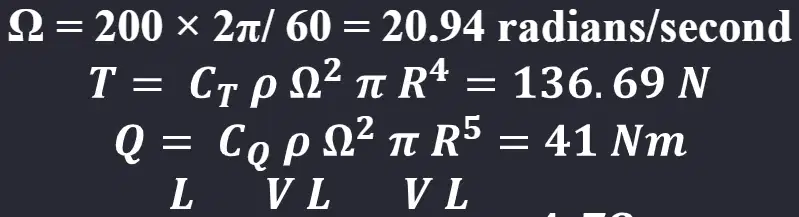
What is the torque (Q) calculated in the given problem?
41 Nm
50 Nm
35 Nm
45 Nm
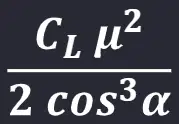
In the equation CT=2cos3αCLμ2 , what does cos3α in the denominator signify?
The effect of the angle of attack on thrust coefficient.
The relationship between velocity and radius.
The calculation of air density.
The effect of rotor speed on lift.
Which helicopter component has the lowest range of parasite drag percentage?
Fuselage
Landing gear
Rotor pylon, hub
Tail rotor, surface
Which of the following components has a parasite drag percentage range of 35% - 50%?
Fuselage
Landing gear
Rotor pylon, hub
Tail rotor, surface
What is the forward speed of the helicopter in the given problem?
12 m/s
32 m/s
2.67 m/s
24 m/s
Which formula is used to calculate the climb speed (V_c) of the helicopter?
V_c = V × (L/D)_c
V_c = V ÷ (L/D)_c
V_c = V × (D/L)_c
V_c = V ÷ (D/L)_c
What is the expression for \( \mu \) in terms of velocity (\( V \)), angular velocity (\( \Omega \)), and rotor radius (\( R \))?
A) μ=ΩRV
B) μ=VΩR
C) μ=ΩVR
D) μ=VRΩ
What is the primary factor affecting the lift generated by a helicopter rotor?
Rotor speed
Fuselage design
Weight of the helicopter
Weather conditions
Which parameter is crucial for determining the effective lift-to-drag ratio (L/D) in helicopter performance?
Fuel type
Engine power
Rotor diameter
Angle of attack
In helicopter aerodynamics, what does the term 'induced drag' refer to?
Drag related to the helicopter's weight
Drag due to the helicopter's forward motion
Drag caused by the rotor blades generating lift
Drag from the fuselage and other components
What is the primary purpose of the helicopter's tail rotor?
To provide lift
To enhance fuel efficiency
To counteract the torque produced by the main rotor
To increase forward speed
In helicopter performance, what does the term 'power required' refer to?
The total power needed to maintain level flight
The power needed to climb at a constant rate
The power required to hover
All of the above
Which factor is most influential in determining the maximum altitude a helicopter can achieve?
Weight of the helicopter
Air density
Rotor blade design
Engine power

