
 Worksheets
8th Grade Final Review
Total questions: 50
Worksheet time: 25mins
Name
Class
Date
1.
What force determines the motions of planets and other objects in the solar system?
a)
static electricity
b)
centrifugal force
c)
magnetic force
d)
force of gravity
2.
For most stars, what does a higher temperature tend to go with?
a)
lower luminosity
b)
higher luminosity
c)
red color
d)
none of the above
3.
For a standard H-R diagram, what are the stars in the lower left region of the diagram?
a)
giants
b)
supergiants
c)
main sequence stars
d)
white dwarfs
4.
About how long does it takes the moon to orbit the earth?
a)
one day
b)
one week
c)
one month
d)
one year
5.
What is the measurement of an Astronomical Unit?
a)
distances from the sun to the earth
b)
distance from earth to the moon
c)
distance from the sun to mercury
d)
distance of the sun to the moon
6.
What is a light-year?
a)
distances light travels across the solar system
b)
distance light travels from the sun to earth
c)
distance light travels from the sun to Neptune
d)
distance light travels in a year
7.
How do you measure the brightness of a star?
a)
apparent magnitude
b)
luminosity
c)
color
d)
temperature
8.
What best describes a nebula?
a)
cloud of gas and dust
b)
ball of neuclei
c)
surface of a star
d)
dwarf planet
9.
What is the difference between a comet and an asteriod?
a)
asteroids are made of rock and ice
b)
asteroids drift through space whiles comets travel in stable orbit
c)
comets have a visible tail
d)
comets have solid iron cores
10.
What is a distinction between an asteriod and a dwarf planet?
a)
asteroids do not circle the sun
b)
dwarf plants are spherical in shape, asteroids have no particular shape
c)
dwarf planets have an atmosphere
d)
larger asteroids strike earth frequently, dwarf plants do not
11.
What is a terrestrial planet?
a)
Ceres
b)
Neptune
c)
Pluto
d)
Venus
12.
What is a meteorite?
a)
surface depression formed by collision with a rock from space
b)
fragment of rock that strikes a planet or a moon
c)
mixture of ice, dust, and gas with a glowing tail
d)
small rocky particle that moves through space
13.
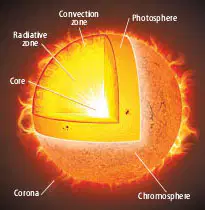
From the figure of the sun’s layers, determine which layer contains sunspots.
a)
photoshpere
b)
corona
c)
radiative layer
d)
core
14.
What is the defining force that holds a sun together?
a)
mass
b)
volume
c)
gravity
d)
temperature
15.
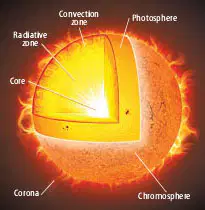
From the figure below, which layer is the outermost layer of a star?
a)
photosphere
b)
corona
c)
radiative layer
d)
visible layer
16.
Which planet is known as the red planet?
a)
jupiter
b)
saturn
c)
earth
d)
mars
17.
What causes day and night on Earth?
a)
earth orbiting the sun
b)
earth rotating on its axis
c)
tile of the earth's axis
d)
moon blocking the sunlight
18.
What galaxy is Earth located in?
a)
andromeda
b)
whirlpool
c)
milky way
d)
sombrero
19.
What is the sun classified as?
a)
planet
b)
moon
c)
star
d)
asteroid
20.
What is the correct order of the scientific method?
a)
questions, carry out, communicate, analyze, hypothesis, test, conclude
b)
hypothesis, test, carry out, communicate, conclude, analyze, question
c)
carry out, communicate, conclude, analyze, test, hypothesis, ask questions
d)
ask questions, hypothesis, test, analyze, conclude, carry out
21.
It is important to follow all safety procedures in the lab in order to:
a)
prevent accidents
b)
prevent damage to the lab equipment
c)
avoid injury to others
d)
all of the above
22.
If you spill a chemical on your skin, what should you do first?
a)
tell you lab partner
b)
wipe if off with a paper towel
c)
ignore it if it does not hurt
d)
wash it off and tell your teacher
23.
What should you do if you do not understand part of the lab instructions?
a)
guess and try anyway
b)
ask your teacher for help
c)
ask a friend in another group
d)
skip that part
24.
What is the safest way to smell a chemical?
a)
take a big sniff
b)
smell it from the container
c)
dont smell it at all
d)
wave your hand to waft the smell toward your nose
25.
Long hair should be
a)
left loose
b)
covered with a hat
c)
styled neatly
d)
tied back or secured
26.
Food may be brought into the lab if:
a)
if it is kept in your bag
b)
you do not eat it until your lab is finished
c)
it does not produce crumbs or waste
d)
none of the above
27.
When working in the science lab:
a)
materials can be assumed to be harmless
b)
washing your hands with soap and water
c)
unsupervised experiments are allowed
d)
all of the above
28.
You find a bottle of liquid on the lab shelf that is missing a label. You should:
a)
give the bottle to your teacher
b)
pour contents down the drain
c)
try to find another bottle like it and assume contents are the same
d)
try to identify the liquid by tasting a drop of smelling it
29.
Safety glasses must be worn when using:
a)
heat
b)
glassware
c)
chemicals
d)
all of the above
30.
Tongs should be used to safely pick up hot glassware.
a)
True
b)
False
31.
An accident has occurred in the lab. The first thing you should do is clean up the mess.
a)
True
b)
False
32.
It is okay to pick up broken glass.
a)
True
b)
False
33.
Never taste chemicals and never touch chemicals with your hands.
a)
True
b)
False
34.
What is an independent variable?
a)
what you observe
b)
what you change
c)
what stays the same
35.
What is an dependent variable?
a)
what you observe
b)
what you change
c)
what stays the same
36.
How do you find the average (mean) of multiple trials?
a)
add together and divide by # of trials
b)
add together
c)
subtract lowest # from highest #
d)
find the most common number
37.
What are tectonic plates?
a)
large pieces of earth's crust that moves slowly over the mantle
b)
layers of magma under the earth's surface
c)
metal plates in earth's core
d)
sedimentary rock layers
38.
What type of boundary occurs when two plates move away from each other?
a)
convergent
b)
transform
c)
divergent
39.
What type of boundary causes seafloor spreading?
a)
convegent
b)
divergent
c)
transform
40.
What type of boundary collides with a continental plate?
a)
convergent
b)
divergent
c)
transform
41.
What type of boundary causes mountains/volcanoes?
a)
convergent
b)
divergent
c)
transform
42.
What type of fault is located in California?
a)
mid-Atlantic ridge
b)
san-andreas fault
c)
ring of fire
d)
east african rift
43.
What type of boundary causes earthquakes?
a)
convergent
b)
divergent
c)
transform
44.
The ring of fire is known for having many:
a)
deserts
b)
glaciers
c)
volcanoes and earthquakes
d)
coral reefs
45.
Which layer of earth do tectonic plates float on?
a)
inner core
b)
outer core
c)
crust
d)
mantle
46.
What is the main source of energy for most processes on earth?
a)
moon
b)
sun
c)
earths core
d)
oceans
47.
What causes the moon to shine light?
a)
makes its own light
b)
reflects sunlight
c)
glows from heat
d)
reflects light from stars
48.
What is the center of our solar system?
a)
earth
b)
sun
c)
moon
d)
milky way
49.
What do scientists typically use to build an artificial reef?
a)
sunken ships and concrete
b)
sand and pipes
c)
blocks and legos
d)
rocks and minerals
50.
What causes coral bleaching?
a)
warming of the ocean
b)
cooling of the ocean
c)
warming of the atmosphere
d)
cooling of the atmosphere
100 %

