
 Worksheets
Design Movements Quiz 2
Total questions: 67
Worksheet time: 34mins
Which designer is most closely associated with the Arts and Crafts movement between 1850-1900?
William Morris
Charles Rennie Mackintosh
Frank Lloyd Wright
Le Corbusier
What was a key belief of Arts and Crafts designers regarding industrialisation?
They supported industrialisation
They were against industrialisation
They ignored industrialisation
They promoted mass production
Which of the following materials was commonly used in Arts and Crafts designs for colour and texture?
Plastic
Wood
Metal alloys
Synthetic fabrics
What style characteristic was emphasized in Arts and Crafts design?
Complexity
Simplicity
Futurism
Minimalism
William Morris was involved in the creation of which company?
Morris, Marshall, Faulkner & Co.
Apple Inc.
Bauhaus
Tiffany & Co.
Which of the following best describes how William Morris’s socialist views influenced his work?
He focused on mass production
He ignored social issues
His views influenced what he created
He only worked with digital media
Arts and Crafts designers experimented with different materials and techniques. What was the result of this experimentation?
Standardized designs
Unusual designs
Mass-produced items
Digital artwork
Which of the following is NOT a material mentioned as used for colour and texture in Arts and Crafts design?
Wool
Linen
Plastic
Stone
William Morris worked with several types of art forms. Which of the following was NOT mentioned?
Stained glass
Carving
Digital photography
Wallpaper
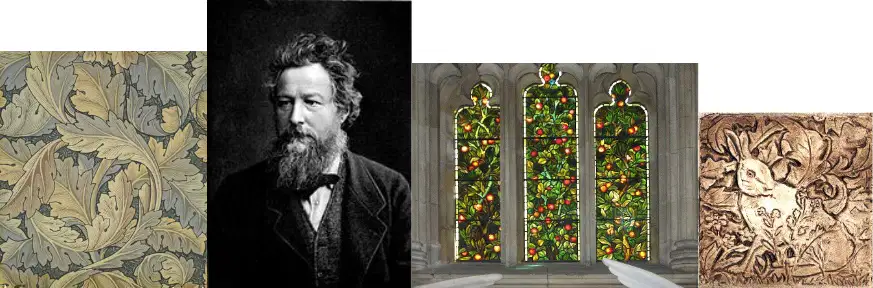
How did the use of natural materials influence the style of Arts and Crafts designs?
It made designs more industrial
It added unity and focus through colour and texture
It reduced the use of colour
It promoted synthetic textures
Which city is considered the starting point of the Art Nouveau movement?
London
Paris
Berlin
Rome
Art Nouveau served as a bridge between which two artistic movements?
Impressionism and Cubism
Arts and Craft and Modernism
Baroque and Rococo
Surrealism and Realism
Which of the following is NOT typically associated with the style of Art Nouveau?
Curvy lines and flowers
Hand-crafted items
Use of glass and wrought iron
Geometric abstraction
Art Nouveau was used in which of the following areas?
Architecture, glass, jewellery, fabrics, and wallpaper
Only painting and sculpture
Only literature and music
Only ceramics and pottery
Which cultures influenced the Art Nouveau style?
Only French and British
Japanese, Celtic, Arabian, ancient Greek
Roman and Egyptian
American and African
Charles Rennie Mackintosh is known for mixing Art Nouveau with which regional architecture?
Italian Architecture
Scottish Architecture
French Architecture
German Architecture
What is a key feature of the Art Nouveau style?
Straight lines and sharp angles
Curvy lines and flowers
Minimalist design
Heavy ornamentation
Which material was commonly used in Art Nouveau designs?
Plastic
Glass and wrought iron
Concrete
Marble
Charles Rennie Mackintosh studied at which institution?
Oxford University
Glasgow School of Art
Royal Academy of Arts
Edinburgh College of Art
Art Nouveau aimed to provide new aesthetic views for which type of lifestyle?
Rural lifestyle
Traditional lifestyle
New urban lifestyle
Nomadic lifestyle
Which of the following is a key characteristic of Modernism (1900-1930)?
Celebrated technology and the mechanised industry.
Focused on ornate decoration.
Emphasized traditional craftsmanship.
Preferred natural, organic forms.
Which design movement is associated with the phrase "Less is more"?
Modernism
Baroque
Art Nouveau
Rococo
What does the term "Bauhaus" mean?
House for building
Art for life
Form and function
Machine aesthetic
Who was the founder of the Bauhaus movement in Germany?
Walter Gropius
Marianne Brandt
Ludwig Mies van der Rohe
Le Corbusier
Which of the following best describes the style of Bauhaus Modernism?
Form follows function and geometrically pure, straight lines
Highly decorative and ornate
Inspired by nature and organic forms
Focused on asymmetry and irregularity
Marianne Brandt is best known for her work in which field?
Metalwork and design at the Bauhaus
Textile design in Paris
Architecture in Italy
Painting in Russia
How did Marianne Brandt's work reflect the influence of Modernism?
By using simple, clean lines and a functionalist perspective
By focusing on elaborate decoration
By imitating natural forms
By prioritizing color over function
Which of the following statements best explains the main priority of Bauhaus design?
Things need to be functional, with the highest priority
Emphasis on decorative frills
Focus on historical styles
Preference for asymmetrical forms
Why was Marianne Brandt's approach to design considered revolutionary for her time?
She approached her work from a functionalist perspective with simple, clean lines.
She used only traditional materials and techniques.
She focused on creating highly decorative objects.
She rejected all forms of modern technology.
Which of the following is NOT a feature of Modernist style?
Ornate natural motifs
Machine aesthetic
"Less is more" philosophy
Rejection of old natural style/aesthetic
Which design movement is characterized by symmetry, repetition, zig-zagged geometric patterns, and the use of expensive materials?
Art Deco
Bauhaus
Minimalism
Gothic Revival
What was Art Deco a reaction to?
The Industrial Revolution
Post-war (WW1)
The Renaissance
The Cold War
Which ancient civilization inspired the style of Art Deco?
Ancient Greece
Ancient Rome
Ancient Egypt
Ancient China
Which of the following is NOT a typical feature of Art Deco style?
Bright colours
Symmetry and repetition
Organic shapes
Sharp edges
Eileen Gray was inspired by which designer?
Frank Lloyd Wright
Marcel Breuer
Le Corbusier
Ludwig Mies van der Rohe
Which school did Eileen Gray attend?
Bauhaus School
Slade School of Fine Arts
Royal College of Art
Parsons School of Design
Eileen Gray started her career in which field before moving onto architecture?
Engineering
Art
Literature
Music
Eileen Gray’s work was influenced by which styles at the time?
Japanese/French art styles
American/Italian art styles
Russian/Spanish art styles
German/Indian art styles
Analyze how the use of expensive materials in Art Deco reflects the social and economic context of the period.
It shows a desire for luxury and optimism after WW1.
It was a way to reduce costs in design.
It reflected a minimalist approach to decoration.
It was intended to make art more accessible to everyone.
Compare the design philosophies of Art Deco and Eileen Gray, considering their inspirations and stylistic choices.
Art Deco focused on mechanical modernity and geometric patterns, while Eileen Gray blended Japanese/French influences and moved from art to architecture.
Both Art Deco and Eileen Gray rejected modernism and preferred traditional styles.
Art Deco and Eileen Gray were both inspired by ancient Rome and used organic shapes.
Eileen Gray’s work was entirely based on Art Deco principles.
Which of the following is a key point of the Streamlining period (1935-1955)?
Focus on traditional craftsmanship
Consumerism and Style
Emphasis on rural life
Rejection of technology
What shape is commonly associated with the style of Streamlining?
Square
Circular
Tear-drop
Hexagonal
Raymond Loewy was influenced by which country's lifestyle?
French
American
British
Japanese
Which statement best describes the impact of streamlining on items designed by Raymond Loewy?
It made items heavier and slower.
It allowed for greater speed and less drag.
It increased the complexity of designs.
It reduced consumer choice.
Raymond Loewy’s design philosophy can be summarized as:
Complexity through Innovation.
Beauty through Simplification.
Tradition through Craftsmanship.
Efficiency through Technology.
Which multinational organization did Raymond Loewy work with later in his career?
Apple
NASA
Ford
How did streamlining reflect the attitudes of people during its era?
People were nostalgic about the past.
People were hyped about the future, air travel, and space exploration.
People rejected technological advancements.
People focused on agricultural development.
Which style did Raymond Loewy mix with Streamlining in his work?
Gothic
Art Deco
Bauhaus
Minimalism

Which of the following items is an example of streamlined design?
A box-shaped suitcase
A tear-drop shaped car
A flat wooden table
A rectangular brick
Which design style is characterized by opposing Modernism and the idea that "More is more" rather than "Less is more"?
Post-Modernism
Art Deco
Bauhaus
Minimalism
Which of the following is NOT typically associated with the style of Post-Modernism?
Humour and personality
Retro Design
Deconstruction
Strict functionalism
Which material is commonly used in Post-Modernist design?
Wood
Plastics
Stone
Glass
Philippe Starck is best known for which of the following?
Being an Italian architect
Mass-producing chairs and toothbrushes
Designing only luxury cars
Creating famous paintings
Which company did Philippe Starck produce a mouse for?
Apple
Microsoft
IBM
Which of the following best describes the approach of Post-Modernist designers to form and function?
Function follows form
Form follows function
Form and function are unrelated
Function is more important than form
Which of the following is a key concept in Post-Modernist design?
Anamorphic design
Symmetry
Monochrome color schemes
Industrial materials only
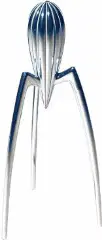
Which designer is known for creating the juicer shown in the image?
Frank Gehry
Philippe Starck
Charles Eames
Zaha Hadid

What design style does the lamp in the image most likely represent?
Post-Modernism
Modernism
Art Nouveau
Gothic Revival
Post-Modernism as a design style began in which year?
1920
1949
1975
2000
Who founded the Memphis Group in 1980?
Ettore Sottsass
Frank Lloyd Wright
Le Corbusier
Ludwig Mies van der Rohe
Which design principle did the Memphis Group reject?
Functional design and 'good taste'
Minimalism
Symmetry
Sustainability
What type of materials did the Memphis Group often incorporate in their work?
Plastic laminate
Marble
Wood
Concrete
The Memphis Group is best known for designing which of the following?
Postmodern furniture, fabrics, ceramics, glass, and metal objects
Gothic cathedrals
Renaissance paintings
Modern skyscrapers
Ettore Sottsass was an architect and designer of which century?
20th century
18th century
19th century
21st century
Which statement best describes the Memphis Group's approach to design?
They regarded design as fashion, with outrageous styles appearing for a season then disappearing quickly.
They focused on timeless, classical styles.
They only used symmetrical shapes and neutral colors.
They strictly followed the principle that 'form should follow function.'
In 1981, what did Ettore Sottsass and a group of young architects and designers do?
Formed the Memphis Group
Built the Eiffel Tower
Invented the Bauhaus movement
Designed the Sydney Opera House
How did Sottsass react to the modernist principle that 'form should follow function'?
He experimented with design and reacted against it.
He strictly adhered to it.
He ignored design principles altogether.
He promoted only functional architecture.

