
 Worksheets
United States History Midterm Review
Total questions: 96
Worksheet time: 48mins
Which of the following was a direct consequence of the Civil War?
The establishment of a more powerful and centralized federal government
The beginning of the American Revolution
The signing of the Treaty of Paris
The start of the Great Depression
Approximately how many enslaved Americans were freed as a result of the Civil War?
More than four million
Less than one million
About ten million
Two hundred thousand
What term describes the period of rebuilding the nation after the Civil War?
Reconstruction
Industrialization
Colonization
Manifest Destiny
How did the Civil War lay the foundation for America's emergence as a world power in the 20th century? (DoK Level 2)
By establishing a stronger federal government and ending slavery
By increasing trade with Europe
By expanding westward territories
By signing peace treaties with neighboring countries
Explain how the process of Reconstruction contributed to rebuilding the United States after the Civil War. (DoK Level 3)
Reconstruction involved efforts to reintegrate Southern states, rebuild infrastructure, and address the rights of freed slaves.
Reconstruction focused on expanding the railroad system to the West.
Reconstruction was a period of economic decline and isolation.
Reconstruction led to the immediate industrialization of the South.
What was the main purpose of the Jim Crow laws in the Southern United States?
To promote equality between races
To oppress and discriminate against Black people by enforcing segregation
To encourage economic growth
To improve education for all citizens
Which term describes segregation that is mandated by law and government?
De facto segregation
De jure segregation
Voluntary segregation
Social segregation
According to the Jim Crow laws, which of the following was NOT a way African Americans were segregated in the South?
Forced to ride in separate railway cars
Required to eat in separate restaurants
Allowed to live in any neighborhood they chose
Attended separate schools
How did the experiences of African Americans in the North differ from those in the South under Jim Crow laws?
Laws were more widespread in the North
African Americans faced less widespread legal segregation but still dealt with prejudice
African Americans had complete equality in the North
Segregation ended earlier in the North than in the South
What was the result of the modern Civil Rights Movement regarding segregation?
Segregation became more widespread
Segregation ended in the 1960s
Segregation was never challenged
Segregation was only enforced in the North
What does the term "laissez-faire" mean in French?
Leave alone
Work together
Regulate strictly
Help everyone
During the Second Industrial Revolution in the United States, what was the main feature of a laissez-faire economic policy?
The government heavily regulated businesses.
Businesses operated without government interference.
The government owned all companies.
Businesses were required to share profits with the government.
Why did capitalists urge governments to stop regulating business during the Second Industrial Revolution?
They wanted to increase government control
They wanted to manufacture and sell goods freely
They wanted to reduce competition
They wanted to lower taxes
What was a consequence for company owners as a result of the laissez-faire policy during the Second Industrial Revolution?
They became very rich
They lost their businesses
They had to pay higher taxes
They were forced to follow strict regulations
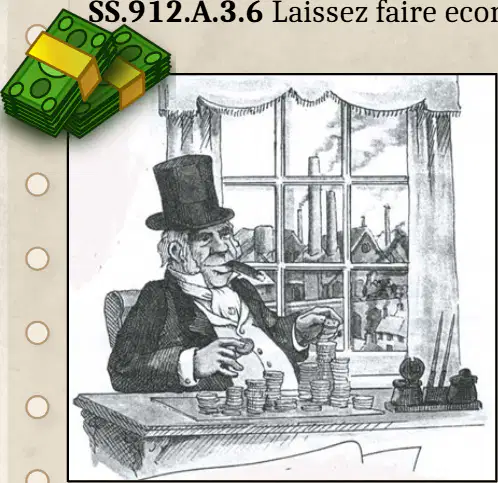
How might the lack of government regulation in a laissez-faire economy affect the distribution of wealth between company owners and workers?
It could lead to greater wealth for company owners and less for workers.
It would ensure equal wealth for everyone.
It would decrease profits for company owners.
It would increase government spending on social programs.
In which year did Japanese immigrants begin arriving on the West Coast of the United States after Japan eased emigration restrictions?
1868
1894
1906
1924
What was the main result of the 1894 US-Japanese treaty regarding Japanese immigration?
Japanese people were allowed to immigrate to the US and enjoy the same rights as citizens.
Japanese people were banned from entering the US.
Only Japanese students could immigrate to the US.
Japanese people had to pay a special tax to enter the US.
What action did the San Francisco School Board take in 1906 regarding Asian children?
Enacted a measure to segregate Chinese and Japanese children.
Allowed all children to attend the same schools.
Banned Japanese children from attending any school.
Provided scholarships for Japanese children.
How did the Japanese government react to the segregation of Japanese children in San Francisco schools in 1906?
The Japanese government was outraged.
The Japanese government supported the measure.
The Japanese government ignored the issue.
The Japanese government sent more immigrants.
Based on the information provided, what was a significant consequence of increased Japanese immigration to the United States in the late 19th and early 20th centuries?
Growing anti-Japanese sentiment in the United States.
Immediate acceptance and integration of Japanese immigrants.
Decrease in immigration from other countries.
The end of all immigration restrictions.
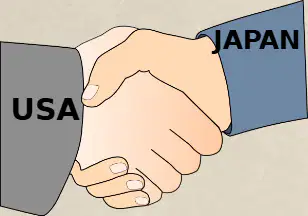
What was the main purpose of the Gentlemen's Agreement of 1907 between the U.S. and Japan?
To ease tensions between the U.S. and Japan regarding immigration
To establish a trade partnership between the U.S. and Japan
To declare war between the U.S. and Japan
To create a formal treaty for military alliance
Which statement best describes the Gentlemen's Agreement of 1907?
It was an informal agreement between the U.S. and Japan about immigration.
It was a formal treaty about trade between the U.S. and Japan.
It was a law passed by Congress restricting Japanese immigration.
It was a peace treaty ending a war between the U.S. and Japan.
According to the Gentlemen's Agreement, what did the U.S. agree to do?
Not impose restrictions on Japanese immigration
Increase tariffs on Japanese goods
Send military aid to Japan
Ban all Japanese immigrants
How did the Gentlemen's Agreement affect Japanese immigration to the United States?
Japan agreed not to allow further immigration to the U.S.
Japan encouraged more citizens to immigrate to the U.S.
The U.S. opened its borders to all Japanese immigrants.
Japanese immigrants were given citizenship automatically.
Explain why the Gentlemen's Agreement was considered "informal" rather than a formal treaty. Use evidence from the context of U.S.-Japan relations at the time.
It was based on mutual understanding rather than written law.
It was signed by both countries in a formal ceremony.
It was ratified by the U.S. Congress.
It was enforced by international courts.
Which of the following best describes the basis of socialism as an economic and political system?
Private ownership of the means of production
Collective, common, or public ownership of the means of production
Individual ownership of all resources
Ownership by foreign investors
According to socialism, what are considered the "means of production"?
Only natural resources
Machinery, tools, and factories used to produce goods
Only money and capital
Only agricultural land
Why do socialist systems aim to produce goods?
To maximize profits for private owners
To directly satisfy human needs
To increase exports
To accumulate wealth for the government
Explain how ownership of the means of production in socialism differs from that in capitalism. Use evidence from the definition provided.
In socialism, ownership is collective, while in capitalism it is private.
In both socialism and capitalism, ownership is always public.
In socialism, only the government owns the means of production, while in capitalism, only individuals do.
In capitalism, ownership is collective, while in socialism it is private.
What is a political machine?
A party organization that recruits members using incentives such as money and political jobs.
A government agency that enforces laws.
A group of citizens who protest government actions.
A committee that organizes elections.
How did leaders of political machines influence new immigrants?
By encouraging them to vote in their favor, strengthening their position in city government.
By providing free education to all immigrants.
By offering them citizenship immediately.
By sending them back to their home countries.
Who was the boss of Tammany Hall mentioned in the text?
William M. "Boss" Tweed
Abraham Lincoln
Franklin D. Roosevelt
Andrew Carnegie
What was the Tweed Ring known for after gaining control of the city government?
Acquiring funds for certain city projects, often through illegal means.
Building schools for immigrants.
Organizing charity events.
Promoting fair elections.
Why were the actions of political machines often hard to stop?
Because their actions could not be traced to one person, making it difficult to acknowledge or halt them.
Because they operated only during elections.
Because they were always legal.
Because they were supported by the federal government.
How could the use of incentives by political machines affect the integrity of city government?
It could lead to corruption and illegal activities, as leaders used money and jobs to gain support and control, making it difficult to trace or stop their actions.
It would always improve government efficiency.
It would ensure fair and equal treatment for all citizens.
It would eliminate the need for elections.
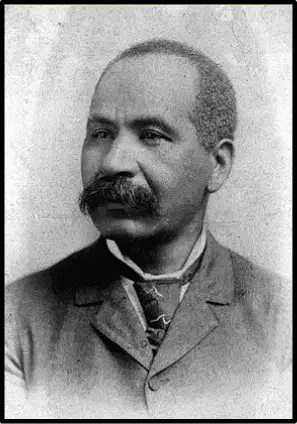
Who was the first president of Florida Agricultural and Mechanical University (FAMU)?
Thomas DeSaille Tucker
Booker T. Washington
Mary McLeod Bethune
Frederick Douglass
From which university did Thomas DeSaille Tucker earn his law degree, as it is known today?
Howard University
Dillard University
Harvard University
Florida State University
What was the original name of Florida Agricultural and Mechanical University (FAMU) when it was co-founded by Tucker in 1887?
State Normal College for Colored Students
Florida State College
Tallahassee Institute
Southern Agricultural College
Explain the significance of Thomas DeSaille Tucker’s role in the history of higher education for African Americans in Florida.
He was the first African American to graduate from Harvard.
He co-founded a college specifically for African American students and became its first president, helping to establish what is now FAMU.
He was a famous civil rights leader in Florida.
He established the first public library in Florida.
What is the definition of imperialism?
The economic and/or political control of a stronger nation over a weaker one.
The peaceful cooperation between two equal nations.
The isolation of a nation from international affairs.
The voluntary exchange of goods between two countries.
According to the passage, why did the United States seek to acquire territories?
To find new places to invest their capital and obtain raw materials for industrial growth.
To promote world peace and democracy.
To reduce the population of the United States.
To avoid international trade.
How did the United States attempt to protect its investments during the period of imperialism?
By exerting control over other countries and regions.
By withdrawing from international affairs.
By reducing industrial production.
By increasing domestic taxes.
Based on the motives described, which economic factors contributed to US imperialism?
The need for raw materials and new markets for investment.
The desire to reduce government spending.
The goal of increasing domestic unemployment.
The intention to limit technological advancement.
Explain how the economic motives for U.S. imperialism could impact the countries and regions under U.S. control. Use evidence from the passage to support your answer.
The U.S. would control resources and investments, potentially limiting the economic independence of those countries.
The U.S. would encourage complete political freedom in those regions.
The U.S. would avoid any economic involvement in those countries.
The U.S. would only provide humanitarian aid without any economic interest.
Why did Russia decide to sell Alaska to the United States?
Russia wanted to expand its territory in Europe.
Russia was heavily in debt and feared losing Alaska to Great Britain.
Russia wanted to improve relations with China.
Russia needed more land for agriculture.
Who purchased Alaska from Russia, and on what date?
President Andrew Johnson on July 4, 1865
Secretary of State William Seward on March 30, 1867
President Abraham Lincoln on April 15, 1865
Secretary of State John Quincy Adams on March 30, 1867
How much did the United States pay for Alaska, and what was the cost per acre?
$10 million, 5 cents an acre
$7 million, 2 cents an acre
$5 million, 1 cent an acre
$8 million, 3 cents an acre
What was a common nickname given to the purchase of Alaska by critics?
"Johnson's Mistake"
"Seward's Folly"
"Lincoln's Gamble"
"Adams' Error"
How did the treaty to purchase Alaska affect the size of the United States?
It reduced the size of the United States by half.
It enlarged the United States by 586,000 square miles, more than twice the size of Texas.
It added only a small island to the United States.
It did not change the size of the United States.
Explain how the discovery of gold in 1898 influenced the settlement of Alaska. Use evidence from the historical context.
The discovery of gold led to a rapid influx of people to Alaska, increasing settlement.
The discovery of gold caused people to leave Alaska.
The discovery of gold had no impact on Alaska's settlement.
The discovery of gold made Alaska less valuable to settlers.
Which year did the United States purchase Alaska?
1776
1867
1901
1848
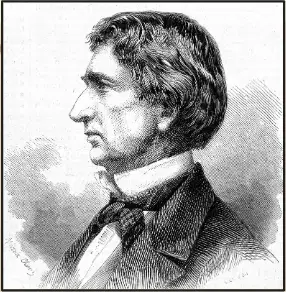
Who was the U.S. Secretary of State responsible for the purchase of Alaska?
William Steward
Thomas Jefferson
Alexander Hamilton
John Quincy Adams
How much did the United States pay for Alaska in 1867?
$1,000,000
$7,000,000
$10,000,000
$20,000,000
Explain why the purchase of Alaska in 1867 was significant for the United States. Use evidence from history to support your answer.
It expanded U.S. territory and provided access to valuable resources.
It led to the immediate discovery of gold in California.
It ended the Civil War.
It resulted in the annexation of Hawaii.
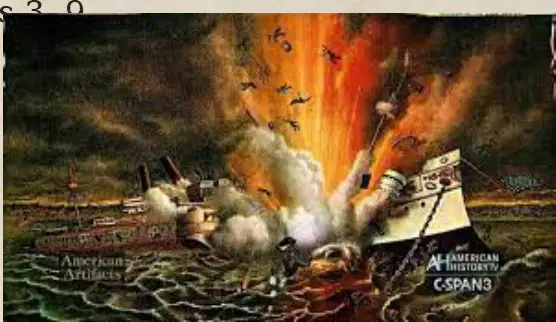
Which event is commonly cited as a major cause for the start of the Spanish American War?
The assassination of Archduke Franz Ferdinand
The sinking of the USS Maine
The signing of the Treaty of Paris
The attack on Pearl Harbor
What type of causes should be examined to understand the origins of the Spanish American War, according to SS.912.A.4.3?
Economic causes
Technological causes
Environmental causes
Religious causes
Explain how the sinking of the USS Maine contributed to the outbreak of the Spanish American War. Use evidence or reasoning in your answer.
It led to increased tensions and public outcry, prompting the U.S. to declare war on Spain.
It resulted in a peace treaty between the U.S. and Spain.
It caused the U.S. to withdraw from international affairs.
It had no impact on the relationship between the U.S. and Spain.
Who was the U.S. President that supported the Panamanian revolution and recognized the new government of Panama?
Theodore "Teddy" Roosevelt
Franklin D. Roosevelt
Woodrow Wilson
William Howard Taft
What was Panama a part of before gaining independence with U.S. support?
The Republic of Colombia
The Republic of Mexico
The United States
The Republic of Venezuela
What did the new treaty between the United States and Panama grant the U.S.?
Complete control of the 10-mile-wide Canal Zone
Ownership of all Panamanian land
Exclusive trading rights with Colombia
Control over the entire country of Panama
Why did the United States support the Panamanian revolution against Colombia?
To gain control over the land needed to build the Panama Canal
To help Panama become a democracy
To stop European influence in South America
To expand U.S. territory into South America
Explain the strategic steps the United States took to secure the land necessary for the construction of the Panama Canal.
Supported the Panamanian revolution, recognized the new government, and signed a treaty for control of the Canal Zone
Purchased the land directly from Colombia
Invaded Panama and took control by force
Negotiated with European powers for the rights to the canal
When did American work on the Panama Canal begin?
May 1904
August 1914
May 1913
August 1903
Which of the following was NOT a problem that hampered the construction of the Panama Canal?
Material shortages
Malaria
Yellow fever
Floods
What method was used to nearly eliminate malaria during the construction of the Panama Canal?
Using mosquito nets
Draining standing water and encouraging spiders, ants, and lizards to breed
Providing vaccinations
Building hospitals
Which ship was the first to pass through the Panama Canal?
SS Ancon
SS Panama
SS Columbia
SS Liberty
Explain how the elimination of malaria by 1913 contributed to the progress of the Panama Canal construction.
It reduced worker illness, allowing construction to proceed more efficiently.
It increased the cost of construction.
It delayed the project further.
It caused more material shortages.
Who sent the Zimmermann Note during World War I?
Arthur Zimmermann
Woodrow Wilson
Winston Churchill
Franklin D. Roosevelt
What did the Zimmermann Note propose to Mexico?
An alliance with Germany in exchange for lost Southwest territory
A peace treaty with the United States
Economic aid from Britain
Military support against Canada
What was the outcome after the British decoded the Zimmermann Note?
Americans called for war
Mexico joined Germany
Germany surrendered
Britain declared neutrality
Explain how the Zimmermann Note contributed to the United States entering World War I.
It revealed Germany's attempt to form alliances against the U.S., increasing American support for entering the war.
It provided economic benefits to the U.S., encouraging neutrality.
It led to peace negotiations between Germany and Mexico.
It caused Britain to withdraw from the war.
What was the main reason President Wilson needed to find ways to pay for during wartime?
To fund scientific research
To pay for going to war
To build new schools
To improve transportation
What were Liberty Bonds?
A type of tax on imported goods
A form of loan to the government from American people
A way to pay soldiers directly
A method for rationing food
Which action did President Wilson take to help finance the war effort?
He increased tariffs
He started a campaign to sell Liberty Bonds
He reduced government spending
He asked for donations from other countries
Why did the United States government sell Liberty Bonds during wartime?
To encourage people to save money
To raise funds for the war effort
To reduce inflation
To support local businesses
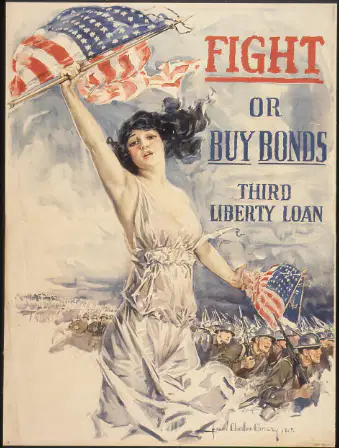
Explain how Liberty Bonds functioned as a financial tool for the United States government during wartime. Use evidence from the concept of loans and public support.
Liberty Bonds were a way for the government to borrow money from American citizens, allowing the government to raise funds for war expenses while citizens supported the war effort financially.
Liberty Bonds were a way for the government to collect taxes directly from citizens.
Liberty Bonds were used to pay soldiers’ salaries only.
Liberty Bonds were a form of currency issued during wartime.
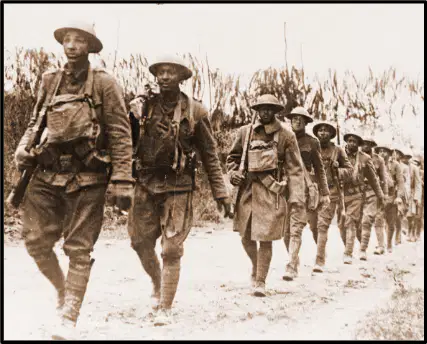
Which section did many African Americans serve in during their time in Europe in World War I?
Services of Supply section of American Expeditionary Forces
Medical Corps of the British Army
Naval Intelligence Division
Air Force Command Unit
What types of roles did many African Americans find themselves in when enlisted or drafted during World War I?
Non-combative roles
High-ranking officer positions
Frontline combat leadership
Intelligence analysis
Which of the following tasks did African Americans perform as part of the Services of Supply section?
Assisting in load and unloading cargo from ships at docks
Piloting fighter planes
Designing military strategies
Negotiating peace treaties
How did the experience of African Americans who fought under the French differ from those who served in non-combative roles?
They participated in combat on the front lines
They only worked as cooks
They were not allowed to leave the United States
They served as diplomats
Explain how the roles of African Americans in the American Expeditionary Forces reflected broader social attitudes of the time.
Their assignment to non-combative and labor roles reflected racial segregation and limited opportunities for African Americans in the military.
Their roles were based solely on personal choice and preference.
They were given equal opportunities as other groups without discrimination.
Their roles were determined by random selection without regard to race.
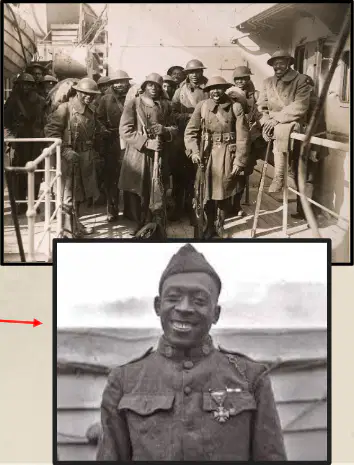
Which infantry regiment was known as the Harlem Hellfighters during World War I?
92nd Infantry Regiment
93rd Infantry Regiment
369th Infantry Regiment
101st Infantry Regiment
What significant achievement did Private Henry Johnson accomplish during World War I?
He led the Second Battle of the Marne.
He became the first American to receive the Croix de Guerre.
He was promoted to general.
He received the Medal of Honor.
In which battles did the Harlem Hellfighters participate while serving with the French Army?
Battle of Gettysburg and Battle of the Bulge
Second Battle of the Marne and Meuse-Argonne Offensive
Battle of Normandy and Battle of Stalingrad
Battle of Verdun and Battle of Somme
Explain the significance of the Harlem Hellfighters’ service in Europe during World War I in the context of African American military history.
Their service was typical and did not differ from other groups.
They were notable for fighting on the front lines and receiving international recognition, highlighting the bravery and contributions of African American soldiers.
They only served in support roles and did not see combat.
Their service was limited to training exercises in the United States.
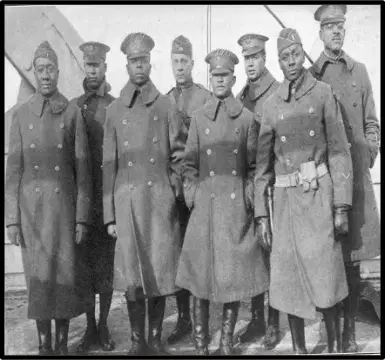
Which Infantry Regiment was given the name "Black Devils" by Germans during their service in Europe?
370th Infantry Regiment
101st Airborne Division
442nd Infantry Regiment
1st Infantry Division
What was unique about the 370th Infantry Regiment in terms of its leadership?
It was the only unit commanded by Black officers.
It was the only unit led by women.
It was the only unit commanded by French officers.
It was the only unit led by German officers.
During which offensive did Corporal Freddie Stowers lead troops through a German line despite receiving mortal wounds?
Meuse-Argonne Offensive
Normandy Offensive
Battle of the Bulge
Verdun Offensive
Why was Corporal Freddie Stowers awarded the Medal of Honor posthumously many years after his death?
His award was not processed and given until 1991.
He refused the medal during his lifetime.
The medal was lost during the war.
He was not recommended for the medal until 1991.
Compare the experiences of African American soldiers in the 370th Infantry Regiment to other groups serving in Europe. What evidence from the text supports the uniqueness of their experience?
They were the only unit commanded by Black officers and were assigned to the French Army.
They were the only unit to fight in Asia.
They were the only unit to use tanks.
They were the only unit to serve in the Navy.
What was the main purpose of the American Friends Service Committee (AFSC) when it was founded in 1917?
To provide young Quakers and conscientious objectors an opportunity to perform a service of love in wartime
To train soldiers for battle
To promote war propaganda
To establish military bases in Europe
Which of the following activities did the AFSC members participate in while serving in France during World War I?
Feeding and caring for refugee children
Building weapons for soldiers
Leading combat missions
Organizing political rallies
In addition to feeding refugee children, what other service did the AFSC provide in France?
Founding a maternity hospital
Training pilots
Designing war strategies
Manufacturing ammunition
How did the AFSC help returning refugees after World War I?
By providing them with necessities to start life once more
By sending them to military camps
By recruiting them for the army
By relocating them to other countries
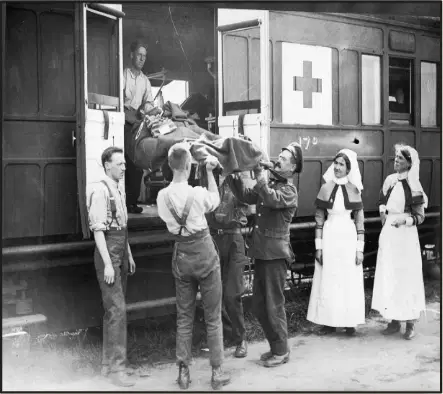
Based on the information provided, how did the experiences of conscientious objectors serving with the AFSC differ from those of soldiers in combat?
They focused on humanitarian aid rather than fighting
They received military honors for bravery
They were responsible for leading attacks
They were trained as spies
Which event contributed to anti-German sentiment in the United States after World War One?
The sinking of the British ship RMS Lusitania by a German U-boat
The signing of the Treaty of Versailles
The invention of the telephone
The construction of the Panama Canal

