
 Worksheets
Biology Semester Exam review
Total questions: 52
Worksheet time: 26mins
Name
Class
Date
1.
By measuring the height of the tortoise, this scientist is gathering
a)
independent variables
b)
dependent variables
c)
quantitative data
d)
qualitative data
2.
The statement "The worm is 2 centimeters long" is a(n)
a)
observation
b)
theory
c)
inference
d)
hypothesis
3.
An inference is
a)
the same as an observation
b)
a logical interpretation of an observation
c)
a statement involving numbers
d)
a way to avoid bias
4.
To be useful in science, a hypothesis must be
a)
measurable
b)
observable
c)
testable
d)
correct
5.
Which of the following statements about a controlled experiment is accurate?
a)
All the variables must be kept the same.
b)
Only one variable is tested at a time.
c)
Everything can be studied by setting up a controlled experiment.
d)
Controlled experiments cannot be performed on living things.
6.
A scientific theory is
a)
the same as a hypothesis.
b)
a well-tested explanation that unifies a broad range of observations.
c)
the same as the conclusion of an experiment.
d)
the first step in a controlled experiment.
7.
A skeptical attitude in science
a)
prevents scientists from accepting new ideas.
b)
encourages scientists to readily accept new ideas.
c)
means a new idea will only be accepted if it is backed by evidence.
d)
is unimportant.
8.
The purpose of peer review in science is to ensure that
a)
all scientific research is funded.
b)
the results of experiments are correct.
c)
all scientific results are published.
d)
published results meet standards set by the scientific community.
9.
The process in which two cells from different parents unite to produce the first cell of a new organism is called
a)
homeostasis
b)
development
c)
asexual reproduction
d)
sexual reproduction
10.
The relatively stable set of internal conditions that organisms maintain is called
a)
metabolism
b)
a genome
c)
evolution
d)
homeostasis
11.
(L2) In a series of chemical reactions, sugar molecules are combined with other reactants to form a protein. Which elements must be included in the reactants for a protein to form? (L2)
a)
A. Carbon, Hydrogen, Oxygen only
b)
B. Carbon, Hydrogen, Oxygen, and Nitrogen
c)
C. Carbon, Hydrogen, Oxygen, and Phosphorus
d)
D. Carbon, Hydrogen, Oxygen, and Sulfur
12.
(L3) The human body maintains a constant internal temperature of about 37°C (98.6°F), even when the external environment changes. Why is this constant temperature important for enzymes? (L3)
a)
A. Enzymes only work in cold conditions, so body temperature must be kept low.
b)
B. Enzymes function best within a narrow temperature range, and changes can reduce their activity or denature them.
c)
C. Enzymes require constant changes in temperature to speed up different reactions in the body.
d)
D. Enzymes are not affected by temperature, so body temperature is unrelated to their function.
13.
(L1) In the atom, which particles are in constant motion around the nucleus?
a)
A. protons
b)
B. protons & neutrons
c)
C. neutrons
d)
D. electrons
14.
(L1) Why is a water molecule considered polar?
a)
A. Because oxygen and hydrogen share electrons equally
b)
B. Because oxygen is more electronegative and pulls electrons closer to itself
c)
C. Because hydrogen atoms are larger than oxygen atoms
d)
D. Because water molecules contain both covalent and ionic bonds
15.
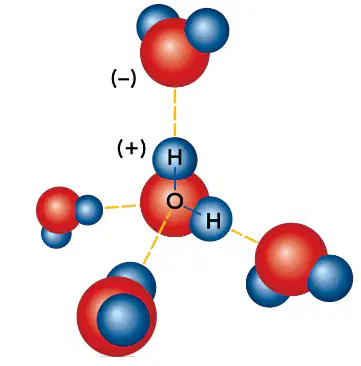
(L1) Which type of bonds hold two or more water molecules together, as shown?
a)
A. covalent bonds
b)
B. van der Waals forces
c)
C. hydrogen bonds
d)
D. ionic bonds
16.
(L1) What is the relationship between monomers and macromolecules?
a)
A. Monomers are the same thing as macromolecules
b)
B. Monomers are small molecules that join together to form macromolecules
c)
C. Macromolecules are broken down into smaller macromolecules
d)
D. Macromolecules cannot be made from repeating units
17.
(L1) Which type of macromolecule stores genetic information?
a)
A. Carbohydrates
b)
B. proteins
c)
C. lipids
d)
D. nucleic acids
18.
(L1) Which type of macromolecule regulates cell processes, transports material into and out of cells and also assists in building tissue?
a)
A. Carbohydrates
b)
B. proteins
c)
C. lipids
d)
D. nucleic acids
19.
(L1) Which are the catalysts of reactions in living things?
a)
A. enzymes
b)
B. lipids
c)
C. carbohydrates
d)
D. substrates
20.
(L1) What happens during a chemical reaction?
a)
A. Atoms are destroyed and replaced with new ones
b)
B. One set of compounds is changed into another set of compounds
c)
C. Energy disappears completely
d)
D. The number of atoms increases
21.
(LS1-2: L1) Despite differences in size and shape, at some point all cells have genetic material and a
a)
A. cell wall
b)
B. cell membrane
c)
C. mitochondria
d)
D. nucleus
22.
(LS1-2: L1) The portion of the cell outside the nucleus is called the
a)
A. organelle
b)
B. cytoplasm
c)
C. Nucleolus
d)
D. ribosome
23.
(LS1-2: L1) Proteins are assembled on
a)
A. ribosomes
b)
B. vacuoles
c)
C. lysosomes
d)
D. centrioles
24.
(LS1-2: L2) Which of the following structures convert light energy into chemical energy stored in food?
a)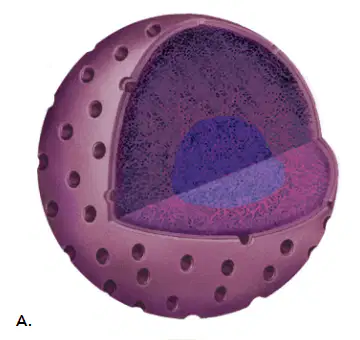
A.
b)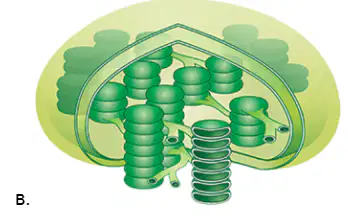
B.
c)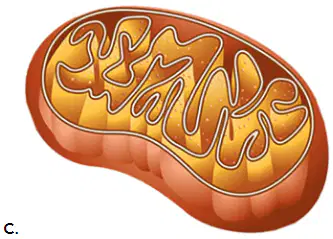
C.
d)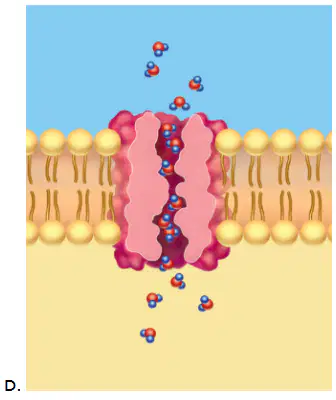
D.
25.
(LS1-2: L2) How are the functions of vacuoles and lysosomes different?
a)
A. Vacuoles break down waste, while lysosomes store water and nutrients.
b)
B. Vacuoles provide storage for materials such as water, salts, and nutrients, while lysosomes contain enzymes that break down waste and damaged cell parts.
c)
C. Vacuoles and lysosomes both store proteins for the cell, but lysosomes also store lipids.
d)
D. Vacuoles move proteins through the cell, while lysosomes package proteins for export.
26.
(LS1-2: L2) Which statement best explains the function of the Golgi apparatus in a cell?
a)
A. It stores water and nutrients for the cell.
b)
B. It packages and modifies proteins and lipids for transport within or outside the cell.
c)
C. It produces energy for the cell by breaking down glucose.
d)
D. It controls which substances enter and leave the cell.
27.
(LS1-2: L2) Which statement best describes the structure of the cell membrane?
a)
A. It is made of a rigid layer of cellulose that surrounds the cell.
b)
B. It is composed of a phospholipid bilayer with proteins embedded, allowing selective transport in and out of the cell.
c)
C. It is a single layer of lipids that stores energy for the cell.
d)
D. It is made entirely of proteins and provides structural support only.
28.
(LS1-3: L1) Solute particles move from an area of higher concentration to an area of lower concentration in a process called
a)
A. osmosis
b)
B. transport
c)
C. diffusion
d)
d. equilibrium
29.
(BI-LS1-5, DOK 2) Nancy is explaining why chlorophyll is classified as a plant pigment and how it is useful in photoysynthesis. Which property of chlorophyll would be most appropriate for her to cite?
a)
chlorophyll's ability to absorb light
b)
chlorophyll's green color
c)
chlorophyll's presence in chloroplasts
d)
chlorophyll's reactivity with oxygen
30.
(BI-LS1-5, DOK 3) Under normal conditions, gases diffuse through small holes in the leaves of a plant known as stomata. When the weather is very hot and dry, plants may close these openings to conserve water. How are the closures most likely to affect photosynthesis?
a)
They increase the rate of photosynthesis by increasing the amount of water in the leaf.
b)
They decrease the rate of photosynthesis by preventing carbon dioxide from entering the leaf.
c)
They increase the rate of photosynthesis by increasing the amount of oxygen in the leaf.
d)
They have little or no effect on photosynthesis because gases do not take part in the process.
31.
(BI-LS1-5, DOK 2) Which of the following correctly lists the main inputs of photosynthesis?
a)
Oxygen and sugar
b)
Carbon Dioxide and water
c)
Nitrogen and sunlight
d)
Oxygen and water
32.
(BI-LS1-5, DOK 2) What is the main pigment in chloroplasts that captures light energy?
a)
melanin
b)
chlorophyll
c)
carotene
d)
hemoglobin
33.
(BI-LS1-5, DOK 2) Xavier is describing the role of electron carriers, such as NADP+, in photosynthesis. Which property of NADP+ should Xavier cite?
a)
the chemical bonds formed by electrons in its molecular structure
b)
its ability to accept and release high-energy electrons and a hydrogen ion
c)
its reactivity with oxygen, water, and carbon dioxide
d)
its ability to emit a stream of electrons in a nuclear reaction
34.
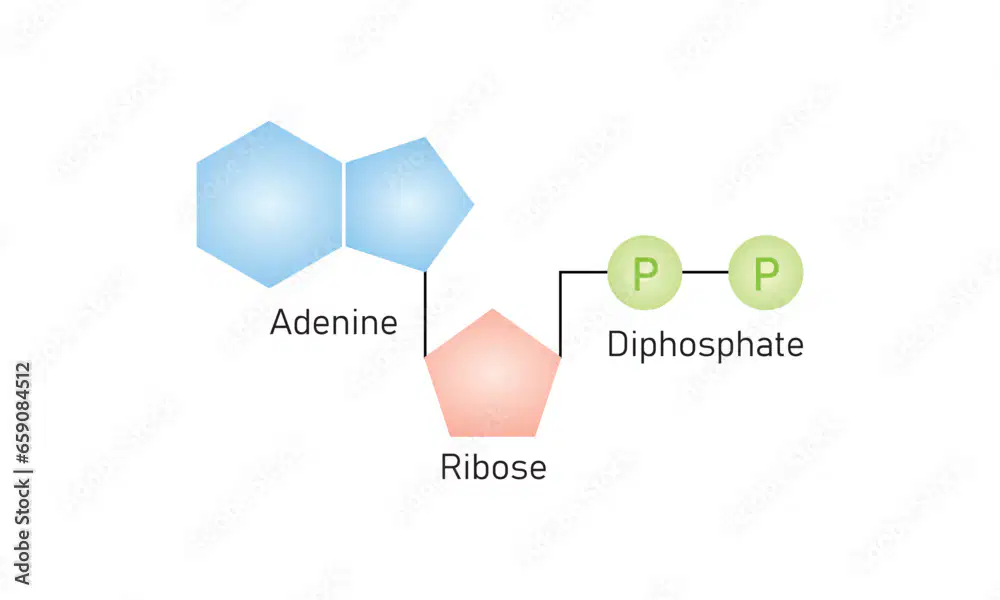
(BI-LS1-5, DOK 3) The diagram shows the structure of adenosine diphosphate (ADP). What describes the conversion of ADP to ATP?
a)
an input of energy as both phosphate groups detach
b)
a release of energy as one phosphate group detaches
c)
a release of energy as a third phosphate group is attached
d)
an input of energy to attach a third phosphate group
35.

(BI-LS 1-5, DOK 3) William is developing the model shown below to illustrate the process of photosynthesis. He plans to use the model to explain how photosynthesis transforms both energy and matter. In a key or legend for the model, how should William describe the roles of NADPH and ATP in the light-independent reactions?
a)
providing the oxygen for sugar molecules
b)
providing the carbon for sugar molecules
c)
absorbing the energy of light and transferring it to electrons
d)
supplying the energy necessary to assemble sugar molecules
36.
(BI-LS1-5, DOK 3) The overall chemical equation that describes photosynthesis is shown below.
6CO₂ + 6H₂0 → C₆H₁₂O₆+ 6O₂
By analyzing this equation, which property of photosynthesis can be identified?
a)
the chemical changes that occur during the light-independent reactions
b)
the chemical changes that occur during the light-dependent reactions
c)
the source of carbon atoms in the carbohydrate product
d)
the identities and roles of electron carriers
37.
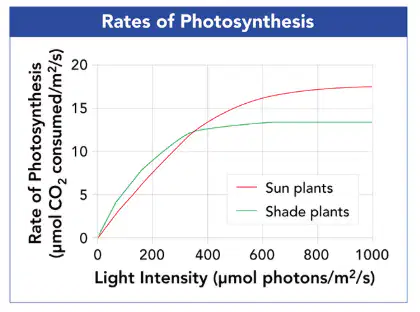
(BI-LS1-5, DOK 2) Different plants perform photosynthesis at different rates. The rates may change in response to several factors, including temperature, available water, and light intensity. The graph showes how the rates of photosynthesis vary with light intensity for two groups of plants: plants that thrive in direct sunlight, and plants that thrive in the shade.
When light intensity is below 200µmol photons/m²/s, do sun plants or shade plants have a higher rate of photosynthesis?
a)
sun plants
b)
shade plants
38.
(BI-LS1-5, DOK 2)Light intensity in the Sonoran Desert averages about 400µmol photons/m²/s. What is the approximate rate of photosynthesis for sun plants that grow in this environment?
a)
7 µmol CO₂ consumed/m²/s
b)
13 µmol CO₂ consumed/m²/s
c)
15 µmol CO₂ consumed/m²/s
d)
17 µmol CO₂ consumed/m²/s
39.
(BI-LS1-7, DOK 1) Which statement best defines a calorie?
a)
A nutrient used to build muscle
b)
The amount of energy needed to raise the temperature of 1 gram of water by 1°C
c)
The amount of heat produced during exercise
d)
A measurement of how much food weighs
40.
(BI-LS1-7, DOK 1) What is cellular respiration?
a)
The process cells use to store DNA
b)
The process cells use to convert glucose into ATP
c)
The process plants use to make glucose
d)
The process of blood circulation
41.
(BI-LS1-7, DOK 1) Which of the following are the reactants of cellular respiration?
a)
ATP and water
b)
Glucose and oxygen
c)
Carbon dioxide and water
d)
Glucose and carbon dioxide
42.
(BI-LS1-7, DOK 2) Which of the following are the main products of cellular respiration?
a)
Glucose and oxygen
b)
ATP, carbon dioxide, and water
c)
DNA and RNA
d)
Oxygen and glucose
43.
(BI-LS1-7, DOK 3) A student runs an experiment and measures the output of a cell performing cellular respiration. Which combination would indicate that the cell is producing energy correctly?
a)
Glucose and oxygen
b)
ATP, carbon dioxide, and water
c)
DNA and RNA
d)
ATP only
44.
(BI-LS1-7, DOK 2) If a plant uses carbon dioxide and water to make glucose and oxygen, which process is happening? And what process uses the glucose and oxygen to produce energy?
a)
Photosynthesis; Cellular respiration
b)
Cellular respiration; Photosynthesis
c)
Photosynthesis; Photosynthesis
d)
Cellular respiration; Cellular respiration
45.
(BI-LS1-7, DOK 3) A cell tried to release all the energy from glucose at once. What would most likely happen?
a)
The cell would safely make extra ATP
b)
Most of the energy would be lost as heat and light
c)
The cell would make energy more efficiently
d)
The glucose would turn into oxygen
46.
(BI-LS1-7, DOK 1) Which of the following lists the three main stages of cellular respiration in the correct order?
a)
Electron Transport Chain, Kreb's Cycle, Glycolysis
b)
Glycolysis, Kreb's Cycle, Electron Transport Chain
c)
Kreb's Cycle, Glycolysis, Electron Transport Chain
d)
Glycolysis, Electron Transport Chain, Kreb's Cycle
47.
(BI-LS1-7, DOK 3) Why does glycolysis capture only about 10% of the energy from glucose?
a)
Most of the energy is lost as heat and light
b)
Cells are inefficient and waste most energy
c)
The rest of the energy is immediately converted to oxygen
d)
Glucose does not contain enough energy to capture more
48.
(BI-LS1-7, DOK 3) What does the term “aerobic” mean?
a)
Occurring without oxygen
b)
Occurring with oxygen
c)
Producing glucose
d)
Releasing energy as heat and light
49.
(BI-LS1-7, DOK 3) What does the term “anaerobic” mean?
a)
Occurring without oxygen
b)
Occurring with oxygen
c)
Producing glucose
d)
Releasing energy as heat and light
50.
(BI-LS1-7, DOK 1) Where does glycolysis occur in the cell?
a)
cytoplasm
b)
mitochondria
c)
nucleus
d)
ribosome
51.
(BI-LS1-7, DOK 1) Where does the Kreb's Cycle and Electron Transport Chain occur in the cell?
a)
cytoplasm
b)
mitochondria
c)
nucleus
d)
ribosome
52.
(BI-LS1-7, DOK 1) Which statement correctly describes the relationship between photosynthesis and cellular respiration?
a)
They are completely unrelated processes
b)
Photosynthesis stores energy, and cellular respiration releases energy
c)
Both produce glucose as a final product
d)
Both require ATP to occur
100 %

