
 Worksheets
Semester 1 Final Exam (Chapters 1-6)
Total questions: 96
Worksheet time: 48mins
Name
Class
Date
1.
Which type of reproduction requires only one parent?
a)
Symbiotic reproduction
b)
Asexual reproduction
c)
Parasitic reproduction
d)
Sexual reproduction
2.
In meiosis, how many times does the cell divide?
a)
Four times
b)
Three times
c)
Twice
d)
Once
3.
Which phase of the cell cycle involves normal cell functions?
a)
G1 phase
b)
G2 phase
c)
S phase
d)
M phase
4.
During which phase of meiosis do homologous chromosomes pair and exchange genetic material?
a)
Prophase I
b)
Metaphase II
c)
Anaphase I
d)
Telophase II
5.
Which type of cell division produces genetically unique gametes?
a)
Mitosis
b)
Meiosis
c)
Budding
d)
Binary fission
6.
What occurs during the S phase of the cell cycle?
a)
Cell growth
b)
Protein synthesis
c)
DNA replication
d)
Chromosome separation
7.
What are mitosis and meiosis both involved in?
a)
Making proteins
b)
Making new cells
c)
Making new IDENTICAL cells
8.
Both mitosis and meiosis begin with one cell.
a)
True
b)
False
c)
It depends
9.
During which phase of meiosis does crossing over occur?
a)
Interphase
b)
Metaphase 2
c)
Prophase 1
d)
Telophase 1
10.
What results at the end of mitosis?
a)
2 identical haploid cells
b)
2 identical diploid cells
11.
What results at the end of meiosis?
a)
4 identical haploid cells
b)
4 non-identical diploid cells
c)
4 non-identical haploid cells
12.
Which of the following is not a function of mitosis?
a)
Growth
b)
Repair damage
c)
Produce new body cells
d)
Produce sperm and egg cells
13.
What is uncontrolled cell growth called?
a)
Hypermitosis
b)
Infection
c)
Cancer
14.
During which phase is a cell growing, replicating its DNA, and carrying out cell functions?
a)
Prophase
b)
Interphase
c)
Telophase
d)
Cytokinesis
15.
What is responsible of the final separation of two cells by splitting the cytoplasm?
a)
Cytokinesis
b)
Cytopsychosis
c)
Telophase
16.
What is the function of the spindle fibers in mitosis/meiosis?
a)
Pull chromosomes to the equator of the cell
b)
Pull tetrads apart
c)
Pull apart chromatids
d)
All of the above
17.
Why is crossing over important?
a)
Recombine DNA
b)
Allows for genetic diversity within a species
c)
Both a and b
18.
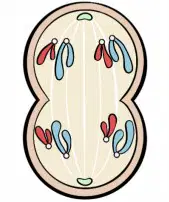
Label the stage of Mitosis
a)
Prophase
b)
Metaphase
c)
Anaphase
d)
Telophase
19.
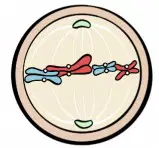
Label the stage of Mitosis
a)
Prophase
b)
Metaphase
c)
Anaphase
d)
Telophase
20.
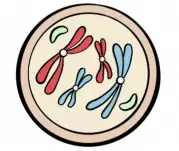
Label the stage of Mitosis
a)
Prophase
b)
Metaphase
c)
Anaphase
d)
Telophase
21.
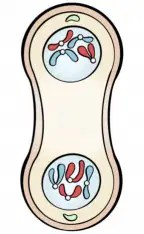
Label the stage of Mitosis
a)
Prophase
b)
Metaphase
c)
Anaphase
d)
Telophase
22.
In humans and other multicellular organisms, which substance plays a central role as an energy source?
a)
fat
b)
water
c)
protein
d)
carbohydrate
23.
What is the result when living things respond to stimuli in ways that allow them to maintain and balance in the internal conditions necessary for life?
a)
osmosis
b)
adaptation
c)
homeostasis
d)
stimulation
24.
Which of the following must happen to ensure the continuation of a species?
a)
Photosynthesis
b)
Metamorphasis
c)
Reproduction
d)
Extinction
25.
What is defined as "anything that has mass and takes up space?"
a)
matter
b)
carbohydrates
c)
proteins
d)
atoms
26.
An organism's genetic information is stored in which type of macromolecule?
a)
carbohydrate
b)
lipid
c)
protein
d)
DNA
27.
What is the primary focus of Life Science?
a)
Study of non-living systems
b)
Study of chemical reactions
c)
Study of living organisms and their interactions
d)
Study of astronomical phenomena
28.
Which approach is fundamental to scientific investigation?
a)
The Scientific Method
b)
Relying solely on personal opinion
c)
Avoiding experimentation
d)
Guessing randomly
29.
What ALWAYS starts the scientific method?
a)
Creating a hypothesis
b)
Testing results
c)
Drawing conclusions
d)
Making observations
30.
What distinguishes a scientific theory from a scientific law?
a)
Theories cannot be tested
b)
Laws describe consistent relationships
c)
Laws are always subjective
d)
Theories are always proven
31.
What is the primary difference between basic and applied science?
a)
Applied science focuses on theoretical knowledge
b)
Basic science explores fundamental principles
c)
Applied science is less important
d)
Basic science seeks practical applications
32.
In the scientific method, what follows making a hypothesis?
a)
Drawing conclusions
b)
Testing the hypothesis
c)
Publishing results
d)
Making observations
33.
What is the primary purpose of safety protocols in a scientific laboratory?
a)
To make experiments more complicated
b)
To slow down research
c)
To increase experimental costs
d)
To prevent accidents and protect researchers
34.
What is the primary goal of communicating scientific results?
a)
To complicate understanding
b)
To hide information
c)
To gain personal fame
d)
To share knowledge with others
35.
Scientific thinking primarily involves:
a)
Memorizing facts
b)
Critical reasoning and thinking outside the box
c)
Avoiding questions
d)
Accepting all information
36.
In scientific research, what does 'analyzing results' mean?
a)
Stopping the experiment
b)
Interpreting experimental findings
c)
Ignoring unexpected data
d)
Avoiding conclusions
37.
What is the primary tool for observing microscopic organisms?
a)
Microscope
b)
Telescope
c)
Binoculars
d)
Magnifying glass
38.
Which of the following would most likely be the major focus of a life scientist?
a)
bacteria found in hot springs
b)
the composition of water in hot springs
c)
the temperature of hot springs
d)
the location of hot springs
39.
Which of the following is an observation?
a)
You record the air temperature every day for a week.
b)
You propose that a cold front is approaching.
c)
You hypothesize that the temperature will increase tomorrow.
d)
You conclude that the season is changing.
40.
Which of the following is closest in meaning to hypothesis?
a)
a random guess
b)
a guess based on previous knowledge
c)
a proposed explanation for an observation
d)
information collected in an experiment
41.
What is the primary purpose of a control group in a scientific experiment?
a)
To make the experiment more complex
b)
To eliminate all variables
c)
To increase experimental costs
d)
To provide a baseline for comparison
42.
Which of the following is NOT a proper safety procedure when conducting a scientific experiment?
a)
Tying back long hair
b)
Wearing protective goggles
c)
Working without adult supervision
d)
Keeping work area clean
43.
In an experiment testing the effect of water temperature on seed germination, the INDEPENDENT variable would be:
a)
Seed type
b)
Number of seeds that sprout
c)
Water temperature
d)
Germination time
44.
In an experiment testing different light intensities on plant growth, which would be the DEPENDENT variable?
a)
Light color
b)
Light intensity
c)
Initial plant size
d)
Plant height
45.
Which of the following is an example of a CONSTANT in a plant growth experiment?
a)
Sunlight duration
b)
Amount of water
c)
All of the above
d)
Type of fertilizer
46.
The smallest unit of structure and function in all living things is the:
a)
A) Atom
b)
B) Molecule
c)
C) Cell
d)
D) Tissue
47.
The branch of biology that involves identifying, classifying, and naming organisms
a)
Binomial Nomenclature
b)
Taxonomy
c)
Classification
48.
A nonliving particle that invades and uses parts of a cell to reproduce itself and distribute more viruses
a)
Virus
b)
Vaccine
c)
Bacteria
49.
Microscopic prokaryotic cells
a)
Virus
b)
Bacteria
c)
Spirilla
50.
The practice of giving each type of organism a two-part scientific name
a)
Domain
b)
Species
c)
Binomial Nomenclature
51.
Arranging organisms into groups according to how they are alike
a)
Taxonomy
b)
Dichotomous Key
c)
Classification
52.
The largest, most general taxonomic group
a)
Kingdom
b)
Phylum
c)
Domain
53.
The second largest group that an organism can be classified into
a)
Kingdom
b)
Class
c)
Phylum
54.
The kingdom that includes unicellular prokaryotes that can be autotrophic or heterotrophic
a)
Archaebacteria
b)
Eubacteria
c)
Protista
55.
The kingdom that includes bacteria
a)
Archaebacteria
b)
Eubacteria
c)
Protista
56.
The most diverse kingdom that includes organisms that are animal-like, plant-like, and fungus-like
a)
Fungi
b)
Animalia
c)
Protista
57.
The kingdom that includes heterotrophs that obtain nutrition by feeding on dead and decaying organic matter
a)
Animalia
b)
Fungi
c)
Plantae
58.
The kingdom that contains multicellular organisms that are photosynthetic autotrophs
a)
Plantae
b)
Animalia
c)
Protista
59.
The kingdom that contains multicellular, heterotrophic organisms that are motile
a)
Plantae
b)
Animalia
c)
Fungi
60.
The smallest, most specific group into which organisms can be classified
a)
Genus
b)
Family
c)
Species
61.
Which of the following lacks a nucleus?
a)
A) Eukaryotic cell
b)
B) Plant cell
c)
C) Prokaryotic cell
d)
D) Animal cell
62.
Which structure controls movement into and out of the cell?
a)
A) Cell wall
b)
B) Ribosome
c)
C) Plasma membrane
d)
D) Cytoplasm
63.
Where is DNA found in a prokaryotic cell?
a)
A) Nucleus
b)
B) Nucleoid region
c)
C) Ribosome
d)
D) Vacuole
64.
Ribosomes are responsible for:
a)
A) Photosynthesis
b)
B) Making proteins
c)
C) Storing energy
d)
D) Packaging materials
65.
The powerhouse of the cell is the:
a)
A) Nucleus
b)
B) Ribosome
c)
C) Mitochondrion
d)
D) Golgi apparatus
66.
The smooth endoplasmic reticulum:
a)
A) Produces proteins
b)
B) Produces lipids
c)
C) Contains DNA
d)
D) Stores enzymes for digestion
67.
The Golgi apparatus functions to:
a)
A) Make proteins
b)
B) Break down waste
c)
C) Modify and package proteins
d)
D) Control cell division
68.
Lysosomes are responsible for:
a)
A) Energy production
b)
B) Waste breakdown
c)
C) Water storage
d)
D) Protein synthesis
69.
Vacuoles are:
a)
A) Used for movement
b)
B) Storage sacs
c)
C) DNA carriers
d)
D) Energy producers
70.
Which organelle is only found in plant cells?
a)
A) Mitochondria
b)
B) Lysosome
c)
C) Chloroplast
d)
D) Ribosome
71.
The cell wall provides:
a)
A) Flexibility
b)
B) Protein synthesis
c)
C) Structural support
d)
D) Energy
72.
The cell membrane helps maintain:
a)
A) Metabolism
b)
B) Photosynthesis
c)
C) Homeostasis
d)
D) Digestion
73.
Passive transport moves substances:
a)
A) With energy
b)
B) Without energy
c)
C) Using enzymes
d)
D) Through endocytosis
74.
Diffusion moves particles from:
a)
A) Low to high concentration
b)
B) High to low concentration
c)
C) Inside to outside only
d)
D) Against the gradient
75.
Osmosis refers to the movement of:
a)
A) Solutes
b)
B) Water
c)
C) Proteins
d)
D) Ions
76.
Facilitated diffusion uses:
a)
A) Energy
b)
B) Transport proteins
c)
C) Ribosomes
d)
D) Endocytosis
77.
Active transport moves materials:
a)
A) From high to low concentration
b)
B) Without energy
c)
C) From low to high concentration
d)
D) Through osmosis
78.
Endocytosis occurs when the cell:
a)
A) Expels material
b)
B) Engulfs material
c)
C) Breaks down material
d)
D) Moves water only
79.
Exocytosis occurs when the cell:
a)
A) Takes in material
b)
B) Releases material
c)
C) Divides
d)
D) Stores energy
80.
The shape of a cell is often related to its:
a)
A) Color
b)
B) Function
c)
C) Age
d)
D) Location
81.
All living things are made of cells.
a)
True
b)
False
82.
Prokaryotic cells have membrane-bound organelles.
a)
True
b)
False
83.
Diffusion requires energy from the cell.
a)
True
b)
False
84.
Active transport uses ATP to move substances.
a)
True
b)
False
85.
Facilitated diffusion requires no energy.
a)
True
b)
False
86.
Cells divide when they get too large.
a)
True
b)
False
87.
Cell division in prokaryotes is more complex than in eukaryotes.
a)
True
b)
False
88.
The cytoplasm is the region outside the nucleus
a)
True
b)
False
89.
A unicellular organism carries out all of its functions in just one cell.
a)
true
b)
false
90.
A cell is a structure that contains all of the materials needed for life.
a)
true
b)
false
91.
Homeostasis is another name for a living thing.
a)
true
b)
false
92.
A cow is an autotroph, because it gets matter and energy from eating plants and other organisms.
a)
true
b)
false
93.
Atom's join together to form molecules.
a)
true
b)
false
94.
An endotherm maintains a constant temperature
a)
true
b)
false
95.
Proteins are made up of building blocks called protein acids.
a)
true
b)
false
96.
Science is an organized method of using evidence to propose explanations for events in the natural world.
a)
true
b)
false
100 %

