
 Worksheets
Global Unit 1-3
Total questions: 154
Worksheet time: 2hrs 16mins


In A Vindication of the Rights of Woman, Mary Wollstonecraft argued that women and men should have equal
property rights
education
voting rights
employment opportunities
Enlightenment writers often faced censorship because they
wrote fiction
challenged the old order
supported traditional ideas
wrote in salons
Enlightenment thinkers were influenced by the idea of natural law that emerged from the
Reformation
Glorious Revolution
Renaissance
Scientific Revolution.
According to Thomas Hobbes, the best form of government is
a federal republic.
a theocracy.
absolute monarchy.
a democracy.
When the government agrees to protect natural rights and citizens agree to abide by the laws and respect their leaders, they have a:
Separation of Church and State
Separation of Powers
Social Contract
Right to Rebel
Citizens have a right to rebel if the government:
Raises taxes
Makes you mad
Gets a new leader you don't like
Breaks the social contract
Many Kings before and during the Enlightenment believed that they were given the right to rule from God. This idea is called:
Natural Right to rule
Divine Right
Unlimited Power
Absolute Monarchy
Which government was created by the 3rd Estate at that start of the Revolution?
National Assembly
National Convention
Directory
Committee of Public Safety
The ________ was developed by Napoleon to block British trade making Europe self-sufficient.
100 Days
Reign of Terror
Continental System
Peninsular Campaign
Nickname for Robespierre's period of rule that ended when he was executed?
100 Days
National Convention
Reign of Terror
Old Regime
The ______ took place when the 3rd estate swore to write a constitution.
Scorched Earth
Storming of the Bastillee
Estates General
Tennis Court Oath
What organization was established to find critics of the Revolution by Robespierre?
National Assembly
Committee of Public Safety
National Convention
Estates General
Legislative group in France prior to the French Revolution that Louis had to meet with to raise taxes on the 3rd Estate:
Congress
Estates General
National Assembly
Old Regime
Tactic used by the Russians to defeat France when Napoleon invaded:
Scorched Earth Policy
Blockades
Continental System
Which events was the officially started the French Revolution?
Storming of the Bastille
Tennis Court Oath
Spanish Invasion
Shooting at Lexington and Concord
Which government of the Revolution gave men the right to vote?
National Assembly
National Convention
Directory
Concordant
What name was given to Robespierre period of control during the Revolution?
Reign of Death
French Terror
Reign of Terror
French Death
Which form of government was least effective and corrupt, it didn't last long?
National Assembly
Committee of Public Safety
National Convention
Directory
What was the series of battle led by Napoleon against Spain and Portugal for trading with Britain?
Invasion of the Peninsula
Peninsula Compaign
Reign of Invasion
Slaughter of the Peninsula
What was the name of the legislative body in France prior to the Revolution?
National Assembly
National Convention
Directory
Estates General
King and queen of France prior to the Revolution
Louis XVI
Louis XIV
Martha Stuart
Marie Antoinette
Who was the leader of the Committee of Public Safety and established the Reign of Terror?
Napoleon
Louis XVI
Louis XIV
Robespierre
Which group was taxed the most prior to the Revolution?
1st Estate
2nd Estate
3rd Estate
All taxed equally
What were the series of laws passed by Napoleon that stabilized and unified France?
Declaration of Rights of men
Napoleonic Code
Bill of Rights
Constitution
Which of the following was NOT a cause for the French Revolution?
Drought
Taxes
Wars
Price of food
What was the document that reestablished the Catholic church in France when Napoleon took over?
Concordant
Preamble
Coup d'etat
Clergy Agreement
What is the term given to the French government prior to the revolution?
Old Rule
Estates Regime
Estates Rule
Old Regime
One result of the Treaty of Nanjing was the
establishment of a British sphere of influence in China
creation of a parliamentary democracy in China modeled on Great Britain
granting of Chinese citizenship to the British living in China
formation of a Chinese protectorate in Great Britain
The Opium Wars of the mid-19th century marked the beginning of the
rivalry between China and Taiwan
domination of China by foreign powers
decline of European influence in East Asia
global effort to combat drug use
The primary goal of the Boxer Rebellion was to
end foreign influence in China
introduce Marxism to East Asia
increase the importation of opium into China
reverse reforms enacted by Sun Yixian (Sun Yat-sen)
The book, Wealth of Nations is connected to which economic system?
Socialism
Capitalism
Communism
T/F, the Berlin Conference divided Africa into colonies?
True
False

Louis Pasteur proved that _____________ made milk, wine, and food spoil.
heat
dirty hands
germs
bad cooks
The Meiji Restoration destroyed ____________.
Communism
Feudalism
Westernization
Industrialization
Before construction of the Suez Canal, European explorers had to sail around ______ to get to _____.
Asia, Africa
Africa, Asia
Australia, Asia
Australia, Africa
belief that in a free market, economies and businesses function better when there is no interference from the government
Capitalism
Socialism
Laissez-Faire
In a communist society...
the government controls the means of production
the individual owns the means of production
wealth is distributed evenly amongst society
there is no wealth or private property
Which term best describes the movement of people into cities and cities’ development?
industrialization
urbanization
immigration
slavery
Where did the Industrial Revolution begin?
England
Japan
United States
China
Which of the following definitions would best describe industrialization?
the movement of people from place
the development of an area into a city
to adapt a country to industrial methods
the occupation of farming and raising livestock
Which natural resource did Great Britain have an abundance of?
coal
steam
natural gas
railroads
Mass production led to:
Products being high quality
goods became less expensive
workers received high wages
industries moved to farming areas
Before the revolution, products were created by hand and in the home or a workshop. What was this system called?
Factory System
Cottage Industry
Industrialization
Urbanization
What was built to house large populations of people in the city?
huts
condominiums
railroads
tenements
What is one way that the Industrial Revolution still negatively affects us all today?
Factory work is still incredibly dangerous and refuse to change.
Greenhouse gases from burning coal has led to climate change.
Children still work in factories in Europe and parts of the US.
Smallpox is still a disease that affects a lot of people.
What is a positive outcome of the Industrial Revolution?
new inventions
pollution
overcrowding
workers' rights violations
What was a typical day like if you worked on an assembly line?
perform the same task over and over
made products by hand in a home
working on a farm harvesting cotton
working deep underground in a coal mine
What caused the rapid spread of disease in the slums?
sanitary conditions
overcrowding
proper sanitation systems
lack of immunity
Which invention allowed for the faster transportation of resources and finished goods, people, and provided many jobs?
Automobile
Subway
Train
Airplanes
What were the reasons why the Industrial Revolution started in England? (select 2)
Abundant natural resources.
Better army.
Stable government and economy.
They had overthrown the monarchy.
The Industrial Revolution began in the textile industry. What are textiles?
Coal
Iron
Animal products
Cloth
What was the Industrial Revolution?
A treaty between Britain and France
A Native American war
A large change in how goods were made
A war for the independence of factories
What is a revolution?
A tiny change
A great change
No change
A big circle
What was the factory system?
A fast way to get to work
A way to make goods more expensive
Put workers and machines together under one roof
A nuclear reactor
What was a major new source of power during the Industrial Revolution?
Solar
Wind
Steam
Nuclear
How can we best describe factory conditions during the Industrial Revolution?
Generally pleasant
Relaxing & quiet
Poor & dangerous with few breaks
Clean & safe with many breaks
What was the Berlin Conference?
A meeting of European nations to declare war
A meeting of the European Nations to partition African lands
A meeting of Germans to create a plan for German unification
A meeting of Africans to develop a plan to keep European nations out of Africa


How would you categorize coal, rubber, and cotton?
inventions
innovations
manufactured goods
natural resources

Which of the following would have been a mother country during imperialism?
Great Britain
South Africa
Philippines
Hawaii

Which of the following best describes "White Man's Burden"?
idea that many European countries had a duty to spread their religion and culture to those less civilized
the invasion, occupation, and colonization of African territory by European powers
the feeling of extreme pride in one's country
the domination of one country over another area for political or economic gain

which of the following best describes exploit?
to use selfishly or take advantage of someone for personal gain
to treat a person or group equally
the belief that one group is biologically superior to another
to create opportunities for other people
A direct result of the Scientific Revolution and the Enlightenment was that people studied the concept of natural laws. The Enlightenment focused on how natural laws impacted which aspect of society?
Medicine
Religion
Mathematics
Government
Which statement would an Enlightenment thinker most likely agree?
All successful rulers are chosen by God
People who are truly free will always act for the common good
The Bible holds the truths that enlightened people must believe
Which statement would an Enlightenment thinker most likely agree?
Governments should function using the power of human reason
Most governmental leaders consider human rights when making laws
The universe has the earth at its center
Which statement most closely represent Jean-Jacques Rousseau’s philosophy?
Good government must have the freedom of all its citizens as its most fundamental objective
Governments should encourage their citizens to respect and vote for religious leaders
Man’s law is inferior to divine law.
Which statement most closely represent Jean-Jacques Rousseau’s philosophy?
Individuals must give up their rights
Government attains its right to exist and to govern by “the consent of the governed.”
A strong leader is needed to create a social contract
The economic principles developed by Adam Smith during the Enlightenment undermined which previous economic paradigm?
Market Economy
Mercantilism
Feudalism
Communism
Which phrase states what Enlightenment philosophers believed had a positive impact on politics?
religious themes
capitalistic goals
natural laws
technological advances
“… Governments are instituted among Men, deriving their just powers from the consent of the governed,—That whenever any Form of Government becomes destructive of these ends, it is the Right of the People to alter or to abolish it …” --- Which idea from the Enlightenment is illustrated in this excerpt as a reason for the American Revolution?
deism
divine rights
social contract
invisible hand of the people
One of the main beliefs of the Enlightenment was...
Each individual's pursuit of economic self-interest in a free economy would promote the prosperity of the entire society.
Governments should regulate the production of goods to promote the success of the nation.
Rulers receive their power from God, which is known as Divine Right.
One of the main beliefs of the Enlightenment was...
People are endowed with natural rights such as life, liberty, and property.
Governments should regulate the production of goods to promote the success of the nation.
Rulers receive their power from God, which is known as Divine Right.
Identify one of the changes that occurred in the world due to Enlightenment thinking.
Laws regulating trade became more burdensome.
More governments protected the rights of the people
Identify one of the changes that occurred in the world due to Enlightenment thinking.
Laws regulating trade became more burdensome
The idea of Mercantilism was rejected as a good economic system
The social contract theory is a morally justified agreement. It was made among individuals through which an organized society is brought into existence. Which of the following did NOT help develop the concept of the social contract?
Hobbes
Jefferson
Locke
Which sentence explains one of Sir Isaac Newton’s theories as presented in his Principia Mathematica?
There is more gravity on the earth than there is on other planets.
People do not need the leadership of those in a monarchy or dictatorship.
All objects, as small as an apple and as large as a planet, are subject to gravity.
Nearly all people able to live beyond the age of 100 if they study health science.
Prior to the Enlightenment, the economic theory of mercantilism dominated. However, Adam Smith’s book titled, An Inquiry into the Nature and Causes of the Wealth of Nations, helped pave the way for which economic theory?
laissez-faire
socialism
command economy
communism
Which of the following was NOT an Enlightenment idea of the 17th and 18th centuries that impacted the French and American Revolutions.
People began to believe that the government should protect their rights.
People felt they should have rights to life, liberty and property
People believed the King was chosen by God and had a Divine Right to govern
What was the main purpose of the Berlin Conference of 1884-1885?
To promote free trade in Africa
To regulate the colonization and trade in Africa
To establish a unified African state
To end slavery in African territories
Who organized the Berlin Conference?
Queen Victoria of the United Kingdom
Otto von Bismarck
President Abraham Lincoln of the United States
King Leopold II of Belgium
Which of the following countries was NOT a participant in the Berlin Conference?
Italy
The United States
Russia
The Ottoman Empire
What was the outcome of the Berlin Conference regarding the division of Africa?
It encouraged peaceful negotiations between African nations
It led to the establishment of the African Union
It resulted in the General Act of the Berlin Conference, dividing Africa among European powers
It promoted independence movements in Africa
By what year was almost 90% of Africa under European control?
1900
1898
1914
1885
Which two African countries remained independent after the Scramble for Africa?
Egypt and Sudan
Morocco and Tunisia
Algeria and South Africa
Liberia and Ethiopia
Before the Berlin Conference, European presence in Africa was mainly in the form of:
Trading posts along the coasts
Military bases
Educational institutions
Large-scale plantations
What did the Berlin Conference formalize?
The creation of the United Nations
The Scramble for Africa
The end of the slave trade
The independence of African nations
How did the Berlin Conference affect the colonization of Africa?
It led to the immediate decolonization of Africa
It slowed down European colonization efforts
It had no significant impact on colonization
It accelerated the process of colonization by European powers
Which statement best describes the role of the Berlin Conference in the colonization of Africa?
It was a meeting to promote African independence from European powers
It was the sole cause of the colonization of Africa
It played a significant role in the partitioning of Africa among European powers
It was a minor event that had little impact on the colonization process

Describe what is happening in this cartoon? You can use bullet points or short sentences.

What term tells us about how Britain extended its control over India by controlling India's government and using military force?
British Indianism
British Socialism
British Imperialism
British Conquest
What is the name Britain gave to India to show how valuable India was?
The Dimond
The Crown
The Crown Jewel
The Capital of the Empire

What group did Britain create to control India's valuable resources?
The Lions company
The Big Ethopan Industry
The British East India Company
The Crown Jewel Company
What did the British East India Company create to protect the company and its trade?
They created a Sepoy
They created an Army
They created a new Flag
They created new rifles or guns
Who were the Sepoys?
British soldiers in the British army.
Indian soldiers in the British army.
Rebels forced into the British army.

What is ONE way the British did NOT try to force changes in India?
Teaching Indians - Western Education
Banning Hindu culture, and customs.
Allowing Indians to practice their own religions.
Forcing Sepoys to use pig and cow fat in their rifles.

Why was the British East India Company created?
To fight native Indians and rebels.
To keep India's King in power.
To control trade between India and Britain
To control trade between Europe and China
Why did Sepoy's refuse to use the British guns?
The guns were too heavy for the Sepoys
It was sinful for the Sepoys to have pigs or cows fat tough their mouths.
The Sepoys didn't want to fight for the British
The Sepoys hated guns

What country does the Lion represent?
India
Great Britain
France
New Delhi

What country does the Tiger represent?
New Delhi
Great Britain
France
India

Which group lost and was crushed in the Sepoy rebellion?
The British
The Chinese
The Sepoys
The Natives
The United States claimed a "sphere of influence" in China (control of an area in China).
True
False
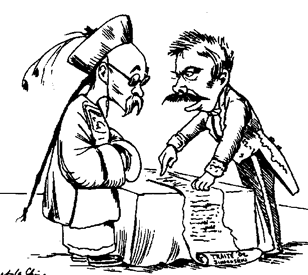


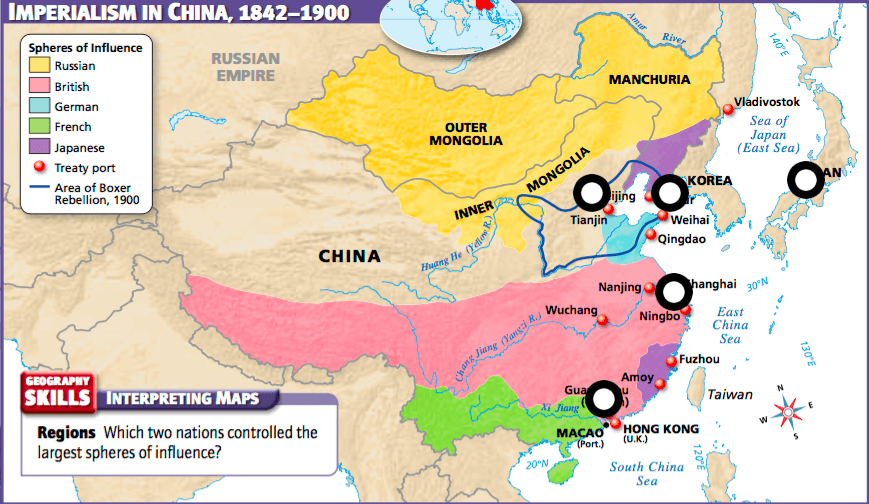

What was the first country to imperialize China?
Japan
France
Great Britain
Russia
What did the Chinese government do to the British traders selling opium?
China declared war against the British
Hired them so that they can put taxes on the products.
Arrested and executed them
Chinese government minded their own business
Who did the Boxers kill?
Members of the Fists of Harmony and Justice
Chinese Muslim
All Qing nobels
Christian missionaries and Western diplomats
To establish American interest in China
Keep trade in China equal with other world powers
To help American trade by finding new markets
All of the above
Who was involved in the Opium Wars?
Britain and China
Britain and Japan
Japan and China
France and China
Where did the opium come from?
Britain
Mexico
European colonies
India

