
 Worksheets
Biology Semester Exam Review
Total questions: 54
Worksheet time: 27mins
Emma and Grace are designing a waterproof backpack for their science project. They need to choose an organic macromolecule that is insoluble in water, often found in biological membranes and other waterproof coverings, and can store energy for a long time. Which macromolecule should they pick?
lipids
nucleic acids
carbohydrates
proteins
Ava and Rohan are watching a reaction between two mysterious substances in a closed container. If Sophia suddenly turns up the heat inside the container, which of the following is most likely to happen?
The rate of the reaction would increase.
The mass of each of the atoms would increase.
The two substances would release nuclear energy.
The two substances would not change into different compounds.
Lily and Scarlett are baking bread together. They notice something interesting when they put their dough in a warm oven. Which of the following is an example of temperature affecting a chemical reaction? (2pts)
Ice melting faster in warm water
Sugar dissolving faster in hot tea
Bread dough rising faster in a warm oven
Salt dissolving faster in cold water
Oliver, David, and Charlotte are in science class, and they're curious about how scientists study tiny cell structures. Their teacher shows them both a light microscope and an electron microscope. Which of the following is a superpower of electron microscopes compared to light microscopes?
Electron microscopes show the true colors of images.
Electron microscopes can study living cells and tissues.
Electron microscopes produce highly magnified images.
Electron microscopes are less expensive and easier to use.
Arjun, Ava, and Maya are on a science adventure, exploring the history of cell discoveries! Since the first compound microscope was created at the end of the 16th century, scientists have made amazing discoveries that shaped our understanding of cells. The table below describes how five scientists contributed to what we know about cells today.
Robert Hooke (1665): published a book that introduced the word "cell" to science and discovered the cellular composition of cork
Anton van Leeuwenhoek (1670s): discovered "animalcules" in lake water and bacteria in a sample of saliva from his mouth
Matthias Schleiden (1838): discovered that plants are made up of cells
Theodor Schwann (1839): discovered that animals are made up of cells
Rudolf Virchow (1855): published a book about the discovery that new cells originate from the division of pre-existing cells
Which of the following best describes the discoveries of these scientists on Arjun, Ava, and Maya's science adventure?
The scientists' discoveries are part of a hypothesis because their work is based on unproven observations.
The scientists' discoveries are part of a law because their work is based on many investigations that can not be verified.
The scientists' discoveries are part of a theory because their work is based on many scientific investigations that were brought together.
The scientists' discoveries are part of a model because their work is based on the cell's structure and appearance.
Abigail, Scarlett, and Mason are discussing the cell theory in science class. Which of the following statements is NOT one of the main principles they should remember? (1pt)
All living things are made of cells.
Cells are the basic units of life.
Very few cells are able to reproduce.
All cells are produced from existing cells.
Hannah, a curious scientist, discovered a mysterious multicellular organism! She examines some of its cells and notices they have nuclei and cell walls. Based on her findings, which of the following statements can Hannah confidently make about how this species is classified? (1pt)
The species is classified in domain Eukarya.
The species could be classified in kingdom Animalia if its cells have cell membranes.
The species could be classified in domain Archaea if it lives in extreme environments.
The species could be classified in domain Bacteria if it has circular DNA.
Oliver and Zoe are training for a big race! Their muscle cells need to be super active to keep up. Which of the following do their muscle cells have lots of? (2pts)
vacuoles
lysosomes
mitochondria
chromosomes
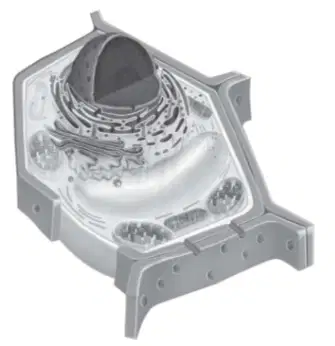
Abigail, Noah, and Nora are exploring the amazing world of plant cells! Take a look at the diagram above. Can you help them figure out which structures surround and protect the cell?
cell wall surrounded by a cell membrane
cell membrane surrounded by a cell wall
cell wall with an inner and outer lining
cell membrane with an inner and outer lining
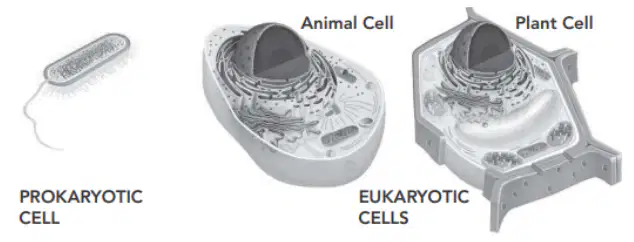
Michael, Harper, and Elijah are on a science adventure! They discover three mysterious cells: a prokaryotic cell, an animal cell, and a plant cell (see the illustration below). Each cell has its own unique features, but the trio wants to know: Which structure is found in all three types of cells?
a cell wall that surrounds the cell
a cell membrane that surrounds the cell
ribosomes contained in endoplasmic reticulum
DNA contained in a nucleus
Priya, Elijah, and Avery are in the science lab, and Hiram is using a super-powered microscope to study a mysterious culture of single-celled organisms. Which observation would give them the strongest clue that these organisms are protists and not bacteria?
Each cell has a flagellum, which functions like a small tail.
Each cell has a nucleus and other membrane-bound organelles.
The cells gather together in chains or clusters.
Each cell is surrounded by a cell wall.
Abigail, Aiden, and Zoe are exploring a mysterious cell under an electron microscope. They notice it has no nucleus and no mitochondria, but it does have a plasma membrane and a cell wall. Based on their observations, what kind of cell do you think they discovered? (2pts)
plant
animal
bacteria
extinct organism
Michael, Ava, and Harper are helping Yuri investigate a mysterious organism! They discover that it's multicellular, heterotrophic, and its cells don't have cell walls. Plus, it reproduces sexually. Which kingdom does this fascinating creature belong to?
Animalia
Plantae
Protista
Fungi
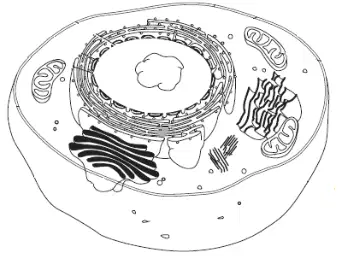
Noah, Henry, and Evelyn are on a science adventure! They discover the mysterious cell shown below. Can you help them figure out what kind of cell it is? (2pts)
The cell is eukaryotic because it has a nucleus.
The cell is prokaryotic because it has a nucleus.
The cell is eukaryotic because it does not have a nucleus.
The cell is prokaryotic because it does not have a nucleus.
Maya and Ethan are exploring a mysterious plant cell under a microscope. Which of the following organelles do they spot that you wouldn’t find in an animal cell? (1pt)
ribosome
chloroplast
mitochondria
endoplasmic reticulum
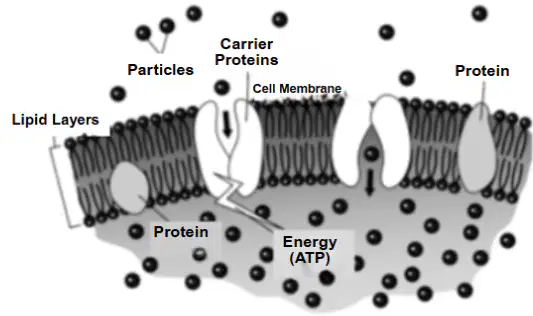
Charlotte, Oliver, and William are on a science adventure inside a cell! They notice the cell membrane is like a high-tech security gate made of a double layer of lipids, with special proteins acting as gatekeepers. Some particles need to sneak past these gates, but only if they have enough energy to go against the crowd (the concentration gradient). The sodium–potassium ion pump is working hard, using lots of the cell’s energy to move sodium ions through the membrane. Based on the diagram above, which type of cellular transport are Charlotte, Oliver, and William observing? (3pts)
Active transport, it requires energy and moves from high to low concentration.
Active transport, it requires energy and moves from low to high concentration.
Passive transport, it does not require energy and moves from high to low concentration.
Passive transport, it does not require energy and moves from low to high concentration.
William and Mason are observing molecules during diffusion. When the concentration of molecules on both sides of a membrane is the same, what do you think the molecules will do? (2pts)
continue to move across the membrane in both directions as seen in an isotonic environment.
move across the membrane to the outside of the cell as seen in a hypertonic solution.
move across the membrane to the inside of the cell as seen in a hypotonic solution.
stop moving across the membrane as seen in an isotonic environment.
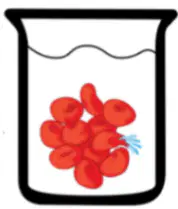
Mia, Arjun, and Avery are doing a science experiment! They place an animal cell in a beaker of fresh water (see the diagram above). Suddenly, the cell starts to swell up and burst! Can you help them figure out why this happens? Is it because the osmotic pressure causes:
water to move into the cell.
water to move out of the cell.
solutes to moved into the cell.
solutes to move out of the cell.
Emma, Oliver, and Luna are on a science adventure! They want to know where cellular respiration—the process that turns nutrients into energy—happens in eukaryotic cells. Can you help them find the right answer? (1pt)
Nucleus
Chloroplast
Lysosome
Mitochondria
Zoe and Avery are learning about cellular respiration in science class. Which of the following is a product of cellular respiration? (1pt)
Light
Oxygen
Glucose
ATP (Energy)
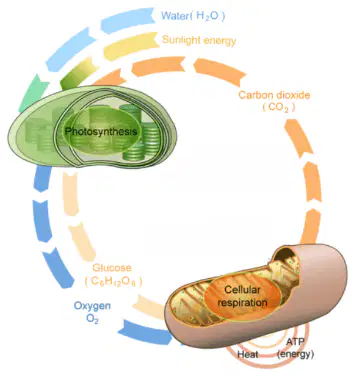
Charlotte, Ethan, and Henry are on a science adventure! They’re looking at the diagram below to solve a mystery about how plants and animals get their energy. Can you help them out? (2pts) Which of the following statements best describes the relationship between the products of photosynthesis and the reactants of cellular respiration?
They are completely unrelated.
The products of photosynthesis are the reactants of cellular respiration.
The products of cellular respiration are the reactants of photosynthesis.
Both processes use the same reactants and products.
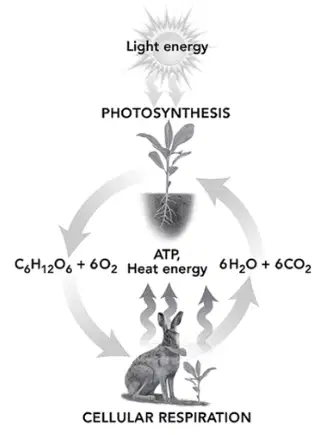
Nora, Sophia, and Emma are studying the diagram below, which shows the relationship between photosynthesis and cellular respiration. They want to know: Which statement best describes how photosynthesis and cellular respiration are interrelated? (2pts)
Oxygen is produced during cellular respiration and stored during photosynthesis.
Carbon dioxide and water released by cellular respiration are used in photosynthesis.
Photosynthesis releases the energy that is stored during the process of cellular respiration.
Glucose is used during cellular respiration to produce food that is broken down during photosynthesis.
Emma, Henry, and Arjun are exploring a garden and notice that the leaves are super green compared to the stems and trunks. Can you help them figure out why chloroplasts are found mostly in the leaves of plants? (2pts)
The large surface area of leaves allows for maximum light absorption.
The waxy coating on the surface of leaves helps prevent evaporation.
Chlorophyll interferes with the xylem and phloem in the stems and trunks of plants.
The large surface area of leaves allows for contact with oxygen.
Nora, Arjun, and Maya are working together in science class to solve a mystery equation: glucose + oxygen → carbon dioxide + water; C6H12O6 + 6O2 → 6CO2 + 6H2O. They want to figure out what important process this equation represents. Which statement would be most helpful for their investigation? (2pts)
The equation describes the process of photosynthesis that occurs in plant and green algae when light is present.
The equation describes both the processes of cellular respiration and fermentation, both of which occur in all organisms.
The equation describes the process of cellular respiration that occurs in many organisms when oxygen is available.
The equation describes both the processes of cellular respiration and photosynthesis, one of which occurs in all organisms.
Benjamin and Isla are having a science debate! Benjamin says that aerobic and anaerobic respiration are totally different. Isla wants to know exactly how. Which statement below best explains the difference between aerobic and anaerobic respiration? (2pts)
anaerobic respiration requires oxygen and aerobic respiration does not need oxygen.
aerobic respiration requires oxygen and anaerobic respiration does not require oxygen.
anaerobic respiration produces more energy than aerobic respiration.
aerobic respiration only occurs in muscle cells, while anaerobic respiration occurs in all cell types.
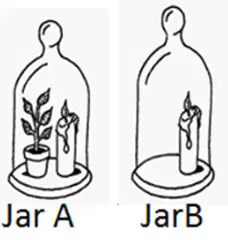
Mia and Avery are doing a science experiment with two jars. In Jar A, Mia puts a plant next to a burning candle. In Jar B, Avery puts only a burning candle. Take a look at the jars below! Why do you think the candle in Jar A might burn longer than the candle in Jar B? (2pts)
Carbon dioxide produced by the plant allows the candle to burn longer.
Chlorophyll produced by the plant allows the candle to burn longer.
Glucose produced by the plant allows the candle to burn longer.
Oxygen produced by the plant allows the candle to burn longer.
Aria, Isla, and Anika are curious about why Earth’s atmosphere has stayed at about 21 percent oxygen for so long. They know that cellular respiration and photosynthesis play a big role. Can you help them figure out how these two processes work together to keep oxygen levels steady?
Photosynthesis helps maintain oxygen levels, while cellular respiration has no effect.
Cellular respiration adds oxygen to the atmosphere, while photosynthesis removes oxygen from the atmosphere.
Cellular respiration helps maintain oxygen levels, while photosynthesis has no effect.
Cellular respiration removes oxygen from the atmosphere, while photosynthesis adds oxygen to the atmosphere.
Emma, Priya, and Elijah are discussing how to help the planet. They read that carbon dioxide levels are rising in Earth's atmosphere. Since plants perform both photosynthesis and cellular respiration, the trio wonders: If we planted more trees and plants everywhere, could it help lower carbon dioxide levels? What do you think? (3pts)
No, photosynthesis and cellular respiration do not involve carbon dioxide.
No, in plants, photosynthesis adds as much carbon dioxide to the atmosphere as cellular respiration removes.
Yes, it would decrease the levels. Photosynthesis acts to remove carbon dioxide from the atmosphere and store the carbon in plant tissues.
Yes, it would increase the levels. Photosynthesis releases more carbon dioxide into the atmosphere than cellular respiration removes.
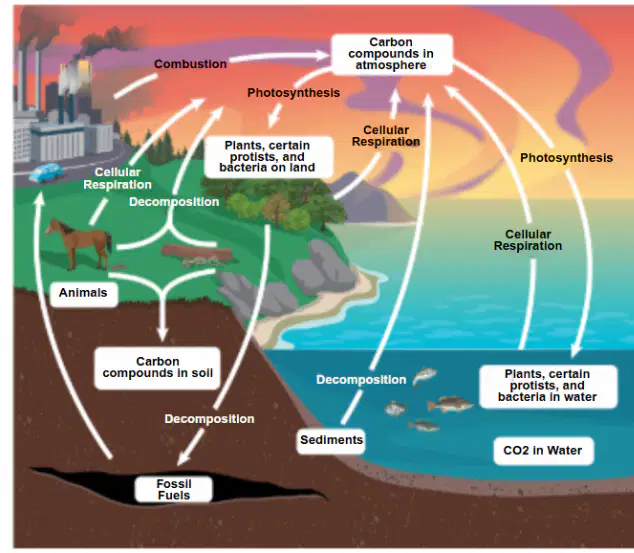
Benjamin, Harper, and Grace are on a mission to make their city greener! They’re looking at the image of the carbon cycle and brainstorming ways to reduce greenhouse gases like carbon dioxide in the atmosphere. They suggest planting more trees and creating awesome green spaces like gardens and parks. How do their ideas help fight greenhouse gases and keep the planet cool? (3pts)
Plants take in carbon dioxide, a greenhouse gas, from the atmosphere to undergo cellular respiration.
Plants take in carbon dioxide, a greenhouse gas, from the atmosphere to undergo photosynthesis.
Plants release carbon dioxide, a greenhouse gas, into the atmosphere during photosynthesis.
Plants release carbon dioxide, a greenhouse gas, into the atmosphere during cellular respiration.
Mason and Abigail are exploring the amazing world of plants in their science class! They notice that terrestrial plants have tiny stomata on the surface of their leaves, each surrounded by two guard cells that change shape depending on the environment. These guard cells open and close the stoma. Which of the following best explains how the leaf’s structure helps the plant with important processes? (2pts)
Water enters the plant through the surface of the leaf for transpiration.
Gases for photosynthesis are exchanged through the surface of the leaf.
Energy for cellular reproduction is absorbed through the surface of the leaf.
Carbon dioxide enter the plant through the surface of the leaf for cellular respiration.
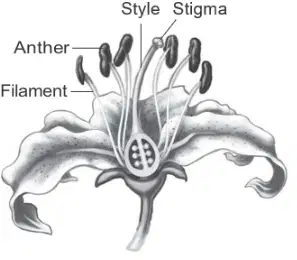
Abigail, Jackson, and Nora are investigating the flower shown in the diagram below for their science project.
If they carefully remove all the filaments and anthers from the flower, do you think the flower could still do its job? (2pts)
Yes, a bird or insect could transfer pollen from another plant to the stigma.
Yes, a bird or insect could gather pollen from the stigma and then transfer it to another flower.
No, the flower needs both its male and female structures for seeds to form and develop.
No, although the male structures are optional, the flower needs its female structures for seeds to form.
Aria and Mia are exploring a magical garden filled with vibrant flowers. As they observe, they notice that one part of the flower acts like a tiny shield, protecting the delicate bud from wind and rain. Which part of the flower is the protective shield for the developing bud? (1pt)
Sepal
Pistil
Stamen
Petal
Isla, Daniel, and Olivia are exploring a mysterious forest where sunlight is scarce. They discover a unique plant species trying to survive in this shady area. Which physiological adaptation would help this plant thrive the most? (2pts)
colorful flowers
large leaves
deep roots
thin cuticles
Priya, Luna, and Nora are exploring a garden and notice tiny openings on the leaves. Which part of the leaf helps them control the rate of transpiration? (1pt)
xylem
phloem
sepal
stomata
Michael and Luna are exploring a young tree in their backyard. Suddenly, they notice the xylem is damaged! Which process will be affected first?
performing photosynthesis
transporting sugar to the roots
transporting water to the leaves
absorbing water from the soil
Zoe, Harper, and Samuel are on a science adventure to discover how plants get water from deep underground! Which part of the plant would help them reach water deep in the soil? (1pt)
stem
leaf
fibrous root
taproot
Arjun and Anika are investigating how plants grow in their science class. They discover that the cambium is a special section of cells in a plant that can become either part of the xylem or phloem, depending on the plant's needs. If Arjun accidentally damages the cambium of a plant during an experiment, what do you think will happen to the plant? (2pts)
The plant would lose its ability to carry out photosynthesis.
The plant would have uncontrolled growth.
The plant would not experience any changes in physiology.
The plant would not be able to transport nutrients and water.
Kai, Elijah, and Rohan are exploring the mysteries of plant life in their school garden. They notice tiny openings called stomata on the leaves and wonder when these stomata are most likely to be closed or nearly closed. Can you help them figure it out?
when a plant is actively growing in spring or summer
when a young plant, or seedling, is actively growing
during hot, humid weather, when water is plentiful
during hot, dry weather, when water is scarce
Isla, Luna, and Ethan are exploring a magical forest filled with all kinds of plants! They notice that mosses and other bryophytes are quite short, while many ferns, cone-bearing plants, and flowering plants tower above them. Which type of tissue, found in the taller plants but not in mosses, helps explain how these plants can reach such impressive heights? (2pts)
endosperm, which nurtures the developing plant embryo in a seed.
meristems, which allow growth in the tips of roots and shoots.
vascular tissues, which conduct water and nutrients against the pull of gravity.
leaf epidermis, which protects inner leaf tissues from drying out.
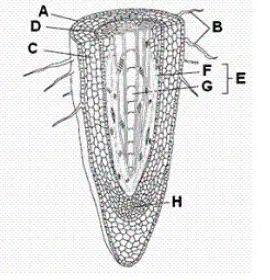
Jackson, Avery, and Kai are exploring the root diagram below for their science adventure! Can you help them out by identifying the primary role of the structure labeled B? (2pts)
storage of food
transporting nutrients
absorption of water
photosynthesis
During a science experiment, Michael and Luna are watching two DNA strands separate for replication. As new bases start attaching to the separated strands, Luna asks, "Hey Michael, which base will pair up with cytosine?" Can you help them out? (1pt)
uracil
adenine
guanine
thymine
David and Ava are learning about DNA in science class. Their teacher asks: DNA replication is said to be semiconservative. What does semiconservative mean in the context of DNA replication?
Only one strand of the double-stranded DNA is replicated.
Both DNA molecules resulting from replication have one of the original strands and one newly synthesized strand.
Only the important parts of the base sequence of the original DNA are conserved during replication.
DNA replication occurs in only half of the chromosomes in each cell cycle.
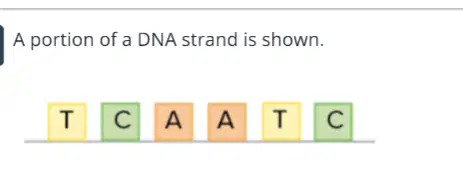
Avery, Liam, and Elijah are on a DNA detective mission! They discover a mysterious DNA strand with the sequence shown in the diagram: T, C, A, A, T, C (from left to right). Can you help them crack the code? Which sequence of nucleotides, read from left to right, would form complementary base pairs with the DNA strand shown? (2pts)
T-C-A-A-T-C
A-G-T-T-A-G
G-A-C-C-G-A
C-T-G-G-C-T
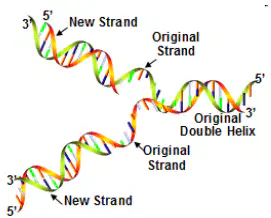
Lily, Evelyn, and Avery are in science class, and they spot the illustration below showing a DNA double helix splitting and new strands forming. Can you help them figure out what amazing process is happening here? (1pt)
Protein Synthesis
Translation
Transcription
DNA Replication
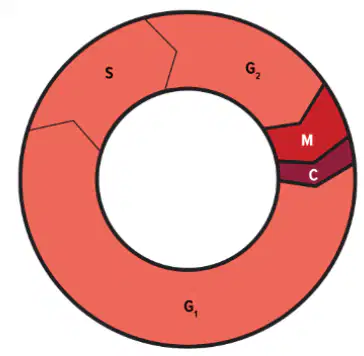
Jackson, Luna, and Ava are studying the cell cycle diagram. Can you help them figure out during which stage the cell gets busy duplicating its DNA? (1pt)
S stage
G1 stage
G2 stage
M stage
Elijah, Lily, and Michael are exploring the mysteries of cell division in their biology class! They learn that mitosis is a fascinating process that ensures each new cell gets the right genetic material. The process has several phases, and after mitosis, the cell splits into two identical daughter cells through cytokinesis.
Here are the phases of mitosis:
Prophase
Metaphase
Anaphase
Telophase
Can you help Elijah, Lily, and Michael figure out: In which phases of mitosis are the chromosomes single stranded? (2pts)
anaphase and telophase
prophase and metaphase
prophase, anaphase, and telophase
metaphase, anaphase, and telophase
Imagine Samuel and Charlotte are scientists observing mitosis in a cell with four chromosomes. After the cell divides, how many chromosomes will each of the two daughter cells have? (1pt)
two chromosomes.
four chromosomes.
eight chromosomes.
sixteen chromosomes.
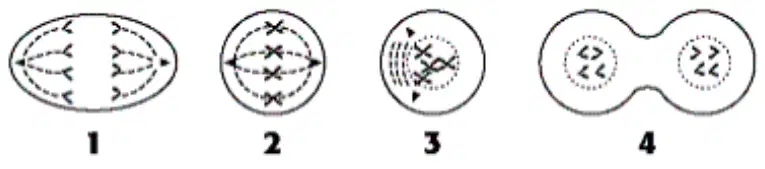
Charlotte, James, and Zoe are racing to see who can put the stages of cell division in the correct order first! Take a look at the illustration showing four numbered stages of cell division. Can you help them out by choosing the option that shows the correct sequence of these events? (1pt)
1, 2, 3, 4
2, 1, 3, 4
3, 2, 1, 4
1, 3, 2, 4
Noah and Sophia are learning about cell division in science class. If a typical human cell has 46 chromosomes, how many chromosomes will each daughter cell have after mitosis and cytokinesis? (1pt)
has 92 chromosomes.
has 46 chromosomes.
has 23 chromosomes.
has two nuclei.
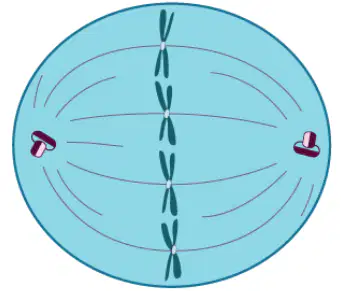
The image illustrates which stage of mitosis? (1pt)
telophase
anaphase
prophase
metaphase
During which phase of mitosis are sister chromatids pulled to opposite ends of the cell? (1pt)
metaphase
prophase
anaphase
telophase
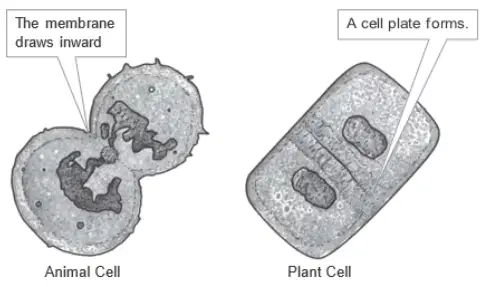
The diagram models a process as it occurs in an animal cell and a plant cell. What has occurred in both cells immediately before this process? (2pts)
A cell nucleus has divided by mitosis.
Two cells have migrated to join together.
A cell wall has increased in size.
A cell has grown larger, without mitosis occurring.
Cancer is a disorder in which some cells have lost their ability to control their (1pt)
cell size.
spindle fibers.
reproduction rate.
surface area.
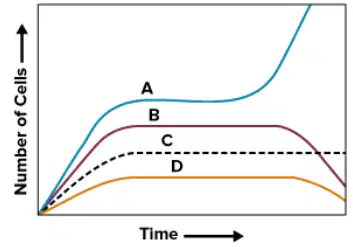
Which of the cells depicted in the line graph are most likely cancerous? (2pts)
A
B
C
D

