
 Worksheets
Unit 5 Review: Meiosis, Genes, protein synthesis, mutations
Total questions: 58
Worksheet time: 58mins
Which event is an important factor in increasing variety among sexually reproducing organisms?
crossing over
gene linkage
testcross
mitosis
Which phrase best describes the process of meiosis?
occurs in body cells
produces haploid gametes
results in genetically identical cells
happens only in haploid cells
Chromosomes determine all inherited traits because they are made up of __________.
ATP
Centromeres
Phospholipids
DNA
Children tend to resemble their parents due to __________.
Heredity
Metabolism
Responsiveness
Homeostasis
Which type of mutation has no effect on phenotype?
Point
Chromosomal
Frameshift
Silent
Genetic variation can arise from a random change in the DNA of a gene. This change is called a(n) __________ .
Allele
Mutation
gene flow
gene pool
Which example is NOT an outcome of the environment modifying a phenotype?
the increased intelligence of a person who attended school for many years
the pink-flowered snapdragons that result from crosses between red-flowered and white-flowered snapdragon plants
the very short stature of a kind of tree that grows at a high altitude in comparison with the same kind of tree growing at a lower altitude
the changing of the color of an animal’s fur as the temperature changes
Which of these will complete the analogy female: XX: _______ : __________?
male: XY
female: eggs
female: gametes
male: YY
In the case of codominant alleles, a plant that is homozygous for red flowers that is crossed with a plant that is homozygous for white flowers will produce flowers that are __________.
pink and red
red and white spotted
dark pink all over
completely white
When crossing over takes place, chromosomes ______.
decrease in number
produce new genes
exchange corresponding segments of DNA
mutate in the first division
Separation of homologous chromosomes occurs during __________.
mitosis
fertilization
meiosis II
meiosis I
A distinguishing characteristic that can be inherited is a(n) __________.
gene
trait
allele
cross
Nondisjunction causes which of the following?
extra gene
extra nitrogen base
extra chromosome
extra codon
Mutations that can affect the offspring of an organism occur in what cell type?
Body
Blood
Brain
Gamete
What is the name of an organism that contains one or more genes from another organism?
Clone
Combination
Transgenic
Copy
The diploid number of chromosomes in pea plants is 14. What is the haploid chromosome number?
56
14
7
28
The observable physical characteristics of an organism is known as its _______ .
Allele
Trait
Phenotype
Genotype

Which genetic disorder can be diagnosed using the human karyotype pictured here?
Cystic Fibrosis
Huntingdon's disease
Down's Syndrome
Tay-Sach's disease

Which of the following statements below is NOT true about the graphic seen pictured here?
It depicts the process of Meiosis
Crossing over would be a characteristic event associated with this process
It shows a diploid cell becoming haploid cells.
It depicts the cellular process of Mitosis
Hierarchy is a theme of biology that we see in several different topics. Genetics is one such area. Which sequence has the terms in the correct sequence from LARGEST to SMALLEST in terms of molecular size?
Genome, Chromosome, Gene, Nucleotide, Deoxyribose
Chromosome, Nucleotide, Genome, Gene, Deoxyribose
Deoxyribose, Nucleotide, Gene, Chromosome, Genome
Genome, Gene, Chromosome, Nucleotide, Deoxyribose
Which of the following can cause cancer?
UV Rays
Viruses
Environmental contaminants
All of the above
One difference between a cancer cell and a normal cell is that
Cancer cells divide uncontrollably
Normal cells divide uncontrollably
Cancer cells cannot make copies of DNA
Normal cells cannot make copies of DNA
Which type of mutation results in NO change in the protein, and therefore no change in the phenotype?
Silent
Chromosomal
Point
Frameshift
A point mutation that changes a codon specifying an amino acid into a stop codon is called a
Missense mutation
Deletion mutation
Frameshift mutation
Nonsense mutation
Sickle Cell Anemia is caused when a single “A” is changed to a “T”, leading to a change in the amino acid sequence of hemoglobin. This disease is caused by what type of mutation?
Silent mutation
Frameshift mutation
Missense mutation
Nonsense mutation

CROSSING OVER INCREASES
LIFE SPAN
GENETIC VARIATION
THE NUMBER OF OFF-SPRING
ALL ARE TRUE

CROSSING OVER TAKES PLACE DURING
PROPHASE II
PROPHASE I
INTERPHASE
METAPHASE I
The production of egg and sperm cells is necessary for sexual reproduction because —
it increases the number of chromosomes so that the gametes can combine, giving the organism a complete set of chromosomes
it increases the number of developing offspring
it decreases the number of developing offspring
it reduces the number of chromosomes so the gametes can combine, giving the organism a complete set of chromosomes

The steps of crossing over during meiosis are shown in the diagram. What is the significance of crossing over in Meiosis I?
Crossing over ensures that the four daughter cells produced at the end of Meiosis II have the original number of chromosomes in each cell.
Crossing over ensures that the two daughter cells produced at the end of Meiosis I have half the original number of chromosomes in each cell.
Crossing over ensures that the same combination of alleles remains in each of the four daughter cells at the end of Meiosis II.
Crossing over ensures that the chromosomes in the four daughter cells produced at the end of Meiosis II will have a different assortment of genes than the corresponding chromosomes in the original cell.
Gametes must be haploid because-
gametes are small and can hold only the haploid number of chromosomes
the gametes chromosomes will be replicated prior to cell division
two gametes will unite during fertilization to create a diploid cell
fertilization results with a haploid zygote
Inversion
When a segment of a chromosome breaks off.
When a segment of a chromosome breaks off, flips, and reattaches.
When a segment of a chromosome is copied or doubles.
When a segment of a chromosome breaks and attaches to a non homologous chromosome.
When entire chromosomes don't separate evenly during meiosis.


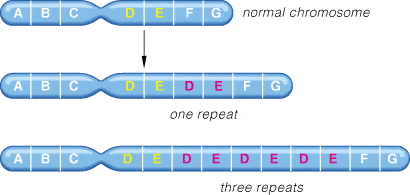
The mutated DNA segment is TTACGCAAC. This is an example of ___ mutation.
The mutated DNA segment is TTCGCAAG. This is an example of ___ mutation.
This type of mutation in DNA alters just one base in a DNA sequence
point mutation
translocation
inversion
trisomy

The picture below shows the steps of DNA replication beginning with step one and ending with step three.
Because you are reusing the old, or parent, DNA strand DNA replication is said to be
Semi- Conservative
Semi-discontinuous
Continuous
Fully-Conserveative

The picture below shows an enzyme unwinding and unzipping DNA.
What is the name of this enzyme?
DNA Helicase
DNA Ligase
DNA polyermase
RNA Polymerase
Match he nucleotide with its complementary nucleotide. (DNA to DNA).
Cytosine-
Thymine
Guanine
Adenine
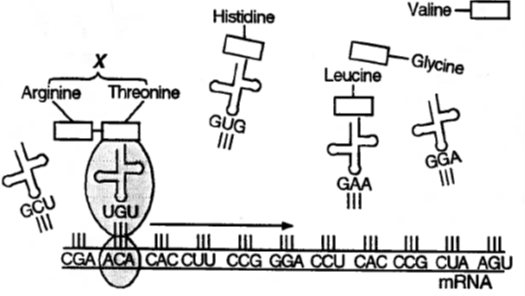

What process is happening in the diagram?
transcription
translation
dna replication
mitosis

Where does TRANSCRIPTION occur?
Nucleus
Ribosome
Cytoplasm
Mitochondria
Which organelle is the location where protein is made?
Ribosome
Nucleus
Cytoplasm
Nucleotide

DNA is an acronym for _____
Diphosphorus Nucleic Acid
Ribose Nucleic Acid
Deoxyribonucleic Acid
Deoxyribonucleic Acetate

The human body contains ____ chromosomes and ___ cells
23 pairs of chromosomes and 75 million cells
46 pairs of chromosomes and 150 trillion cells
48 pairs of chromosomes and 75 trillion cells
23 pairs of chromosomes and 75 trillion cells

A nucleotide is composed of
A phosphate, sugar and nitrogenous base
A protein, protein and Guanine
A phosphate, Adenine, and nitrogenous base
A protein, Adenine and nitrogenous base

