
 Worksheets
Magnet Unit 7 RETAKE (Thermochemistry and Gases)
Total questions: 25
Worksheet time: 13mins
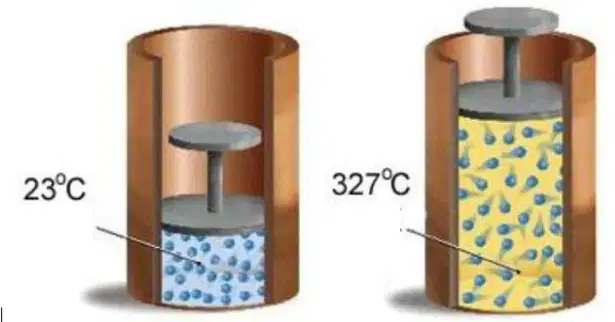
If the initial volume for the container on the left is 4.33 L, calculate the final volume if the pressure is held constant.
0.11 L
2.1 L
8.78 L
61.6 L
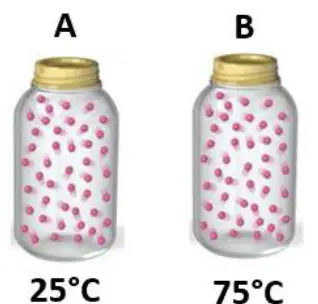
Using the diagram above, which sample of gas has a higher pressure?
Sample A
Sample B
Sample A and B have the same pressure
Not enough information is given
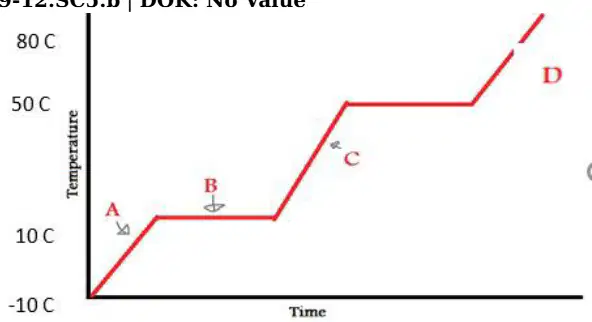
Where on the graph in Figure 1 is the solid being heated?
A
B
C
D
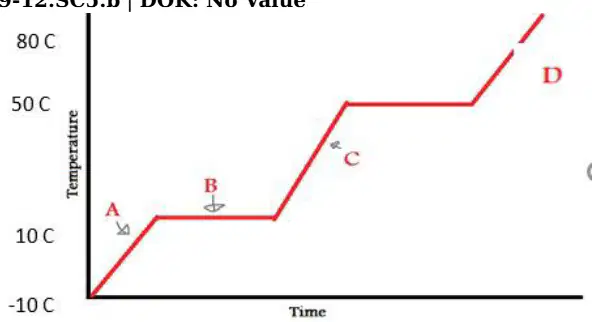
Where on the graph in Figure 1 is the substance going through a phase change?
A
B
C
D
If a balloon is heated, what happens to the volume of the air in the balloon if the pressure is constant?
it increases
it stays the same
it decreases
the change cannot be predicted
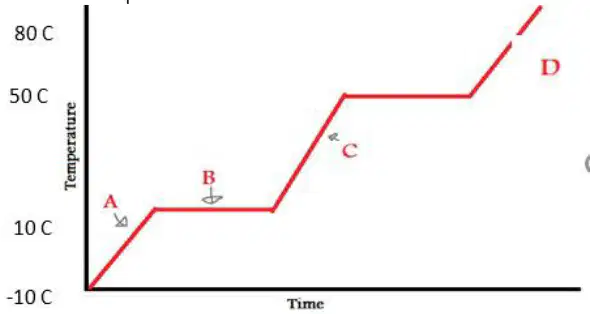
According to the graph in Figure 1, at what temperature would this substance boil?
-10
10
50
80
A sample of a gas occupies a volume of 753 mL at 25 C. What volume will the gas occupy if the temperature increases to 50 C, if the pressure remains constant?
376 mL
694 mL
816 mL
1500 mL
During a phase change, what happens to the temperature of a substance?
It remains constant
It increases
It decreases
Cannot be determined from this information
A steel tank with a volume of 9.583 L contains N2 gas under a pressure of 4.972 atm at 31.8°C.
Calculate the number of moles of N2 in the tank.
0.0021 moles
0.0180 moles
0.05252 moles
1.904 moles
How much energy is required to heat 200 g of water from 25°C to 110°C?
62,700 J
66,832 J
451,889 J
517,780 J
Copper has a specific heat of 0.382 J/g°C. If 2.51g of copper absorbs 2.75 J of heat, what is the change in temperature?
0.419°C
2.63°C
2.87°C
4.12°C
Which change in state would be considered endothermic?
Freezing
Deposition
Condensing
Melting
What is the volume of 4.5 moles of a gas at 0.96 atm and 25 degrees C?
8.9 L
9.6 L
100 L
110 L
How much heat is released when 25.0g of water is cooled from 110°C to 23°C?
9,092 J
11,286 J
18,434 J
64,931 J
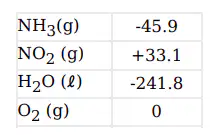
Ammonia reacts with oxygen to form nitrogen dioxide and steam, as follows:
4NH3(g) + 7O2(g) → 4NO2(g) + 6H2O(g)
Given the following standard enthalpies of formation (given in kJ/mol), calculate the enthalpy of the reaction.
-1318.4 kJ/mol
+1318.4 kJ/mol
-1134.8 kJ/mol
+1134.8 kJ/mol
The reaction shown below is _______________, and therefore heat is _______________ by the reaction.
4Al (s) + 3O2 (g) → 2Al2O3 (s) ΔH = -3351 kJ
endothermic, absorbed
exothermic, absorbed
endothermic, released
exothermic, released
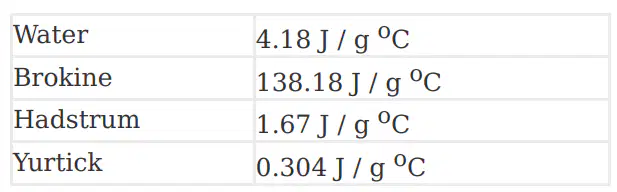
When 5.5 grams of a certain material is dropped into a cup containing 200g of liquid water at 10°C the temperature of the mixture is increased to 30°C. The material was initially at 52°C. What is the material that was dropped into the water?
Water
Hadstrum
Brokine
Yurtick
Given the following thermochemical information, determine the heat of reaction for the combustion of sulfur dioxide
2 SO2 (g) + O2 (g) → 2 SO3 (g)
Thermochemical equations:
S8 (s) + 8 O2 (g) → 8 SO2 (g) ΔH = -2374.6 kJ
S8 (s) + 12 O2 (g) → 8 SO3 (g) ΔH = -3165.8 kJ
-5540.4 kJ
-197.8 kJ
-1385.1 kJ
791.2 kJ
If you had 1.00 grams of each substance in the table above, which would decrease in temperature by 1°C the FASTEST?
Iron (c = 0.45 J/g°C)
Glass (c = 0.84 J/g°C)
Aluminum (c = 0.90 J/g°C)
Copper (c = 0.39 J/g°C)
Which of the following accurately describes the transfer of heat when A metal cube at temperature of 70°C is immersed in a liquid at a temperature of 10°C. What is the temperature of the liquid when thermal equilibrium is achieved in a calorimeter?
Heat is absorbed by the metal cube and released from the liquid
Both the metal and the liquid absorb heat from the surroundings
Heat is released from the metal cube and absorbed by the liquid
Both the metal and the liquid release heat into the surroundings
2 C8H18 (l) + 25 O2 (g) → 16 CO2 (g) + 18 H2O (g)
What volume of water vapor would be produced if 78.0 grams O2 gas were burned at a temperature of -10.0°C and a pressure of 1.3 atm?
39.3 L water vapor
1.75 L water vapor
29.1 L water vapor
1.11 L water vapor
31.4 L water vapor
2 C8H18 (l) + 25 O2 (g) → 16 CO2 (g) + 18 H2O (g)
What volume of water vapor would be produced if 78.0 grams O2 gas were burned at STP (standard temperature and pressure)?
39.3 L water vapor
31.6 L water vapor
1.76 L water vapor
29.1 L water vapor
22.4 L water vapor
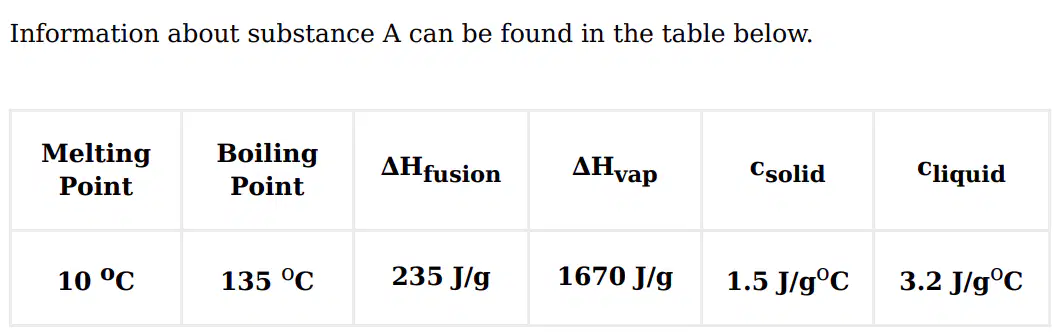
How much heat energy is needed to completely melt 25 grams of substance A that has an initial temperature of -25ºC?
(Hint: Start by sketching the heating curve for this process)
1300 J
5900 J
7200 J
4600 J
8700 J
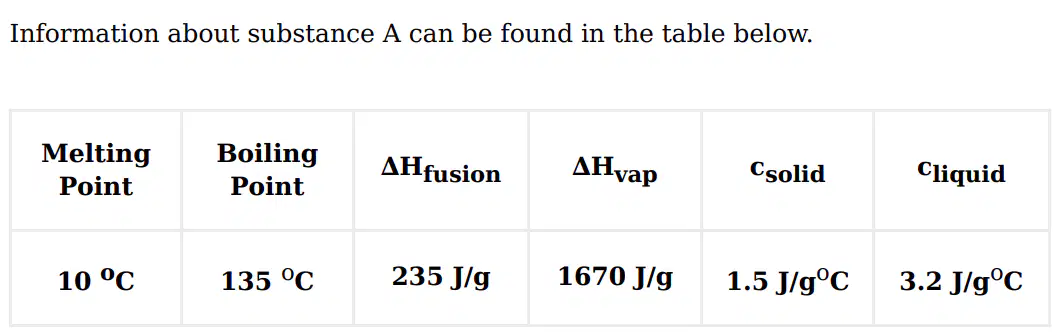
How many kilojoules of heat energy are released when a 107 gram sample of substance A at 135ºC is completely condensed?
46.2 kJ
25.1 kJ
25100 kJ
1790000 kJ
179 kJ
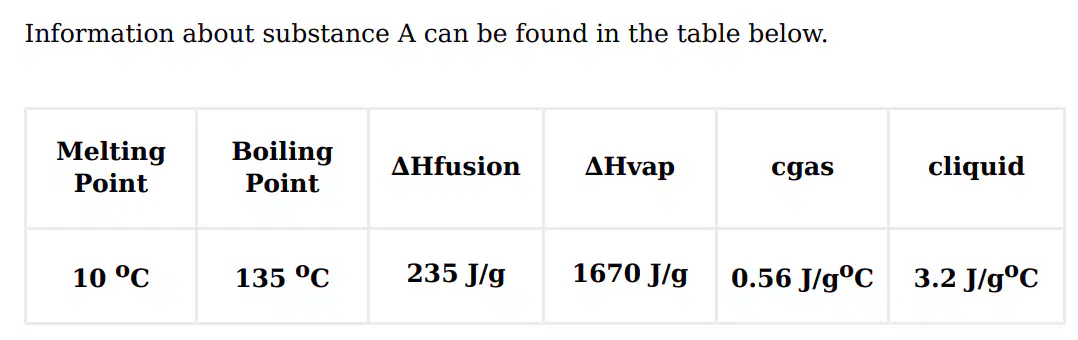
How many joules of heat energy are released when an 82 gram sample of substance A at 200.0ºC completely condenses? (Hint: Start by drawing a cooling curve for this process)
33,000 J
2,990 J
30,000 J
27,000 J

