
 Worksheets
2025-2026 Semester 1 REVIEW- 8th Grade
Total questions: 39
Worksheet time: 2hrs 57mins
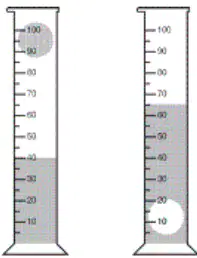
A rock was dropped into water in a graduated cylinder. What is the correct volume of the rock?
25 mL
40 mL
65 mL
105 mL
Your teacher gives you a mystery substance that has a mass of 160 g and a volume of 57 cm³. What is the density of the mystery substance?
0.36 g/cm³
103 g/cm³
2.8 g/cm³
9120 g/cm³
The overall charge of an atom is electrically neutral even though it contains charged particles. What is the best explanation for this phenomenon?
Only neutrons count for the overall charge of the atom, and they are electrically neutral.
Atoms have the same number of protons and electrons which allows the positive and negative charges to cancel each other out.
Electrons are so small that they have very little mass which means the electrical charge will not affect the atom.
The charged, subatomic particles do not interact, so the overall charge of the atom is neutral.
Liam’s mother had to hang his clean clothes outside because the dryer in their Florida home broke. How did Liam’s clothes dry?
The water in the clothes froze in the sunshine and the ice fell off, leaving the clothes dry.
The water in the clothes dripped out onto the ground, leaving the clothes dry.
The water in the clothes condensed into the material, leaving the clothes dry.
The water in the clothes evaporated into the air, leaving the clothes dry.
The elements in one period of the periodic table (SC.8.P.8.6)
Have the same number of electrons.
Have the same number of protons.
Decrease in atomic mass from left to right.
Increase in atomic number from left to right.
In the periodic table, how are elements in the same group related to each other? (SC.8.P.8.6)
They have the same atomic mass.
They have very different properties.
They have the same atomic number.
They have the same chemical reactivity.
Why is it useful for scientists to develop models for the structure of atoms?
Atoms are too small to study directly.
Atoms move too quickly to see.
Looking at atoms directly can be harmful.
Atoms are too far away to study.
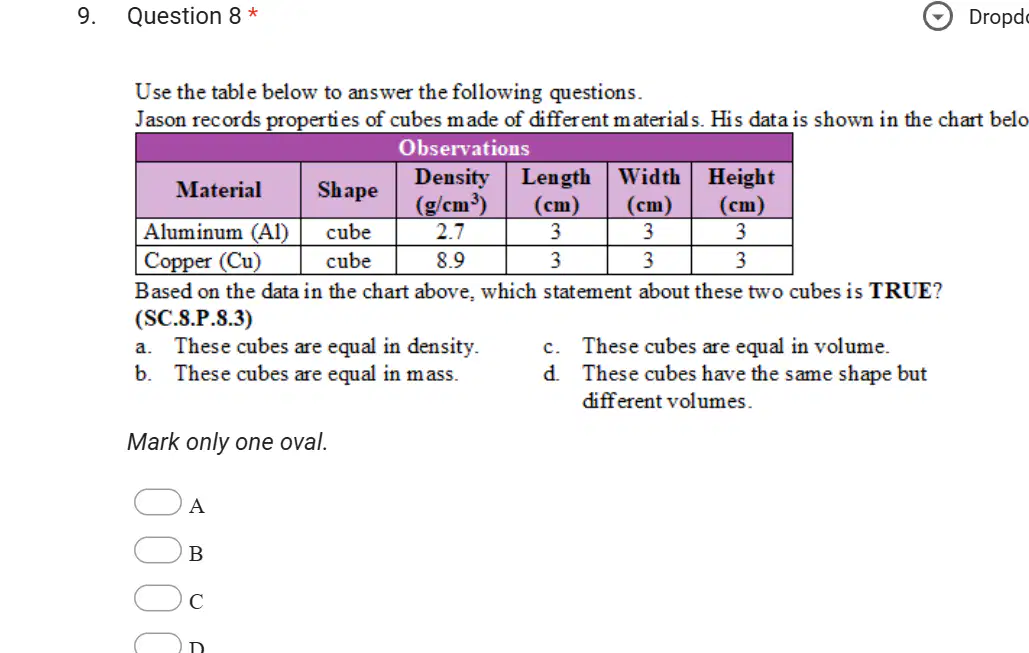
Based on the data in the chart above, which statement about these two cubes is TRUE?
These cubes are equal in density.
These cubes are equal in mass.
These cubes are equal in volume.
These cubes have the same shape but different volumes.
Paul tested the effect of temperature on the growth of bread mold. Before the experiment, he hypothesized that bread mold grows better in warm temperatures. He conducts his experiment and more mold grew at 15°C than 30°C in 48 hrs. How would you BEST describe the results of Paul's experiment?
The results support the hypothesis
The results fail to support the hypothesis
No conclusion can be drawn from the results
The results are inaccurate
Ling's grandfather told him that garlic was good for you. Ling wanted to test whether garlic would kill bacteria. He set up three groups of petri dishes in which he grew bacteria. The first group of dishes contained bacteria with no garlic present. The second group contained bacteria with 20 mL of garlic. The third group contained bacteria as well as 60 mL of garlic. After 24 hours, Ling measured the amount of bacterial growth that had occurred. He found that the third group had much less bacterial growth than the others. What was the independent variable in this experiment?
The amount of garlic used.
The amount of bacteria used.
The type of bacteria used.
The number of days tested.
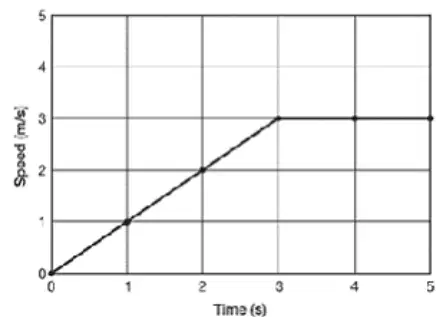
Ashley hypothesizes that the speed of a ball rolling downhill is greater on steep hills than on hills that are not as steep. How can Ashley BEST test her hypothesis?
Push the ball with varying force down inclines set at different angles, and measure the force with which the skateboard hits the wall
Push the ball with varying force down inclines set at different angles, and measure the distance traveled each time
Roll the ball down a single incline, and measure the force with which it hits the wall
Roll the ball down inclines set at different angles, and measure the time it takes to roll the same distance each time
Chandra hypothesized that the blue winged butterfly likes dark, moist places over sunny, dry environments. She performs an experiment to test her hypothesis where she repeats the experiment three times. None of the results support her hypothesis. What should she do?
Repeat the experiment again
Revise her hypothesis and test the new hypothesis
Use someone else's hypothesis because it is supported by her data
Use another person's data because it fits her hypothesis
Your teacher gives you a table of substances and their physical properties. She gives you three unknown samples of substances. How could you determine what each substance is? (SC.S.P.8.4)
Burn the substances to see if they are flammable.
Perform experiments to test what each substance reacts with most violently.
Examine and record each substance's color, texture, boiling point, and density.
Leave the substances out on the counter overnight to see if they oxidize rust.
How are repeated trials different from replication?
Repeated trials must be organized in one data chart. Replication may use several data Charts.
Repeated trials are based on observations. Replication is based on evidence.
The same scientists can do repeated trials. Replication occurs when another scientist repeats the experiment.
Repeated trials require the use of a calculator. Replication requires the use of a computer.
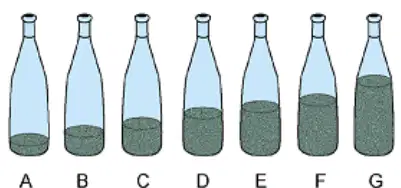
Benny fills seven bottles with different amounts of water (H2O), as shown below. When he taps on the bottles with a spoon, each produces a different pitch. Bottle A, which holds the least amount of water, produces the lowest pitch. Bottle B has a slightly higher pitch, and bottle C has an even higher pitch. The pitch continues to get higher, all the way through bottle G, which holds the most water. Study the picture and the description of the experiment above. Which of the following statements BEST describes Benny’s observations?
The more air inside the bottle, the higher the pitch of sound produced.
The more air inside the bottle, the lower the pitch of sound produced.
Tapping the bottles with a spoon produced sounds of the same pitch in each bottle.
The amount of air and water in the bottle did not affect the pitch of sound produced.
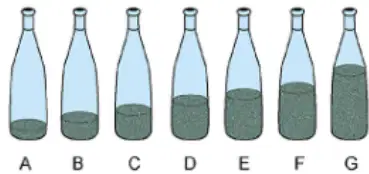
Benny fills seven bottles with different amounts of water (H2O), as shown below. When he taps on the bottles with a spoon, each produces a different pitch. Bottle A, which holds the least amount of water, produces the lowest pitch. Bottle B has a slightly higher pitch, and bottle C has an even higher pitch. The pitch continues to get higher, all the way through bottle G, which holds the most water. Study the picture of the bottles and the description of the experiment above. Which of the following statements about the pitch made by these bottles when tapped with a spoon is TRUE?
A. As the amount of water in the bottle increases, a softer sound is produced.
B. As the amount of water in the bottle increases, a louder sound is produced.
C. As the amount of water in the bottle increases, the pitch lower.
D. As the amount of water in the bottle increases, the pitch higher.
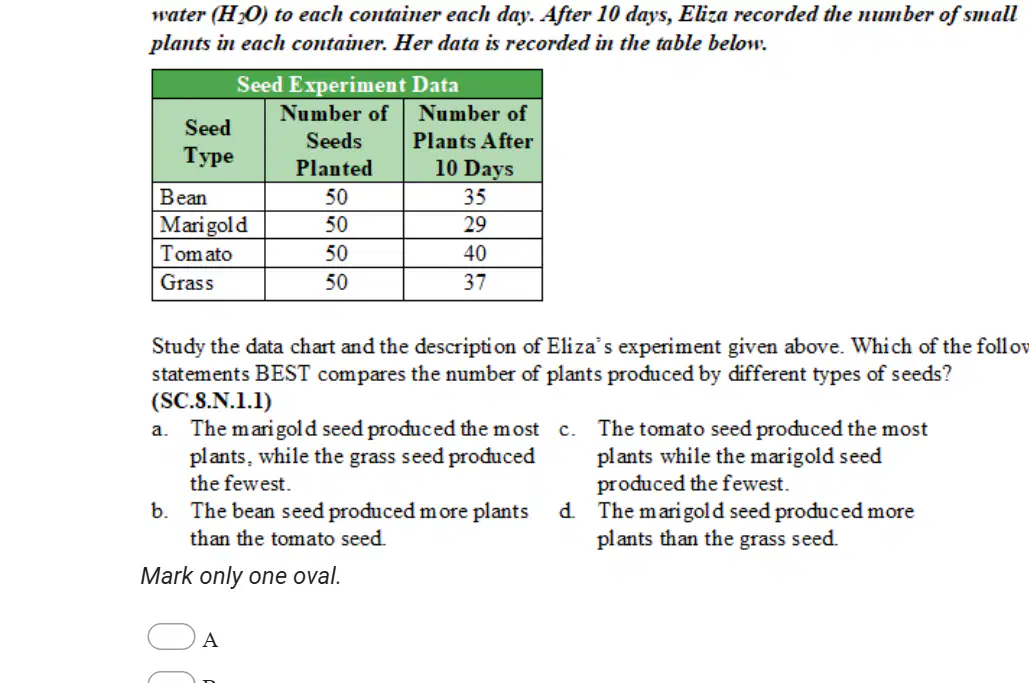
Eliza planted 50 bean seeds, 50 marigold seeds, 50 tomato seeds, and 50 grass seeds in four different containers. She left each container in a warm, sunny spot. She added 100 milliliters of water (H2O) to each container each day. After 10 days, Eliza recorded the number of small plants in each container. Her data is recorded in the table below. Seed Experiment Data Seed Type | Number of Seeds Planted | Number of Plants After 10 Days Bean | 50 | 35 Marigold | 50 | 29 Tomato | 50 | 40 Grass | 50 | 37 Study the data chart and the description of Eliza’s experiment given above. Which of the following statements BEST compares the number of plants produced by different types of seeds?
A. The marigold seed produced the most plants, while the grass seed produced the fewest.
B. The bean seed produced more plants than the tomato seed.
C. The tomato seed produced the most plants while the marigold seed produced the fewest.
D. The marigold seed produced more plants than the grass seed.
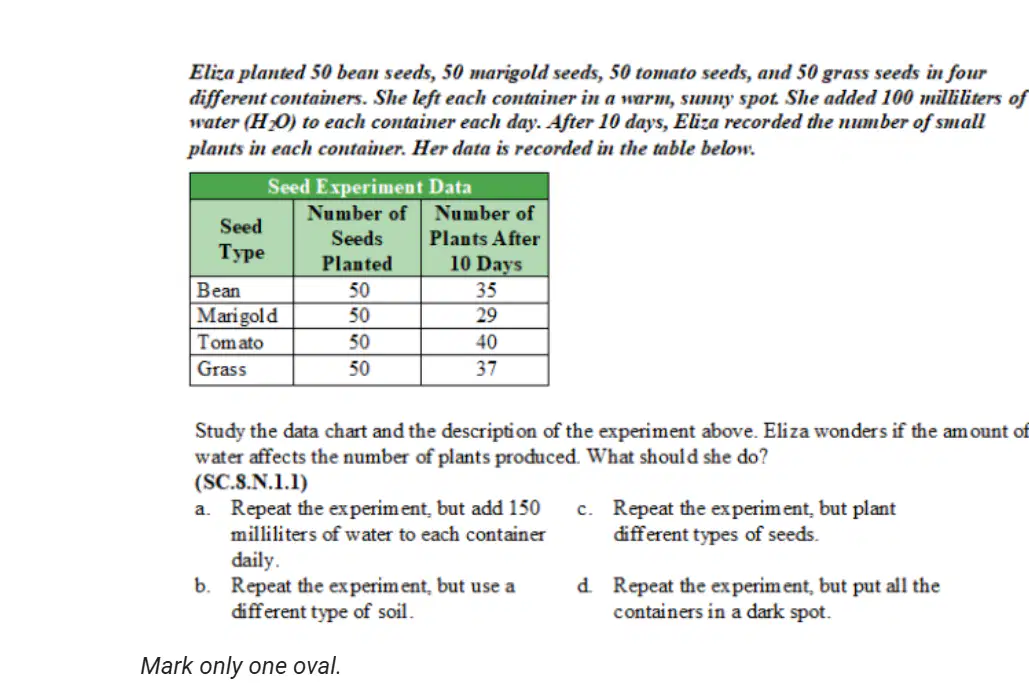
Eliza wonders if the amount of water affects the number of plants produced. What should she do?
Repeat the experiment, but add 150 milliliters of water to each container daily.
Repeat the experiment, but use a different type of soil.
Repeat the experiment, but plant different types of seeds.
Repeat the experiment, but put all the containers in a dark spot.
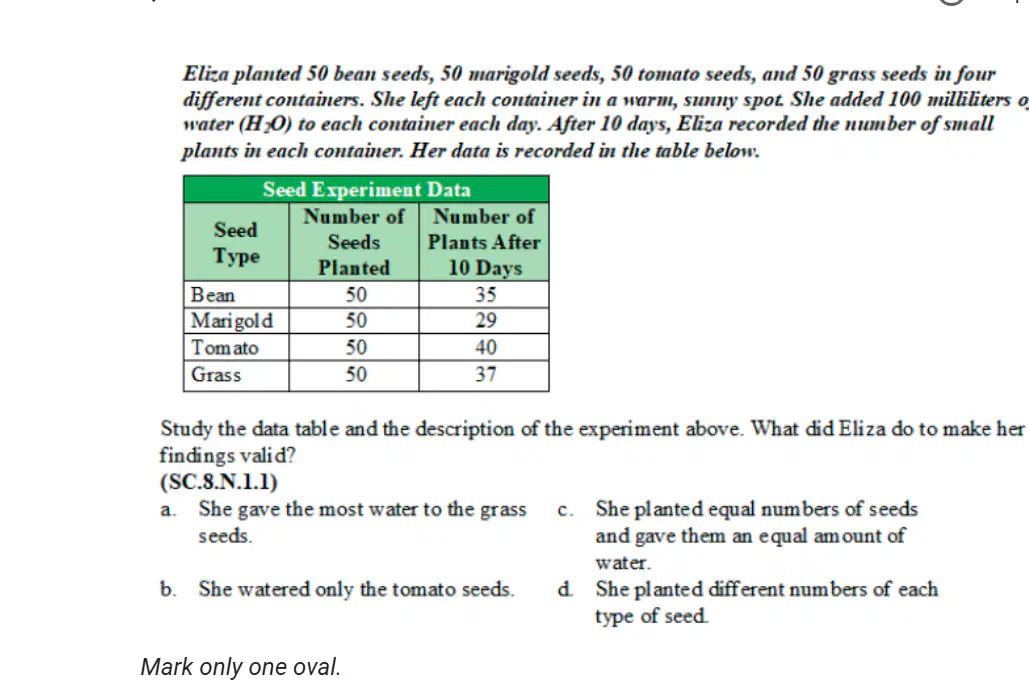
Eliza planted 50 bean seeds, 50 marigold seeds, 50 tomato seeds, and 50 grass seeds in four different containers. She left each container in a warm, sunny spot. She added 100 milliliters of water (H₂O) to each container each day. After 10 days, Eliza recorded the number of small plants in each container. Her data is recorded in the table below. Seed Experiment Data Seed Type | Number of Seeds Planted | Number of Plants After 10 Days Bean | 50 | 35 Marigold | 50 | 29 Tomato | 50 | 40 Grass | 50 | 37 Study the data table and the description of the experiment above. What did Eliza do to make her findings valid?
A. She gave the most water to the grass seeds.
B. She watered only the tomato seeds.
C. She planted equal numbers of seeds and gave them an equal amount of water.
D. She planted different numbers of each type of seed.
Cailynn wanted to know if adding fertilizer would create taller pepper plants that produced more peppers. She mixed up a solution of fertilizer and water using the amount recommended on the label. She planted the pepper plants in the same size pots with the same amount of potting soil. All of her pepper plants received the same amount of sunlight. The only difference between her two groups of pepper plants was that the one group had fertilizer in the water they were given. She measured the height of each plant every week for 3 months. She also counted the number of peppers each plant produced. What is the outcome variable (dependent variable) in Cailynn’s experiment? (SC.8.N.1.1)
The fertilizer.
The height of the plant.
The amount of sunlight.
The amount of potting soil.
Cailynn wanted to know if adding fertilizer would create taller pepper plants that produced more peppers. She mixed up a solution of fertilizer and water using the amount recommended on the label. She planted the pepper plants in the same size pots with the same amount of potting soil. All of her pepper plants received the same amount of sunlight. The only difference between her two groups of pepper plants was that the one group had fertilizer in the water they were given. She measured the height of each plant every week for 3 months. She also counted the number of peppers each plant produced.
What is the test variable (independent variable) in Cailynn’s experiment? (SC.8.N.1.1)
The number of peppers produced.
The fertilizer.
The amount of sunlight.
The height of the plant.
Cailynn wanted to know if adding fertilizer would create taller pepper plants that produced more peppers. She mixed up a solution of fertilizer and water using the amount recommended on the label. She planted the pepper plants in the same size pots with the same amount of potting soil. All of her pepper plants received the same amount of sunlight. The only difference between her two groups of pepper plants was that the one group had fertilizer in the water they were given. She measured the height of each plant every week for 3 months. She also counted the number of peppers each plant produced. Study the description of the experiment above. Which group of plants serves as Cailynn's control group?
The group of pepper plants with the fertilizer.
The group of pepper plants without fertilizer.
The amount of sunlight.
The height of the pepper plants.
Cailynn wanted to know if adding fertilizer would create taller pepper plants that produced more peppers. She mixed up a solution of fertilizer and water using the amount recommended on the label. She planted the pepper plants in the same size pots with the same amount of potting soil. All of her pepper plants received the same amount of sunlight. The only difference between her two groups of pepper plants was that the one group had fertilizer in the water they were given. She measured the height of each plant every week for 3 months. She also counted the number of peppers each plant produced. Study the description of the experiment above. What were Cailynn's constants (controlled variables)?
A. The sunlight, amount of potting soil, and the amount of water.
B. The height of the plants and the number of peppers produced.
C. The group of pepper plants that had no fertilizer.
D. The group of pepper plants that had fertilizer.
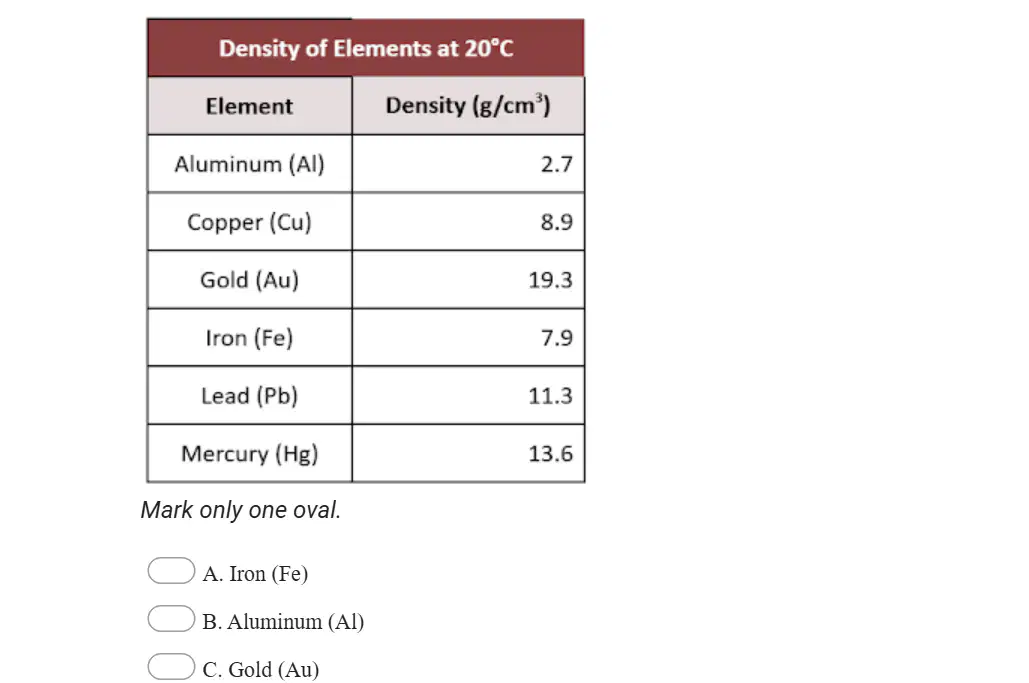
Based on the chart below, which element has particles that are packed most closely together at this temperature?
Iron (Fe)
Aluminum (Al)
Gold (Au)
Lead (Pb)
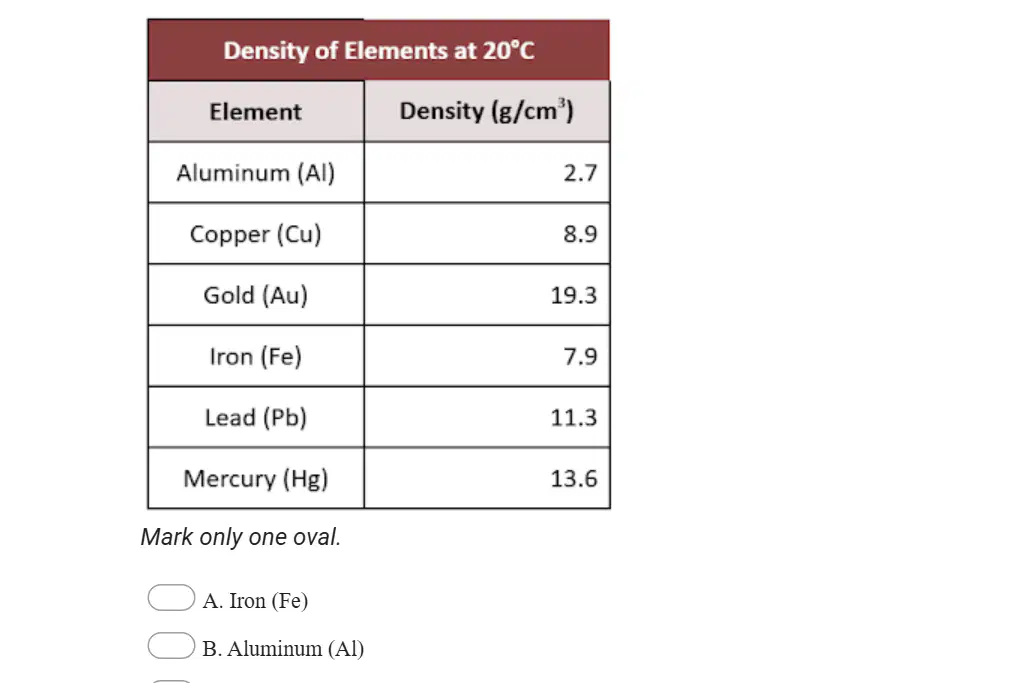
Based on the chart below, which element has particles that are farthest apart at this temperature?
Iron (Fe)
Aluminum (Al)
Gold (Au)
Lead (Pb)
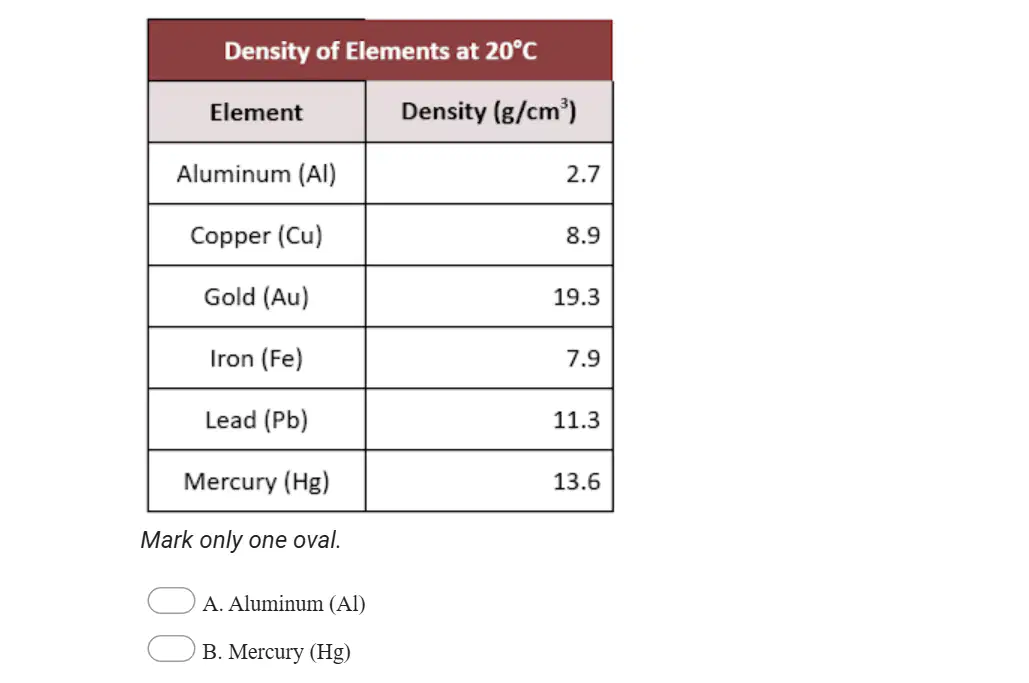
Based on the chart below, which element is the most dense at this temperature?
Aluminum (Al)
Mercury (Hg)
Copper (Cu)
Iron (Fe)
The density of corn syrup is 1.33 g/mL and the density of vegetable oil is 0.91 g/mL. Which liquid(s) will float on water?
both corn syrup and vegetable oil
corn syrup but not vegetable oil
vegetable oil but not corn syrup
neither vegetable oil nor corn syrup
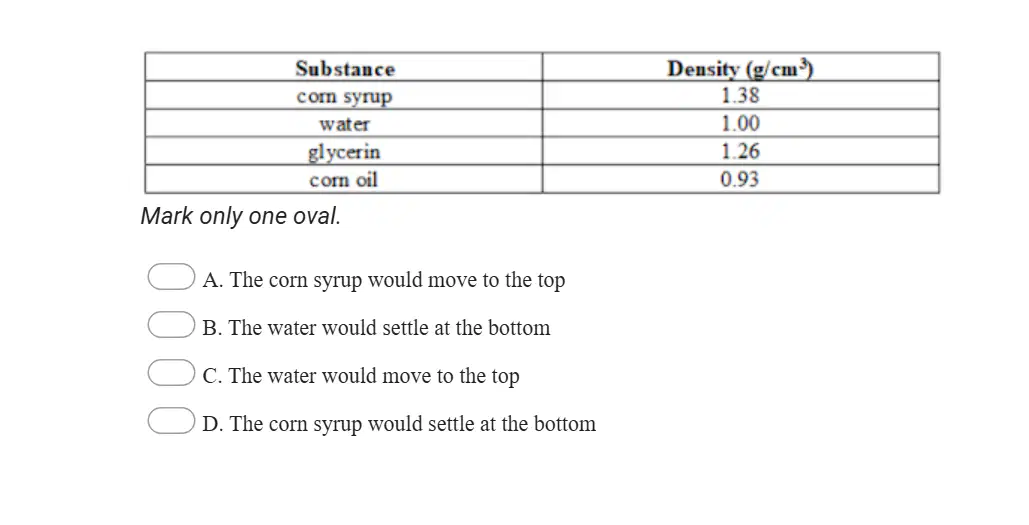
Use the table below to predict what would happen if corn syrup, water, and corn oil were combined in a beaker.
The corn syrup would move to the top
The water would settle at the bottom
The water would move to the top
The corn syrup would settle at the bottom
Chris has designed a mini hot air balloon. In order for his hot air balloon to work, he must use a candle to heat up the air trapped under the balloon. When molecules are heated they move faster, take up more space, and their volume increases. How does this enable the hot air balloon to rise?
The thermal energy is converted to kinetic energy which pushes the hot air balloon.
The air outside the balloon increases in density.
The heat pushes on the balloon, causing it to move.
The warm air becomes less dense than the air outside the balloon.
Lindsay noticed that the baby flamingos born at the zoo all had white feathers. She noticed all the adult flamingos had bright pink feathers. While doing some research on the internet, she found an article that discussed how diet can affect the feathers of flamingos. She decided that a specific type of shrimp eaten by the flamingos would cause the feathers to turn pink over time. She designed an experiment where one group of flamingos would be fed a diet that included the special shrimp and the other group would not have this shrimp in their diet. Each group was made up of flamingos of the same size, gender, weight and health. All flamingos were fed the same amount of food. What was her hypothesis?
That the feather’s turn pin as the flamingos mature.
That the pink feathers were genetic.
That all flamingos had white feathers as juveniles.
That the special shrimp was causing the flamingo’s feathers to turn pink.
Lindsay noticed that the baby flamingos born at the zoo all had white feathers. She noticed all the adult flamingos had bright pink feathers. While doing some research on the internet, she found an article that discussed how diet can affect the feathers of flamingos. She decided that a specific type of shrimp eaten by the flamingos would cause the feathers to turn pink over time. She designed an experiment where one group of flamingos would be fed a diet that included the special shrimp and the other group would not have this shrimp in their diet. Each group was made up of flamingos of the same size, gender, weight and health. All flamingos were fed the same amount of food. What was the independent variable?
The age of the flamingos.
The flamingo’s diet.
The color of the flamingo’s feathers.
The amount of water given to the flamingos.
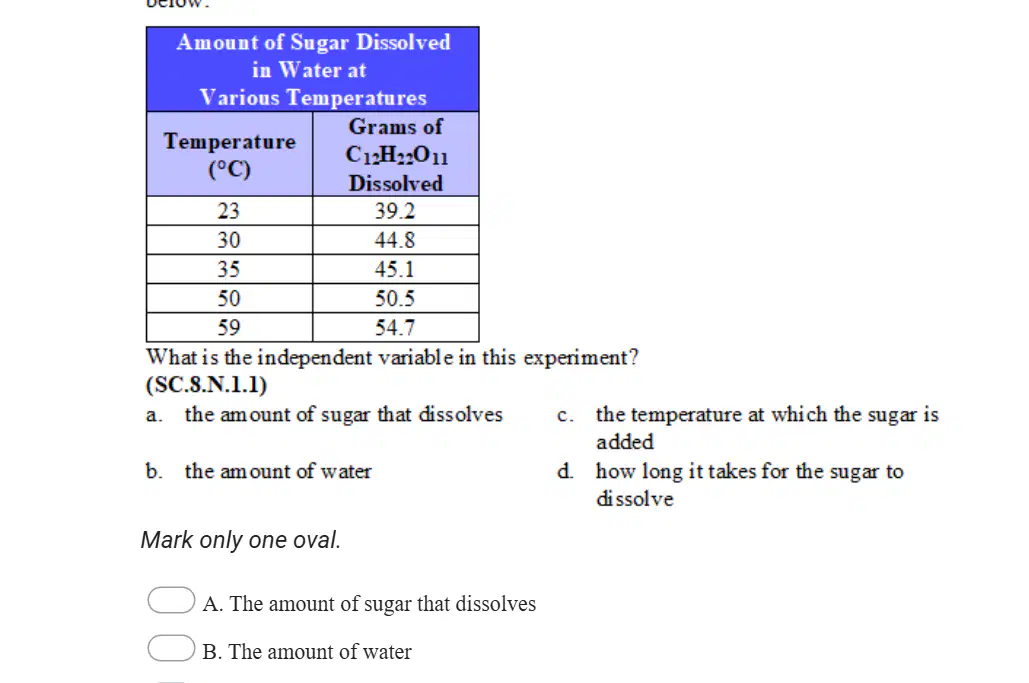
Mr. Lambdin's class is studying how solid materials dissolve in liquids and what effect temperature has on this process. In an experiment, students dissolve as much sugar (C12H22O11) as possible into water (H2O) at different temperatures. They generate the data shown in the table below. What is the independent variable in this experiment? (SC.8.N.1.1)
The amount of sugar that dissolves
The amount of water
The temperature at which the sugar is added
How long it takes for the sugar to dissolve
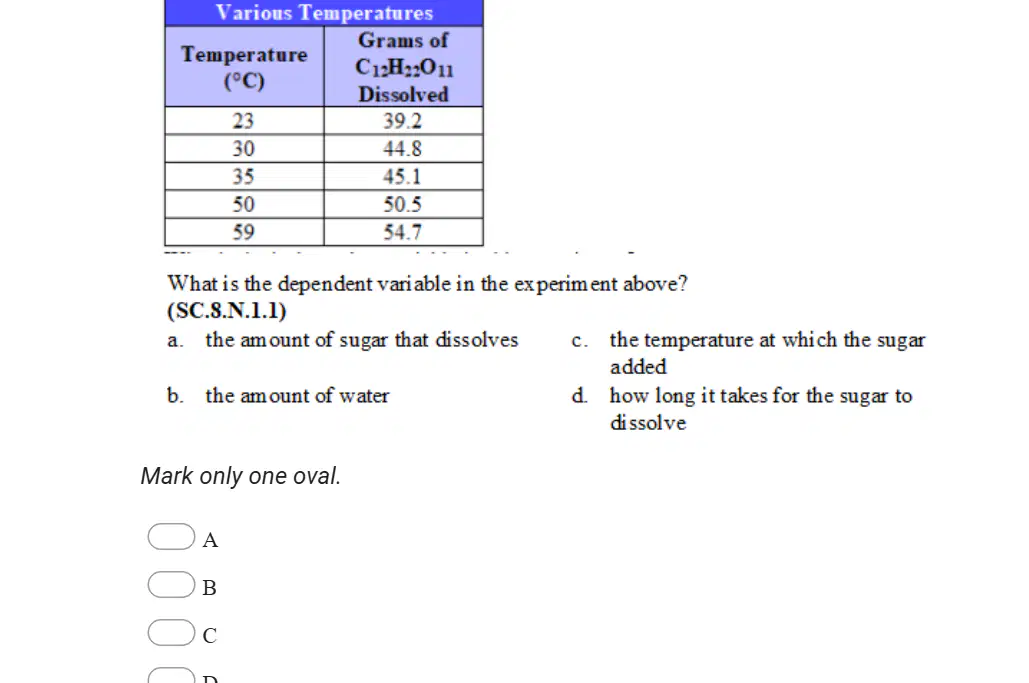
What is the dependent variable in this experiment?
the amount of sugar that dissolves
the amount of water
the temperature at which the sugar is added
how long it takes for the sugar to dissolve
When observations deal with amounts or numbers they are called
responding observations.
quantitative observations.
manipulated observations.
qualitative observations.
An explanation of the things you observe based on logical reasoning and prior knowledge is called a(n):
prediction.
classification.
observation.
inference.
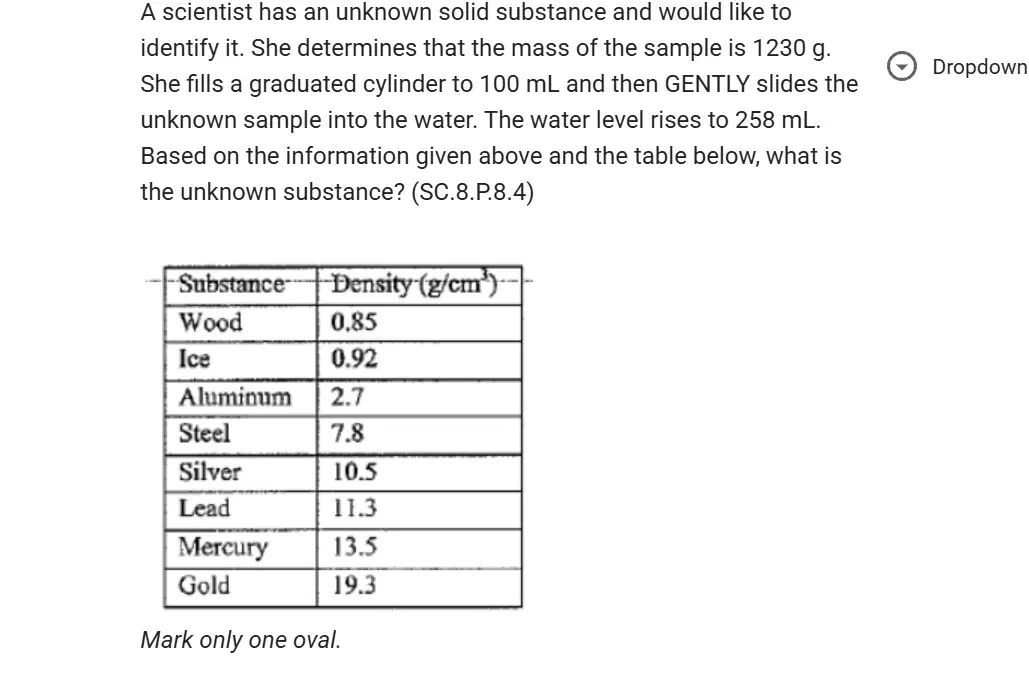
A scientist has an unknown solid substance and would like to identify it. She determines that the mass of the sample is 1230 g. She fills a graduated cylinder to 100 mL and then GENTLY slides the unknown sample into the water. The water level rises to 258 mL. Based on the information given above and the table below, what is the unknown substance?
gold
silver
lead
steel
Which parts of the atom move around the nucleus? (SC.P.8.7)
neutrons
protons
electrons
atomic mass units
Neutrons have (SC.8.P.S.7)
a. a negative charge
b. no charge
c. a positive charge
In a neutral atom, the number of protons equals the number of
electrons.
neutrons.
isotopes.
nuclei.

