
Font size
 Worksheets
Physics Semester Review
Total questions: 30
Worksheet time: 45mins
Defined as mass in motion...
speed
velocity
momentum
acceleration
Which is NOT true of acceleration?
Acceleration of an object is zero if the forces acting on the object are balanced.
Acceleration is the greatest when change in velocity is the greatest for the same change in time.
An object is accelerating when it is at rest.
The steepest line on a velocity/time graph shows the fastest acceleration.
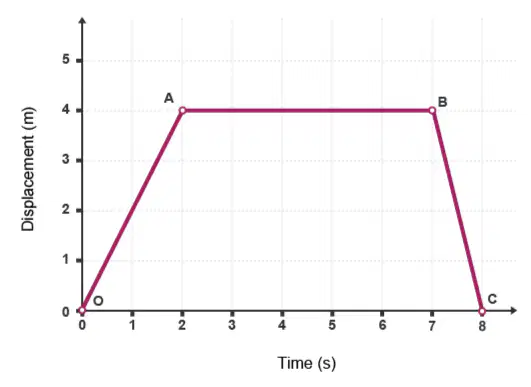
Which BEST describes the object's motion according to the graph?
The object is accelerating for the first 2 seconds, then is in constant motion for the next 5 seconds, and finally decelerates for the last second.
The object is moving at a constant speed for the first 2 seconds, then is at rest for the next 5 seconds, and moves fast back home in 1 second.
The object is moving away from home for the first 2 seconds, then moves at a velocity of 4 for the next 5 seconds, and finally returns home in 1 second.
The object travels 4 m in the first 2 seconds, then is in constant motion for the next 5 seconds, and finally decelerates for the last second.

When is the object moving the fastest?
O-A
A-B
B-C
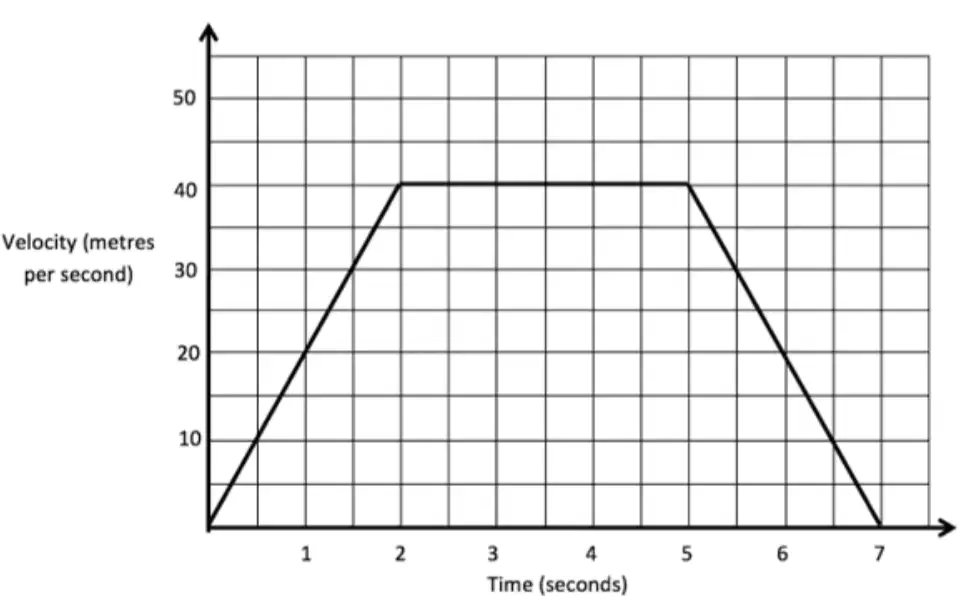
Which BEST describes the object's motion according to the graph?
The object moves away from home in the first 2 seconds, is at rest for 3 seconds, then takes 2 seconds more to return home.
The object accelerates during the first 2 seconds, is at rest for 3 seconds, then decelerates for 2 seconds.
The object accelerates during the first 2 seconds, is at constant velocity of 40 m/s for 3 seconds, then takes 2 seconds to come to rest.
The object increases speed during the first 2 seconds, has no motion for 3 seconds, then takes 2 seconds to come to rest.
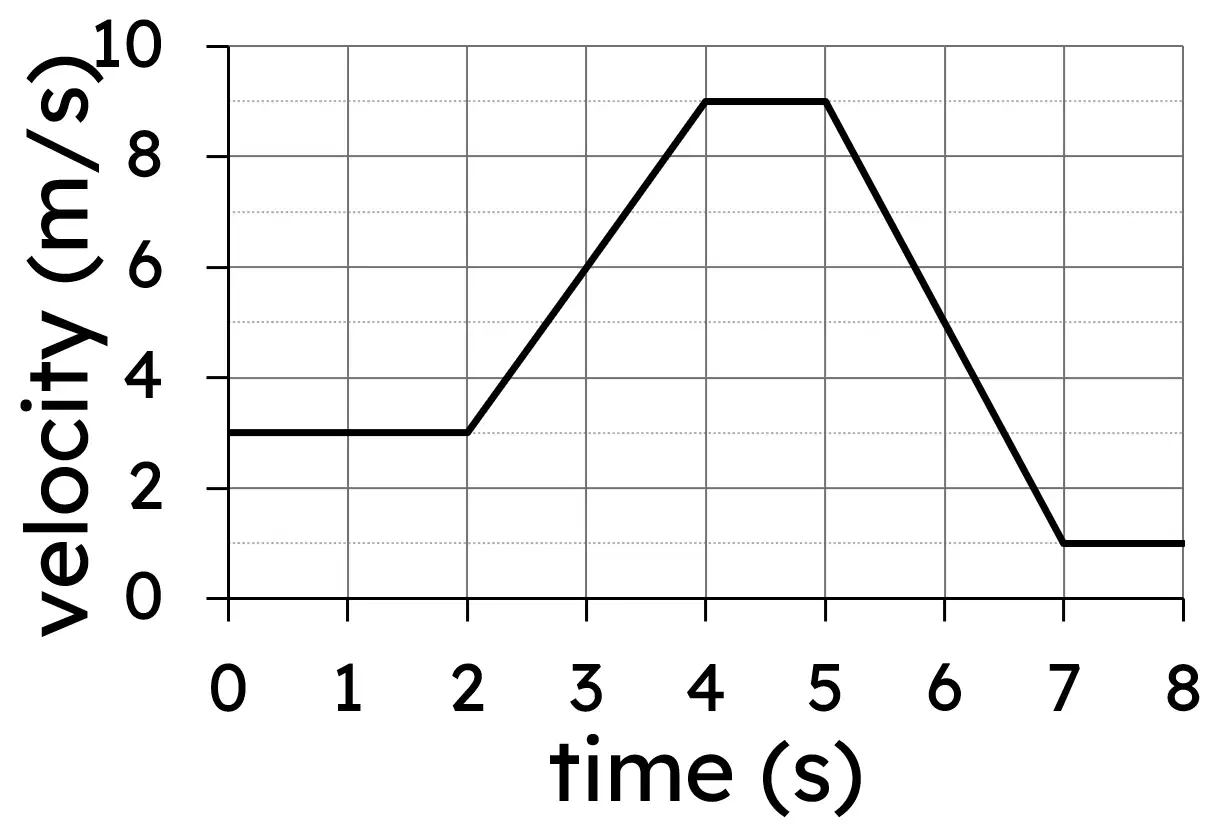
According to the graph, when does the object have the greatest (value of) acceleration?
0-2 seconds
2-4 seconds
4-5 seconds
5-7 seconds
7-8 seconds

When was the greatest acceleration?
2-3 seconds
3-4 seconds
4-5 seconds
5-6 seconds
6-7 seconds
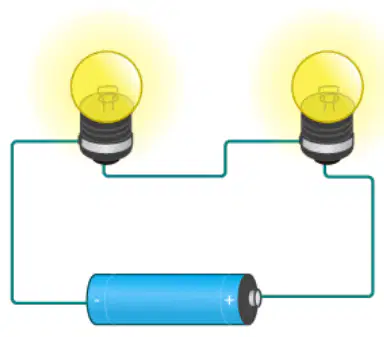
What would make the light bulbs brighter? Select 2
Adding another battery
Removing a light bulb, so there is only 1 in the circuit
Cutting the wire
Positioning the battery the opposite direction
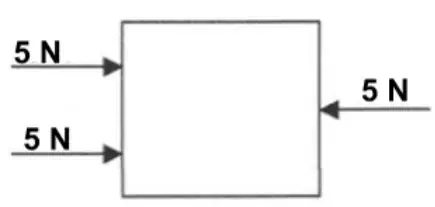
If the mass of the object is 10 kg, what is the net force and acceleration of the object?
5 N right, 0.5 m/s2
5 N left, 0.5 m/s2
5 N right, 2 m/s2
5 N right, 0.5 m/s
A wave’s frequency is directly proportional to its _______________, since increasing one, increases the other.
current
amplitude
wavelength
energy
Waves combine to create a wave with lower amplitude during...
destructive interference
constructive interference
Doppler effect
resonance
What type of thermal energy transfer occurs when a warmer fluid particles rise as the colder fluid particles fall?
conduction
convection
radiation
What type of thermal energy transfer occurs when hot chocolate warms the mug that it is in?
conduction
convection
radiation
What type of thermal energy transfer occurs when the ground gets hot on a sunny day?
conduction
convection
radiation
How small amounts of mass can be converted to large amounts of energy is described in the _________________________________.
law of conservation of mass
mass-energy equivalence equation
net force equation
law of conservation of energy
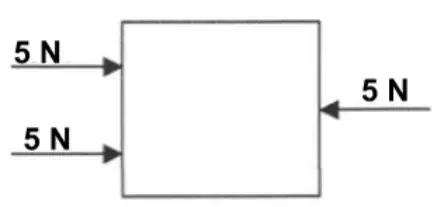
If more force is added to push the object to the right, which statement is TRUE?
The forces are balanced.
The object comes to rest.
The object accelerates more to the right.
The object accelerates less to the right.
If a force of 5 N was added against the right side of the object, which statement is TRUE?
The forces are balanced.
The forces are unbalanced.
The object accelerates to the right.
The object accelerates to the left.
What type of system transfers energy and mass with its surroundings?
open system
closed system

Which is the strongest fundamental force?
gravitational
electromagnetic
strong nuclear
weak nuclear
Which fundamental force deals with the attraction and repulsion of charged particles?
gravitational
electromagnetic
strong nuclear
weak nuclear
What statement describes when an object changes speed or direction?
The forces acting on the object are unbalanced.
The forces acting on the object are balanced.
The object is not accelerating.
What type of electromagnetic waves that can pass through the atmosphere and buildings?
infrared waves
x-rays
gamma rays
radio waves
What has more momentum?
an object at rest
a light object moving fast
a heavy object moving fast
a heavy object moving slow
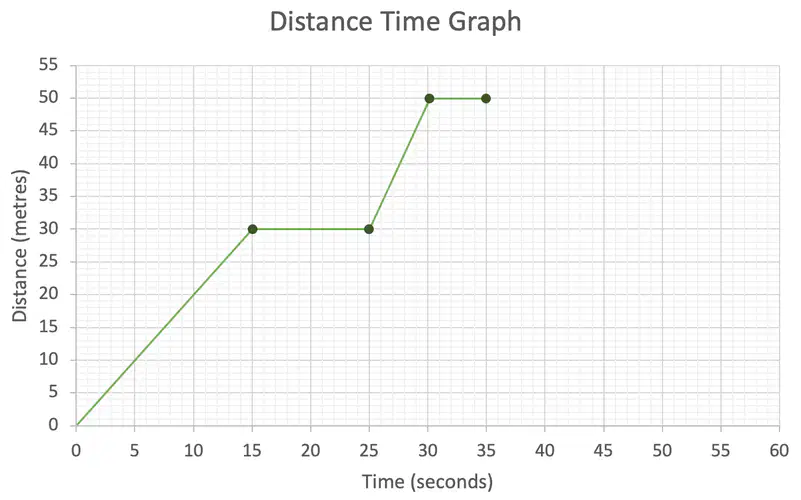
Using the graph, how far did the object travel from 25-30 seconds?
20 meters
50 meters
4 m/s
5 seconds
TRUE or FALSE: Acceleration is inversely proportional to mass for a given force.
TRUE
FALSE
Which would not make a generator more efficient?
coils spinning faster
more coils of wire
stronger magnet
more resistance in the wire

bends when it passes through water (diffraction)
bends when it passes through water (refraction)
bends when it passes through water (reflection)
bends when it passes through water (interference)

A student built a prototype of a simple electromagnet using a nail, some length of wire, and a battery with the goal of using it to lift three paperclips. When the student first tested this prototype, it could only lift one paperclip.
What design change would increase the magnetic field strength of this electromagnet so that it would lift three paper clips?
Remove the nail from within the coil.
Move the battery closer to the nail.
Increase the number of loops in the coil.

