
NEW
Font size
 Worksheets
US History EOC: Domain 1-2 Review
Total questions: 70
Worksheet time: 35mins
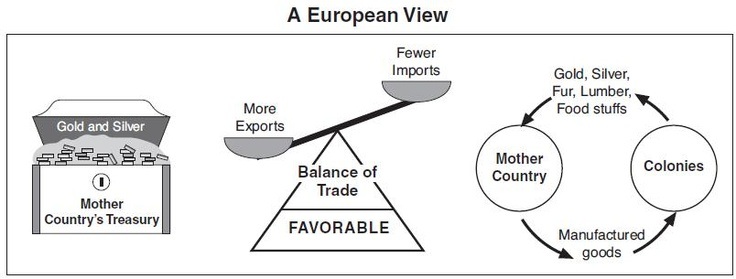
What is mercantilism?
A system where a mother country gains money and power from natural resources that come from its colonies.
Where colonies trade gold and silver with each other.
Wars that start over money.
Plantation colonies trading slaves for money.

Gives them more people
- A sea voyage lasting a month or more
- Between Africa and the Americas
- Approximately 12 million people made the journey
- A death rate of approximately 25% during the journey
What do all of these describe?
Triangular Trade
The Middle Passage
Mercantilist Theory
the Columbian Exchange
What was the primary industry that the economy of the Southern colonies was based on?
Mining
Fishing
Agriculture
Lumber
What is the term for someone who agreed to work for a certain number of years in exchange for food, shelter, and freedom dues at the end of their term?
Slavery
Chattel slavery
Indentured servitude
Plantation servitude
In the Southern colonies, the representatives of the people were called (first representative government in the colonies):
Colonial governors
House of Burgesses
Governor's Council
House of Representatives
A religious movement in the colonies that led to more people attending new types of churches:
The Salem Witch Trials
The Great Awakening
The Emancipation Proclamation
Manifest Destiny
Very diverse and tolerant colonies:
New England Colonies
Mid-Atlantic or Middle Colonies
Southern Colonies
Spanish territory
What system of trade brought goods between Europe, Africa, and North America?
Triangular Trade
Group Trade
Social trade
global trade
Which group of colonies is called the "breadbasket" of the colonies?
New England
Middle
Southern
Western
An order by Britain that prohibited its American colonists from settling west of the Appalachian Mountains.
Treaty of Paris 1763
Stamp Act
Proclamation of 1763
Intolerable Acts
The treaty that ended the Revolutionary War, confirmed the independence of the United States, and set the boundaries of the new nation.
Treaty of Paris 1783
Social Contract
Treaty of Tordesillas
Treaty of Ghent
A series of laws enacted by Parliament in 1774 to punish Massachusetts colonists for the Boston Tea Party.
Stamp Act
Boston Massacre
Intolerable Acts
Navigation Acts
A group established by American colonists to exchange information about British threats to their liberties.
Committee of Five
Virginia House of Burgesses
Committees of Correspondence
Stamp Act
A pamphlet by Thomas Paine, published in 1776, that called for the separation of the colonies from Britain.
Declaration of Independence
Proclamation of 1763
Boston Tea Party
Common Sense
John Adams, Benjamin Franklin, Thomas Jefferson, Robert Livingston, and Roger Sherman were part of the group tasked with writing a document listing the reasons for colonial independence (Declaration of Independence).
Sons of Liberty
The Fab Five
Committee of Five
Daughters of Liberty
Prussian-born American Revolutionary military leader who trained the previously undisciplined troops of the Continental Army.
Baron von Steuben
Lord Cornwallis
Ben Franklin
John Adams
The site in Pennsylvania where the Continental Army spent the winter of 1777-1778 under extremely harsh conditions.
Trenton
Saratoga
Valley Forge
Yorktown
Battle in New York during the American Revolution that resulted in a major defeat of British troops. It is considered the turning point of the war. The French also decided to give aid to the colonists to defeat the British after this battle.
Saratoga
Trenton
Valley Forge
Yorktown
Ended the French and Indian War, and the French lost all land holdings in North America.
Treaty of Ghent
Treaty of Appomattox
Treaty of 1763
Treaty of Guadalupe Hidalgo
At which site did the British army formally surrender to the Continental Army, ending the American Revolution?
Saratoga
Trenton
Valley Forge
Yorktown
North American conflict that was part of a worldwide struggle between France and Britain, ending with the defeat of France and the transfer of French Canada to Britain.
Boston Massacre
French and Indian War
Lexington and Concord
Townshend Act
Protest against the tea tax in which the Sons of Liberty dumped British tea into Boston Harbor.
SSUSH3
Boston Massacre
Boston Tea Party
Battle of Lexington
Battle of Concord
When Thomas Jefferson wrote the Declaration of Independence, he was influenced by which of the following?
SSUSH4
Enlightenment philosophers like John Locke
King George
Louis XIV
George Washington
Which group insisted that the Bill of Rights be added to the Constitution?
The Committee of Correspondence
The Sons of Liberty
Federalists
Anti-Federalists
The first 10 Amendments to the Constitution are also called the
Declaration of Sentiments
The Communist Manifesto
The Declaration of Independence
Bill of Rights
Why did they revolt in Shays' Rebellion?
Growing debt from high state taxes
Boston Tea Party
Declaration of Independence
British Invasion

Which of the following words means that a person places the interests of a small area above the interests of the entire country?
Nationalism
Sectionalism
Popular Sovereignty
Secession

What term refers to the God-given right to control everything from sea to sea?
Proviso
Popular Sovereignty
Secession
Manifest Destiny

Who was the slave that brought his case all the way to the Supreme Court in an attempt to gain his freedom?
Stephen Douglas
Harriet Tubman
Dred Scott
Fredrick Douglas

The election of which president was the final straw that caused the South to leave the country and start their own?
James K. Polk
Abraham Lincoln
Ulysses S. Grant
James Buchanan

What was the name given to the southern states?
Union
Free States
Confederacy
Mexico
The Louisiana Purchase
did not occur until Congress passed an amendment approving it
doubled the size of the US
offered the US an opportunity to expand its commercial and manufacturing industries
tripled the size of the US
Who was the person who wanted to acquire the Louisiana Territory?
Lewis and Clark
Thomas Jefferson
Robert Livingston
Napoleon
The process of rebuilding the South after the Civil War.
Reconstruction
Amendments
Black Codes
Constitution
Which three Amendments were designed to ensure equality for the slaves?
17th, 18th, 19th
13th, 14th, 15th
13th, 14th, 16th
8th, 9th, 10th
Which Amendment was passed to guarantee African American men the right to vote?
13th
14th
16th
15th
Issued by Abraham Lincoln, it declared that all slaves in the Confederate states would be free.
Emancipation Proclamation
Bill of Rights
Confederate States of America
Amendments

During which years did the Civil War take place?
1861-1865
1860-1865
1861-1864
1860-1863
Which of the following phrases is part of the Declaration of Independence?
"They are endowed by their Creator with certain unalienable Rights, that among these are Life, Liberty, and the pursuit of Happiness."
"All persons born or naturalized in the United States are citizens of the United States."
"No soldier shall, in time of peace be quartered in any house, without the consent of the owner."
"Congress shall make no law respecting an establishment of religion, or prohibiting the free exercise thereof."
Which principle was adopted in the US Constitution to ensure that no branch of the federal government became too powerful?
republican government
popular sovereignty
judicial review
checks and balances
This Reconstruction plan stated that a state could rejoin if 10% of its population swore an oath of loyalty.
Lincoln's Plan
Johnson's Plan
Radical Republican's Plan
Grant's Plan
What was the name of the terrorist group that used violence to prevent African-Americans from having equal rights in the South?
Freedman's Bureau
Black Codes
Jim Crow Laws
Ku Klux Klan
President Johnson was impeached for violating which law?
Tenure of Office Act
1st Reconstruction Act
Civil Rights Act of 1866
14th Amendment
Why was John Brown important in the fight against slavery?
He led a slave revolt against plantation owners in Virginia.
He fought for the South to maintain slavery.
He fought for the North to receive his freedom after the war.
He led a revolt at Harper's Ferry in an attempt to start a slave rebellion.
What did the Supreme Court rule in the case of Dred Scott v. Sanford?
Congress had no right to ban slavery in any territory
Slaves were free everywhere
Dred Scott was a free man
Slaves were American citizens
Where were the first shots of the Civil War fired?
Fort Sumter
Gettysburg
Antietam
Bull Run
This battle was the turning point of the war.
Gettysburg
Vicksburg
Bull Run
Fredericksburg
Whig
Bull Moose
Whig
Bull Moose


How did President Adam's decision to maintain neutrality in the war between France and Britain affect the U.S.?
England began a war with the US.
France began a war with the US.
France interfered with US ships at sea.
England demanded bribes
What land that was acquired during the presidency of Thomas Jefferson led to the expedition of Lewis and Clark?
the Florida Territory
the Louisiana Territory
the Northwest Territory
the Southwest Territory
Which US president signed the Indian Removal Act of 1830?
James K. Polk
Andrew Jackson
Martin Van Buren
John Quincy Adams
How were voting rights expanded during the Jacksonian era?
The voting age was reduced.
The poll tax was decreased.
Women were allowed to vote.
Property ownership qualifications were eliminated


