
Font size
 Worksheets
Biology DC Final Review
Total questions: 83
Worksheet time: 42mins
Which of the following best distinguishes a hypothesis from a theory?
A hypothesis is a testable statement, while a theory is a well-supported explanation.
A hypothesis is a proven fact, while a theory is an untested idea.
A hypothesis is a law, while a theory is a prediction.
A hypothesis is a universal truth, while a theory is a guess.
Which variable in an experiment is deliberately changed by the scientist?
Independent variable
Dependent variable
Controlled variable
Experimental group
Which type of bond involves the sharing of electron pairs between atoms?
Covalent bond
Ionic bond
Hydrogen bond
Van der Waals interaction
Which property of water allows it to stick to other substances?
Adhesion
Cohesion
Density
High specific heat
Which of the following is NOT one of the four major biological macromolecules?
Enzymes
Proteins
Nucleic acids
Lipids
What is the process called when water is removed to join two monomers together?
Dehydration synthesis
Hydrolysis
Denaturation
Polymerization
Which level of protein structure is primarily maintained by hydrogen bonds?
Secondary structure
Primary structure
Tertiary structure
Quaternary structure
If all hydrogen bonds in a protein were disrupted, which level of protein structure would remain intact?
Primary structure
Secondary structure
Tertiary structure
Quaternary structure
Why is it important to alter only one condition at a time in a scientific experiment?
To ensure that the results are due to the variable being tested
To make the experiment more complicated
To increase the number of variables
To reduce the sample size
Which environmental factor can affect protein shape?
Temperature
Color
Size
Shape
Which of the following is NOT a function of all living organisms?
Reproduction
Photosynthesis
Response to stimuli
Growth
What is homeostasis?
The process of cell division
The maintenance of a stable internal environment
The breakdown of glucose for energy
The movement of water across a membrane
Which of the following is an example of a negative feedback loop in homeostasis?
Blood clotting
Childbirth contractions
Regulation of body temperature
Growth hormone release
Which of the following is NOT one of the three Domains of Life?
Bacteria
Archaea
Eukarya
Protista
Which organelle is responsible for energy production in eukaryotic cells?
Golgi apparatus
Mitochondria
Lysosome
Endoplasmic reticulum
Which of the following is a passive transport mechanism?
Endocytosis
Diffusion
Pump
Co-transport
Predict what will happen to an animal cell placed in a hypotonic solution.
The cell will shrink
The cell will swell and may burst
The cell will remain unchanged
The cell will divide

Which molecule in the cell membrane is primarily responsible for maintaining fluidity?
Phospholipid
Cholesterol
Protein
Carbohydrate
Which type of molecules can pass through the cell membrane via simple diffusion?
Large polar molecules
Small nonpolar molecules
Proteins
DNA
Why are cells generally small in size?
To increase their surface-to-volume ratio for efficient transport
To store more genetic material
To allow for more organelles
To prevent cell division
Which of the following is a function of cell membrane molecules in cell communication?
They store genetic information.
They help in cell communication.
They produce energy for the cell.
They synthesize proteins.
What are the three stages of a signal transduction pathway?
Reception, translation, replication
Reception, transduction, response
Transcription, translation, replication
Reception, replication, transcription
What is the main difference between intracellular and membrane-bound receptors?
Intracellular receptors are found on the cell surface, membrane-bound receptors are inside the cell.
Intracellular receptors bind to DNA, membrane-bound receptors bind to RNA.
Intracellular receptors are inside the cell, membrane-bound receptors are on the cell surface.
Intracellular receptors are only found in bacteria, membrane-bound receptors are found in plants.
What is the role of a kinase in cell communication?
It breaks down proteins.
It adds phosphate groups to proteins.
It removes water from molecules.
It synthesizes carbohydrates.
What does phosphorylation do to a protein enzyme?
It denatures the enzyme.
It adds a phosphate group, often activating or deactivating the enzyme.
It removes a phosphate group, making the enzyme inactive.
It breaks the enzyme into smaller pieces.
Which law of thermodynamics states that energy cannot be created or destroyed?
First Law of Thermodynamics
Second Law of Thermodynamics
Law of Conservation of Mass
Law of Gravity
What is the difference between exergonic and endergonic reactions?
Exergonic reactions absorb energy, endergonic reactions release energy.
Exergonic reactions release energy, endergonic reactions absorb energy.
Both release energy.
Both absorb energy.
What is free energy (ΔG)?
The total energy in a system.
The energy available to do work in a system.
The energy lost as heat.
The energy stored in DNA.
How are coupled reactions related to ATP hydrolysis?
Coupled reactions use ATP hydrolysis to drive non-spontaneous reactions.
Coupled reactions produce ATP.
Coupled reactions only occur in plants.
Coupled reactions do not involve ATP.
What is activation energy in the context of enzymes?
The energy required to start a chemical reaction.
The energy released during a reaction.
The energy stored in ATP.
The energy used to break down enzymes.
Which of the following is an example of competitive inhibition?
An inhibitor binds to the active site of an enzyme, blocking substrate binding.
An inhibitor binds to a site other than the active site, changing enzyme shape.
The enzyme is denatured by heat.
The substrate is broken down by the enzyme.
Which factor does NOT affect enzyme activity?
Temperature
pH
Cofactors
Color of the enzyme
What does it mean when an enzyme is denatured?
The enzyme is activated.
The enzyme loses its shape and function.
The enzyme becomes more efficient.
The enzyme changes color.
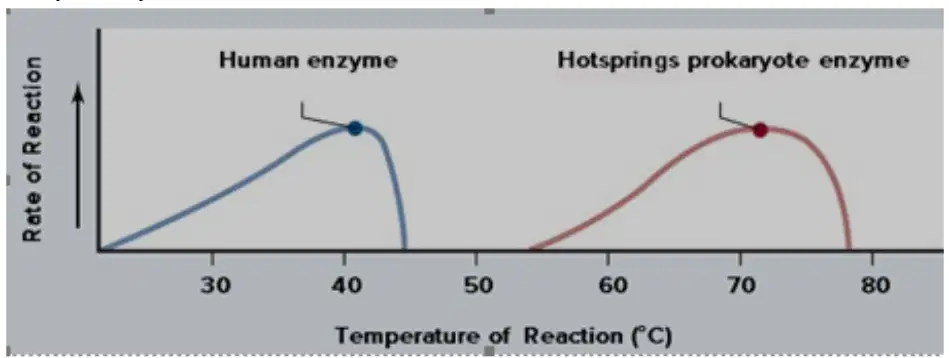
Based on the graph, what is the optimal temperature for the human enzyme?
20°C
37°C
60°C
80°C
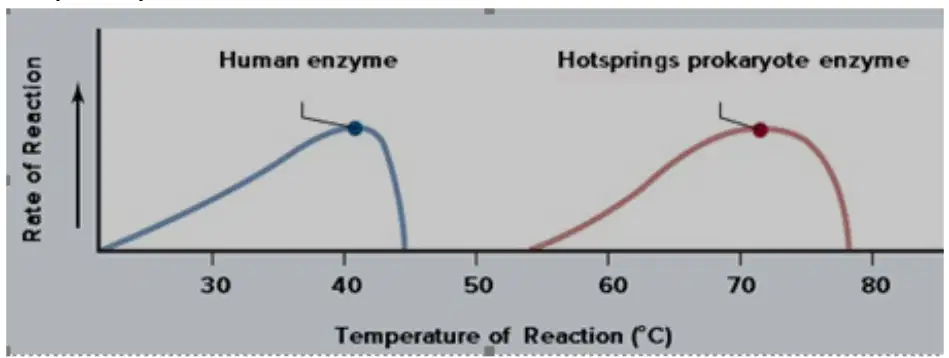
Based on the graph, what is the optimal temperature for the hot springs prokaryote enzyme?
37°C
50°C
75°C
20°C
What is allosteric inhibition?
Inhibitor binds to the active site.
Inhibitor binds to a site other than the active site, changing enzyme function.
Enzyme is broken down.
Substrate is removed from the reaction.
How does an allosteric inhibitor affect an enzyme’s activity compared to a competitive inhibitor?
Allosteric inhibitors bind to the active site, competitive inhibitors bind elsewhere.
Allosteric inhibitors change the enzyme’s shape, competitive inhibitors block the active site.
Both bind to the active site.
Both increase enzyme activity.
What is metabolism?
The process of cell division.
The sum of all chemical reactions in a cell.
The breakdown of DNA.
The movement of water in cells.
Which process converts energy through catabolic pathways such as glycolysis and cellular respiration?
Photosynthesis
Catabolic processes
Protein synthesis
DNA replication
What is the difference between anabolic and catabolic pathways?
Anabolic pathways break down molecules, catabolic pathways build molecules.
Anabolic pathways build molecules, catabolic pathways break down molecules.
Both build molecules.
Both break down molecules.
What is the main function of photosynthesis in autotrophs?
Convert light energy into chemical energy.
Break down glucose.
Produce oxygen only.
Absorb water from soil.
What is metabolism?
The process by which cells divide
The sum of all chemical reactions in an organism
The movement of molecules across a membrane
The breakdown of food in the stomach
Which terms should be used to compare catabolic and anabolic reactions?
Endergonic, exergonic, dehydration synthesis, and hydrolysis
Photosynthesis, respiration, glycolysis, and fermentation
Mitosis, meiosis, cytokinesis, and replication
Chromosome, gene, allele, and locus
Oxidation reactions are chemical processes that result in a __________ of __________.
gain of electrons
loss of electrons
gain of protons
loss of protons
Reduction reactions are chemical processes that result in a __________ of __________.
gain of electrons
loss of electrons
gain of protons
loss of protons
What are pigments, and what pigment molecule is required for photosynthesis?
Proteins; hemoglobin
Lipids; carotene
Molecules that absorb light; chlorophyll
Sugars; glucose
Where do the carbon atoms in glucose come from during photosynthesis?
Water
Oxygen
Carbon dioxide
Nitrogen
What is glycolysis?
The process of cell division
A metabolic process that breaks down glucose
The formation of ATP from ADP
The absorption of light by pigments
In aerobic respiration, what are H⁺ ions used for?
To break down glucose
To generate ATP via chemiosmosis
To form water molecules
To transport oxygen
What happens to the oxygen used in cellular respiration?
It is converted into glucose
It is released as carbon dioxide
It acts as the final electron acceptor and forms water
It is stored in the mitochondria
Describe the major events of interphase (G₁, S, G₂) and explain their roles in cell growth and DNA replication.
Interphase includes mitosis and cytokinesis
Interphase is only for DNA replication
Interphase consists of cell growth, DNA replication, and preparation for division
Interphase is when the cell rests and does not grow
What are the two copies of the same type of chromosome found in normal somatic cells called?
Sister chromatids
Homologous chromosomes
Centromeres
Telomeres
Before somatic cell division, each chromosome must be replicated. These two copies are called __________ and are held together by a __________.
homologous chromosomes; telomere
sister chromatids; centromere
centromeres; spindle fiber
telomeres; chromatin
Meiosis I separates homologous chromosomes, Meiosis II separates sister chromatids; reduction division because chromosome number is halved.
Meiosis I separates sister chromatids, Meiosis II separates homologous chromosomes; reduction division because chromosome number is halved
Meiosis I separates homologous chromosomes, Meiosis II separates sister chromatids; reduction division because chromosome number is halved
Both Meiosis I and II separate homologous chromosomes; reduction division because DNA is doubled
Meiosis I and II are identical; reduction division because cells grow larger
How do crossing-over events during prophase I contribute to genetic diversity?
By increasing the number of chromosomes
By exchanging genetic material between homologous chromosomes
By duplicating DNA
By preventing cell division
How does independent assortment of homologous chromosomes during meiosis generate genetic variation?
By ensuring all offspring are identical
By randomly distributing maternal and paternal chromosomes to gametes
By preventing crossing-over
By doubling the chromosome number
A typical eukaryotic cell cycle diagram should include which of the following phases?
G₁, S, G₂, and M phases
Only mitosis
Photosynthesis steps
Glycolysis steps
How many sets of chromosomes does a sperm cell contain?
One set (haploid)
Two sets (diploid)
Three sets (triploid)
Four sets (tetraploid)
Which of the following best describes a homozygous genotype?
Two identical alleles for a trait
Two different alleles for a trait
Three alleles for a trait
No alleles for a trait
What is the observable physical expression of the genes present in an organism called?
Genotype
Phenotype
Chromotype
Allelotype
Which law explains how alleles separate during gamete formation?
Law of Segregation
Law of Dominance
Law of Probability
Law of Codominance
A parent has genotype AaBb. Which of the following is a possible gamete they could produce?
AB
ab
Aa
BB
When solving dihybrid crosses, which tool helps predict offspring genotypes and phenotypes?
Punnett square
Venn diagram
Pie chart
Line graph
In what way do incomplete dominance and codominance differ from classical Mendelian expectations?
They produce only dominant phenotypes
They result in blended or co-expressed phenotypes
They eliminate recessive alleles
They follow the law of segregation strictly
A female has the genotype FFGgHHJjkk. A male has the genotype FFGgHhJjKk. What is the probability that their offspring will have genotype FFGgHHJjKk?
1/16
1/8
1/4
1/2
The ABO blood group is an example of which two types of non-Mendelian inheritance patterns?
Incomplete dominance and codominance
Codominance and multiple alleles
Multiple alleles and linkage
Sex-linked and incomplete dominance
When examining a pedigree, which clue helps you distinguish between autosomal dominant and X-linked modes of inheritance?
The trait appears equally in males and females for autosomal dominant
The trait skips generations for X-linked inheritance
Only males are affected in autosomal dominant inheritance
Only females are affected in X-linked inheritance
Which model explains the structural stability and function of the DNA double helix?
Watson–Crick model
Chargaff’s model
Meselson–Stahl model
Avery–MacLeod–McCarty model
What is meant by antiparallel strand orientation in DNA?
Both strands run in the same direction
One strand runs 5' to 3', the other runs 3' to 5'
Strands are perpendicular to each other
Strands are circular
Which enzyme is responsible for unwinding the DNA helix during replication?
DNA polymerase
Ligase
Helicase
Topoisomerase
What is the function of Okazaki fragments in DNA replication?
They help unwind the DNA helix
They are short DNA segments synthesized on the lagging strand
They join the leading and lagging strands
They repair DNA damage
Which DNA sequence is capable of pairing with 5' GCGAATCGA 3'?
5' GCGAATCGA 3'
3' CGCTTAGCT 5'
5' CGCTTAGCT 3'
3' GCGAATCGA 5'
Describe one way in which the replication machinery ensures fidelity during DNA replication.
By using RNA polymerase to synthesize DNA
By proofreading and correcting mismatched bases
By synthesizing DNA only on the leading strand
By forming Okazaki fragments on both strands
What is the role of RNA polymerase in transcription?
It unwinds the DNA helix
It synthesizes RNA from a DNA template
It adds poly-A tails to mRNA
It splices introns from pre-mRNA
Which process adds a protective cap to the 5' end of eukaryotic mRNA?
Poly-A tail addition
5' capping
Intron splicing
DNA replication
How does eukaryotic transcription differ from prokaryotic transcription in terms of mRNA processing?
Eukaryotes do not process mRNA
Prokaryotes add a poly-A tail to mRNA
Eukaryotes perform 5' capping, poly-A tail addition, and intron splicing
Prokaryotes splice introns from mRNA
What is the function of transcription factors in eukaryotic transcription?
They unwind the DNA helix
They bind to DNA and regulate the initiation of transcription
They synthesize RNA from DNA
They add poly-A tails to mRNA
How does the structure of tRNA, particularly the anticodon, allow it to accurately match amino acids to codons on the mRNA during translation?
It allows tRNA to base pair with the mRNA codon, ensuring the correct amino acid is added.
It allows tRNA to bind directly to DNA, ensuring accurate transcription.
It enables tRNA to synthesize mRNA, ensuring correct gene expression.
It allows tRNA to degrade mRNA, ensuring only correct proteins are made.
What are the functions of the A, P, and E sites on the ribosome, and how do they coordinate the steps of protein synthesis?
They bind tRNA and coordinate the entry, peptide bond formation, and exit of tRNA during translation.
They synthesize DNA, coordinate replication, and repair DNA damage.
They degrade proteins, coordinate protein folding, and export proteins from the cell.
They store amino acids, coordinate their release, and recycle them for new proteins.
Why are start and stop codons essential for translation, and what might happen if a mutation alters these codons?
They signal where translation begins and ends; mutations can lead to incorrect protein synthesis or no protein at all.
They determine the shape of the ribosome; mutations can cause ribosome malfunction.
They regulate DNA replication; mutations can cause uncontrolled cell division.
They control cell membrane transport; mutations can cause loss of cell function.
Describe the process of polypeptide elongation. How are amino acids added sequentially to form a growing protein chain?
Amino acids are added one by one to the growing chain as tRNAs bring them to the ribosome, matching codons on the mRNA.
Amino acids are removed from the chain as tRNAs detach from the ribosome.
Amino acids are synthesized by the ribosome and released into the cytoplasm.
Amino acids are stored in the nucleus until needed for protein synthesis.
Explain how translation terminates and how the completed polypeptide is released from the ribosome. What factors or signals are involved in this process?
A stop codon is reached, release factors bind, and the polypeptide is released from the ribosome.
A start codon is reached, initiation factors bind, and the polypeptide is released.
A tRNA with no amino acid binds, causing the ribosome to disassemble.
The ribosome runs out of mRNA, causing translation to stop automatically.
Explain what it means for the genetic code to be redundant. How does this redundancy influence the effect of point mutations on the resulting protein, and give an example of a mutation that might have little or no impact on the amino acid sequence.
Redundancy means multiple codons code for the same amino acid, so some mutations do not change the protein sequence (silent mutation).
Redundancy means each codon codes for multiple amino acids, so mutations always change the protein.
Redundancy means the genetic code is repeated in every cell, so mutations have no effect.
Redundancy means only one codon codes for each amino acid, so all mutations are harmful.

