wayground logo

Free Printable Worksheets

Font size

S
M
L
XL
Worksheets

Combined Parts 1 and 2 Midterm Review Environmental Science

Total questions: 80

Worksheet time: 1hrs 5mins

Name
Class
Date
1.

the contamination of the atmosphere by the introduction of pollutants from human and natural sources

a)

air pollution

b)

smog

c)

acid deposition

d)

climate change

2.

What do greenhouse gases do?

a)

Make the sky blue

b)

Trap heat inside our atmosphere

c)

Keep out sunlight

d)

Keep plants growing

3.

We can reduce air pollution by:

a)

Car pool and walk/bike more

b)

Limit factories burning fossil fuels

c)

Use more renewable energy sources

d)

All of the above

4.

what causes air pollution?

a)

Cars

b)

Fossil fuels

c)

Wildfires

d)

All of the above

5.

What is Water Pollution?

a)

Water that is healthy for human and animals to drink and use

b)

When a body of water becomes contaminated with chemicals, waste and other pesticides, making it harmful for animals and humans.

c)

Water that flows in lakes only

d)

Water that comes from mountains and flows into dams and lakes

6.

What is the Noise Pollution definition?

a)

Excess noise produced by humans.

b)

Unwanted noise that disturbs all life.

c)

Unwanted noise.

7.

How does air pollution affect humans?

a)

Humans will get super powers

b)

Humans will get sick with diseases

c)

Humans will live longer

d)

Humans will not be affected

8.

Which pair below are the two main sources of air pollution in urban (populated) areas?

a)

vehicles, volcanoes

b)

vehicles, industries

c)

Industries, agriculture

d)

All of the above

9.

True or False: Fertilizers used for growing crops always stay within the boundaries of the farm.

a)

True

b)

False

10.

In a dead zone, _________ levels are really low such that living organisms are not able survive.

a)

nitrogen

b)

oxygen

c)

fertilizer

d)

carbon dioxide

11.

Which statement best explains this image?

a)

The west coast is the source of the most nutrients due to colonization and development of land.

b)

The midwest is the source of most nutrients due to farming and fertilizer use.

c)

The east coast is the source of most nutrients due to flooding of fields.

12.

Which of the following is not a benefit of GMOs

a)

Increases pest resistance

b)

Decreases biodiversity

c)

Increases drought resistance

d)

Reduces cost of manufacturing

13.
Which of the following best describes a genetically modified organism (GMO)?
a)
An organism that has been selectively bred for the best traits
b)
An organism that contains foreign DNA
c)
An organism that is produced after exposure to a mutagen.
d)
An organism that has been cloned
14.

Coal is a

a)

Renewable Resource

b)

Nonrenewable resource

15.

Natural Gas is a

a)

Renewable Resource

b)

Nonrenewable Resource

16.

Sunlight is a

a)

Renewable Resource

b)

Nonrenewable Resource

17.

Water

a)

Renewable Resource

b)

Nonrenewable Resource

18.

Geothermal

a)

Renewable Resource

b)

Nonrenewable Resource

19.

Nuclear energy

a)

Renewable Resource

b)

Nonrenewable Resource

20.

Which of the options below is a cost of renewable energy?

a)

clean energy

b)

lower CO2

c)

expensive to setup

d)

pollution

21.

Why are natural resources such as fossil fuels considered to be nonrenewable?

a)

they replenish themselves quickly

b)

they take millions of years to replace

c)

they produce pollution

d)

none of the above

22.

What is one of the primary factors that draws people from rural areas to urban areas?

a)

less pollution

b)

more jobs

c)

more open space

d)

heat islands

23.

A jackhammer on a city street is an example of what type of pollution?

a)

light

b)

water

c)

noise

d)

air

24.

Sprawl affects which of the following?

a)

pollution

b)

all of these

c)

public health

d)

economics

25.
Based on the graph, which area is the coolest temperature?
a)
downtown
b)
rural
c)
suburban residential
d)
park
26.
Urban areas consist of ___% of the population.
a)
80
b)
3
c)
20
27.

Urban sprawl

a)

is when cities spread out using up surrounding land.

b)

puts a strain on existing infrastructures.

c)

creates an increase in pollution.

d)

all of these.

28.

What does the acronym GMO stand for?

a)

Georgia Missouri Ohio

b)

Golf Motel October

c)

Genius Musical Orator

d)

Genetically Modified Organism

e)

None of the above.

29.
Weathering and erosion are the same thing.
a)
True
b)
False
30.
The picture shows desert soil. This forms in dry regions, so which of the following characteristics seems to fit best? The soil is...
a)
Deep and contains much organic matter
b)
Deep and contains little organic matter
c)
Shallow and contains much organic matter
d)
Shallow and contains little organic matter
31.
What contributes sediment to soil formation?
a)
Parent rock
b)
Father rock
c)
Mother rock
d)
Large rocks
32.
What are the four soil components?
a)
Sand, rock, humus, air
b)
Rock, humus, air, water
c)
Rock, humus, roots, water
d)
Rock, humus, animals, plants
33.

As soil matures, it becomes

a)

Deeper

b)

Sandier

c)

Thinner

d)

It doesn't change

34.
What is humus?
a)
soil
b)
organic matter
c)
loam
d)
minerals
35.

2. What problem did The Green Revolution attempt to solve?

a)

They didn’t solve anything.

b)

The problem the green revolution attempted to solve was biotechnology.

c)

The problem the green revolution attempted to solve was hunger.

d)

The problem the green revolution attempted to solve was world peace.

36.

Which statement about 1961 to 2011 is best supported by the graph?

a)

Food scarcity improved in both Asia and Africa

b)

Green Revolution techniques worked better in Asia than in Africa

c)

Population growth was higher in Africa than in Asia

d)

Green Revolution techniques worked well in both regions but slowed down dramatically

e)

Millet and rice are not very important food sources for either region, indicating that a conclusion about food security is invalid

37.

Between 1950 and 1990, wheat production in India in average pounds per acre more than tripled, which allowed India to meet its population's need for food. Which of the following best explains this change?

a)

The elimination of poverty in India's rural regions

b)

The use of genetically modified seeds

c)

The increase of microloan programs that provide farmers with credit

d)

The use of large farm tractors and combine harvesters

e)

The use of improved plant hybrids and agricultural chemicals.

38.

Which of the following is the most favored option in the waste disposal hierarchy?

a)

reuse

b)

disposal

c)

prevention

d)

energy recovery

39.

Most municipal solid waste in the United States will end up in a(n) _____.

a)

a. recycling center

b)

b. open dump

c)

c. waterway

d)

d. landfill

40.

The following picture is an example of what energy source?

a)

Wind

b)

Biomass

c)

Coal

d)

Hydropower

41.
The type of plate boundary where two plates come together is a .....
a)
Convergent Boundary
b)
Divergent Boundary
c)
Transform Boundary
d)
Plate Boundary
42.
Which of the following causes Earth's tectonic plates to move?
a)
Energy from the Sun
b)
Magnetic Pole Reversal
c)
Convection currents in the mantle
d)
Faults in Mountain Ranges
43.
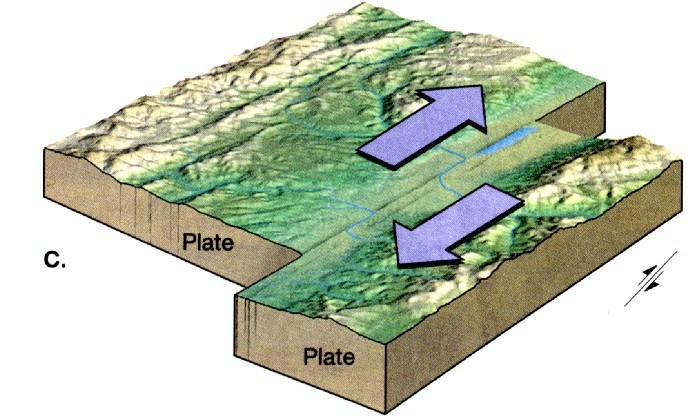
What type of plate boundary is this?
a)
Plate
b)
Divergent
c)
Convergent
d)
Transform
44.
What type of event will occur at this boundary?
a)
Earthquake
b)
Volcano Eruption
c)
Tornado
d)
Mountain Building
45.
A divergent boundary occurs when plates ....
a)
Pull apart
b)
Come together
c)
Slide past each other
d)
subducting
46.
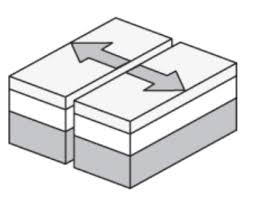
What type of plate boundary is this?
a)
Transform
b)
Convergent
c)
Divergent
d)
Plate
47.
Mountains are created when....
a)
Two continental plates collide
b)
Two oceanic plates pull apart
c)
An Oceanic plate subducts under a Continental Plate
d)
Two continental plates pull apart
48.
Name the boundary
a)
convergent boundary
b)
divergent boundary
c)
transform boundary
d)
sergent boundary
49.
The Great Rift Valley in Africa and the Mid-Ocean Ridge were all created by this boundary
a)
Divergent
b)
Convergent
c)
Reform
d)
Transform
50.
What are the reasons for the season?
a)
Earth's tilt & rotation
b)
Earth's tilt & revolution
c)
Earth's rotation & rovolution
d)
Earth's tilt & resolution
51.
Why does the area around the equator stay the same temperature all year?
a)
The equator rotates slower than the poles 
b)
The equator remains the same distance from the sun.
c)
The equator always receives direct sunlight.
d)
The equator has 18 hour days.
52.
What happens when the area in which you live tilts away from the sun?
a)
It is summer.
b)
It is spring.
c)
It is winter.
d)
It is fall.
53.
At position A, in the Northern hemisphere it would be _____?
a)
Summer
b)
Winter
c)
Spring
d)
Fall
54.

Air masses have properties from where they...

a)

were formed

b)

end up

55.

Which type of air mass brings WARM and DRY weather?

a)

Maritime Polar (mP)

b)

Maritime Tropical (mT)

c)

Continental Polar (cP)

d)

Continental Tropical (cT)

56.

Which type of air mass bring COLD and DRY weather?

a)

Maritime Polar (mP)

b)

Maritime Tropical (mT)

c)

Continental Polar (cP)

d)

Continental Tropical (cT)

57.

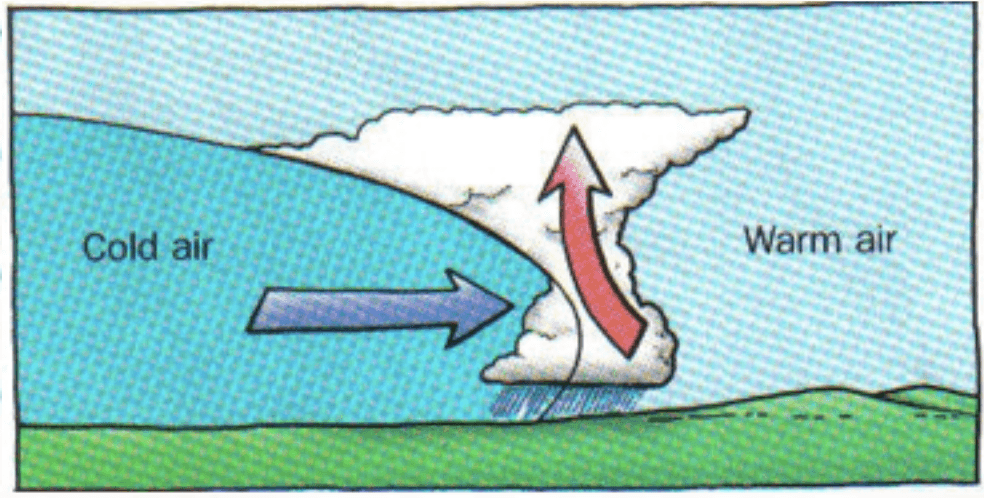
Name that front.

a)

Cold Front

b)

Warm Front

c)

Stationary Front

d)

Occluded Front

58.
This is the symbol for which type of front?
a)
cold front
b)
warm front
c)
stationary front
d)
occluded front
59.

What type of weather will you see along a cold front?

a)

Thunderstorms

b)

Sunny skies

c)

Gentle rain

d)

No weather

60.
Which statement best describes the difference between weather and climate?
a)
Weather is the conditions when you look outside while climate is the conditions you can expect for the next 6 months.
b)
Climate is the current condition outside while weather is what you can expect for the next 6 months.
61.
The conditions of the atmosphere at a certain time and place. 
a)
weather
b)
climate
c)
precipitation
d)
atmosphere
62.
The average temperature of the surface of Earth has increased approximately 1°C in the past century. Which reason best explains this increase in temperature?
a)
lower levels of ozone in the atmosphere
b)
lower levels of nitrogen in the atmosphere
c)
higher levels of carbon dioxide in the atmosphere
d)
higher levels of oxygen in the atmosphere
63.
What type of process forms soil?
a)
weathering
b)
erosion
c)
deposition
d)
compaction
64.
What is humus?
a)
soil
b)
organic matter
c)
loam
d)
minerals
65.

Select all the reactants

a)
b)
c)
66.
Substances present at the start of a chemical reaction
a)
subscripts
b)
coefficients
c)
reactants
d)
products
67.
What type of respiration requires oxygen?
a)
Aerobic
b)
Anaerobic
68.
What type of respiration does not require oxygen?
a)
Aerobic
b)
Anaerobic
69.
The parts of an ecosystem that are currently living or that have once lived.
a)
Biotic Factor
b)
Abiotic Factor
c)
Species
d)
Biome
70.
The factors in an ecoysystem that have never had the ability to live.
a)
Biotic Factor
b)
Abiotic Factor
c)
Biome
d)
Community
71.
The products of cellular respiration are
a)
carbon dioxide, water, energy
b)
oxygen and sugar (glucose)
72.
The products of photosynthesis are
a)
carbon dioxide, water, energy
b)
sugar (glucose), oxygen, water
73.
The reactants in photosynthesis are
a)
carbon dioxide, water
b)
sugar (glucose), oxygen
74.
The reactants in cellular respiration are
a)
sugar (glucose), oxygen
b)
carbon dioxide, water
75.
The efficiency of energy transfer from a lower trophic level to the next highest level is roughly
a)
1%
b)
10%
c)
100%
d)
1000%
76.
If only 10% of an organism's energy is available for the next trophic level, what happens with the other 90% of the energy?
a)
It is destroyed after it is used up.
b)
It is used for life processes or lost as body heat.
c)
It remains for the next trophic level IF the predator consumes ALL of the organism.
d)
It is lost completely as body heat. 
77.

A person who eats a chicken that ate grain is a ...

a)

primary producer

b)

primary consumer

c)

secondary consumer

d)

quaternary consumer

78.
An organism that gets energy from eating dead organisms, non-living material or waste
a)
producer
b)
consumer
c)
decomposer
79.
Which gas in our atmosphere is most abundant?
a)
Argon
b)
Oxygen
c)
Nitrogen
d)
Carbon Dioxide
80.

What biogeochemical cycle is occuring?

a)

Hydrologic cycle

b)

Carbon Cycle

c)

Nitrogen Cycle

d)

Phosphorus