
NEW
Font size
 Worksheets
Unit 4: Cell Communication & Division
Total questions: 42
Worksheet time: 47mins
The type of feedback loop that reduces the initial stimulus back to its set point:
Negative feedback loop
Positive feedback loop
Both negative and positive feedback loops do this
When glucose levels are at very high levels in the bloodstream, the pancreas will release a hormone to alert cells and the liver to uptake the excess glucose. The hormone is:
insulin
glucagon
epinephrine
cortisol
When the bloodstream has very low levels of glucose, the pancreas will release a hormone to alert liver cells to break down stored glycogen (polymer) into glucose (monomer). The hormone responsible for this is:
epinephrine
estrogen
insulin
glucagon
The type of feedback loop that amplifies responses further away from the set point:
Negative feedback loop
Positive feedback loop
Both positive and negative feedback loops do this
Child birth and fruit ripening are examples of which feedback loop?
Either negative or positive feedback loops
Negative feedback loop
Positive feedback loop
Plant cells contain small channels that allow direct movement of smaller, water soluble molecules (such as ions, signaling molecules, and some proteins) between adjacent cells. These channels help maintain communication and coordination across tissues by enabling cytoplasmic continuity. What are these plant cell structures called?
Neurotransmitters
Plasmodesmata
Glycoproteins
Gap junctions
In the immune system, T-cells bind directly to antigen-presenting cells (APCs) when a receptor on the T-cell surface recognizes and attaches to a complementary molecule on the APC. Both of these surface molecules are membrane glycoproteins. Which statement best explains the role of these glycoproteins in this interaction?
They act as enzymes that break down foreign antigens before T-cell activation can occur.
They function as cell-surface markers that enable specific binding between cells, leading to targeted immune activation.
They serve primarily as transport proteins that move antigens across the plasma membrane.
They create channels that allow cytoplasmic contents to flow directly between the T-cell and the APC.
In animal tissues such as cardiac muscle, adjacent cells are connected by specialized protein channels that link their cytoplasm, allowing ions and small molecules to pass directly from one cell to another. This coordination enables the tissue to contract in a synchronized rhythm. What are these structures called?
Gap junctions
Desmosomes
Plasmodesmata
Tight junctions
In long-distance signaling, endocrine cells release hormones that must travel throughout the body to reach target cells in distant organs. Through which pathway do these hormones primarily travel?
synaptic cleft
lymph nodes
bloodstream
interstitial fluid
The first step in a signal transduction pathway is:
Second messengers activate intracellular enzymes.
Protein kinases begin phosphorylating target proteins.
A ligand binds to a receptor protein on the target cell.
Ion channels open to propagate an electrical signal.
Receptor proteins on the surface of a cell can bind only certain signaling molecules (or ligands). Which property of these receptors is most responsible for ensuring that only specific ligands can attach?
Their direct connection to second messenger pathways
Their location within the plasma membrane
Their ability to move freely throughout the cytoplasm
Their unique combinations of charge distribution and three-dimensional shape
Kinases are enzymes that play a key role in many signal transduction pathways. What is the main function of a kinase in these pathways?
Transporting signaling molecules across the plasma membrane
Removing phosphate groups from proteins to deactivate them
Binding ligands on the cell surface to initiate signaling
Adding phosphate groups to proteins to alter their activity
Polar signaling molecules cannot generally cross the hydrophobic lipid bilayer of the plasma membrane. How do these molecules typically initiate a cellular response?
By binding to intracellular receptors in the cytoplasm
By binding to receptors embedded in the plasma membrane
By passing through ion channels to enter the cytoplasm
By being transported across the membrane via vesicles and binding nuclear proteins
When a signaling molecule binds to its receptor on a target cell, the receptor often changes shape. What is the significance of this conformational change?
It initiates the transduction of the signal inside the cell.
It causes the receptor to be degraded by lysosomes.
It prevents other signaling molecules from binding to neighboring cells.
It allows the ligand to enter the cytoplasm directly.
Calcium ions (Ca+) and Cyclic AMP (cAMP) are important molecules in many signal transduction pathways. They work in different ways within a pathway, but serve the same purpose. What is their primary role?
They both degrade ligands that bind to the receptors.
They both serve as secondary messengers to relay or amplify signals inside the cell.
They both transport signaling molecules across the plasma membranes.
They both act as a receptor for signaling molecules.
What is the correct order of the cell cycle phases:
G1 > S > G2 > M
G1 > G2 > S > M
S > M > G1 > G2
G1 > M > G2 > S
What major event occurs in S phase of the cell cycle?
Chromosomes condense and become visible under a microscope
The cell grows and produces new organelles
The nuclear envelope breaks down and spindle fibers form
DNA is replicated, resulting in the duplication of chromosomes
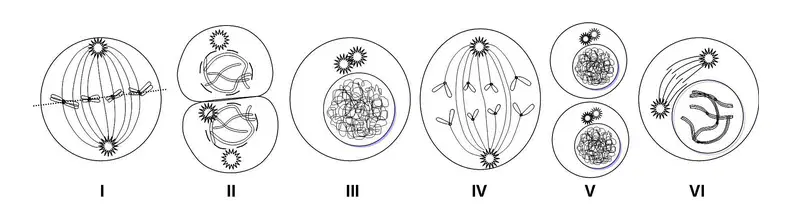
The images show different stages of the cell cycle. Arrange them in the correct chronological order from first to last.
VI > I > IV > III > V > II
III > VI > I > IV > II > V
III > IV > I > VI > II > V
VI > III > I > IV > II > V
Which molecules are primarily responsible for regulating the progression of the cell cycle at checkpoints?
DNA polymerases and ligases
Ribosomes and tRNA
Cyclins and cyclin-dependent kinases (CDKs)
Microtubules and actin filaments
How do cyclins and cyclin-dependent kinases (CDKs) work together to regulate the cell cycle?
Cyclins activate CDKs, which then phosphorylate target proteins to advance the cell cycle
Cyclins break down DNA while CDKs form the mitotic spindle
CDKs produce cyclins, which replicate the cell’s DNA
Cyclins and CDKs both directly synthesize proteins for cell growth
What happens to cyclin levels in a cell before it reaches a specific cell cycle checkpoint?
Cyclin levels stay high throughout the entire cell cycle
Cyclin levels are always zero
Cyclin levels remain very low until they are needed to help the cell pass the checkpoint
Cyclin levels randomly fluctuate without affecting the cell cycle
What is the main purpose of the M phase (spindle) checkpoint in the cell cycle?
To check that all chromosome centromeres are properly attached to spindle fibers before anaphase
To verify that DNA has been fully replicated during S phase
To ensure the cell has enough nutrients before DNA replication
To trigger cell growth and organelle production
What is the main purpose of the G1 checkpoint in the cell cycle?
To verify that DNA has been fully replicated
To trigger the breakdown of the nuclear envelope
To ensure all chromosomes are attached to the spindle fibers before anaphase
To check if the cell has enough nutrients, growth signals, and undamaged DNA before entering S phase
What is the main purpose of the G2 checkpoint in the cell cycle?
To check that the chromosomes are attached to the spindle fibers
To ensure that all DNA has been accurately replicated before mitosis
To verify that the cell has enough nutrients to grow
To trigger the breakdown of the nuclear envelope
Why do cancer cells often survive when normal cells would undergo apoptosis?
They have extra nutrients to support growth
They replicate DNA more slowly than normal cells
They are unable to divide
They ignore signals that normally trigger programmed cell death
Which of the following correctly lists the three main components of a DNA nucleotide?
Phosphate group, sugar, nitrogenous base
Ribosome, amino acid, phosphate group
Protein, lipid, carbohydrate
DNA, RNA, protein
In DNA, base pairs always consist of one purine and one pyrimidine. Which of the following correctly matches this rule?
Adenine (purine) pairs with Cytosine (pyrimidine), and Guanine (purine) pairs with Thymine (pyrimidine)
Adenine (purine) pairs with Guanine (purine), and Cytosine (pyrimidine) pairs with Thymine (pyrimidine)
Adenine (purine) pairs with Thymine (pyrimidine), and Guanine (purine) pairs with Cytosine (pyrimidine)
Adenine (pyrimidine) pairs with Thymine (purine), and Guanine (pyrimidine) pairs with Cytosine (purine)
A DNA molecule is found to contain 30% adenine (A). What are the approximate percentages of the other bases?
Thymine (T) 20%, Cytosine (C) 30%, Guanine (G) 20%
Thymine (T) 30%, Cytosine (C) 20%, Guanine (G) 20%
Thymine (T) 30%, Cytosine (C) 25%, Guanine (G) 15%
Thymine (T) 30%, Cytosine (C) 30%, Guanine (G) 10%
During DNA replication, how are the leading and lagging strands synthesized?
Both strands are synthesized continuously in the 3′ → 5′ direction
The leading strand is synthesized continuously in the 5′ → 3′ direction, while the lagging strand is synthesized discontinuously in short fragments in the 5′ → 3′ direction
The leading strand is synthesized discontinuously in short fragments in the 3′ → 5′ direction, while the lagging strand is synthesized continuously in the 3′ → 5′ direction
What is the main role of DNA polymerase during DNA replication?
To unwind the DNA double helix
To add nucleotides to a growing DNA strand
To join DNA fragments together
To synthesize RNA primers
What is the main role of DNA ligase during DNA replication?
To add nucleotides to a growing DNA strand
To join multiple fragments on the lagging strand and the fragment on the leading strand through a covalent bond
To unwind the DNA double helix
To synthesize RNA primers
What is the main role of DNA helicase during DNA replication?
To add nucleotides to the growing DNA strand
To synthesize RNA primers
To join fragments on the lagging strand
To unwind the DNA double helix at the replication fork
What is the main role of the enzyme topoisomerase during DNA replication?
To relieve the tension and supercoiling caused by unwinding the DNA
To add nucleotides to the growing DNA strand
To join fragments on the lagging strand
To unwind the DNA double helix at the replication fork
DNA replication is described as semi-conservative. What does this mean?
Each new DNA molecule contains two newly synthesized strands
Each new DNA molecule contains one original (template) strand and one newly synthesized strand
DNA is copied without separating the original strands
The new DNA molecules are completely different from the original DNA

The image shows a DNA replication fork with the two template strands labeled. Based on the direction of replication- Which template strand will make the leading strand? Hint: Look at the 5' to 3' directionality to determine this! Does the leading strand get made towards or away from the fork?
Template Strand 1 → Will be used to make the leading strand towards the replication fork
Template Strand 2 → Will be used to make the leading strand towards the replication fork
Template Strand 2 → Will be used to make the leading strand away from the replication fork
Template Strand 1 → Will be used to make the leading strand away from the replication fork
Which statement correctly matches a stage of mitosis with what happens during that stage?
Prophase – Chromosomes condense and the nuclear membrane breaks down
Metaphase – Chromosomes are pulled apart to opposite sides of the cell
Anaphase – Chromosomes line up across the center of the cell
Telophase – Chromosomes first become visible as long, thin strands
If a DNA sample contains 22.4% guanine (G), what are the correct percentages of all four bases in the sample?
A = 22.4%,
T = 22.4%
G = 27.6%
C = 27.6%
A = 27.6%
T = 27.6%
G = 22.4%
C = 22.4%
A = 22.4%
T = 27.6%
G = 22.4%
C = 27.6%
A = 38.8%
T = 38.8%
G = 11.2%
C = 11.2%
Which mitosis phase has spindle fibers attaching to the centromeres of the 2 sister chromatids of a chromosome?
Prophase
Metaphase
Anaphase
Telophase
What is the main purpose of cytokinesis?
To replicate DNA
To divide the nucleus into two identical parts
To separate the cytoplasm and form two distinct daughter cells
To line up chromosomes in the center of the cell

Which of the following best explains the role of Enzyme 1?
Enzyme 1 is a DNA ligase that joins DNA fragments at a replication fork to form continuous strand
Enzyme 1 is a DNA primase that catalyzes the synthesis of RNA primers on the lagging- strand of a replication fork
Enzyme 1 is a DNA polymerase that synthesizes new DNA by using the leading strand and lagging strands of a replication fork as templates
Enzyme 1 is a topoismerase that relieves the tension in the over would DNA in front of the replication fork.

Examine the image. Which strands are the template strands?
Strands 2 and 3
Strands 1 and 3
Strands 3 and 4
Strands 1 and 4
Examine the image. Which strand is the lagging strand?
Lagging is Strand 3-
It is made discontinuously in the 5' to 3' direction
Lagging strand is Strand 2-
It is made continuously in the 5' to 3' direction
Lagging strand is Strand 3-
It is made continuously in the 3' to 5' direction
Lagging strand is Strand 4-
It is made in the 3' to 5' direction

