
 Worksheets
Physics Quiz
Total questions: 164
Worksheet time: 7hrs 6mins

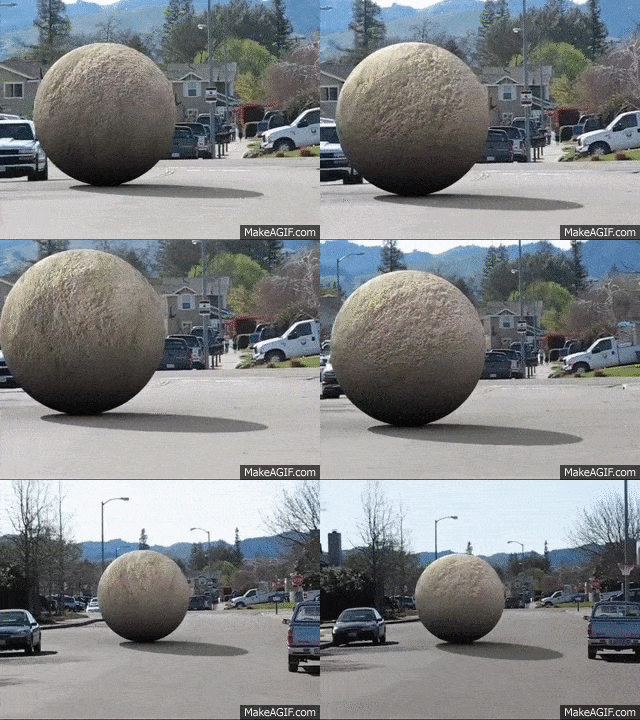
Which "soccer" ball (in the image) lost velocity after the collision?
A
B
neither
both
A collision in which total momentum and total kinetic energy are conserved is called ...
inelastic collision
perfectly inelastic collision
elastic collision
conserved collision
A collision in which two objects stick together after colliding is called ...
perfectly elastic collision
perfectly inelastic collision
elastic collision
conserved collision
In order for an object to have momentum it must be ________
moving
motionless
alive
asleep
If an object has a momentum of 40 kg x m/s and a mass of 60 kg, what is it's velocity?
2400 m/s
1.5 m/s
240 m/s
.67 m/s
What is the unit for velocity?
m/sec
kg/sec
kg/m
kg x m/sec
What is the unit for momentum?
m/sec
kg/sec
kg/m
kg x m/sec
The equation to calculate momentum is
p = m x v
p = 1/2 m x v2
p = m x g x h
p = m x g
What force slows objects down and keeps them from moving?
Acceleration
Gravity
Friction
Net Force

Which one of Newton's laws are displayed
2nd law
1st law
3rd law
An object in motion will stay in motion and an object at rest will stay at rest unless acted upon by an outside force. Which law does this describe
2nd law
1st law
3rd law

This is Newton's 3rd law
True
False

When there is a change in motion?
When forces are balanced
When the forces are unbalanced
Whe forces are equal
Never



Two skaters begin at rest. Skater 1 has a smaller mass than Skater 2. After they push off each other,...
Skater 1 experiences a greater change in momentum
Skater 2 experiences a greater change in momentum
Skater 1 has a greater speed than Skater 2
Skater 1 experiences a greater force


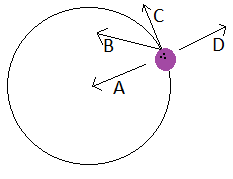
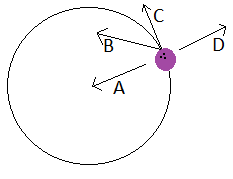
What would the force between them be if the distance between them were doubled?
What would the force between them be if the distance between them were divided by 2?
What would the force between them be if one of the masses were doubled?
What would the force between them be if both of the masses were doubled?
A satellite of mass m and speed v orbits the Earth at a distance r from the center of the Earth. The gravitational acceleration due to the Earth at the satellite is equal to.
v/r
v2/r
mv/r
mv2/r
Centripetal force is...
the inward force acting on a body moving at constant speed in a circle
the outwards force acting on a body moving at constant speed in a circle
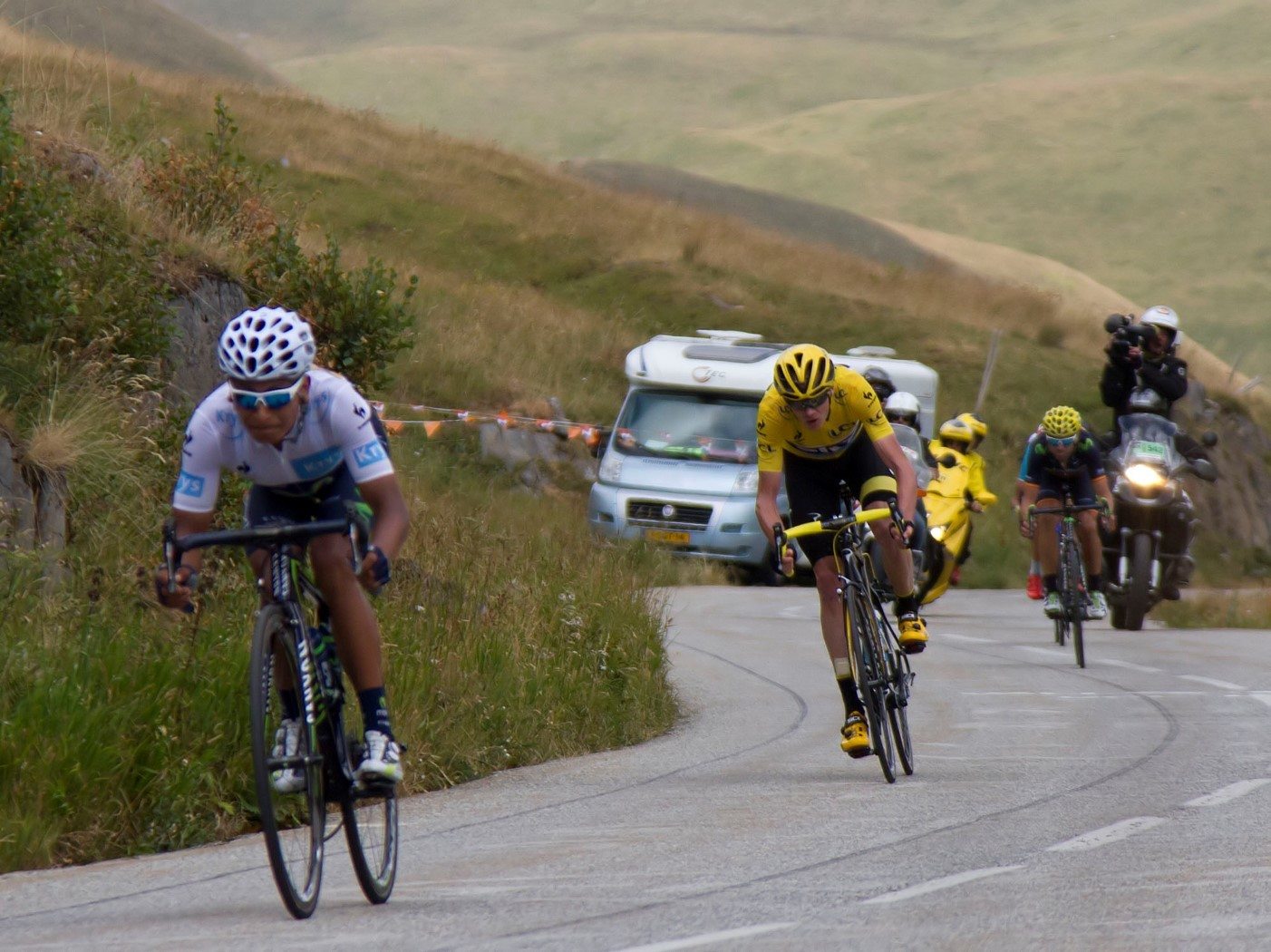
Why do objects experience centripetal acceleration even though they can have a constant speed?
Because they are speeding up as they move in a circle
Because they are constantly changing direction and hence, velocity changes, and that net change is directed inward.
Because they are constantly changing both speed and direction
Because when you have 100 people pedaling, you can speed up more easily.
The linear velocity is always _____ to the line of a circle.
outwards
towards the center
tangent
faster
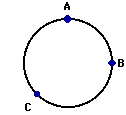
A fairground roundabout makes 8 revolutions in 1 minute. The angular velocity of the roundabout is
0.10 rad s-1
0.42 rad s-1
0.84 rad s-1
0.94 rad s-1
A particle moving in a circular path completes 8.0 revolutions in 5.0 s.
Its angular velocity in rad s−1 is
1.6
10
40
250
The drum of a washing machine rotates with an angular velocity of 8.5 rad s−1.
The time to complete 10 revolutions is
0.85 s
1.3 s
3.7 s
7.4 s
A particle completes 6.0 revolutions in 4.0 s. The angular velocity, in rad s−1, is
1.5
9.4
24
150
A racing car of mass 1200 kg travels at 0.63 rad s−1 around a bend of radius 50 m. The force on the car necessary for this motion is
2.4 x 10⁴ N away from the centre of the circle
2.4 x 10⁴ N towards the centre of the circle
3.8 x 10⁴ N away from the centre of the circle
3.8 x 10⁴ N towards the centre of the circle

A mass rotates along a circular path, as indicated by the dotted line. The diameter of the circular path is 0.80 m and the period of rotation is 0.60 s.
The mass of the pendulum is 0.30 kg and its speed is 4.2 m s−1.
What is the centripetal force acting on the mass?
13 N
6.6 N
3.2 N
2.1 N
A particle, mass 0.020 kg, is moving with an angular velocity of 3π rad s−1 around a circle of radius 0.50 m. The force, in N, responsible for this motion is
0.03 π towards the centre of the circle
0.03 π away from the centre of the circle
0.09 π2 towards the centre of the circle
0.09 π2 away from the centre of the circle

A pendulum consists of a bob of mass m and a string of length x. The diagram shows the pendulum swinging through the arc of a circle. At the bottom of its swing
the tension in the string is T and the velocity of the bob is v.
Which of the following is correct for the bob at the bottom of the swing?
T=xmv2−mg
T=xmv2+mg
T=mg−xmv2
T=xmv2

The mass rotates along a circular path, as indicated by the dotted line. The diameter of the circular path is 0.80 m and the period of rotation is 0.60 s.
Which of the following shows how the angular velocity can be determined?
2π×0.60
2π÷0.60
2π×0.40÷0.60
2π×0.40×0.60
A student is sitting on the right-hand side in a bus, facing the direction of travel. The bus goes round a bend to the left. The student remains in the same position within the bus.
The student experiences
a force to the left and a force to the right.
a resultant force to the left.
a resultant force to the right.
no resultant force.

A car, mass m, drives over a circular hump-back bridge of radius r with a constant speed v.
When it is at the top of the bridge, the force on the car from the bridge is given by
mg
rmv2+mg
rmv2−mg
mg−rmv2
What is the symbol for displacement?
d
s
u
v
What does u represent?
Upwards acceleration
Final velocity
Initial velocity
Average velocity
What does v stand for?
Final velocity
Initial velocity
Average velocity
Terminal velocity
What is the symbol for acceleration of free fall at the Earth's surface?
a
f
g
v
What are the standard units for velocity?
km/h
km h-1
m/s
m s-1
Which of these could not be a positive acceleration?
Acceleration towards the Earth as an object falls.
Slowing down while moving in the negative direction.
Speeding up while moving in the positive direction.
Acceleration of an object thrown upwards from the surface of the Earth with an initial velocity of 8m s-1.
What are the standard units of acceleration?
m
s
m s-1
m s-2
When can you not use the suvat equations?
For a falling object.
When acceleration is constant.
When velocity is changing by a constant amount.
When acceleration is changing.

Which of the following is NOT correct?
V=u+ta
u2=v2−2as
ut=21at2−s
V=2u+v

Not present in the equations of motion
Acceleration
displacement
speed
force

Constant speed with respect to time is___
linear acceleration
uniform speed
uniform acceleration
instantaneous speed
Using SUVAT calculate a when v = 30, u = 10, t = 5
4
6
-6
-4

Using SUVAT, find s when v = 5, u = 3, a = 2
4
5
6
7

A particle is accelerated uniformly from rest, so that after 10 seconds it has achieved a speed of 15 m/s. Find its acceleration and the distance it has covered.
2.5ms−2 75m
1.5ms−2 75m
0.5ms−2 55m
2.5ms−1 75m
Acceleration can be negative or positive
True
False
Uniformly accelerated motion involves motion of objects with constant rate of change of displacement.
True
False
Distance s is
s=vt
s=tv
s=vt
tv−u

Which of the following terms describes a Vector and it's proper units?
position in seconds
distance in meters
speed in hours
velocity in m/s

A car goes from rest to 30 m/s. If it takes the car 40 seconds to reach that speed then what is the car's rate of acceleration?
1.33 m/s2
0.75 m/s2
10 m/s2
0 m/s2

A car is traveling south for 250 meters over the course of 100 seconds. What was the car's average velocity?
0.4 m/s south
0.4 m/s
2.5 m/s
2.5 m/s south

What is the average velocity of the object between 0 and 10 seconds?
6.0 m/s
1.5 m/s
-4 m/s
0 m/s

What is the average velocity of the object between 10 and 15 seconds?
6 m/s
1.5 m/s
-4 m/s
0 m/s

What is the average velocity of the object between 15 and 40 seconds?
6.0 m/s
1.5 m/s
-4 m/s
0 m/s

What is the rate of acceleration of the object between 0 and 4 seconds?
1 m/s
0 m/s2
-1 m/s2
1 m/s2

What is the velocity of the object between 4 and 5 seconds?
0 m/s
5 m/s
1 m/s
2 m/s

Which graph(s) represents a constant velocity?
a and c
b and c
c
a and b

Horse A is running East at a speed of 6 m/s. Horse B is running at a speed of 8 m/s East as it passes Horse A. What is Horse B's velocity relative to Horse A?
14 m/s
-2 m/s
2 m/s
48 m/s
If an object is neutrally buoyant it will ________.
sink
float
neither float or sink
objects cannot be neutrally buoyant...
This is what happens to an object when the gravitational force is stronger than the buoyant force.
sinks
floats
neutrally buyant
I don't know...
This is what happens to an object when the buoyant force is stronger than the gravitational force.
sinks
floats
neutrally buyant
I don't know...
This is what happens to an object when the buoyant force is EQUAL to the the gravitational force.
sinks
floats
neutrally buyant
I don't know...
If we place an empty sealed plastic bottle in water, we know it will float. What could we do to make it sink?
You can't make a plastic bottle sink
Increase mass (fill it with coins)
Fill the bottle with helium
Decrease mass (use a bottle made out of lighter plastic)
If an object, such as a ball of clay sinks, what would we need to do to its volume to make it float?
Clay can't float
Increase the volume
Decrease the volume
Keep the volume the same
Which properties affect buoyancy?
(select all that apply)
Mass
Volume
Density
Luster
The density of fresh water is 1 g/cm3.
Imagine the clay boat you just designed has a density of 1.5 g/cm3. What would happen to your boat if you placed it in fresh water?
sink
float
neutrally buoyant
no way of knowing what would happen
The density of fresh water is 1 g/cm3.
Imagine the clay boat you just designed has a density of 0.8 g/cm3. What would happen to your boat if you placed it in fresh water?
sink
float
neutrally buoyant
no way of knowing what would happen
The density of fresh water is 1 g/cm3.
Imagine the clay boat you just designed has a density of exactly 1 g/cm3. What would happen to your boat if you placed it in fresh water?
sink
float
neutrally buoyant
no way of knowing what would happen
Assume you have an ice cube and also a small rock that is the same size and shape as the ice cube. Predict what would happen if you placed the ice cube and rock in a glass of water.
The ice cube and rock will both float.
The ice cube will sink and the rock will float.
The ice cube will float and the rock will sink.
The ice cube and rock will both sink.
A fluid exerts pressure only in an upward direction.
True
False
_____ force is an upward force that fluids exert on any object that is placed in them.
Buoyant
Gravity
Torque
The amount of mass in a given volume of a substance is its (a) .
An object floats in a fluid when the buoyant force acting on the object is
acting above the object.
less than the object’s weight.
acting under the object.
equal or greater than the object’s weight.
A denser substance will...
become more dense in a less dense fluid.
become less dense in a less dense fluid.
float on a less dense fluid.
sink in a less dense fluid.
Buoyant force occurs because the fluid below an object exerts greater (a) on the object than the fluid above it.
Buoyant force is a/an _______ force that fluids exert on any object that is placed in them.
Upward
Downward
When a body is totally or partially immersed in a fluid, the up thrust is less than the weight of the fluid displaced by it.
True
False
If a body weighs 600 gf in the air but appears to only weight 450 gf when completely immersed in water, then the upthrust on the body by the water is _____ .
600 gf
450 gf
1050 gf
150 gf


from the image below which represents the correct force of the fluid pressure on solid objects ...


What is the likely identity of a material (see Table 10–1) if a sample has a mass of 55 g when measured in air and an apparent mass of 34.6 g when submerged in water?
Iron or steel
Lead
Aluminum or granite
Gold
A 3.80-kg aluminum ball has an apparent mass of 2.10 kg when submerged in a particular liquid. The density of the liquid is:
2185.7 kg/m3
0.44 kg/m3
1207.9 kg/m3
0.81 kg/m3
An iron anchor weighs 1112.06 N in air. If it is immersed in sea water, how much force would be required to lift it while it is immersed?
1112 N
900.2 N
965.9 N
952.6 N
A cube of iron 0.300 m on a side is suspended (in equilibrium) from a rope in a giant tank of water. What is the tension in the rope?
1720N
1600 N
1552 N
1810N
You, Archimedes, suspect that the king’s crown is not solid gold but is instead goldplated lead. To test your theory, you weigh the crown, and find it to weigh 60.0 N and to have an apparent weight of 56.2 N when it is completely submerged in water. What is the density of the crown?
15789.5 kg/m3
11300 kg/m3
7500 kg/m3
19300 kg/m3
without friction, an object in motion would never stop
true
false
you can walk because there is friction between your __________ and ______________
ground and air
feet and ground
feet and air
air and ground
friction helps you write on a paper or black board.
true
false

In which of these examples is friction helpful:
soil erosion
engine parts wearing out
breaks stopping a car
holes developing in your socks
Haley is standing outside in the cold weather waiting for her bus. How can she create heat with her hands?
Wave her hands in the air
Rub her hands together
Cover her hands in a towel
Wash her hands with water
Two objects will create some heat if what is true?
The objects are far apart.
. The objects are both very heavy.
The objects are made of different mate
The objects rub against each other
Right after a nail is pulled from a piece of wood, it feels hot. What makes the heat?
The wood rubs against the nail
The nail is made of iron, a kind of metal.
The nail was heated by the air around it.
The wood is made from a tree, a living thing.
Wesley is bored during class and begins rubbing his pencil eraser on the desk. He notices he created energy. What kind of energy can be created by rubbing an eraser on a desk?
electric energy
heat energy
light energy
magnetic energy
Micah is riding his bike. He stops quickly and notices the tires feel very hot. Why are the tires hot?
They are filled with ai
They moved in a circle.
They are very smooth.
They rubbed against the road.
Which of these actions would most likely make the most heat?
Dragging a heavy box across the floor
Letting ice cubes melt on a plate
Growing plants in a sunny window
Pouring water from one cup to another
Larissa is enjoying a camping trip with her friends and all of their dads. The dads decide to show the girls how to start a fire without the use of a lighter or match. Which of these is the best way to create the heat to start a campfire?
Allowing the sun to shine on a pile of sticks
Rubbing two large sticks together
Blowing warm air onto a pile of sticks
Breaking one long stick into smaller sticks
Adrian has two blocks of wood. What can Adrian do with the blocks so they will make heat?
Place one block on top of the other
Put the blocks under a heavy blanket
Rub one block against the other
Carefully take the temperature of the blocks


What is the best description of the relationship shown in this graph?
In this graph, the relationship between force and extension is linear.
In this graph, the relationship between force and extension is non-linear.
In this graph, the relationship between force and extension is directly proportional.
In this graph, there is no relationship between force and extension.

The graph shows the relationship between force and extension as a spring is extended. What is another name for point A?
Point A is the elastic limit
Point A is the elastic summet
Point A is the plastic limit
Point A is the extension limit
Which statement most accurately represents Hooke's Law?
a) The stretch of a spring is directly proportional to the force applied.
b) The stretch of a spring is proportional to the number of coils.
c) The stretch of a spring is inversely proportional to the force applied.
d) Thickness of a spring wire is proportional to the force applied.

An unstretched spring becomes longer when a force is applied to it. Which word describes the additional length of the spring gains?
Expansion
Extension
Stretched

The _________ of an object is the increase in its length when it is stretched.
compression
extension
A spring has a spring constant of 5N/m. What is its extension when loaded with 15N?
4m
5m
3m
10m

