
 Worksheets
Trimester 1 Review (AP Bio Units 1-4)
Total questions: 160
Worksheet time: 3hrs 41mins
What type of bond joins oxygen and hydrogen together within one water molecule?
Nonpolar Covalent Bonds
Hydrogen Bonds
Polar Covalent Bonds
Ionic Bonds
What is the range of the entire pH scale?
2-14
1-14
0-14
1-13
All lipids are _________ in water.
hydrophobic
phosphate
insoluble
dehydration synthesis
What are example of nucleic acids
Adenine
DNA
Thymine
RNA
What is dehydration synthesis
A reaction where large molecules are made into small molecules by removing water
A reaction where small molecules are made into large molecules by removing water
A reaction where small molecules are made into large molecules by adding water
A reaction where large molecules are made into large molecules by adding water
What type of bonds join two water molecules together?
covalent bonds
hydrogen bonds
ionic bonds
capillary action
What property allows water molecules to stick together?
cohesion
adhesion
density
capillary action
What property allows water to stick to other substances?
Cohesion
Adhesion
High Specific Heat
Capillary Action
What property allows water to move up from the roots to the leaves of the plant?
Capillary Action
Cohesion
Adhesion
Surface Tension
Why does Ice float?
It is more dense than water
surface tension
It is less dense than water
high specific heat
What property prevents large bodies of water from quickly fluctuating in temperature?
Surface Tension
High Specfic Heat
Polarity
Covalent Bonds
What property allows some insects to walk accoss water?
Jesus
Surface Tension
Density
Polarity
What does polar mean?
When they share the same amount of electrons
There are more positive electrons
There are more negative electrons
Unequal sharing of the electrons making water a polar molecule
What type of ions do bases produce?
H+
OH-
H-
OH+
What type of ions do acids produce?
H+
H-
OH-
OH+
What is the range of an acid?
1-6
1-6.7
1-6.3
1-6.9
What is the range of a base?
7.2-14
7-14
7.1-14
7.5-14
What number on the pH scale is considered neutral?
7
6
8
9
How are polymers made from monomers?
Hydrolysis
Dehydration synthesis
Cellulose
Starch
How are polymers broken back down into monomers?
Hydrolysis
Dehydration synthesis
Starch
Cellulose
What is the function of carbs?
Supply short term energy
Structure Support
Long term energy
No support in structure
Plants store excess sugar as?
Starch
Cellulose
Glucose
Fructose
Which polysaccharide makes up the tough cell wall of plants?
Starch
Cellulose
Glucose
Sugar
What is a monosaccharide and a example?
A simple sugar
1
Lactose
Glucose
What is a disaccharide and an example?
2
Lactose
A sugar
3 or more
What is a Polysaccharide and an example?
3 or more
Starch
A Simple Sugar
Lactose
Phospholipids have a glycerol head, fatty acid tails and a __________________?
Carbon
Oxygen
Phosphate
Hydrogen
Saturated fats are ?
Solid
Liquid
Lack double bonds
Have double bonds
Unsaturated fats are ?
Solid
Liquid
Lack double bonds
Have double bonds
Which level of protien structure includes the alpha helix and Beta pleated sheets?
Primary
Secondary
Teritary
Quaternery
Which level of protien structure includes amino acids joined otgether by peptide bonds?
Primary
Secondary
Teritary
Quaternery
What are the functions of protiens?
Body tissue
Coordinate body functions
No body tissue
No body functions
What part of an amino acid is different for each of the 20 amino acids?
Structure
Body tissue
Electrical Charge
Polarity
What are the elements found in the four macromolecules?
Carbon
Hydrogen
Oxygen
Nitrogen
Phosphorus
What is the monomer of nucleic acids?
Monosaccharide
Amino acids
Nucleotide
Glycorel and fatty acids
What are two examples of Nucleic Acids?
DNA
Meat
RNA
Eggs
What is dehydration synthesis
Two monomers come together with water
Two monomers break apart with water
Two monomers come together with glucose
Two monomers break apart with glucose
What is hydrolysis
Two monomers come together with water
Two monomers break apart with water
Two monomers come together with glucose
Two monomers break apart with glucose

One of the key innovations in the evolution of eukaryotes from a prokaryotic ancestor is the endomembrane system. What eukaryotic organelles or features might have evolved as a part of, or as an elaboration of, the endomembrane system?
plasma (cell) membrane
chloroplasts
mitochondria
nuclear membrane

In a bacterial cell, one of the subunits of the ribosome is called 30s and is composed of about 20 different proteins. A mutation occurs that changes the structure of one of these proteins. What effect will this most likely have on the bacterial cell?
It would stimulate binary cell fission and the cell would divide uncontrollably.
The cell would be unable to properly synthesize proteins.
Development of abnormal hereditary features would occur in the cell.
Increased protein absorption would occur through the cell membrane

Which of the following statements regarding the mitochondria is correct?
Mitochondria contain their own ribosomes and thus produce some of their own proteins.
Mitochondria are involved in the transport that occurs as a part of the endomembrane system.
Mitochondria rely on the DNA of the eukaryote cell in order to function correctly.
Mitochondria produce ATP only used by themselves.

A cross section of part of a Golgi complex is shown. Part of the membrane of the Golgi complex pinches off and moves away. Which of the following is a function of this process?
to release energy from ATP
to deliver proteins to other locations in the cell
to collect amino acids for use in protein synthesis
to sent messages about cell requirements to the nucleus
Which of the following statements correctly matches a cell part with its function
The cell membrane packages lipids for export
The mitochondria perform photosynthesis
The lysosome digests molecules
The nucleus produces energy

Trichondia is a eukaryotic organism that attaches itself to fish and eats bacteria. Which of the following distinguishes Trichodina from all prokaryotes?
Trichodina is unicellular
Trichodina has a nucleus
Trichodina has cytoplasm
Trichodina is heterotrophic

Keratin is a protein found in hair. Where in a cell is keratin made?
nucleus
vacuole
ribosomes
mitochondria

After a protein is constructed at the ribosome, it can be transported to the Golgi complex for modification. What cellular structure is used in this transport?
Lysosome
Mitochondrion
Nuclear pore
Endoplasmic reticulum
You are told that the cells on a microscope slide are plant, animal, or bacterial. You look at them through a microscope and see cell walls and membrane-bound organelles. How should these cells be classified?
plant cells
animal cells
They could be plant cells or bacterial cells.
They could be plant cells, animal cells or bacterial cells.
Which of the following is a major difference between a prokaryote and a eukaryote?
The need for nutrients.
The presence of a nucleus.
The presence of a cell membrane.
The presence of DNA.
Why are chloroplasts found in plant cells but NOT in animal cells?
Plant cells are producers that make their own food.
Plant cells need additional protection from herbivores.
Animal cells do not need to store water.
Animal cells store their DNA in the nucleus.

What is the name of organelle D?
mitochondrion
nucleus
Golgi body
vacuole

Which organelle breaks down food to release energy?
B
D
G
H

Identify cholesterol molecule
structure a
structure b
structure h
structure i

identify a glycolipid
structure a
structure d
structure e
structure g

Identify a peripheral protein
structure a
strucure b
structure g
structure h
Plasma membranes are selectively permeable. This means
anything can pass in and out
the membrane regulates the passage of the material in and out of the cell
glucose cannot enter the cell
cholesterol cannot enter
Which of the following substances would have the most trouble crossing the membrane by diffusing through the bilayer?
water
oxygen
carbon dioxide
a sodium ion
A major function of glycoproteins and glycolipids in the membane is to
glue cells together to form tissues
allow cells to identify each other
attach membrane to cytoskeleton
help retain shape

In a lipid bilayer, ___________ fatty acid tails face each other within the bilayer and form a region that excludes water.
A. Hypotonic
B. Hypertonic
C. Hydrophilic
D. Hydrophobic
The Endosymbiotic Theory suggests that eukaryotic cells evolved when an ancient cell engulfed another, forming a permanent symbiotic relationship. Choose the evidence that best justifies this claim.
Both mitochondria and chloroplasts perform energy functions
Eukaryotic cells have many mitochondria
Eukaryotic cells have traits in common with archaea
Mitochondria and chloroplasts contain circular loops of unique DNA

Long hair-like structure that allows movement of the cell
Pili, Eukaryotic
Flagella, Eukaryotic
Cilia, Prokaryotic
Bacteria, Eukaryotic
Flagella, Prokaryotic
Which of the following statements about osmosis is correct?
a)If a cell is placed in an isotonic solution, more water will
enter the cell than leaves the cell.
a)Osmotic movement of water into a cell would likely occur
if the cell accumulates water from its environment.
a)The presence of aquaporins (proteins that form water
channels in the membrane) should speed up the process
of osmosis.
a)If a solution outside the cell is hypertonic compared to the cytoplasm, water will move into the cell by osmosis.
a)Osmosis is the diffusion of water from a region of lower water concentration to a region of higher water concentration.
Cells (e.g., bacteria) are taken up by other cells (e.g., an immune cell) by which of the following?
a)pinocytosis
a)exocytosis
a)receptor-mediated endocytosis
a)phagocytosis
a)facilitated diffusion

As shown on the next slide, two solutions with similar solute concentration are separated by a membrane that allows only water to pass, and one solution is of greater volume than the other. Which choice best describes what will happen next?
a)The energy in the pressure gradient will drive water to the
left side, which will cause the solute concentration on the
right side to increase.
a)Water will pass to the right side and increase its volume.
a)Any water that passes to the left side will create a tension
on the right side, pulling the water back to the right side.
a)The water will flow to the left side, down its pressure gradient, until the two sides achieve equal height.
a)Since there is no concentration gradient present, there will
be no net movement of water.
One strategy used by many animal species to avoid the need for their body cells to have either a stiff external cell wall or active contractile vacuoles is to
a)have membranes that are impermeable to water and keep it from entering their cells.
a)use aquaporins to actively pump water out through a hydrophilic pore.
a)keep the concentration of solutes in their cytosol the same as that found in pond water.
a)maintain a high internal pressure to constantly push extra water out of cells.
a)carefully regulate the solute concentration of the extracellular solution to which their cells are exposed.
A correct distinction between facilitated diffusion and active transport of a substance across a biological membrane is that
a)active transport requires conformational changes in the
transport protein associated with the transport process,
and facilitated diffusion does not.
a)active transport requires an integral membrane protein to
carry out the transport, and facilitated diffusion does not.
a)facilitated diffusion requires a protein lined pore in the
membrane, and active transport does not.
a)facilitated diffusion depends on an existing energy gradient
acting on the transported substance, while active transport
makes such a gradient.
a)facilitated diffusion requires cellular energy (often from ATP hydrolysis), but active transport does not.

The location where the enzyme and substrate bind is the...
allosteric site
inhibition site
reaction site
active site
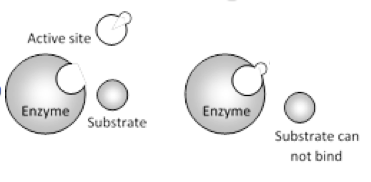
This image shows...
Competitive Inhibition
Uncompetitive Inhibition
Noncompetitive Inhibition
Normal enzyme function

Chemiosmosis is best described as...
Moving high energy electrons through carrier molecules toward oxygen
The use of a proton gradient to power ATP Synthase and produce ATP
The breakdown of pyruvate into electron carrier molecules
The enzyme that combines ADP and inorganic phosphate to produce ATP

The point of the Krebs Cycle is to...
Produce high amounts of ATP using a proton gradient
Move high energy electrons through series of proteins to eventually bind with O2, creating water and protons
Break down pyruvate to produce electron carrier molecules, FADH2 and NADH, as well as CO2 and ATP as byproducts
Use ATP and NADPH to produce 6 carbon sugars
What effect does adding an enzyme to a reaction cause?
increasing the time it takes for the reaction to occur
increases the activation energy
decreases the activation energy
increasing the amount of energy necessary for the reaction
What serves as the final acceptor of the electrons moving down the ETC during cellular respiration?
sulfur
carbon dioxide
ATP
oxygen
What is true of glycolysis?
produces a net of 2 ATP
occurs in the mitochondria
produces ATP through oxidative phosphorylation
produces 34ish ATP
all of the above are true

Which enzyme functions best in acidic environments?
neither enzyme
Enzyme A
Enzyme B
Both enzymes
The break down of larger molecules into small one.
metabolism
catabolism
anabolism
oxidation

The goal of photosynthesis is to
convert light energy into glucose energy
use light energy to make oxygen gas
convert sugar energy into ATP
convert sugar energy into oxygen gas
Rubisco is important in which step of photosynthesis
energizing the electrons in chlorophyll
carbon fixation when CO2 is connected to RUBP during calvin cycle
regeneration phase as RUBP is made during calvin cycle
reduction of the carbon chain during the calvin cycle
Plants obtain CO2 into the chloroplast by
active transport
diffusion
facilitated diffusion
endocytosis
An increase in CO2 in the air would most likely
increase photosynthesis
increase cell respiration
increase photorespiration
increase transpiration
Transport electrons and hydrogen ions (H+) to the electron transport chain
Capture energy throughout the process of cellular respiration
Provide the reactants for the process of cellular respiration
Pump positive hydrogen ions and shuttle electrons across the electron transport chain and contribute to chemiosmosis
The ETC provides the energy needed to make the majority of the cell's ATP in a process known as:
chemiosmosis
substrate level phosphorylation
oxidative phosphorylation
What produces ATP during glycolysis?
chemiosmosis
oxidative phosphorylation
substrate level phosphorylation
fermentation
The amount of energy needed for a reaction to occur is called the (a) ?

What's going on in this picture?
The enzyme is taking the red substrate and turning it blue
The enzyme's active site is blocked by a competitive inhibitor
The enzyme can't function if too many substrates are trying to bind
This is an example of an anabolic enzyme reaction
An activor or inhibitor binding place that is not the active site, causing the enzyme to change conformation (shape) is an example of ...
competitive inhibition
allosteric control
optimum conditions
induced fit
Which of the following is NOT produced during the electron transport chain in cellular respiration?
ATP
NADP+
FADH+
H2O
Which of the following is NOT produced during the Calvin Cycle in photosynthesis?
G3P
RuBP
NADPH
FADH2
Name the key enzyme in the Calvin Cycle that fixes CO2.
RuBP
RUBISCO
Carboxylase
Pyruvate Dehydrogenase
Which of the following does NOT belong?
Glycolysis
Citric Acid Cycle
Chemiosmosis
Light Dependent Reactions

What does A represent?
inner membrane
cristae
outer membrane
matrix

What does c represent?
inner membrane
cristae
matrix
outer membrane

What letter represents the matrix?
a
b
c
b and c
Which of these are reactants needed to start cellular respiration?
oxygen
carbon dioxide
glucose
water
Which of these are products of cellular respiration?
oxygen
carbon dioxide
water
ATP
What stage occurs in the cytosol (cytoplasm) of the cell?
glycolysis
Kreb's cycle
ETC
Calvin Cycle
Where in the mitochondria does the Kreb's cycle occur?
outer membrane
inner membrane
cristae
matrix
Glycolysis splits glucose into 2, 3 carbon ________ molecules
G3P
ATP
pyruvate
acetyle COA
Immune cells, specifically Antigen presenting cells, was an example of which type of communication
Direct contact
Local signaling (paracrine)
Long distance signaling
Local signaling (synaptic)
Ligands, such as growth factors, was an example of which type of communication
Direct contact
Local signaling (paracrine)
Long distance signaling
Local signaling (synaptic)
Seritonine is a neurotransmitter that is extremley important for healthy sleep. This is an example of which type of communication
Direct contact
Local signaling (paracrine)
Long distance signaling
Local signaling (synaptic)
A popular product for fruit and vegetable fans are 'Debbie green bags' which can be purachsed almost anywhere. Produce is placed in a bag that allows for the escape of ethylene gas, a hormone released by plants to ripen other nearby produce. This is an example of what type of communication?
Direct contact
Local signaling (paracrine)
Long distance signaling
Local signaling (synaptic)
Hormones released in the bloodstream is an example of what type of cell communication?
Direct contact
Local signaling (paracrine)
Long distance signaling
Local signaling (synaptic)
Small ions or non-protein moelcules that help amplify a signal during transduction
Protein phophatase
Protein kinase
Secondary messangers
Ligands
Cyclic AMP (cAMP) was an example of...
Protein phophatase
Protein kinase
Secondary messangers
Ligands
A molecule respsonsible for phosphorylating intracellular signaling molecules
Protein phophatase
Protein kinase
Secondary messangers
Ligands
A molecule respsonsible for de-phosphorylating intracellular signaling molecules
Protein phophatase
Protein kinase
Secondary messangers
Ligands
A molecule that is recieved by either a membrane bound or intracellular receptor. Also known as a messenger
Protein phophatase
Protein kinase
Secondary messangers
Ligands
Hydrolysis reaction
A reaction that breaks down a moelcule by adding water
A reaction that builds a moelcule by adding water
A reaction that breaks down a molecule by removing water
A reaction that builds a molecule by removing water
Dehydration reaction
A reaction that breaks down a moelcule by adding water
A reaction that builds a moelcule by adding water
A reaction that breaks down a molecule by removing water
A reaction that builds a molecule by removing water
What is the term for maintaining balanced internal environments
Set points
homeostasis
Positive feedback
Negative feedback
When the effects of a stimulus is reduced this is known as
Set points
homeostasis
Positive feedback
Negative feedback
When the effects of a stimulus is enhanced this is known as
Set points
homeostasis
Positive feedback
Negative feedback
Example of negative feedback
blood clotting
Glucose levels
Fruit ripening
Child birth
Example of positive feedback
blood clotting
Glucose levels
Fruit ripening
Child birth

How many chromosomes are in this image?
3
6
8
12
How many chromatins are in this image?
3
6
8
12
How many centromeres are in this image?
3
6
8
12
Looking at the DNA in this image, it is clear that the cells is
undergoing apoptosis
going about its normal function
Going through meiosis
going through mitosis
If a skin cell undergoes 3 rounds of mitosis, how many daughter cells will there be after the 3rd round
2
6
8
10

What stage of mitosis is shown
Metaphase
Telophase
Anaphase
Prophase

What stage of mitosis is shown
Metaphase
Telophase
Anaphase
Prophase

What stage of mitosis is shown
Metaphase
Telophase
Anaphase
Prophase

What stage of mitosis is shown
Metaphase
Telophase
Anaphase
Prophase
Identify the stage of mitosis:
Chromain condenses
Prophase
Prometaphase
Metaphase
Anaphase
Telophase/Cytokinesis
Identify the stage of mitosis:
Nucleoli disappears
Prophase
Prometaphase
Metaphase
Anaphase
Telophase/Cytokinesis
Identify the stage of mitosis:
Duplicated chromosomes appear as sister chromatids
Prophase
Prometaphase
Metaphase
Anaphase
Telophase/Cytokinesis
Identify the stage of mitosis:
Mitotic spindle begins to form
Prophase
Prometaphase
Metaphase
Anaphase
Telophase/Cytokinesis
Identify the stage of mitosis:
Centrosomes move away from each other
Prophase
Prometaphase
Metaphase
Anaphase
Telophase/Cytokinesis
Identify the stage of mitosis:
Nuclear envelope fragments
Prophase
Prometaphase
Metaphase
Anaphase
Telophase/Cytokinesis
Identify the stage of mitosis:
Microtubules enter nuclear area and some attach to kinetochores
Prophase
Prometaphase
Metaphase
Anaphase
Telophase/Cytokinesis
Identify the stage of mitosis:
Centrosomes are at opposite poles
Prophase
Prometaphase
Metaphase
Anaphase
Telophase/Cytokinesis
Identify the stage of mitosis:
Chromosomes line up at the metaphase plate
Prophase
Prometaphase
Metaphase
Anaphase
Telophase/Cytokinesis
Identify the stage of mitosis:
Microtubules are attached to each kinetochore
Prophase
Prometaphase
Metaphase
Anaphase
Telophase/Cytokinesis
Identify the stage of mitosis:
Sister chromatids separate and move to opposite ends of the cell due to the microtubules shortening
Prophase
Prometaphase
Metaphase
Anaphase
Telophase/Cytokinesis
Identify the stage of mitosis:
Cell elongates
Prophase
Prometaphase
Metaphase
Anaphase
Telophase/Cytokinesis
Identify the stage of mitosis:
Two daughter nuclei form
Prophase
Prometaphase
Metaphase
Anaphase
Telophase/Cytokinesis
Identify the stage of mitosis:
Nucleoli reappear
Prophase
Prometaphase
Metaphase
Anaphase
Telophase/Cytokinesis
Identify the stage of mitosis:
Chromosomes become less condensed
Prophase
Prometaphase
Metaphase
Anaphase
Telophase/Cytokinesis
a cleavage furrow appears due to a contractile ring of actin filaments
Telophase (Animals)
Telophase (Plants)
Cytokinesis (Animals)
Cytokinesis (Plants)
vesicles produced by the Golgi travel to the middle of the cell and form a cell plate
Telophase (Animals)
Telophase (Plants)
Cytokinesis (Animals)
Cytokinesis (Plants)
Cells will enter G0 state during this checkpoint
G1
G2
G3
M phase
Stage where completion of DNA replication AND damage is checked
G1
G2
G3
M phase
Checkpoint for microtubule attachment to chromosomes at the kinetochores at metaphase
G1
G2
G3
M phase
All of the following are examples of external cell cycle regulators, except...
Growth factors
contact/density inhibition
anchorage dependancy
All of these are examples
A polymer of a protein is called a...
polysaccharide
polypeptide
polynucleotide
triglyceride

