
 Worksheets
Final Review HChem
Total questions: 160
Worksheet time: 4hrs 39mins
If a gas is at 0.95 atm, how many kPa is this?
0.35 kPa
1.07 kPa
96 kPa
400,025 kPa
_________ is a measure of the average kinetic energy of the particles in an object. When temperature increases, the motion of these particles also increases.
Measurement
Pressure
Temperature
At STP what is the temperature?
0 K
100 C
273 K
30 F
At STP, how many liters are in 2 moles of oxygen gas?
22.4 L
44.8 L
11.2 L
24.2 L
What happens at absolute zero?
All Motions cease
everything turns to a solid
everything dies
who knows?
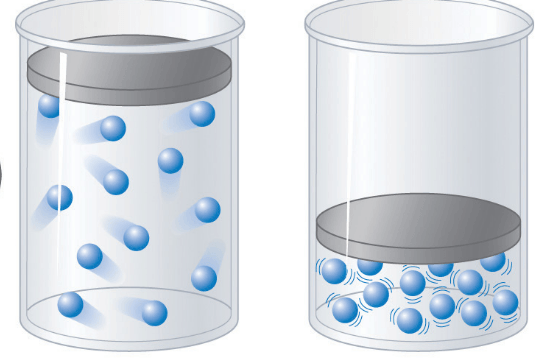
A student inflates a balloon with helium then places it in the freezer. The student should expect
the balloon's volume to increase
the balloon's volume to decrease
the balloon's moles to increase
the balloon's moles to decrease
If a hairspray can is heated, what can be expected of the pressure of the gas inside the can?
The pressure will increase
The pressure will decrease
The pressure will remain constant
The pressure will equalize
Three gases are mixed together in a container with a total pressure of 4.8 atm. If two of the gases have pressures of 1.2 atm and 1.5 atm, what is the pressure of the third gas?
2.5 atm
1.8 atm
2.1 atm
1.3 atm
If pressure is constant, temperature and volume have a(n) ________ relationship with each other.
Direct
Inverse
If temperature is constant, pressure and volume have a(n) ________ relationship with each other.
direct
indirect

What is the name of this instrument, which is used to measure atmospheric pressure?
barometer
thermometer
anemometer
voltmeter
ammonia (NH3)
True or False?
Surface tension is the property of water in which...
water molecules at the surface tend to stick together.
water spills easily.
water tends to be see-through.
water tends to push up into a dome over a container before it finally spills.
What is a surfactant?
A molecule that does not adsorb at surfaces
A substance that prevent bubble formation
A molecule that reduces surface tension of a liquid
A substance that is always water soluble
A substance that conducts an electrical current when dissolved in water is called
catalyst
metalloid
electrolyte
nonelectrolyte

Which of the following containers most likely contains sugar?
A B
Container A because it forms ions.
Container B because it forms ions.
Container A because it does not form ions.
Container B because it does not form ions.
A teacher performs a demonstration in which she places a conductivity tester into a series of solutions. Which substance listed below would have made the bulb light up the most brightly?
Acetic acid (HC2H3O2)
Sucrose (C12H22O11)
Methanol (CH3OH)
Sodium hydroxide (NaOH)
Water is held together by _____________ which lead to its ______ surface tension and _______ boiling point.
Dipole-dipole forces, high, high
Hydrogen bonds, high, high
LDF forces, high, low
Hydrogen bonds, low, high
During the process of ______________, a __________ dissolves in a _____________.
Solute, solvation, solvent
Solute, solvent, solvation
Solvent, solvation, solute
Solvation, solute, solvent
How does the solubility of a gas in a liquid change as the temperature is increased?
remains the same
decreases
Increases
Which of the following operations usually make a substance dissolve faster in a solvent?
Agitation
Raising the temperature
crushing the substance into a powder
all of the above
How does this factor affect the solubility of a SOLID?
Increasing temperature
More soluble
Less soluble
No effect


The amount of solute that can be dissolved in a specific volume of solvent at a specific temperature.
Solution
Solubility
Solvent

Determine the type of solution present when 110 grams of Potassium Nitrate are dissolved at 60°C.
Saturated
Supersaturated
Unsaturated

Determine the type of solution present when 60 grams of Ammonia are dissolved at 10°C
Supersaturated
Saturated
Unsaturated
Which of these pH values represent an acid?
4
8
10
12
Which of the following are properties of acids?
They conduct electricity when dissolved in water
They taste sour
They react with metals to produce hydrogen gas
All of the answer choices are correct
If the substance is neutral, what would the pH be?11
3
5
7
9
11
A substance is found to have the following characteristics:
Very bitter taste
Feels slippery to the touch
Produces OH- ions when dissolved in water
In what category would the substance be classified?
acid
base
enzyme
fatty acid
Phenolophalein turns from clear to pink when the pH turns
acidic
basic
saline
ionic
What completely ionizes in solution?
Weak acids
Strong acids
Strong Salts
Neutral salts
The substance in the beaker
For a solution, pH + pOH =
7
14
1.0 x 10⁻¹⁴
-log (1.0 x 10 -14)
Which of the following is a strong acid?
oxalic acid
nitric acid
carbonic acid
acetic acid
What is the pH of a solution that has a [H+] of 2.5 x 10⁻⁵?
4.6
5.0
2.5
7.0
What is the [OH-] if the pH is 4.9?
7.94 x 10⁻¹⁰ M
1.0 x 10⁻⁴ M
7.94 x 10⁻¹⁴ M
4.9 x 10⁻¹⁰ M
An aqueous solution of HNO3 has a pH of 2.34. What is the concentration of the acid?
218.78 M
4.57 x 10⁻³ M
1 M
6.04 x 10⁻³ M
Human blood has a pH of between 7.38 and 7.42. This means that the blood is ________.
very acidic
slightly acidic
very basic
slightly basic
An increase in the amount of hydroxide ions in a solution ____ the pH.
raises
lowers
does not effect
doubles
According the Bronsted Lowry acid-base theory a base is an
H+ acceptor
H+ donator
OH- acceptor
OH- donator
Name the following compound.
H NO3
Nitric acid
Hydrogen nitride acid
Hydronitric acid
Name the following compound.
KOH
Potassium monohydroxide
Potassium hydroxide
Monopotassium monohydroxide

What is the formula for hydrochloric acid?
HCl
HClO
H3ClO3
HClO3
Which of the following compounds is a base?
CH3COOH
HCl
NaOH
HNO3
What color does red litmus paper turn in a basic solution?
Red
Blue
Green
Yellow
Which of the following substances will turn red litmus paper blue?
Orange juice
Vinegar
Ammonia solution
Lemon juice
What is the pH of a solution with a hydrogen ion concentration of 1.0 x 10⁻⁷ M?
14
10
7
1
Which of the following is a property of acids?
They react with metals to produce hydrogen gas
They taste bitter
They turn blue litmus paper blue
They feel slippery
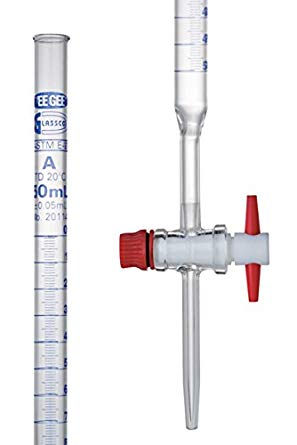
What is this piece of apparatus called
Pipette
Burette
Janette
Cuvette
What allows us to know when the end point has been reached?
Bubbles
Feels warm
indicator changing color
Turns to a solid

How much liquid is in this buret? (Burets are read from the top down)
8.61 mL
7.34 mL
7.4 mL
7.43 mL

How is the H+ concentration related to the OH- concentration in a solution?
In a solution, the product of the H+ concentration and the OH- concentration is always equal to 1 x 10-14.

Which of the solutions in are acids? Which are bases?
Solution A and D are acids, solution C and B are bases
Only Solution B is an acid, and Solution A is a base
Solution A and B are acids, solution C and D are bases
Both Solution A and Solution B are bases

How does H⁺ concentration relate to pH?
If the hydroxide ion (OH-) concentration is greater than the hydronium ion (H3O+) concentration, then what is the solution?
acidic
basic
neutral
salty

Is this a strong acid or a weak acid?
strong
weak
Which of the following is a weak base?
NH3
KOH
NaOH
Ba(OH)2
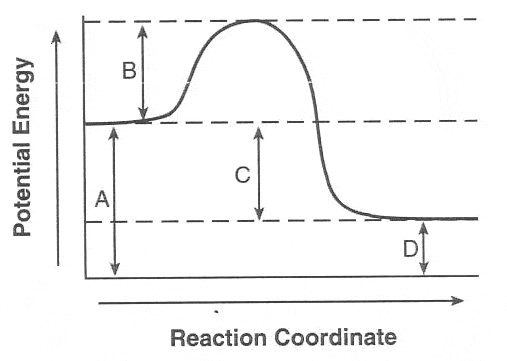
What letter represents the energy of the products?
A
B
C
D
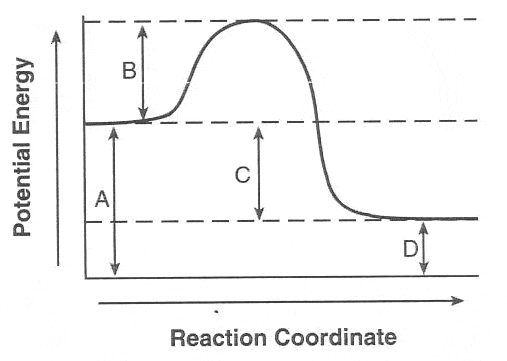
If a catalyst for this reaction was present, which arrows would be affected?
Arrow A
Arrow B
Arrow C
Arrow D
Arrows B and C
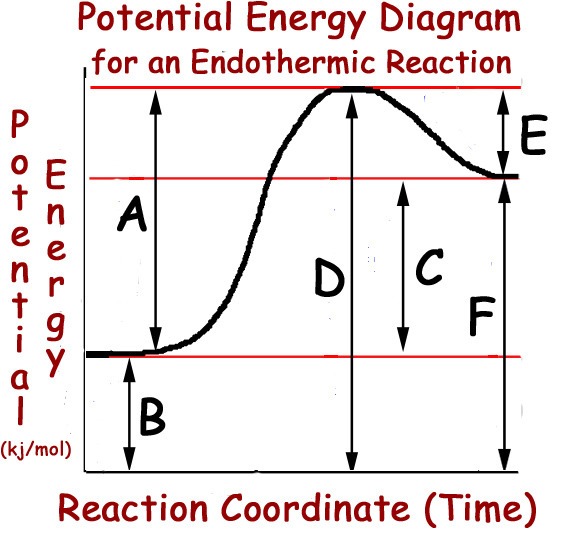
What letter represents the activation energy for the forward reaction?
A
B
C
D
E
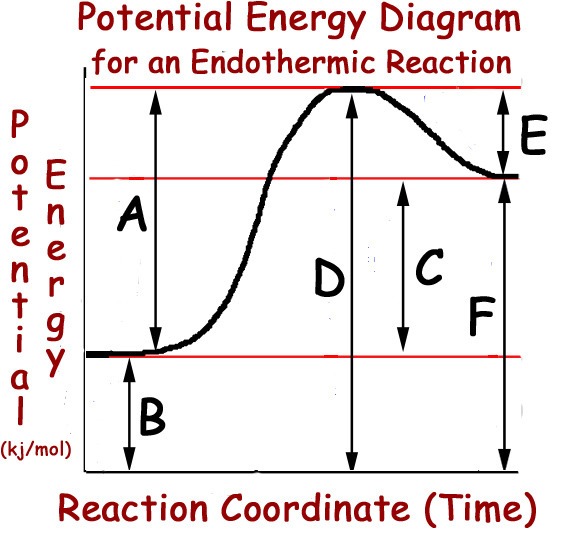
Is the forward reaction endothermic or exothermic?
endothermic
exothermic
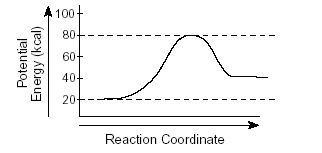
What is the ΔH of the forward reaction?
40 kJ
20 kJ
80 kJ
-60 kJ
-20 kJ
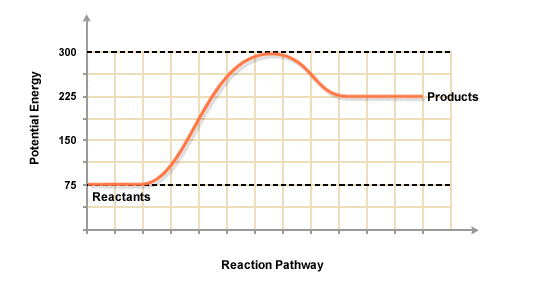
What is the energy of the activated complex?
75 kJ
225 kJ
300 kJ
225 kJ

Which letter represents the activation energy for the reverse reaction?
A
B
C
D
E
Which of the following increase the reaction rate?
less surface area
lower temperature
increasing pressure
increased concentration
A catalyst works by
changing the order of the reaction
increasing the temperature
lowering the amount of energy needed
making the activated complex
If the concentration of a reactant is increased, the reaction rate will ___________.
increase
decrease
stay the same
If the temperature is reduced, a reaction rate will ______
increase
decrease
stay the same
The ____________ states that atoms, ions, or molecules must collide in order to react.
transition state
activation energy
rate law
collision theory
What is the concentration equilibrium constant expression?

Which is the correct equilibrium constant expression for the following reaction?
Fe2O3(s) + H2(g) —> Fe(s) + H2O(g)
K = [H2O]3 / [H2]3
K = [Fe2O3] [H2]3 / [Fe]2[H2O]3
K = [Fe]2[H2O]3 / [Fe2O3] [H2]3
K= [Fe] [H2O] / [Fe2O3] [H2]
K = [H2] / [H2O]

Around what time does the reaction reach equilibrium?
25 min
70 min
45 min
80 min
What states of matter are omitted when writing Keq expressions?
solids and liquids
aqueous solutions and gas
solids, liquids, aqueous solutions and gases
aqueous solutions & liquids

Which changes occur when O2(g) is added to this
system?
The equilibrium shifts to the right and the
concentration of PCl3(g) increases.
The equilibrium shifts to the right and the
concentration of PCl3(g) decreases.
The equilibrium shifts to the left and the
concentration of PCl3(g) increases.
The equilibrium shifts to the left and the
concentration of PCl3(g) decreases.

Which change will cause the equilibrium to shift to
the right?
adding a catalyst
adding more PCl3(g)
increasing the pressure
increasing the temperature

The formation of ammonia is favored by
an increase in pressure
a decrease in pressure
removal of N2(g)
removal of H2(g)

Increasing the temperature of the system causes the
concentration of
HI to increase
H2 to increase
HI to remain constant
H2 to remain constant

Which change will not shift the point of
equilibrium?
changing the pressure
changing the temperature
changing the concentration of H2(g)
changing the concentration of HF(g)
Rewrite the above equation with energy as a reactant or product:
heat + N2(g) + O2(g) <−> 2NO(g)
If the heat is removed to the chemical system, the equilibrium will _______.
Which of the following statements is FALSE for a system that has established equilibrium?

A melting ice cube is an example of
exothermic
endothermic
none
both

If 20 g of water undergoes a temperature change from 25° C to 30° C, how much heat energy (Q) moves from the water to the surroundings?
418 J
209 J
83 J
4.18 J
Which substance would heat up the fastest?
aluminum
water
copper
gold
What is chemical potential energy?
Energy from chemicals
Energy to make chemicals
Energy stored in chemical bonds
Energy from the sky
SO2(g) + O2(g) <−> SO3(g)
If the concentration of SO2(g) is increased, the equilibrium of the reaction will ___________.
Which change will cause the equilibrium to shift to
the right?
adding a catalyst
adding more PCl3(g)
increasing the pressure
increasing the temperature
N2 (g) + 3 H2 (g) <−> 2 NH3 (g)
If the pressure in the system is decreased, which substance will increase in concentration?

Concentration
Pressure
Temperature
Catalysts

The diagram shows what happens when zinc reacts with hydrochloric acid. Which of these best describes the energy transformation that occurs during this reaction?
Thermal energy - kinetic energy
Kinetic energy -potential energy
Chemical energy - thermal energy
Potential energy - chemical energy

The potential energy diagram of a reaction is shown. Which statement below is correct relating to this reaction?
#1 represents the enthalpy change for this exothermic reaction.
#2 represents the enthalpy change for this endothermic reaction.
#3 represents the enthalpy change for this endothermic reaction.
#4 represents the enthalpy change for this exothermic reaction.
During an exothermic reaction, heat content in the surroundings increases because
heat energy is destroyed during reactions
the reaction absorbs heat energy
the energy contained in the reactants is lower then the products
the energy contained in the products is lower than the reactants

The diagram represents two solids and the temperature of each. What occurs when the two solids are placed in contact with each other?
Heat energy flows from solid A to solid B. Solid A decreases in temperature
Heat energy flows from solid A to solid B. Solid A increases in temperature
Heat energy flows from solid B to solid A. Solid B decreases in temperature.
Heat energy flows from solid B to solid A. Solid B increases in temperature.
The amount of heat energy required to change the temperature of 12 g of gold from 45°C to 15°C is -47 J. What is the specific heat capacity of gold?
0.13 J/(g°C)
17,000 J/(g°C)
1600 J/(g°C)
0.065 J/(g°C)

The graph represents the uniform heating of a substance, starting with the substance as a solid below its melting point. Which line segment listed below represents an increase in potential energy and no change in average kinetic energy?
Line segment AB
Line segment BC
Line segment CD
Line segment EF
What is energy?
Something you get from sleeping
The ability to do work or supply heat
A stadium in Houston
A magical power
What is thermochemistry?
study of heat changes that occur during a chemical reaction & physical changes of state
the study of heat and chemistry
the study of heat
the study of chemistry
How does heat move?
From cold to hot
From hot to cold
What is chemical potential energy?
Energy from chemicals
Energy to make chemicals
Energy stored in chemical bonds
Energy from the sky
When a hot object and a cold object come together, heat will move from the warmer one to the colder one until they are the same temperature. What is this called?
Equal
Equilibrium
Equality
Match the following
Q
heat
M
mass
C
specific heat
ΔT
change in temperature
g ∘CJ or g ∘Ccal
c
g or kg
m
ΔT
C or K
c
J or cal, kJ or Kcal
How much heat, in calories, is needed to raise the temperature of 125.0 g of lead (c lead= 0.130 J/g°C) from 17.5°C to 41.1°C?
91.7 cal
9.17 cal
917 cal
917.0 cal
A sample of H2O with a mass of 60 grams boils until it has completely changed to steam. How much heat was absorbed?
Hfus = 334 J/g
Hvap = 2260 J/g
7525 J
135,600 J
1112.1 J
20,040 J
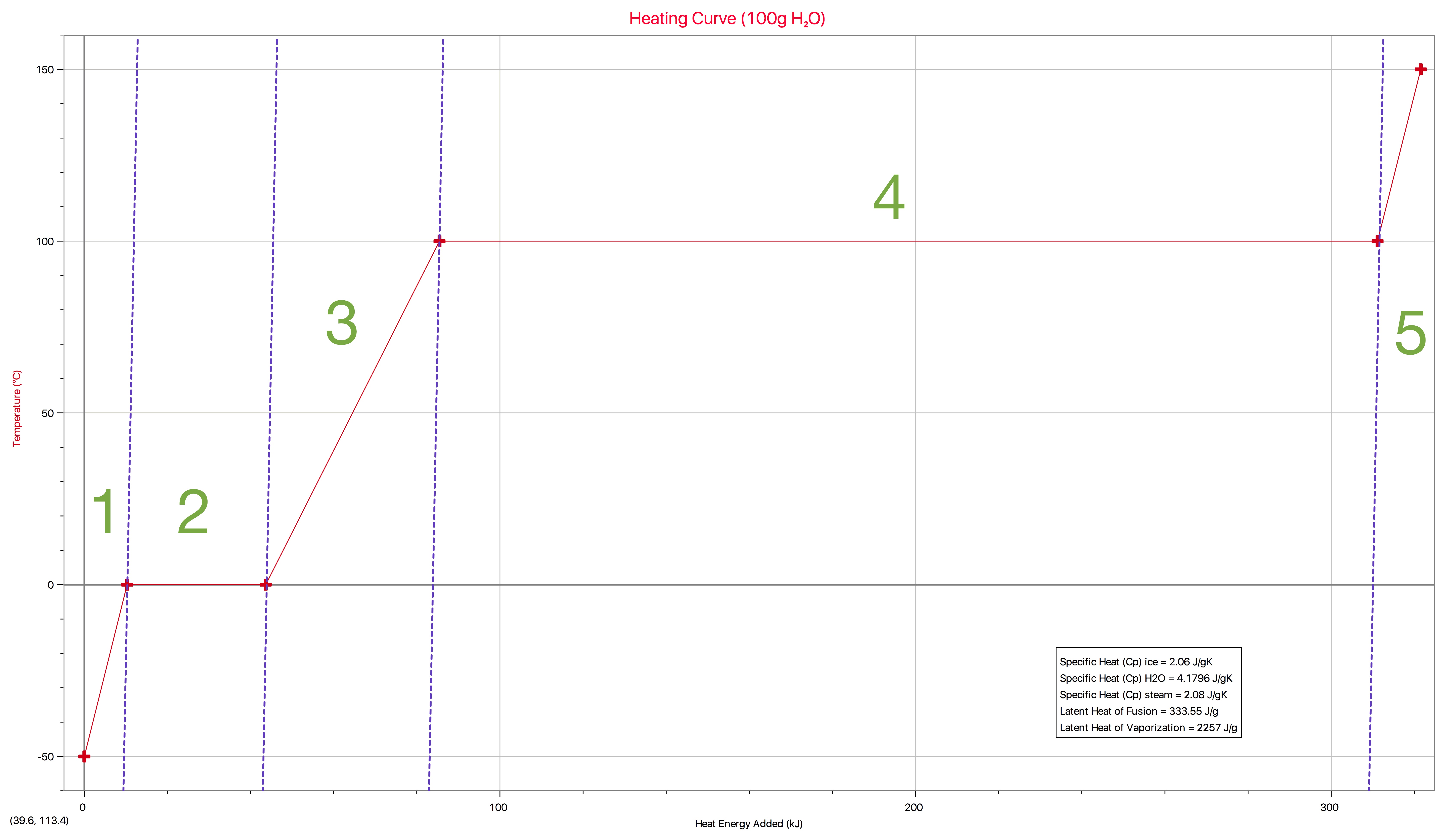

Convert 42 kJ into joules
0.042 J
175.73 J
42000 J
10.04 J
Consider the reaction: 2 H2O + energy --> 2H2 + O2
exothermic because releasing energy
exothermic because absorbing energy
endothermic because absorbing energy
endothermic because releasing energy

In which region(s) does temperature increase?
Region C only
Regions B and D
Regions A, C, and E
Regions A and B

During which phase change is energy (heat) added?
Melting
Freezing
Condensation
Deposition

During which phase change is energy (heat) removed
Melting
Vaporization
Sublimation
Freezing

Is graph B showing an endothermic reaction or an exothermic reaction?
Endothermic
Exothermic
Both
No way to tell
2Na + Cl2 → 2NaCl + 25kJ energy
What is Standard Temperature and Pressure (STP)?
1 Degrees Celsius and 0 atm
0 Degrees Celsius and 1 atm
0 Kevin and 10 atm
273 Celsius and 273 atm

