wayground logo

Free Printable Worksheets

Font size

S
M
L
XL
Worksheets

1st Semester Review

Total questions: 155

Worksheet time: 3hrs 32mins

Name
Class
Date
1.
Which gas in our atmosphere is most abundant?
a)
Argon
b)
Oxygen
c)
Nitrogen
d)
Carbon Dioxide
2.
The air in the troposphere has a greater density than the air in any other layer of the atmosphere,
a)
True
b)
False
3.
Temperature in the stratosphere warms as altitude increases.
a)
True
b)
False
4.
What is the percentage of nitrogen in Earth's atmosphere?
a)
1%
b)
21%
c)
78%
d)
90%
5.
What is the percentage of oxygen in Earth's atmosphere?
a)
1%
b)
21%
c)
78%
d)
90%
6.
What percentage of our atmosphere is made up of other gases such as argon, water vapor, and carbon dioxide?
a)
1%
b)
21%
c)
78%
d)
90%
7.
Which layer of the atmosphere contains the greatest amount of water vapor?
a)
Thermosphere
b)
Troposphere
c)
Mesosphere
d)
Stratosphere
8.
In which layer of the atmosphere does weather occur?
a)
Mesosphere
b)
Thermosphere
c)
Stratosphere
d)
Troposphere
9.
What decreases as you go up in the atmosphere?
a)
Altitude
b)
Atmosphere
c)
Meteors
d)
Air Pressure
10.
What is the outer most main layer of Earth's atmosphere?
a)
Thermosphere
b)
Troposphere
c)
Stratosphere
d)
Mesosphere
11.
Where is the air pressure the greatest?
a)
1
b)
2
c)
3
d)
4
12.
The layers of the atmosphere are classified according to changes in _________.
a)
altitude
b)
density
c)
composition
d)
temperature
13.
James plans to climb to the top of Mount Everest.  Which of the following statements about his climb will be the most accurate?
a)
Air pressure will rise and the temperature on a thermometer will increase.
b)
Air pressure will fall and the temperature on a thermometer will decrease.
c)
Air pressure will rise and the temperature on a thermometer will decrease.
d)
Air pressure and thermometer will not change.
14.
What is the function of the ozone layer?
a)
to allow UV rays to get to Earth
b)
to block UV rays from getting to Earth
c)
To keep oxygen in
d)
to allow meteors to get to Earth
15.
This is the layer where most commercial jet airliners fly.
a)
Troposphere
b)
Stratosphere
c)
Mesosphere
d)
Thermosphere
16.
This is the layer where meteors, or shooting stars, burn up.
a)
Troposphere
b)
Stratosphere
c)
Mesosphere
d)
Thermosphere
17.
What happens to the density (thickness)/air pressure of the air as you increase in altitude?
a)
density increases
b)
density decreases
c)
density stays the same
d)
density disappears
18.
Which layer contains the ionosphere, a layer of charged particles, that interact with solar winds to cause the auroras?
a)
Exosphere
b)
Stratosphere
c)
Thermosphere
d)
Mesosphere
19.
Choose the correct order of the layers of the atmosphere (from closest to farthest from earth’s surface). 
a)
a)Troposphere, mesosphere, stratosphere, thermosphere 
b)
a)Thermosphere, mesosphere, stratosphere, thermosphere 
c)
a)Troposphere, stratosphere, mesosphere, thermosphere 
d)
a)Stratosphere, troposphere, mesosphere, thermosphere 
20.

The ozone layer is damaged by

a)

CFCs (chlorofluorocarbons)

b)

Increase in greenhouse gases

c)

Increased global temperatures

d)

Sulfuric and nitric acids

21.

Which of these sets of three items produce CFCs

a)

cars, factories, and cardboard

b)

spray cans, cardboard, insulation

c)

spray cans, refrigerant, cardboard

d)

aerosol spray cans, refrigerant, plastics

22.

50% of the incoming solar radiation is

a)

absorbed directly or indirectly by Earth's surface

b)

scattered to space by the atmosphere

c)

is reflected from clouds

d)

absorbed directly by the atmosphere

23.

What created the early atmosphere?

a)

space

b)

volcanoes erupting

c)

big bang

d)

nuclear explosion

24.

What were the gases in the early atmosphere?

a)

Carbon dioxide, Oxygen, ammonia and methane

b)

Carbon monoxide, Oxygen, ammonia and methane

c)

Carbon dioxide, Water vapour, sulfuric acid and methane

d)

Carbon dioxide, Water vapour, ammonia and nitrogen

25.

What happens as heated air expands and becomes less dense than the air surrounding it?

a)

The air rises in an updraft.

b)

The air is deflected, causing the Coriolis effect.

c)

The air is rapidly forced down in a downburst.

d)

The air sinks in a downdraft.

26.

A region of Earth's atmosphere that has a high concentration of ozone

a)

mesosphere

b)

thermosphere

c)

atmosphere

d)

stratosphere

27.

When the barometric pressure is dropping, what weather condition will most likely occur?

a)

sunny weather

b)

calm weather

c)

hot weather

d)

stormy weather

28.
Weather
a)
 description of weather conditions for an area in general terms over long periods of time
b)
constantly changing state of the atmosphere at a given time and place
29.
Aerosols
a)
layer in stratosphere
b)
 tiny solid and liquid particles suspended in air 
c)
contributes to humidity
30.
What type of weather usually goes with this symbol?
a)
Clear, sunny skies
b)
Cloudy skies
c)
Hot temperature
d)
Thunderstorms
31.
Air is more and more thin as you go higher in altitude because there is ___________ at a high altitude.
a)
less gravity and less air pressure
b)
more gravity and more air pressure
c)
more snow and more gravity
d)
more water vapor and more air pressure
32.

Which weather condition will most likely occur when the atmospheric pressure in an area begins falling (becoming less)?

a)

dry

b)

cold

c)

rainy

d)

sunny

33.
How are air (atmospheric) pressure and cloud formation related?
a)
Air pressure has no affect on cloud formation
b)
When air pressure expands,  cloud formation increases
c)
Higher air pressure increases cloud formation
d)
Low air pressure increases cloud formation
34.
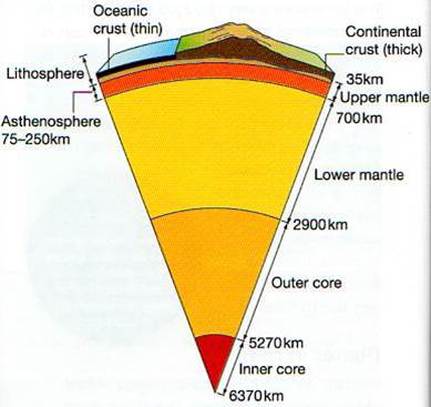
Which best describes the asthenosphere?
a)
molten metal
b)
dense, solid metal ball
c)
solid that flows
d)
dry land and ocean floor
35.
What part of the earth is a layer of rock that comprises 67% of Earth’s mass?
a)
mesosphere
b)
mantle
c)
asthenosphere
d)
lithosphere
36.
What is the rigid layer of the Earth's surface made up of the  crust and upper mantle called?
a)
asthenosphere
b)
lithosphere
c)
mesosphere
d)
continental crust
37.
Which of the following occurs because of convection currents?
a)
Tectonic plates on the crust move.
b)
The mantle increases in size.
c)
Pressure in the crust increases.
d)
Pressure in the crust decreases.
38.
Scientists think that convection currents that move the plates flow in Earth's
a)
Continental crust
b)
Oceanic crust
c)
Asthenosphere
d)
Lithosphere
39.
As you travel from the inner core to the crust, how would temperature, pressure and density of the material change?
a)
The would all increase
b)
The would all decrease.
c)
They would stay the same.  
d)
Temperature would decrease, but pressure and density would increase. 
40.
During sea floor spreading, molten material rises up from the mantle...
a)
along the continents
b)
at the mid ocean ridges
c)
deep ocean trenches
d)
at north and south poles
41.
Oceanic crust is
a)
Younger and less dense than continental crust
b)
Thinner, younger and more dense than continental crust
c)
Older, thicker and less dense that continental crust
d)
Bigger and younger than continental crust
42.
Associated with transform boundaries.
a)
Volcanoes
b)
mountains
c)
trenches
d)
earthquakes
43.
The theory of _______ states that Earth’s crust and upper mantle are broken into sections that are in constant, slow motion.
a)
plate tectonics
b)
continental drift
c)
seafloor spreading
d)
divergent boundaries
44.
The theory of continental drift was first proposed by __________.
a)
Thomas Edison
b)
Alfred Wegener
c)
Benjamin Franklin
d)
Harry Hess
45.
The San Andreas Fault in California is an example of a ________.
a)
divergent boundary
b)
convergent boundary
c)
transform fault
d)
subduction zone
46.
Which type of plate boundary occurs at B?
a)
convergent
b)
divergent
c)
transform
d)
country
47.
The feature labeled C represents some of the deepest spots on the ocean floor. These areas are called ___.
a)
mid-ocean ridge
b)
trenches
c)
deep-sea vent
d)
abyssal plain
48.
The feature labeled D is part of the continuous underwater mountain range that circles Earth. It is called ___.
a)
mid-ocean ridge
b)
trenches
c)
deep-sea vent
d)
abyssal plain
49.
Which type of plate boundary is shown at A?
a)
transform boundary
b)
convergent boundary
c)
divergent boundary
d)
fractured boundary
50.
What type of boundary is shown in the image?
a)
convergent 
b)
divergent 
c)
transform 
51.
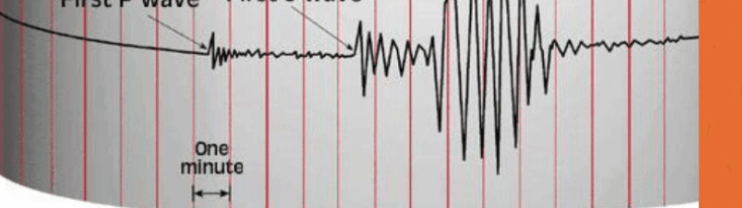
Here is a picture of a seismogram. Which seismic wave reaches the station first?
a)
P Wave
b)
S Wave
c)
H Wave
d)
L Wave
52.
Look at the picture. What is the location called where all three circles intersect?
a)
focus
b)
earthquake
c)
epicenter
d)
seismograph
53.
An instrument that detects and measures earthquakes is a 
a)
seismogram
b)
focus seismic map
c)
focus
d)
seismograph 
54.
P Waves can move through which of the following?
a)
Gas
b)
Liquid
c)
Solid
d)
All of these
55.
S Waves can move through which of the following?
a)
Gas
b)
Liquid
c)
Solid
d)
All of these
56.
With the help of a graph, the time difference between P and S waves can tell you ____________.
a)
how big the earthquake is
b)
how long the earthquake lasted
c)
how far away the earthquake is
d)
how deep the earthquake is
57.
The epicenter of an earthquake is
a)
The point below the surface where rock begins to break and the first motion occurs
b)
The seismic station closest to the earthquake
c)
The place where the greatest damage occurs
d)
The point on the surface directly above the focus
58.
At about what time did all of the S-waves hit?
a)
20 sec
b)
45 sec
c)
50 sec
d)
10 seconds
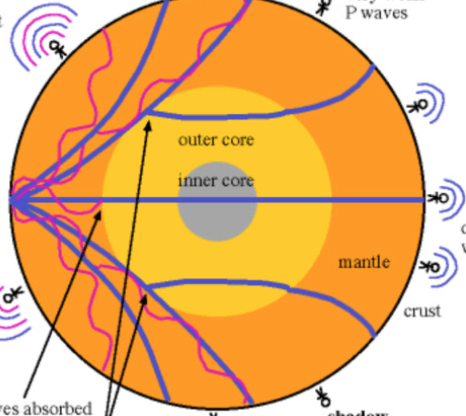
59.
We know there are two layers to the Earth’s core because...
a)
S Waves stop at the outer core
b)
P Waves bend as they reach inner core
c)
P Waves bend as they outer core
d)
All of the above
60.
This volcano is most likely which type of volcano?
a)
Felsic
b)
Composite
c)
Shield
d)
Cinder cone
61.
What type of volcano is this..
a)
Shield
b)
Cinder Cone
c)
Composite or Stratovolcano
62.

What type of volcano is this?

a)

Fissure

b)

Shield

c)

Dome

d)

Stratovolcano/ Composite

63.
Which of the following is an opening through which molten rock and gas leave a volcano
a)
pipe
b)
magma chamber
c)
crater
d)
vent
64.
What type of boundary formed the East African Rift Valley?
a)
divergent
b)
convergent
c)
transfrom
65.
What type of boundary formed the Himalaya mountains?
a)
divergent
b)
convergent
c)
transform
66.
Why did other scientists not believe Wegener's theory of continental drift?
a)
He did not have evidence to support his theory
b)
other scientists had evidence that contradicted Wegener's theory
c)
He could not explain how the continents had moved
d)
None of these
67.
At a continental-oceanic convergent plate boundary, what geologic land forms are created? 
a)
chain of inland volcanoes
b)
deep ocean trench
c)
folded mountain range
d)
BOTH a chain of inland volcanoes and a deep ocean trench
68.
What is the process of higher density crust going beneath lower density crust, entering the mantle, melting, and becoming magma?
a)
subduction
b)
convection currents
c)
convergence
d)
divergence
69.
Name an example of a continental-oceanic convergent boundary.
a)
Hawaiian Island Chain
b)
San Andreas Fault in California 
c)
Himalayan Mountain Range
d)
Cascadia Subduction Zone in the Pacific Northwest US
70.
a)
normal fault
b)
reverse fault
c)
strike-slip fault
71.
a)
normal fault
b)
reverse fault
c)
strike-slip fault
72.
The cat is standing on the...
a)
foot wall
b)
hanging wall
c)
left
d)
weirdest elevator ever
73.

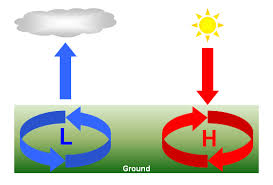
Thunderstorms are the result of which type of pressure system?

a)

Low

b)

High

74.

Which leads to low pressure systems?

a)

warm air rising

b)

warm air falling

c)

cold air rising

d)

cold air falling

75.
Collectively, the states of Texas, Oklahoma, Kansas and Nebraska, where tornadoes occur often, are all called
a)
Tornado towns
b)
Storm centers
c)
Tornado Alley
d)
Cyclone counties
76.
Where do tornadoes start?
a)
Over the ocean near the equator
b)
In the clouds that create blizzards
c)
In the clouds of severe thunderstorms
d)
Any time that it rains
77.
What happens in Tornado Alley to create so many tornadoes?
a)
The rate of condensation is higher than the rate of precipitation
b)
Warm air from Canada meets cold air from Virginia
c)
Cold, dry air from Canada meets warm dry air from Gulf of Mexico
d)
Warm air in Texas clashes with even warmer air in Texas
78.
Thunderstorm clouds are called - 
a)
Cirrus
b)
Stratus
c)
Cumulus
d)
Cumulonimbus
79.
Near the Phillippines and the China Sea, hurricanes are called ____.
a)
Typhoon
b)
Big Storm
c)
Hurricane
80.
Around the center winds move at speeds between ____ and _____ miles per hour
a)
55, 200
b)
74, 300
c)
55, 250
d)
74, 200
81.
It is no longer a Hurricane if the wind speed Is less than ___?
a)
7.4 miles per hour.
b)
740 miles per hour.
c)
74 miles per hour.
d)
704 miles per hour.
82.
What happens when a hurricane crosses over land?
a)
 it moves more quickly 
b)
it breaks apart and forms tornadoes
c)
it loses strength
d)
It speeds up
83.
10. What is the strongest category of hurricane?
a)
Category 5
b)
Category 10
c)
Category 1
84.

What is the most powerful part of a hurricane?

a)

Eye

b)

Eye Wall

c)

Storm surge

d)

Edge

85.

Why does a hurricane slow down when it hits land?

a)

The wind stops it

b)

It stops raining

c)

It loses its energy source

d)

The air is different

86.
Where are the strongest winds and heaviest rains in a hurricane located?
a)
In the eyewall
b)
In the outer bands
c)
On the leading edge
d)
On the lagging edge
87.
Tornadoes are measured using which type of scale?
a)
Richter scale
b)
Bathroom scale
c)
Fujita Scale
d)
Mercator Scale
88.

North America's concern for tsunami's exists ....

a)

along the St. Lawrence 'divide'.

b)

in the Pacific Cascadia region.

c)

in the mid-Atlantic, on the divergent ridge.

d)

in the deepest canyons of Hudson Bay.

89.

Pangaea is best described as...

a)

the place where two tectonic plates meet.

b)

a supercontinent 300 million years ago.

c)

the oldest mountain range in the world.

d)

the microplate of Vancouver Island's west coast.

90.

At places where tectonic plates pull apart, it is considered a ...

a)

divergent rift zone.

b)

convergent subduction zone.

c)

cataclysmic volcanic zone.

d)

folding uplift zone.

91.
Large pieces of lithosphere that move around on the asthenosphere are called
a)
Crust plates
b)
Tectonic plates
c)
Mantle pieces
d)
Core plates
92.

The _____________ is the plastic (slowly flowing) layer made of solid rock in the mantle

a)

Asthenosphere

b)

Lithosphere

c)

Cryosphere

d)

Mesosphere

93.
The pieces of the lithosphere that move around on top of the asthenosphere are called
a)
continents.
b)
mesospheres. 
c)
crust
d)
tectonic plates.
94.

Water molecules have the greatest kinetic energy WHEN...

a)

They have the greatest temperatures

b)

They have the lowest temperature

c)

They are in a solid state

d)

They are in a gaseous state

95.
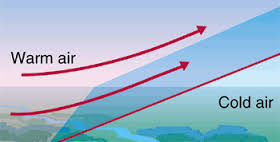
What type of storm front is this? 
a)
warm front
b)
cold front
c)
stationary front
d)
occluded front
96.
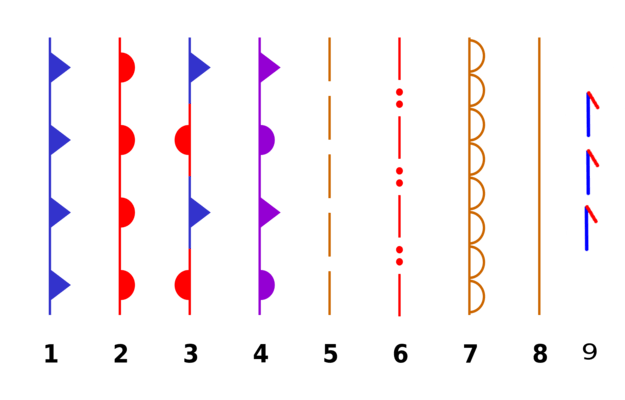
What does symbol # 3 mean?
a)
stationary front
b)
occluded front
c)
warm front
d)
cold front
97.
A front is
a)
where warm air is cooling at earth's surface
b)
a line where hot and cold air are separating
c)
a line where two different air masses meet
d)
where cold air is rising and forming rain clouds
98.
Which type of front is pictured?
a)
Cold front
b)
Warm front
c)
Occluded front
d)
Stationary front
99.
Which system results in drier, fairer weather?
a)
high pressure
b)
low pressure
c)
hurricane
d)
weather system
100.
Which type of front is associated with purple humps and triangles facing the same direction?
a)
Cold
b)
Warm
c)
Stationary
d)
Occluded
101.

What type of front is shown?

a)

Warm Front

b)

Cold Front

c)

Occluded Front

d)

Stationary Front

102.

Where do MARITIME air masses form?

a)

Over water

b)

Over land

103.

Where do CONTINENTAL air masses form?

a)

Over water

b)

Over land

104.

Which type of air mass brings WARM and DRY weather?

a)

Maritime Polar (mP)

b)

Maritime Tropical (mT)

c)

Continental Polar (cP)

d)

Continental Tropical (cT)

105.

Which type of air mass brings WARM and WET weather?

a)

Maritime Polar (mP)

b)

Maritime Tropical (mT)

c)

Continental Polar (cP)

d)

Continental Tropical (cT)

106.

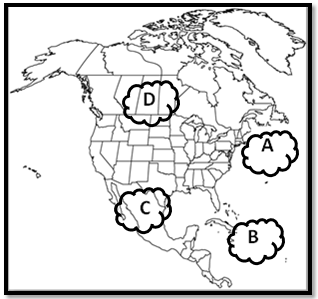
Which air mass would be classified as Maritime Polar (mP)?

a)

purple

b)

green

c)

blue

d)

yellow

e)

red

107.

Which air mass would be classified as Maritime Tropical (mT)?

a)

purple

b)

green

c)

blue

d)

yellow

e)

red

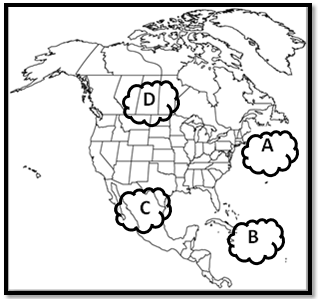
108.
Which type of air would you find at air mass C?
a)
cold, dry
b)
warm, humid
c)
warm, dry
d)
cold, humid
109.
Which type of air would you find at air mass D?
a)
cold, dry
b)
warm, humid
c)
warm, dry
d)
cold, humid
110.

An earthquake of magnitude 5.0 releases how much more energy than an earthquake of magnitude 4.0.

a)

four calling birds.

b)

three times the energy

c)

one hundred times the energy

d)

none of the above.

111.
What are the two classifications of waves?
a)
Body and Legs
b)
Rayleigh and Love
c)
Body and Surface
d)
Inner and Outer
112.
Which classification of wave does the most damage?
a)
Body Waves
b)
Mega Waves
c)
Surface Waves
d)
Love Waves
113.
Which body wave is pictured?
a)
P-Wave
b)
S-Wave
c)
Rayleigh Wave
d)
Love Wave
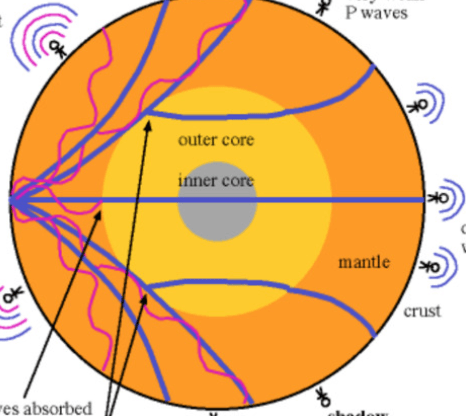
114.

The blue lines are _______

a)

p waves

b)

s waves

c)

rayleigh waves

d)

love waves

115.

The pink lines are

a)

p waves

b)

s waves

c)

rayleigh waves

d)

love waves

116.

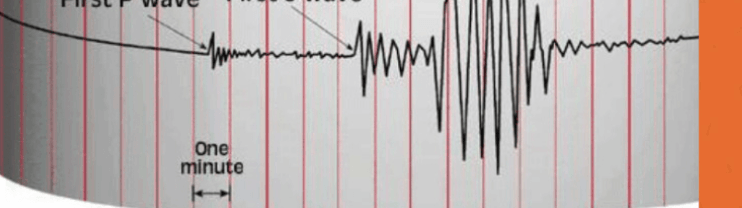
The arrow to the left is pointing at the signal for a ______

a)

p waves

b)

s waves

c)

surface waves

117.

The arrow to the right is pointing at the signal for a ______

a)

p wave

b)

s wave

c)

surface wave

118.
The composition of magma determines its _____.
a)
viscosity
b)
darkness
c)
color
d)
none of the above
119.
TRUE OR FALSE:  A substance that flows quickly has high viscosity...
a)
True
b)
False
120.
Very explosive volcanoes tend to have
a)
Low viscosity magma
b)
Gases rich in sulfur dioxide
c)
gentle, sloping sides
d)
High viscosity magma
121.
Which types of magma contains the least amount of SiO2
a)
rhyolitic
b)
andesitic
c)
felsic
d)
basaltic
122.
What is a determining factor in which type of eruption will occur?
a)
the chemistry of the magma
b)
the size of the mountain
c)
the climate around the volcano
d)
the number of people living near the volcano
123.

Rank the volcanic stages from LEAST likely to MOST likely to erupt.

a)

active, dormant, extinct

b)

extinct, dormant, active

c)

dormant, extinct, active

d)

dormant, active, extinct

124.
What factor(s) determine(s) whether an eruption will be explosive?
a)
The amount of gases in the magma
b)
The amount of silica in the magma
c)
The amount of gas and silica in the magma
d)
None of these affect the explosiveness of the volcano
125.

Effusive volcanos generally have

a)

thick slow lava flows

b)

giant pyroclastic explosions

c)

runny lava flows

126.

Gases escape more readily out of

a)

low-silica content (basaltic) magma

b)

high-silica content magma

127.
When an explosive eruption  forms a mixture of hot rock, ash, and gas, this material is called a...?
a)
Land slide
b)
Lava
c)
Eruption trail
d)
Pyroclastic flow
128.
Volcanoes that are NOT found at plate boundaries occur in the middle of plates in areas called ___________. 
a)
hot spots
b)
mid-ocean ridges
c)
fissure volcanoes
d)
shield volcanoes
129.
Lava that looks like ropelike coils is called
a)
aa
b)
pahoehoe
c)
ropeband
d)
aloha
130.
This famous transform fault is located in the western United States creates significant earthquake activity for California
a)
New Madrid
b)
Denali Fault
c)
Ramapo Seismic Zone
d)
San Andreas
131.
A stress force that pushes a mass of rock in 2 opposite directions causing rock to break, slip apart or change shape:
a)
tension
b)
compression
c)
shearing
d)
uplifting
132.

Which of the following hazards undermine the foundations and supports of buildings, bridges, pipelines, and roads, causing them to sink into the ground, collapse, or dissolve?

a)

eutrophication

b)

ground shaking

c)

liquefaction

d)

pyroclastic density currents

133.

(a)   falls refers to volcanic rock and lava materials that are ejected into the air by explosions or carried upward by the eruption column’s hot gases or lava fountains.

134.

What two crustal features occur near every subduction zone?

a)

Volcanoes and Trenches

b)

Rift Valleys and Mid Ocean Ridges

c)

Volcanoes and Rift Valleys

d)

Mid Ocean Ridges and Trenches

135.

A divergent boundary in the ocean creates what feature?

a)

Mid Ocean Ridge

b)

Rift Valley

c)

Deep Ocean Trench

d)

Subduction Zone

136.

The process that occurs at a divergent oceanic boundary that creates new crust (sea floor) is called?

a)

Subduction

b)

Seafloor Spreading

c)

Continental Drift

d)

Volcanism

137.

Identify the divergent plate boundary.

a)
b)
c)
d)
138.

The letter B represents

a)

Subduction zone

b)

Trench

c)

Oceanic crust

d)

Island Volcano Arc

139.

The diagram shows a nonvolcanic mountain range. How did the movement of Earth’s plates form this land feature?

a)

Two oceanic plates slid past each other.

b)

Two continental plates collided.

c)

One continental plate slid past an oceanic plate.

d)

One continental plate subducted beneath an oceanic plate.

140.

Use the diagram to answer the question. Identify the geological land features that results as two oceanic plates converge.

a)

formation of a deep sea trench and island volcanoes (island arc)

b)

earthquake activity and appearance of a transform fault

c)

volcanic eruption along both oceanic plate edges

d)

formation of a continental mountain range

141.

In a hot spot, Volcano A is on top of the mantle plume, Volcano B is 10 km farther from A while Volcano C is 30 km away from Volcano A. D is the farthest. What can you infer about the ages of the volcanoes?

a)

Volcano A is older than C

b)

Volcano B is the oldest

c)

Volcano D is the youngest

d)

Volcano B is younger than C

142.

Right in the middle of an island, you can find a rift valley. What type of plate boundary exists on that island?

a)

convergent

b)

divergent

c)

normal fault

d)

transform fault

143.
According to scientists, both Earth and moon are...
a)
About 1.6 Billion Years Old
b)
About 4.6 Billion Years Old
c)
About 9.6 Billion Years Old
d)
About 14 Billion Years Old
144.

How do scientist think that early atmosphere was probably formed?

a)

Gases from volcanoes

b)

Lava from volcanoes

c)

Gases released from bacteria

d)

They are unsure how it is formed

145.

Which gas did organisms in the sea take out of the air?

a)

Oxygen

b)

Carbon Dioxide

c)

Nitrogen

d)

Sulfer

146.

The oxygen that entered Earth's atmosphere was produced by

a)

clouds

b)

plants

c)

cyanobacteria

147.
Which gas was introduced by stromatolites and allowed for more complex life to exist on Earth?
a)
oxygen
b)
carbon dioxide
c)
sulfur oxides
d)
water vapor
148.

What is the process where plants use light, energy, carbon dioxide, and water to make food (and releasing oxygen to the air)

a)

Outgassing

b)

Photosynthesis

c)

Stromatolites

d)

Climate change

149.

This evidence of past atmospheric conditions contains tiny bubbles of gas trapped in the past

a)

Glacial ice cores

b)

Fossils

c)

Stromatolites

d)

Banded iron formations

150.

How are the atmosphere's layers determined?

a)

By the type of gas molecules found there

b)

By the presence of different life forms

c)

By the trends in temperature change with altitude

d)

By the amount of radiation passing through the layer
151.
When the temperature of matter increases the particles...
a)
speed up and move closer
b)
speed up and move farther apart
c)
slow down and move closer together
d)
slow down and move farther apart
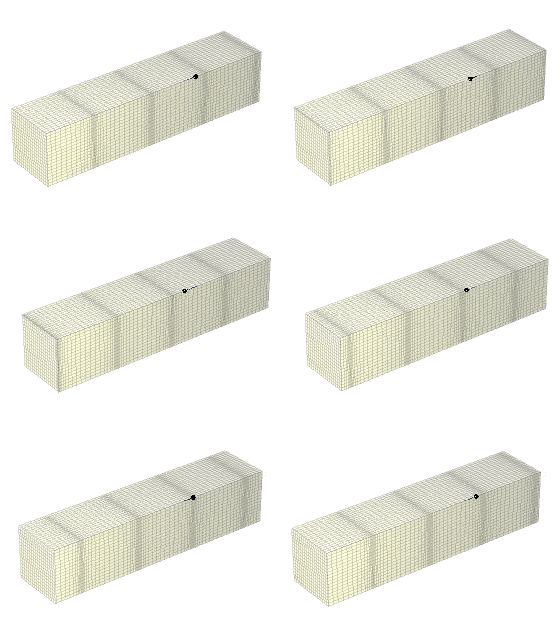
152.
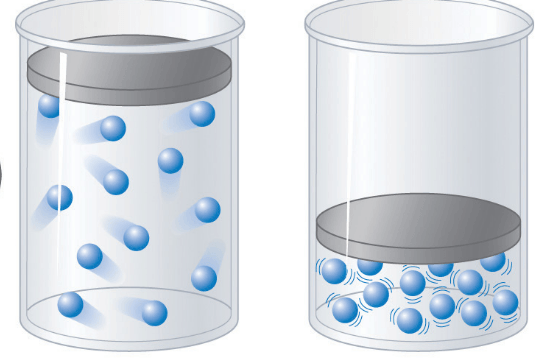
Which container will have a lower pressure?
a)
left
b)
right
c)
they both have the same pressure
d)
I don't know
153.
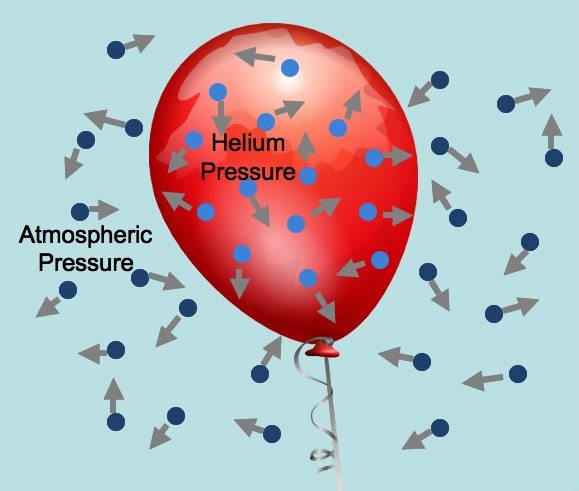
What causes pressure?
a)
The walls of the container
b)
The vacuum in the container
c)
The collisions of the particles
d)
Atmospheric pressure acting on the outside walls
154.

What happens as the rock breaks into two fault blocks?

a)

elastic rebound

b)

plastic rebound

c)

nothing happens

155.

What happens first to rocks upon experiencing tectonic stress?

a)

bends

b)

breaks

c)

nothing happens