wayground logo

Free Printable Worksheets

Font size

S
M
L
XL
Worksheets

Biology EOC Review

Total questions: 160

Worksheet time: 13hrs 20mins

Name
Class
Date
1.
Glucose (sugar) is an example of a
a)
Carbohydrate
b)
Lipid
c)
Protein
d)
Nucleic Acid
2.
Glycerol and fatty acids combine to form...?
a)
Carbohydrates
b)
Lipids
c)
Proteins
d)
Nucleic Acids
3.
I am responsible for long term energy storage in mammals.
a)
Protein
b)
Lipid
c)
Carbohydrate
d)
Nucleic Acid
4.
The diagram shows the structure of an amino acid. Which type of molecule is formed from amino acids?
a)
lipids
b)
proteins
c)
carbohydrates
d)
nucleic acids
5.
DNA and RNA are examples of 
a)
Carbohydrates
b)
Lipids
c)
Proteins
d)
Nucleic Acids
6.

What is the function of nucleic acids?

a)

store genetic information

b)

store energy (long-term)

c)

quick energy

d)

build skin, hair, nails, muscles

7.
Which of the following organic compounds is the main source of energy for living things?
a)
carbohydrates
b)
lipids
c)
nucleic acids
d)
proteins
8.
Which macromolecule stores energy, insulates us, and makes up the cell membrane?
a)
lipids
b)
proteins
c)
carbohydrates
d)
nucleic acids
9.
You are analyzing a compound in the laboratory. You find that it is made up of carbon, hydrogen, and oxygen in a ratio of two hydrogen atoms for each carbon atom. How will you classify the compound?
a)
lipid
b)
protein
c)
carbohydrate
d)
nucleic acid
10.
Many plants have waxy coatings on some surfaces. This coating reduces water loss because it is not water-permeable. This waxy coating is which of the following types of organic molecule?
a)
protein
b)
carbohydrate
c)
nucleic acid
d)
 lipid
11.

What is the purpose of an enzyme?

a)

give permission for the reaction

b)

raise activation energy

c)

speed up chemical reactions

d)

control how many reactions occur

12.

Each enzyme only has 1 substrate that will fit its active site. This is an example of which fact about enzymes?

a)

reusable

b)

catalyst

c)

specific

d)

fragile

13.

Enzymes have a unique shaped site where reactants called substrates can be brought together in an enzyme-catalyzed reaction. The site is called the

a)

enzyme substrate complex.

b)

reaction site.

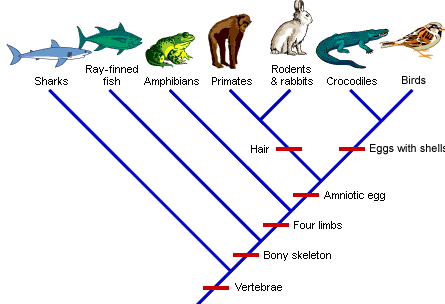
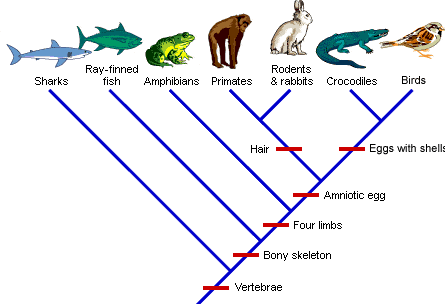
c)

active site.

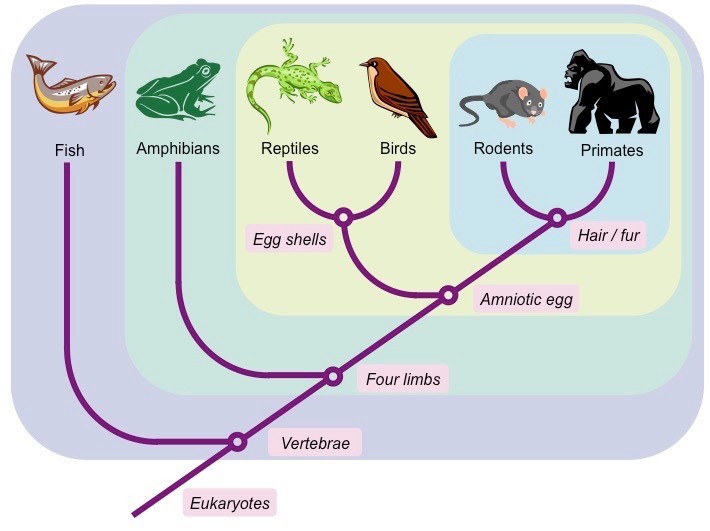
d)

lock and key.

14.
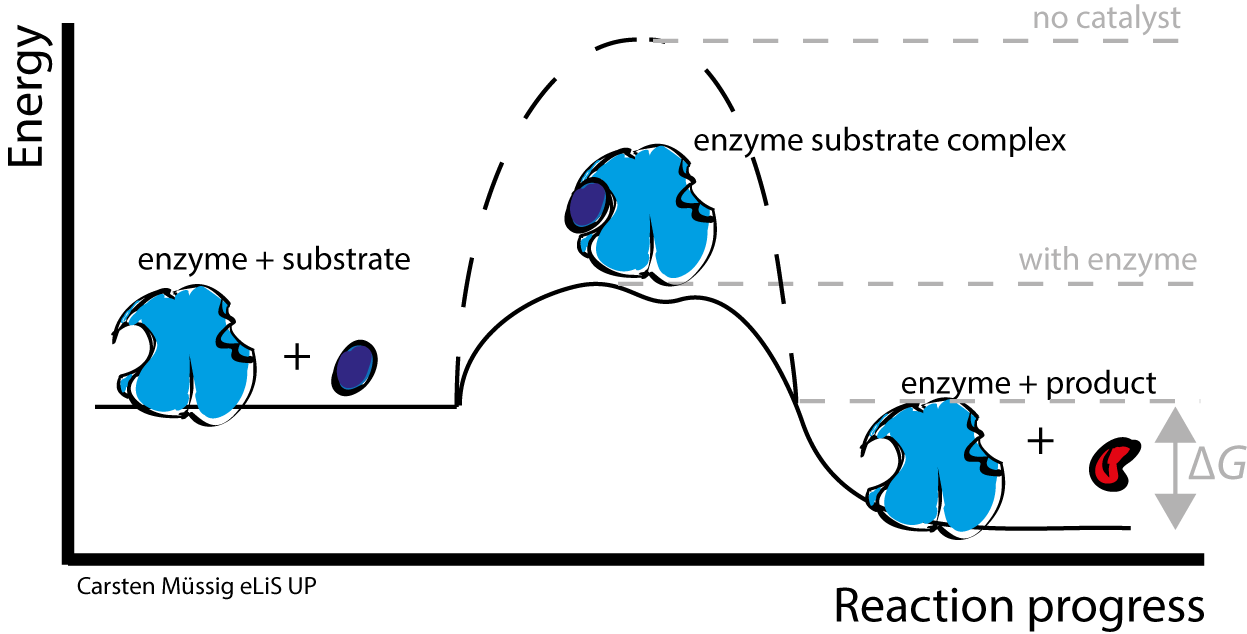
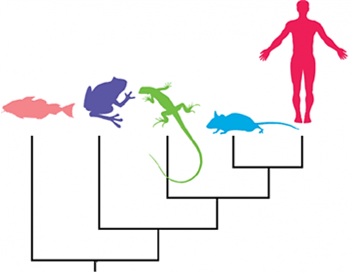
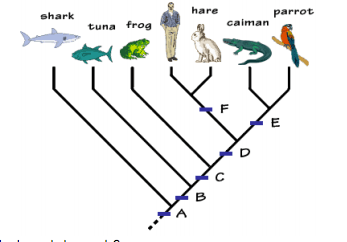
An enzyme speeds up a reaction by
a)
lowering the activation energy.
b)
raising the activation energy.
c)
releasing energy.
d)
absorbing energy.
15.
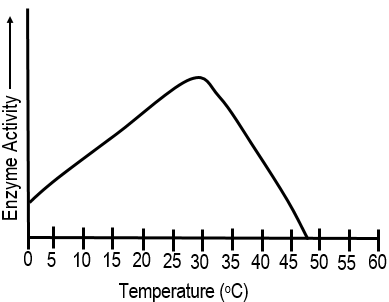
Based on the graph, what is the optimal temperature for this enzyme? 
a)
15oC
b)
40oC
c)
30oC
d)
35oC
16.
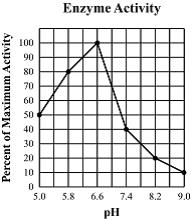
Which of the following conclusions can be drawn from this graph?
a)
The optimum pH of the enzyme is 6.6.
b)
The optimum pH of the enzyme is 5.8
c)
The enzyme’s activity increases as pH increases 5.0 to 9.0
d)
The enzyme’s activity is greater around pH of 8.0 .
17.

Which statement best describes the function of the cell membrane?

a)

The protective outer layer that controls what enters and leaves the cell.

b)

Stores information on DNA molecules.

c)

A folded membrane that moves materials around inside cells.

d)

Makes proteins

18.

What is embedded in the phospholipid bilayer and forms pumps or channels for molecules to move through?

a)

Proteins

b)

Salt

c)

Water

d)

Worms

19.
The picture is an example of...
a)
active transport
b)
passive transport
c)
diffusion
d)
osmosis
20.
What is one major difference between passive and active transport?
a)
Passive transport uses energy; active transport does not.
b)
Both types of transport use energy.
c)
Active transport uses energy; passive transport does not.
d)
No difference. They are both the same.
21.
Small, non-polar molecules like COand O2 and NO can pass through the cell membrane using what type of transport?
a)
Diffusion
b)
Osmosis
c)
Facilitated Diffusion
d)
Endocytosis
22.

Which is the protein?

a)

A

b)

B

c)

C

d)

D

23.

This picture show the molecules getting help across the membrane through transport proteins. Which type of membrane transport is happening?

a)

diffusion

b)

osmosis

c)

facilitated diffusion

d)

active transport

24.
Osmosis is the diffusion of __________.
a)
water
b)
glucose
c)
air
d)
passive transport
25.

Describe the movement of molecules going through the proteins in the illustration.

a)

Molecules are moving from a higher concentration to a lower concentration.

b)

Molecules are moving from a lower concentration to a higher concentration.

c)

Molecules are moving from a higher concentration to a lower concentration and then from a lower to higher concentration.

d)

Molecules are moving from a lower concentration to a higher concentration and then from a higher concentration to a lower concentration.

26.
The cell membrane is selectively permeable, which means...
a)
All materials can enter and leave the cell
b)
Certain things can enter while others cannot
c)
The cell manually sorts through all materials
d)
Only certain cells can interact with the cell.
27.

Which type of Passive Transport is being represented in this picture?

a)

Passive Diffusion

b)

Simple Diffusion

c)

Active Diffusion

d)

Facilitated Diffusion

28.
This picture represents which type of cellular transport?
a)
passive transport
b)
endocytosis
c)
exocytosis
d)
osmosis
29.
This picture represents what type of cell transport?
a)
endocytosis
b)
exocytosis
c)
osmosis
d)
passive transport
30.
Which of the following modes of cellular transport does NOT require energy?
a)
Facilitated Diffusion
b)
Protein Pumps
c)
Endocytosis
d)
Exocytosis
31.
Where will the water go?
a)
Into the cell
b)
Out of the cell
c)
Equally in & out - it's isotonic
d)
There is no water
32.
A blood cell is placed into the jar, as seen. Where will the water go?
a)
Into the cell
b)
Out of the cell
c)
Equally in & out - it's isotonic
d)
The water is a lie
33.
 An animal cell placed in a hypertonic (salty) solution will
a)
Stay the same
b)
Shrink- get smaller
c)
Swell- get bigger
34.
The cell below is in a _________ solution.
a)
Hypotonic
b)
Hypertonic
c)
Isotonic
35.
Which cell is placed into a hypotonic environment? 
a)
A
b)
B
c)
C
d)
D
36.

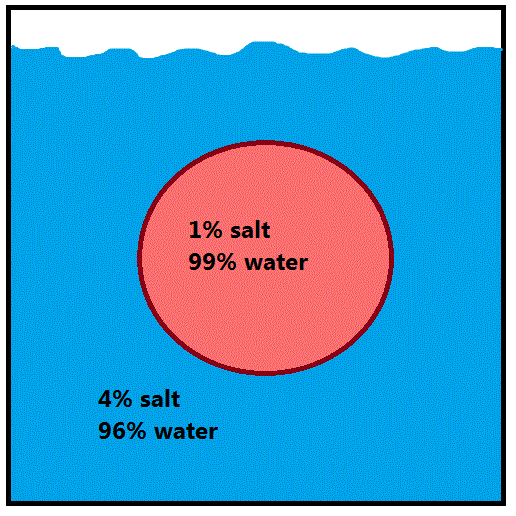
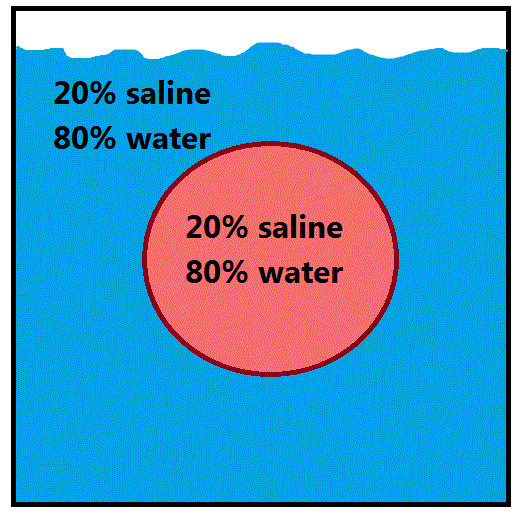
After examining this diagram showing the concentration of water inside and outside of the cell, identify the tonicity of the solution.

a)

hypertonic

b)

hypotonic

c)

isotonic

37.

After examining this diagram showing the concentration of water inside and outside of the cell, identify the tonicity of the solution.

a)

isotonic

b)

hypotonic

c)

hypertonic

38.
The cell below is in a _____________ solution.
a)
Hypertonic
b)
Hypotonic
c)
Isotonic
39.

If the dots represent sugar what direction will the water flow?

a)

Into the cell

b)

Out of the cell

c)

Both equally (equilibrium)

40.

What will happen to the cell in the given solution?

a)

Swell up

b)

Shrink

c)

Stay the same

41.

Modifies, packages and prepares proteins

to be shipped out of the cell.

a)

golgi body

b)

chloroplast

c)

ribosomes

d)

lysosome

42.

outermost structure that gives support and shape to plant cells

a)

cell wall

b)

cell membrane

c)

mitochrondria

d)

cytoplasm

43.

Captures energy from the sun and turns it into glucose during photosynthesis.

a)

chloroplast

b)

nucleus

c)

endoplasmic reticulum

d)

lysosome

44.

Stores water and waste

a)

vacuole

b)

cytoplasm

c)

chloroplast

d)

cell wall

45.

Barrier that encloses all cells

controls the movement of materials into and out of the cell

a)

cell membrane

b)

cell wall

c)

endoplasmic reticulum

d)

golgi body

46.

Makes proteins from amino acids

a)

ribosomes

b)

mitochondria

c)

nucleus

d)

lysosome

47.

Breaks down glucose to produce energy (ATP) during cellular respiration

a)

mitochondria

b)

nucleus

c)

cytoplasm

d)

chloroplast

48.

contains DNA, which has the information on how to make the cell's proteins

control center for the cell

a)

nucleus

b)

lysosome

c)

mitochondria

d)

endoplasmic reticulum

49.

Destroys worn-out or damaged organelles and

gets rid of waste materials.

a)

lysosome

b)

vacuole

c)

cell wall

d)

golgi body

50.

Gel like substance where all other organelles are found

it is constantly moving and some cellular reactions can occur here

a)

cytoplasm

b)

vacuole

c)

chloroplast

d)

golgi body

51.

Transports proteins to the Golgi apparatus.

a)

rough endoplasmic reticulum

b)

golgi body

c)

ribosomes

d)

mitochondria

52.
Which sequence of DNA bases would pair with this partial strand
CAT TCA CTG
a)
ATG TGA CAG
b)
TAC ACT GTC
c)
GTA AGT GAC
d)
CAT TCA CTG
53.
A process in which DNA has the unique ability to make an exact copy of itself.
a)
Replication
b)
Translation
c)
Transcription
54.
The process of DNA replication is called semi conservative because it results in
a)
none of these
b)
Two DNA molecules.  One original molecule and one with two new strands
c)
two exact copies with new strands
d)
two identical molecules, each with 1 original strand and one new.
55.
Which of the following best describes a DNA molecule?
a)
double helix
b)
contains ribose
c)
made of amino acids
d)
contains Uracil
56.
Cytosine always pairs with
a)
Adenine
b)
Thymine
c)
Uracil
d)
Guanine
57.

Adenine bonds with ______________.

a)

Adenine

b)

Guanine

c)

Cytosine

d)

Thymine

58.
Mitosis results in the formation of...
a)
Two identical cells with all of the original chromosomes
b)
Two different cells with half of the original chromosomes
c)
Four identical cells with all of the original chromosomes
d)
Four different cells with half of the original chromosomes
59.
What is the purpose of mitosis?
a)
To increase the surface area of a cell
b)
To allow cells to divide for growth, repair, and renewal
c)
For increasing genetic variation within a species
d)
To allow for DNA replication and protein synthesis
60.
During interphase, what important step must occur for mitosis to happen correctly?
a)
Cytoplasm & Cell membrane must separate
b)
Chromosomes must line up at opposite poles
c)
Spindle fibers must make the centrioles
d)
DNA must replicate and twist to form chromosomes
61.
If a parent cell going through mitosis starts with 22 chromosomes, how many chromosomes will be in the daughter cells?
a)
22
b)
11
c)
44
d)
15
62.

Fruit fly body cells have 8 chromosomes. After mitosis, you would expect a resulting fruit fly daughter cell to have -

a)

16 chromosomes.

b)

46 chromosomes.

c)

8 chromosomes.

d)

4 chromosomes.

63.

Mitosis happens in what type of cells?

a)

somatic body cells

b)

sex cells

c)

dead cells

d)

none of the above

64.
In RNA, Uracil pairs with ______. 
a)
cytosine
b)
adenine
c)
guanine
d)
thymine
65.
The process to go from DNA to mRNA is _______
a)
translation
b)
transcription
c)
replication
66.
The process to go from mRNA to a protein is called ____
a)
transcription
b)
rRNA
c)
replication
d)
translation
67.
DNA holds the code for
a)
lipids
b)
carbohydrates
c)
protein
d)
sugar
68.
Choose the nucleotide sequence of the RNA strand that would be complementary to the following strand: 
GTAGTCA
a)
UATUAGA
b)
ACGACTG
c)
CAUCAGU
d)
CATCAGT
69.
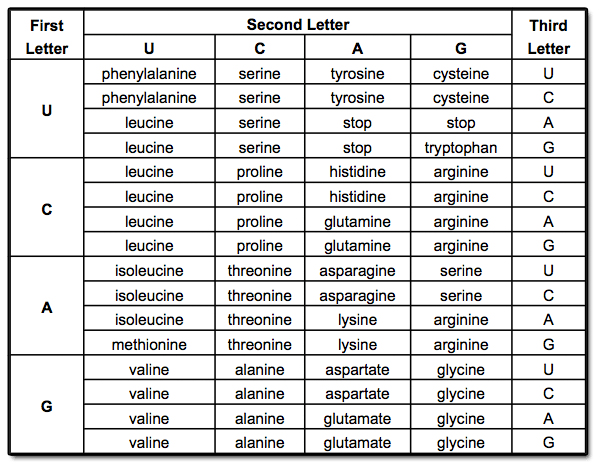
What amino acid is represented by the codon UUA?
a)
Phenylalanine
b)
Tyrosine
c)
Leucine
d)
Stop codon
70.
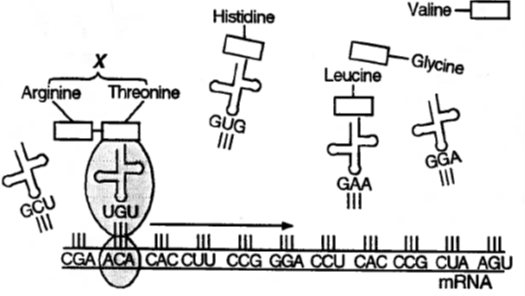
What process is going on in this photo? 
a)
Transcription 
b)
Translation 
c)
Replication 
d)
All the above 
71.

What is the location in the cell for translation?

a)

nucleus

b)

mitochondria in cytoplasm

c)

ribosome in cytoplasm

d)

chloroplast in cytoplasm

72.
What is the three base sequence of mRNA that codes for a single amino acid?
a)
Anticodon
b)
Codon
c)
Protein
73.
What is the location in the cell for transcription?
a)
nucleus
b)
cytoplasm
c)
ribosome
d)
mitochondria
74.
Translation is the process where
a)
mRNA is created in the Nucleus
b)
mRNA is decoded to form a protein 
c)
glucose molecules are made
d)
is where lipids are synthesised
75.

What process is happening in the diagram?

a)

transcription

b)

translation

c)

dna replication

d)

mitosis

76.

If ATGCCG is the original sequence, and AGCCG is the mutated sequence, what type of mutation do you have?

a)

Insertion

b)

Point

c)

Substitution

d)

Deletion

77.

Which component of the DNA molecule provides instructions for the production of the protein and determines the traits of the organism?

a)

The phosphate group

b)

The sugar molecule

c)

The sequence of nitrogen bases

d)

The hydrogen bonds that hold the sugars to the bases

78.

What is a mutation?

a)

The specific sequence of bases in a molecule of DNA

b)

A change in the genetic material of a cell

c)

The process by which a molecule of DNA make a copy of itself

d)

The perfect replication of DNA molecule

79.
What mutation has occurred here? 
T-G-A-C-C-A
T-G-A-G-C-A
a)
Substitution
b)
Deletion
c)
Insertion
d)
Frameshift 
80.
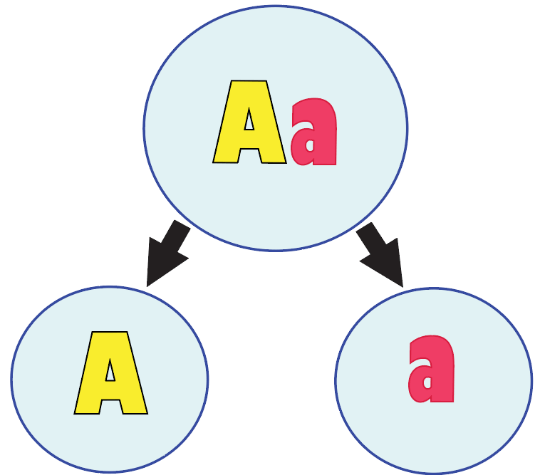
Which process and type of resulting cells are represented?
a)
mitosis, gametes
b)
mitosis, body cells
c)
meiosis, gametes
d)
meiosis, body cells
81.
Compared to the number of chromosomes contained in a body cell, how many chromosomes would normally be contained in a gamete?
a)
The same number
b)
One-fourth as many
c)
Twice as many
d)
Half as many
82.
What causes genetic variation in meiosis?
a)
chromosomes lining up
b)
crossing over of chromosomes
c)
separation of chromosomes
d)
chromosomes pulling apart
83.

What is a benefit of meiosis?

a)

survival of the fittest

b)

results in overproduction of offspring

c)

creates genetic variation in offspring

d)

allows cloning in offspring

84.
Chromosomes exchange genetic material during 
a)
crossing over
b)
replication
c)
synthesis
d)
translation
85.
A human being has a somatic cell that has 46 chromosomes.  What is the haploid number found in a gamete?
a)
23
b)
46
c)
69
d)
92
86.

The purpose of meiosis is to form ________ for sexual reproduction.

a)

body

b)

gametes

c)

somatic

d)

brain

87.
How many daughter cells are produced at the end of meiosis?
a)
1
b)
2
c)
3
d)
4
88.
In meiosis, Prophase 1 is when chromosomes...
a)
cross over
b)
mutate
c)
hybridize
d)
fertilize
89.

What process occurs during meiosis that can result in chromosomal disorders due to errors in meiosis?

a)

Crossing over

b)

Disjunction

c)

Non-disjunction

d)

Segregation

90.
What do you call the physical expression of a gene?
a)
genotype
b)
dominant
c)
phenotype
d)
allele
91.

During meiosis and gamete formation, homologous (paired up) alleles split up

a)

Phenotype

b)

Law of Segregation

c)

Genotype

d)

Dihybrid Cross

92.
Two brown eyed parents (Bb) have a baby. What is the chance the baby is blue eyed?
a)
0 %
b)
25%
c)
50%
d)
75%
93.
Two black mice reproduce and have four babies.  Some of the babies are black and some of the babies are white. What are the genotypes for each parent? 
a)
BB and Bb
b)
BB and BB
c)
Bb and Bb
d)
Bb and bb
94.
Round seeds (R) are dominant over wrinkled seeds (r). What percentage of the offspring will be round from the following cross?
RR X Rr
a)
100%
b)
75%
c)
50%
d)
25%
95.
Tomato plants usually have hairy stems. Hairless stems are present in tomato plants that are homozygous recessive for this trait. If the stem characteristics are determined by a single gene, what are the expected phenotype percentages for the offspring of a heterozygous hairy plant and a hairless plant?
a)
100% hairy, 0% hairless
b)
75% hairy, 25% hairless
c)
50% hairy, 50% hairless
d)
25% hairy, 75% hairless
96.
In domestic swine there is a dominant allele that produces a white belt around the body. Suppose a heterozygous belted pig and solid pig mate.  What is the probability they will produce a solid pig?
a)
0%
b)
50%
c)
75%
d)
100%
97.
What gamete possibilities could come from this parent's genotype?
a)
AB, AB, aB, aB
b)
Ab, AB, Ab, ab
c)
Ab, Ab, Ab, Ab
d)
AB, aB, ab, aB
98.
What goes in box 1
a)
AABb
b)
AABB
c)
aabb
d)
AaBb
99.
What goes in box 3
a)
Aabb
b)
AABB
c)
AAbb
d)
aaBb
100.

In peas, round is dominant to wrinkled and yellow is dominant to green. Based on this dihybrid cross, what is the phenotypic ratio?

a)

8:8:0:0

b)

9:3:3:1

c)

16:0:0:0

d)

0:0:8:8

101.
If this image were real, it would represent what type of inheritance?
a)
incomplete dominance
b)
codominance
c)
polygenic inheritance
d)
compete dominance
102.
What type of inheritance is shown?
a)
complete
b)
incomplete
c)
codominance
d)
sex-linked
103.
Snap dragon color is a incomplete dominant trait.  A red flower (RR) is crossed with white flower (rr)? What color are flowers that are Rr?
a)
Red
b)
Red and White
c)
White
d)
Pink
104.
A breed of chicken shows codominance for feather color. One allele codes for black feathers, another codes for white feathers. The feathers of heterozygous chickens of this breed will be:
a)
all black
b)
all white
c)
all gray
d)
speckled black and white
105.

If you cross two heterozygous pink roses where red color is incompletely dominant and white is recessive, what will the phenotype probability be for the offspring?

a)

25% red, 50% pink, 25% white

b)

50% red, 50% white

c)

100% pink

d)

50% pink, 50% red

106.

Which of these is true of sexual reproduction

a)

offspring are genetically identical to each other

b)

slower and more energy required to find a mate and exchange genetic material

c)

offspring are genetically identical to their parent cell

d)

fast; not a lot of energy required

107.

Which disadvantage is most related to asexual reproduction

a)

slower process

b)

requires more energy

c)

produces less offspring

d)

there is no genetic diversity

108.
Provided is a table of organisms and some data on their characteristics. Based on the information in the table, which organism is likely to produce offspring with the greatest genetic diversity?
a)
Black mold
b)
Bell tree dahlia
c)
Spruce
d)
Hydra
109.

A heterotrophic, eukaryotic organism associated with the decomposition of dead material should be classified into which kingdom?

a)

eubacteria

b)

fungi

c)

plantae

d)

archaebacteria

110.
This kingdom includes unicellular organisms, they reproduce quickly by binary fission (asexual), and live in your gut.
a)
Archaebacteria
b)
Fungi
c)
Eubacteria
d)
Protists
111.

The organisms in which kingdom possess these traits?

Made of Eukaryotic cells

Photosynthetic

Cell walls made of Cellulose

a)

Eubacteria

b)

Fungi

c)

Plantae

d)

Archaebacteria

112.

A newly described organism is multicellular, does not carry out photosynthesis, and absorbs nutrients from the environment. It is composed of eukaryotic cells with cell walls made of chitin. In which kingdom would the organism be classified?

a)

Plantae

b)

Eubacteria

c)

Animalia

d)

Fungi

113.

All organisms made of eukaryotic cells belong in which domain(s)?

a)

Eukarya

b)

Bateria

c)

Archaea

d)

Eukarya, Bacteria, and Archaea

114.

This domain is characterized by ancient bacteria that can live in extreme environments, such as hot springs.

a)

Archaea

b)

Bacteria

c)

Eukarya

d)

Prokarya

115.

archaea and bacteria are domains that are...

a)

plantae

b)

eukaryotes

c)

protists

d)

prokaryotes

116.
I have no cell walls
I am eukaryotic
I reproduce sexually
I am multicellular
What kingdom do I belong to?
a)
Plantae
b)
Animalia
c)
Protista
d)
Fungi
117.

I have cell walls made of cellulose

I am an autotroph

I am multicellular

What kingdom am I?

a)

Plantae

b)

Animalia

c)

Eubacteria

d)

Unicorn

118.
I am unicellular
I am prokaryotic
I am found in extreme ecosystems
What kingdom do I belong to?
a)
The Candy Kingdom
b)
Kingdom Plantae
c)
Kingdom Animalia
d)
Kingdom Archaebacteria
119.

I can be either a heterotroph or an autotroph-

I can be either multicellular or unicellular-

I can have cell walls or not-

The only thing for sure about me is that I have a nucleus in my cells...

I am Kingdom ____________ .

a)

Plantae

b)

Protista

c)

Animalia

d)

Fungi

120.

Which of the following excludes a virus from being considered a living organism?

a)

It cannot reproduce on it's own

b)

It has DNA or RNA, but never both

c)

It is not made of cells

d)

All the above

121.
Where must a virus be to reproduce?
a)
in a eukaryote cell
b)
in water
c)
in a living cell
d)
viruses do not reproduce
122.

When an organism is best suited for its environment and has a better chance of passing on its traits to the next generation.

a)

natural selection

b)

adaptation

c)

evolution

d)

selective breeding

123.

There was once a large population of cheetah, but about 12,000 years ago most of the cheetahs were killed off because of human activity and only a few survived and reproduced. What is this an example of?

a)

Bottleneck Effect

b)

Genetic Drift

c)

Founder Effect

d)

Natural Selection

124.

Bats are common in Texas, especially in rocky regions. Bats with longer hang claws have demonstrated higher fitness because of their ability to cling to rock while resting. This adaptation is becoming more frequent in the population. What mechanism of evolution is this?

a)

Natural Selection

b)

Non-random mating

c)

Gene Flow

d)

Genetic Drift

125.
One day a group of scientists collected a small group of brown anole lizards from a large group of the lizards.  Then they placed this small group of lizards on an island that had no brown anole lizards on it.  What is this an example of?
a)
Bottleneck Effect
b)
Hardy Effect
c)
Founder Effect
d)
None of These
126.
Since the 1800s humans have stopped burning coal, and the trees have returned to their original color. Which moth will be more successful in this environment?
a)
Dark moth
b)
Light moth
c)
Both will be equally successful
d)
Neither will be successful
127.

In a mouse population inhabiting a grassland area, a mutation occurs that results in a new coat color allele.


Which factor has the GREATEST effect on whether the new coat color will become more common in the mouse population?

a)

Whether abundant food is available in the grassland.

b)

Whether the new coat color allele is dominant or recessive.

c)

Whether the rate of reproduction in the mouse population is stable.

d)

Whether the new coat color allele increases the survival of mice in their environment.

128.

The diagram shows light-and dark-colored beetles that live on a tree.


Which result is MOST LIKELY to occur to the beetle population over time due to natural selection?

a)

The number of light-colored beetles will decrease.

b)

The dark-colored beetles will move to a different type of tree.

c)

The number of light-colored beetles in the population will increase.

d)

There will be more dark-colored beetles than light-colored beetles.

129.

Starting in 1954, commericial fishers in the northwest Pacific were paid by weight, rather than by the individual fish, for pink salmon. The fishers increased the use of a type of net that selectively catches larger fish.


Which of the following effects did this change in fishing techniques MOST LIKELY have on the salmon population over the next 20 years?

a)

The average body size of the salmon population increased significantly.

b)

The average body size of the salmon population decreased significantly.

c)

There was no effect on the average body size of the salmon in this population.

d)

The average body size of the males in the population increased while the average body size of the females decreased.

130.

Recently, scientists have been able to use ___________to find common proteins and amino acids to determine how closely related species are.

a)

DNA

b)

Vestigial structures

c)

Fossils

d)

Homologous structures

131.

_____________________are features present in modern organisms which are no longer in use.

a)

DNA

b)

Vestigial structures

c)

Fossils

d)

Homologous structures

132.

_________________ show clear changes in an organism over time, the environment organisms lived in, the time period the organism lived in, and where the organism lived.

a)

DNA

b)

Vestigial structures

c)

Fossils

d)

Homologous structures

133.
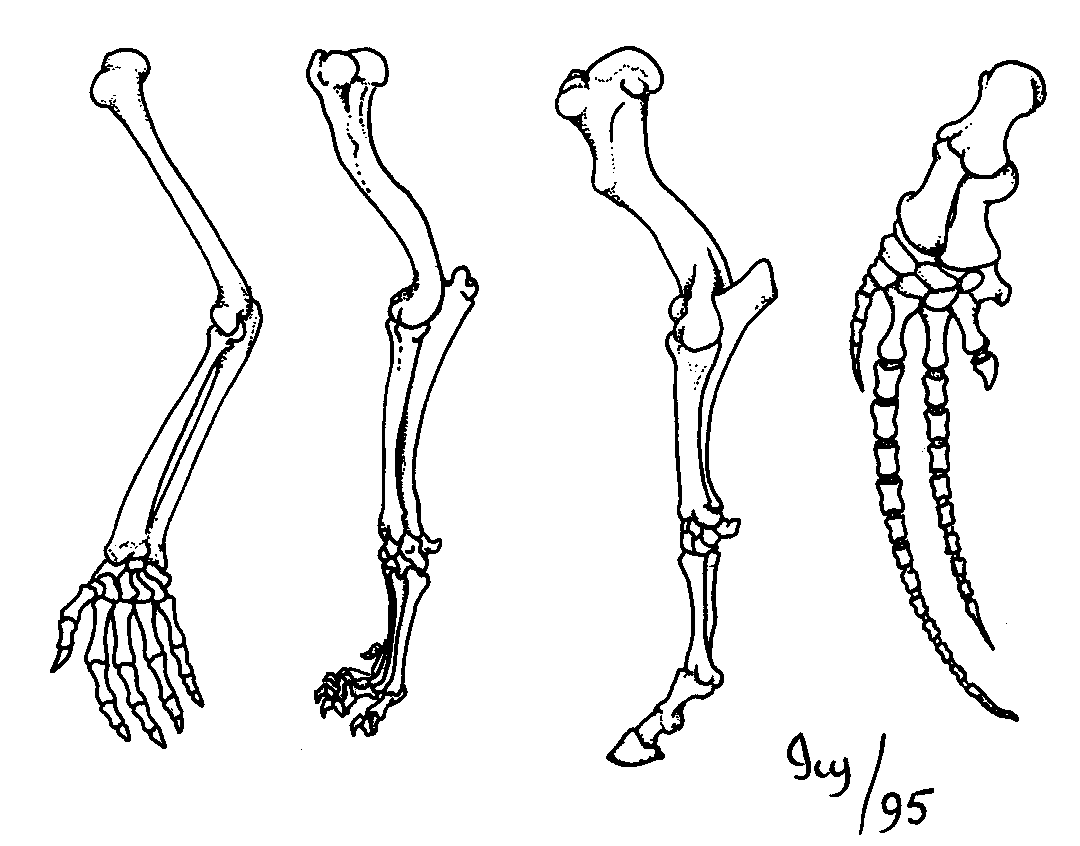
The similarities of the bones in the diagram provide evidence that---
a)
The organisms shown lived in the same natural envionrment
b)
The organisms shown may have developed from a common ancestor
c)
The organisms shown have the same genetic diseases
d)
All vertebrate species have identical forelimbs
134.

What type of evidence are shown in the picture above?

a)

Fossils

b)

Embryology

c)

Homologous Structures

d)

Vestigial Structures

135.

What type of evidence is shown in the image above?

a)

Fossils

b)

Vestigial structures

c)

Homologous Structures

d)

DNA

136.
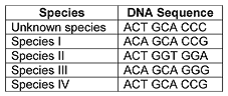
According to this data, the unknown bacterial species is most closely related to: 
a)
Species I
b)
Species II
c)
Species III
d)
Species IV
137.
The diagram shows fossils in different rock layers. Which of these statements about the age of these fossils is most likely correct?
a)
Fossil A and C are the same age
b)
Fossil B is older than fossil C
c)
Fossils A is older than fossil B
d)
Fossil D is older than fossil C
138.

Structures that have the same bones in the same place, but have different functions; suggests that organisms share a common ancestor.

a)

vestigial structures

b)

homologous structures

c)

adaptive radiation

d)

fossil

139.

The chart shows the amino acid sequences from several animals for cytochrome C, a protein that carries oxygen.


Based on the chart, which two animals MOST LIKELY evolved from the most recent common ancestor?

a)

The bullfrog and the shark.

b)

The chicken and the iguana.

c)

The gorilla and the chicken.

d)

The iguana and the bullfrog.

140.
According to this cladogram, sharks are MOST closely related to which organism? 
a)
Amphibians
b)
Ray finned fish
c)
Crocodiles
d)
Birds
141.
According to this cladogram, birds are LEAST related to: 
a)
Amphibians
b)
Sharks
c)
Ray Finned Fish
d)
Crocodiles
142.
Which trait do only humans have, according to the cladogram?
a)
jaws
b)
mammary glands & hair
c)
terrestrial during all life stages
d)
opposable thumbs
143.

What characteristic distinguishes amphibians from birds and reptiles?

a)

Amniotic egg

b)

Egg shells

c)

Vertebrae

d)

Hair/fur

144.

What characteristic do all the organisms on this cladogram share?

a)

Being bi-pedal & having language

b)

Complex brains

c)

Fully binocular vision

d)

Partial binocular vision & opposable thumbs
145.

On the cladogram, which organism is the closest relative of the parrot?

a)

Frog

b)

Hare

c)

Caiman

d)

Parrot

146.

Who is most closely related to Taxidea taxus?

a)

Lutra lutra

b)

Panthera pardus

c)

Canis latrans

d)

Canis lupus

147.

According to this phylogenetic tree, which creature is the least related out of all pictured?

a)

Fish

b)

Frog

c)

Salamander

d)

Human

148.

Which group of animals on this tree are most closely related to birds?

a)

Saurischian dinosaurs

b)

Ornithischian dinosaurs

c)

Crocodiles

d)

None of these are related to birds

149.

What number is the common ancestor of C and D

a)

1

b)

2

c)

3

d)

4

150.

What is the common ancestor of Letters A, B, C, D, E?

a)

1

b)

2

c)

3

d)

4

151.

Which of the following organisms is a producer?

a)

grass

b)

rabbit

c)

fox

d)

snake

152.

Which of the following organisms is a primary consumer?

a)

grass

b)

rabbit

c)

fox

d)

snake

153.

What would happen to the rabbit population if the fox population moved out of the area represented by the food web?

a)

The rabbit population would increase

b)

The rabbit population would decrease

c)

The rabbit population would neither increase nor decrease

154.
All energy on Earth ultimately comes from what source?
a)
Water
b)
Sun
c)
Consumers
d)
Oxygen
155.
The arrows in a food chain or web represents what?
a)
They point to the organism that is being eaten.
b)
It shows how sunlight flows within an ecosystem.
c)
They show what direction the energy is flowing between organisms. 
d)
They represent how water is transferred within a habitat.
156.
What organism consumes both rabbits and birds?
a)
The Hawk
b)
The Wolf
c)
The Plant
d)
The Mushroom
157.
What level consumer could you consider the deer?  
a)
Primary
b)
Secondary
c)
Tertiary
d)
Quarternary
158.
If there are 10,000KCal unites of nergy available for the producers, and a lion is the secondary consumer in a food chain, how many calories does the lion get
a)
1
b)
10
c)
100
d)
1000
159.
When taken to a new habitat, non-native plants often threaten native plants of the new habitat.  Why do they do this?
a)
Non-native plants are able to mutate rapidly
b)
Non-native  plants cause native animals to relocate
c)
Non-native plants are able to be used for medicine
d)
Non-native plants compete with native plants for resources
160.
If a blue catfish is introduced and eats the large fish who eat the smaller fish, what will happen to the population of the smaller fish?
a)
Increase
b)
Decrease
c)
Stay the same
d)
No affect on smaller fish