wayground logo

Free Printable Worksheets

Font size

S
M
L
XL
Worksheets

Year End Challenge

Total questions: 157

Worksheet time: 3hrs 58mins
Name
Class
Date
1.
What is the basic structural and functional unit of all living things? 
a)
atom
b)
cell
c)
molecule
d)
human
2.
How are unicellular organisms different from multicellular organisms? 
a)
There are no differences.
b)
They are made of many cells. 
c)
They are only classified as prokaryotes.
d)
They are made of only one cell. 
3.
What organelle of the cell produces energy?
a)
Mitochondria 
b)
Golgi Body 
c)
Vesicle 
d)
Vacuole 
4.
What kind of transport does not require energy?
a)
Active 
b)
Vacuole 
c)
Passive 
d)
Na/K Pump 
5.
Which of the following is correct about the Golgi? 
a)
Digests waste materials 
b)
Protection and Support 
c)
Modifies and packages molecules 
d)
cellular movement 
6.
Osmosis is the movement of... 
a)
salt 
b)
sugar 
c)
water 
d)
none of these 
7.
In cells a large oval organelle that contains the cells genetic material in the form of DNA and controls many of the cells activities
a)
organelle
b)
ribosome
c)
cell wall
d)
nucleus
8.
an organelle in the cells of plants and some other organisms that captures energy from sunlight and changes it to an energy from that cells can use in making food
a)
vacuole
b)
chloroplasts
c)
cytoplasm
d)
mitochondria
9.
Which of the following is the correct equation for PHOTOSYNTHESIS?
a)
CO+ light + H2O --> O+ Sugar
b)
CO+ sugar + H2O --> O+ light
c)
O2 + light + H2O --> CO+ Sugar
d)
CO+ O2 + H2O --> Light+ Sugar
10.
The main source of energy for all life comes from ____.
a)
the Earth
b)
the moon
c)
the sun
d)
the food we eat/make
11.
Why are producers (plants) important for all life on Earth? 
a)
They make our world more beautiful
b)
They make the planet look green
c)
They use carbon dioxide and give us oxygen
d)
They provide shade for insects
12.
What phase of mitosis is shown in the picture?
a)
Prophase
b)
Anaphase
c)
Telophase
d)
Metaphase
13.
Chromatid pairs line up in the middle of the cell.
a)
Metaphase
b)
Telophase
c)
Anaphase
d)
Interphase
14.
What phase of mitosis is shown in the picture?
a)
Prophase
b)
Anaphase
c)
Telophase
d)
Metaphase
15.
How many chromosomes does a human cell have?
a)
42
b)
46
c)
24
d)
64
16.
Which of the following lists, in order, the phases of mitosis?
a)
interphase, metaphase, anaphase, telophase
b)
prophase, metaphase, anaphase, telophase
c)
prophase, metaphase, anaphase, interphase
d)
prophase, anaphase, metaphase, telophase
17.
having two different genes for a trait (sometimes called hybrid).
a)
protein
b)
homozygous
c)
heterozygous
d)
genotype
18.
G = green, g = yellow
The genotype for a yellow plant is...
a)
GG
b)
Gg
c)
gg
d)
all of the choices result in yellow
19.
Sex cells are produced through the process of
a)
mitosis
b)
cytokinesis
c)
binary fission
d)
meiosis
20.
Which of the following is homozygous dominant?
a)
Yy
b)
Y
c)
yy
d)
YY
21.
Who is considered the "father" of modern genetics?
a)
Einstein
b)
Mendel
c)
Disney
d)
Trump
22.
What type of "square" helps us solve genetic problems?
a)
carpenter square
b)
Mendel square
c)
Punnett square
d)
genetic square
23.
TT,tt,PP,pp,SS,ss are examples of alleles that are?
a)
homozygous
b)
heterozygous
c)
different
d)
homologous 
24.
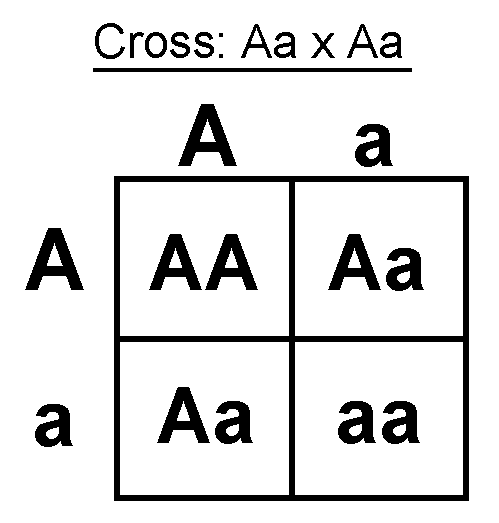
What is the phenotype of the offspring? (A-Brown hair; a-blond hair) 
a)
50 % Brown Hair and 50% Blond Hair 
b)
25 % Brown Hair and 75% Blond Hair 
c)
75 % Brown Hair and 25% Blond Hair 
d)
0% Brown Hair and 100% Blond Hair 
25.
What are the possible genotypes for this cross?
a)
TT = 25% Tt= 50% tt=25%
b)
all tall
c)
TT= 75% tt = 25%
d)
Tt = 100%
26.
What two factors are primarily used to describe climate?
a)
temperature and density
b)
temperature and precipitation
c)
precipitation and density
d)
winds and humidity
27.

Both El Nino and La Nina have this in common

a)

Influence birds that migrate over the ocean

b)

Influence rainy / dry weather world wide

c)

The weather at the polar regions

d)

The directions that ships travel in the oceans

28.

If you don't have a basement, which of the following choices is the safest shelter during a tornado?

a)

An interior room (closet, hallway, bathroom, etc.) on the lowest floor of your house away from windows.

b)

If one is available, in an outside garage or shed.

c)

The North wall of the house is always the safest.

d)

If you have a fireplace try to crawl into it. Use it as a shelter.

29.

What should you do if you are in a car during a tornado?

a)

Try to outrun it if you can.

b)

Get out and away from the car. Find a low ditch and lay flat in it. Cover your head.

c)

Find an over pass and climb up the embankment of the bridge. Stay low.

d)

Stay in the vehicle.

30.
What is the strongest category of hurricane?
a)
Category 5
b)
Category 10
c)
Category 1
31.
What measures the intensity of a tornado?
a)
Categories
b)
Tornado Scale
c)
Fujita Scale 
d)
Intense Scale
32.
A tornado that does light damage, such as breaking branches and damaging siding on buildings is most likely an
a)
EF0
b)
EF1
c)
EF2
d)
EF5
33.
Why is person B having a hard time moving down the hill?
a)
Person B has more friction than person A.
b)
Person B has the same friction as person A.
c)
Person B is out of shape.
d)
Person B has less friction has person A.
34.
A measure of how fast something moves over a certain distance is ________________.
a)
motion
b)
speed
c)
work
d)
force
35.
Calculate the net force of the object in the image shown.
a)
20N
b)
35N
c)
5N
d)
25N
36.
The forces represented by the arrows in the diagrams are applied to the four objects that are at rest on a table. Which object is most likely to move to the right?
a)
Object W
b)
Object X
c)
Object Y
d)
Object Z
37.
The forces represented by the arrows in the diagrams are applied to the four objects that are at rest on a table. Which object is most likely to remain in place?
a)
Object W
b)
Object X
c)
Object Y
d)
Object Z
38.
The roller coaster car begins at point W.  At what point along the track will the car have the greatest amount of kinetic energy?
a)
W
b)
X
c)
Y
d)
Z
39.
What are some major parts of the digestive system?
a)
kidneys, liver, bladder, and skin
b)
brain, spinal cord, and nerves
c)
mouth, stomach, large intestine, small intestine
d)
heart, arteries, and veins
40.
Which body system lets you breathe oxygen in and carbon dioxide out?
a)
respiratory system
b)
circulatory system
c)
excretory system
d)
none of the above
41.
Which body system helps you remove waste products from your body that you do not need?
a)
muscular system
b)
excretory system
c)
skeletal system
d)
none of the above
42.
Which statement about body systems is true?
a)
Your body is made up of exactly seven systems.
b)
The skeletal system is more important than any other body system.
c)
All of your body systems must work together to keep you healthy.
d)
Each of your body systems works by itself to keep you healthy.
43.
What makes the human body most similar to a busy city?
a)
Both have a lot of movement, lights, and noise.
b)
Both are found in every part of the world.
c)
Both have many systems and many things that keep moving all of the time.
d)
Both have circulatory and muscular systems.
44.
The smallest units or parts of living things; the body's building blocks.
a)
cells
b)
organs
c)
tissues
d)
system
45.
A collection of the same kinds of cells working together to do the same job.
a)
cells
b)
tissues
c)
organs
d)
system
46.
Information gathered by closely watching someone or something.
a)
observation
b)
lens
c)
microscope
d)
systems
47.
Roles, jobs, or purposes.
a)
function
b)
cells
c)
stimulus
d)
microscopic
48.
I have many jobs. I make bile to help your stomach break down food.  I also store nutrients your body needs.  I also make antibodies to help you fight disease.  What am I?
a)
liver
b)
kidneys
c)
stomach
d)
lungs
49.
When you eat, I mix your food with chemicals made by your body, then I churn up your food into smaller parts.  What am I?
a)
small intestines
b)
large intestines
c)
liver
d)
stomach
50.
We take oxygen that your body needs from the air and put it in your blood and send it out of your body. What are we?
a)
lungs
b)
heart
c)
liver
d)
veins
51.
I hold your body parts in.  I have pores so sweat can escape your body.  I am filled with nerves that help you sense temperature and feel the things around you. What am I?
a)
skin
b)
bones
c)
heart
d)
muscles
52.
I control your muscles and all of the organs in your body.  I make sure you breathe automatically, ensure your heart beats properly, and remind you to blink your eyes. I even hold all of your thoughts and memories. What am I?
a)
muschles
b)
brain
c)
arteries
d)
veins
53.
We are blood vessels that send blood back towards your heart. Most of the blood we carry doesn't have much oxygen left in it. What are we?
a)
veins
b)
esophagus
c)
lungs
d)
kidneys
54.
We are blood vessels that send blood away from your heart to all different parts of your body. We have thicker, stronger walls than veins. What are we?
a)
veins
b)
trachea
c)
arteries
d)
esophagus
55.
I am sometimes called your "windpipe." When you breathe air travels through me to your lungs. What am I?
a)
esophagus
b)
trachea
c)
arteries
d)
veins
56.
I am a tube in your throat. When you swallow, food, or drink travels down through me into your stomach. What am I?
a)
trachea
b)
stomach
c)
small intestines
d)
esophagus
57.
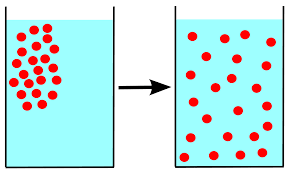
What is diffusion?
a)
when molecules move 
b)
when molecules move from a high concentration to a low.
c)
no movement 
d)
molecules move everywhere
58.
The picture below is an example of _________________.
a)
osmosis
b)
isotonic
c)
diffusion
d)
active transport
59.
Osmosis is the movement of _____ across a membrane.
a)
food
b)
energy
c)
oxygen
d)
water
60.
Permeable means
a)
things can pass through
b)
the concentration levels are different
c)
it is permanent
d)
things are stuck
61.
What is the definition of  Selective Permeability?
a)
The movement of materials across the cell membrane that requires NO ENERGY from the cell.
b)
The movement of materials through (or across) the cell membrane
c)
The ability of the cell membrane to allow some things to pass through while preventing other things from passing through.
d)
The movement of molecules from an area of high concentration to a area of low concentration 
62.
Passive transport requires no
a)
concentration gradients
b)
osmosis
c)
motion
d)
energy
63.
Which structures are found in every living cell?
a)
cell membrane and cytoplasm
b)
chloroplasts and mitochondria
c)
a cell wall and nucleus
d)
chloroplasts and cell wall
64.
Which of the following is the smallest unit of life that can carry out all life functions?
a)
the mitochondria
b)
the vacuoles
c)
the nucleus
d)
the cell
65.
Cell organelles that are responsible for digesting food, worn out organelles and other cellular wastes are called ___________________.
a)
Mitochondria
b)
Vacuoles
c)
Lysosomes
d)
Chlororplasts
66.
What is the function of the cell nucleus found in both plant and animal cells?
a)
to produce energy
b)
to control cell activity
c)
to remove waste products
d)
to allow molecules to enter the cell
67.
What is the function of a cell wall?
a)
to protect and support the cell
b)
to perform different functions in each cell
c)
to prevent water from passing through it
d)
to prevent oxygen from entering the cell
68.
All living things do which of the following?
a)
Chemosynthesis
b)
Respiration
c)
photosynthesis
d)
all of the answers
69.
Where does aerobic respiration take place?
a)
Cytoplasm
b)
Mitochondria
c)
Stroma
d)
Thylakoid
70.
The passing of traits from parents to offspring
a)
heredity
b)
genetics
c)
trait
d)
alleles
71.
The different forms of a gene
a)
heredity
b)
genetics
c)
gene
d)
alleles
72.
The factors that control a trait
a)
genetics
b)
trait
c)
gene
d)
alleles
73.
This trait always shows up in an organism when the allele is present
a)
dominant allele
b)
codominance
c)
probability
d)
recessive allele
74.
This trait is hidden whenever the dominant allele is present
a)
dominant allele
b)
codominance
c)
recessive allele
d)
Punnett Square
75.
The mathematical chance that an event will occur
a)
dominant allele
b)
probability
c)
recessive allele
d)
Punnett Square
76.
An organism's genetic makeup, or allele combination
a)
fertilization
b)
genotype
c)
phenotype
d)
heterozygous
77.
A possible explanation to a problem that has not yet been tested. 
a)
data
b)
theory
c)
hypothesis
d)
fact
78.
This part of the experiment serves as a basis of comparison; the one variable being tested has been omitted. 
a)
experimental group
b)
control group
c)
data
d)
variables
79.
This variable in an experiment is the one being deliberately changed by the scientist. 
a)
dependent variable
b)
independent variable
c)
data
d)
control group
80.
What step does every scientific experiment begin with?
a)
hypothesis
b)
question/problem
c)
procedures
d)
conclusion
81.
An experiment is performed on plants to see how different liquids affect plant growth. Each plant in the experiment is given a different liquid; water, apple juice, or milk. Each plant has the same amount of soil, sunlight, and listens to the same music. In this investigation, the independent variable is ...
a)
The type of plant
b)
The amount of sunlight
c)
The type of music
d)
The type of liquid
82.
The summary at the end of an experiment that explains the results. 
a)
conclusion
b)
procedures
c)
materials
d)
responding variable
83.
Testing a hypothesis often involves a(n):
a)
answer
b)
experiment
c)
problem
d)
safety check
84.
A student wants to test the effects of type of exercise on heart rate.  What is the dependent variable?
a)
heart rate
b)
type of exercise
c)
amount of exercise
d)
time of day exercise occurs
85.
Observations made during an experiment are called:
a)
data
b)
problems
c)
conclusions
d)
questions
86.
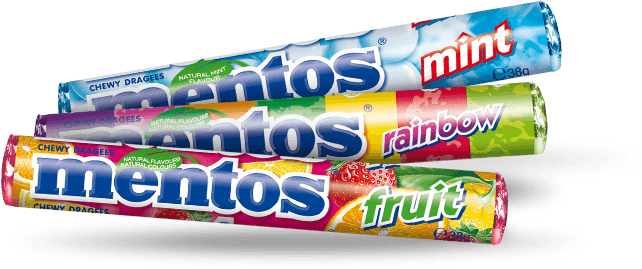
A test is set up to test which brand of soda creates the biggest foam explosion when adding a Mentos candy.  Three different sodas were tested. They measured the height of the foam eruption.   What is the dependent variable?
a)
Brand of soda
b)
Number of mentos candies used
c)
Height of foam eruption
d)
Temperature of soda
87.
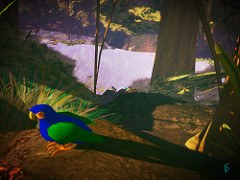
Which of the following is a quantitative observation?
a)
The bird is very colorful.
b)
The bird has 4 different colors on him.
c)
The bird has many, many feathers.
d)
It is a bird. 
88.
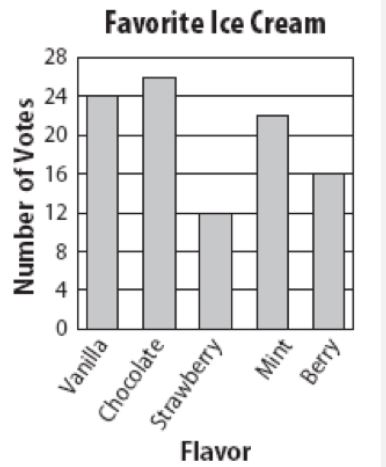
Which character did exactly 10 people say was their favorite?
a)
Mickey Mouse
b)
Dora
c)
Daffy Duck
d)
Sponge Bob
89.
How many more people like purple than red?
a)
3
b)
5
c)
7
d)
9
90.
The graph below shows the number of sunny days and rainy days in a city during four months.

Based on the graph,how many more sunny days than rainy days did this city have during the months of April, May, and June?
a)
21
b)
56
c)
26
d)
20
91.
How many total people took the survey?
a)
50
b)
150
c)
100
d)
200
92.

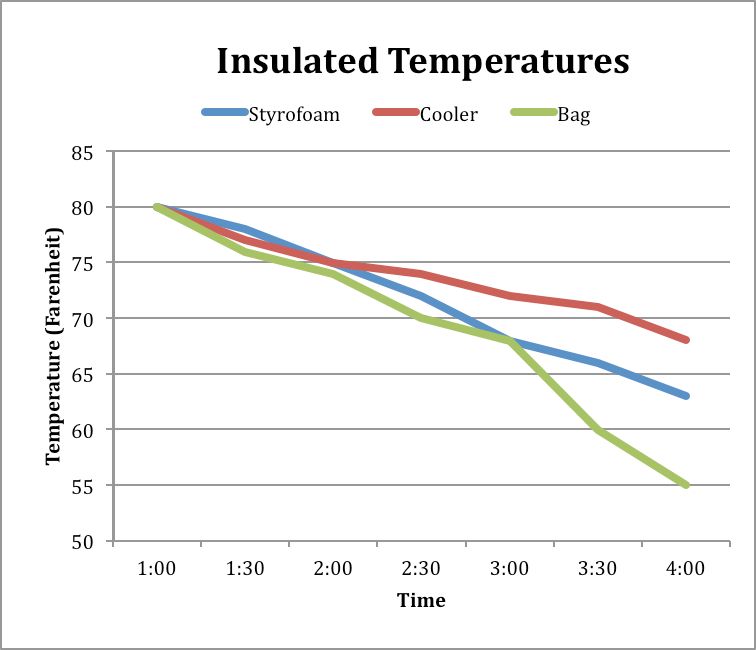
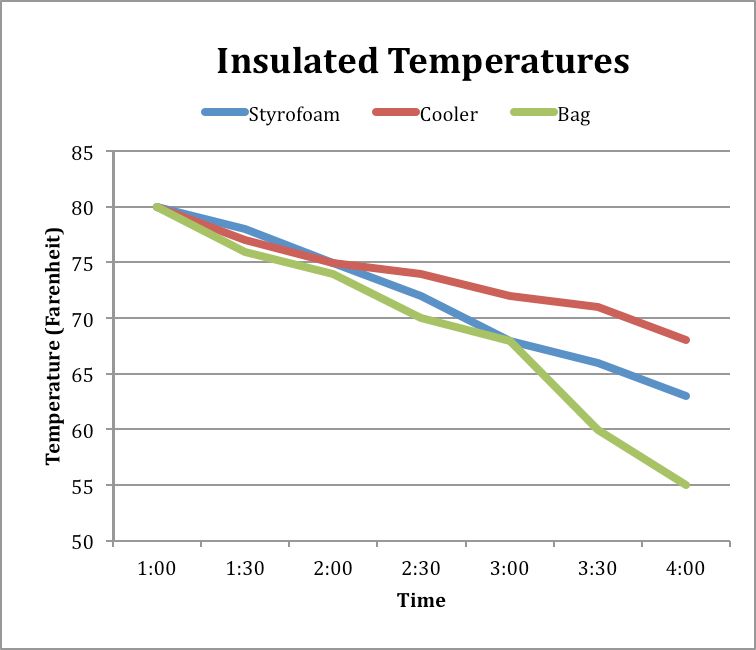
What data does this graph represent?

a)

Change in temperature of a liquid over time in 3 different containers

b)

How temperature can change the molecules in a material

c)

The phase changes of a material

d)

What type of container people use the most to store hot liquids.

93.

Which type of container keeps liquid the hottest for the longest time?

a)

Bag

b)

Cooler

c)

Cooler and bag are tied

d)

Styrofoam

94.

What was the temperature of the liquid in the Styrofoam container at 4:00?

a)

55 degrees

b)

68 degrees

c)

73 degrees

d)

63 degrees

95.

Which of the following is an accurate observation that you could make based on what this graph shows.

a)

There was no change to the gummy bear after 24 hours of being submerged in water.

b)

The gummy bear changed the most in length from being submerged in vinegar

c)

The gummy bear that has the greatest mass is the one that was submerged in vinegar.

d)

Gummy bears change color when they are submerged in different liquids.

96.

What was the controlled variable in this experiment, based on the data the graph shows?

a)

the type of solution

b)

the length of the gummy bear before it was submerged

c)

the length of the gummy bear after it was submerged

97.

What is the independent variable of this experiment based on this graph?

a)

the length of the gummy bear before it was submerged

b)

the different types of solutions used to submerge the gummy bears.

c)

the length of the gummy bears after they were submerged in different liquids

98.
What does a barometer do?
a)
measures air pressure
b)
measures temperature
c)
measures humidity
d)
measures length
99.
What is a true fact about the mesosphere?
a)
it is the hottest layer
b)
meteors burn up here
c)
the ozone layer is found here
d)
Northern Lights happen here
100.
The weight of the atmosphere is ...
a)
temperature
b)
humidity
c)
air pressure
d)
weather
101.

How does air pressure change as you climb a mountain?

a)

it decreases (less air pressure)

b)

it increases (more air pressure)

c)

stays the same

d)

the temperature gets warmer

102.

In which temperature of air do the molecules spread out and take up more space?

a)

cold

b)

warm

103.
In what layer would you find the ozone layer?
a)
troposphere
b)
stratosphere
c)
mesosphere
d)
thermosphere
104.
The Northern Lights occur in which layer?
a)
mesosphere
b)
exosphere
c)
thermosphere
d)
stratosphere
105.

What gas makes up the majority of the atmosphere?

a)

oxygen

b)

nitrogen

c)

water vapor

d)

carbon dioxide

106.

What layer of the atmosphere is closest to outer space?

a)

mesosphere

b)

exosphere

c)

troposphere

d)

stratosphere

107.

What is precipitation?

a)

Sweat from our bodies on hot days

b)

Warm rain but not cold snow or sleet

c)

Gas that we use in furnaces or ovens

d)

Any form of water that falls from the sky

108.

What is another name or synonym for the water cycle?

a)

Geologic cycle

b)

Hydrologic cycle

c)

Geosphere

d)

Carbon cycle

109.

What are formed when water vapor condenses?

a)

Clouds

b)

Mountains

c)

Transpiration

d)

Valleys

110.

The act of turning from a gas into a liquid. ________________________

a)

Condensation

b)

Evaporation

c)

Transpiration

d)

Precipitation

111.

The movement caused within a fluid by the tendency of hotter and therefore less dense material to rise, and colder, denser material to sink under the influence of gravity, which consequently results in transfer of heat. ____________________

a)

Evaporation

b)

Convection

c)

Precipitation

d)

Transpiration

112.

The act of turning from a liquid into a gas. ___________________

a)

Transpiration

b)

Condensation

c)

Evaporation

d)

Precipitation

113.

The process where plants absorb water through the roots and then give off water vapor through pores in their leaves. __________________________

a)

Transpiration

b)

Condensation

c)

Evaporation

d)

Precipitation

114.
88 m/s
a)
Speed
b)
Velocity
c)
Acceleration
115.
20 m/s west
a)
Speed
b)
Velocity
c)
Acceleration
116.
88 m/s2
a)
Speed
b)
Velocity
c)
Acceleration
117.
What is the formula to calculate speed?
a)
S = t/d
b)
S = d/t
c)
S = d x t
d)
S = t x d
118.

An object moving at -5 m/s2 is doing what?

a)

Speeding up

b)

Slowing down

c)

Moving at the same speed

d)

Stopped

119.

Assume the letters label each point shown on the graph. The last point should be labelled F. Between which two letters is this object accelerating the most?

a)

A to B

b)

B to C

c)

E to F

d)

A to F

120.
At 60 seconds, how far had this object traveled? 
a)
0 m
b)
10 m
c)
20 m
d)
40 m
121.
Energy from a compressed spring would be an example of...
a)
kinetic
b)
elastic
c)
gravitational
d)
chemical
122.
How do you calculate power?
a)
P = W/t
b)
P = E/t
c)
P = w * t
d)
P = bbq/chicken
123.
How do we calculate work?
a)
W = F * d
b)
w = f * D
c)
W = F * D
d)
w = f * d
124.
The SI unit of work is?
a)
Joules
b)
Watts
c)
Newtons
d)
meters
125.
The faster an object moves, the ________ kinetic energy it has. 
a)
more
b)
less
c)
none of the above
d)
all of the above 
126.
What is the energy of position or shape that depends on weight and height, also called stored energy?
a)
Energy
b)
Kinetic energy
c)
Potential energy
d)
Sound energy
127.
What type of cloud looks like cotton and is in the lower altitudes?
a)
Cumulus
b)
Stratus
c)
Cirrus
128.
Clouds are made up of tiny drops of ______ or ice. The moisture in the cloud affects the weather.
a)
dust
b)
water
c)
cloud particles
d)
precipitation
129.
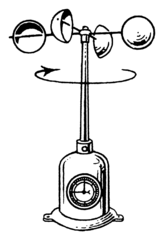
This weather instrument is an...
a)
wind vane
b)
anemometer
c)
barometer
d)
thermometer
130.
At which humidity is it more likely to rain?
a)
50%
b)
20%
c)
77%
d)
99%
131.
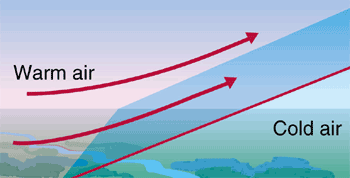
Which type of front is displayed?
a)
Cold
b)
Warm
c)
Stationary
d)
Occluded
132.
When two different air masses collide...
a)
A front forms
b)
They casually become one
c)
A new planet evolves
d)
Dinosaurs become extinct
133.

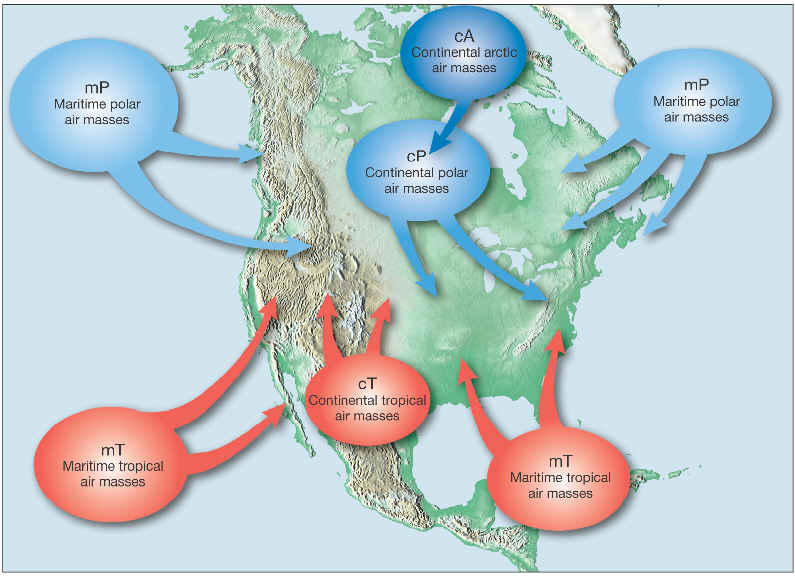
An air mass is a large mass of air that is defined by its temperature and ____________________.

a)

Elevation (altitude)

b)

Water vapor content (humidity)

c)

Strength

d)

Weather

134.

Which type of air mass is dry and warm?

a)

Continental polar

b)

Continental tropical

c)

Maritime polar

d)

Maritime tropical

135.

Which type of air mass is cold and dry?

a)

Continental polar

b)

Continental tropical

c)

Maritime polar

d)

Maritime tropical

136.

Blizzards form in which type of air mass?

a)

Continental polar

b)

Continental tropical

c)

Maritime polar

d)

Maritime tropical

137.

Hurricanes form in which type of air mass?

a)

Continental polar

b)

Continental tropical

c)

Maritime polar

d)

Maritime tropical

138.

This is the symbol for a _____________ weather front.

a)

Cold

b)

Warm

c)

Stationary

d)

Occluded

139.

This is the symbol for a _____________ weather front.

a)

Cold

b)

Warm

c)

Stationary

d)

Occluded

140.

A _____________ weather front occurs when a cold air mass and a warm air mass meet, but cannot move one another so they both stay still for several days.

a)

Cold

b)

Warm

c)

Stationary

d)

Occluded

141.

Why does warm air rise above cold air?

a)

Warm air is less dense

b)

Warm air is more dense

c)

Cold air is stronger than warm air

142.

Which type of weather front can produce foggy weather that can last for several days?

a)

Cold

b)

Warm

c)

Stationary

d)

Occluded

143.

Daytime Entertainment

a)

TV's No Good

b)

Nothing Good On TV

c)

TV Under No Good

d)

CNN

144.
a)

Too FUNNY for WORDS

b)

Two FUNNY over four WORDS

c)

Funniest Words

145.

Healthy Breakfast?

a)

Kays in a Row

b)

Circle K

c)

The one in the middle

d)

Special K

146.
Pigs has an excellent sense of __________.
a)
smell
b)
touch
c)
taste
d)
thought
147.
How fast can a dragonfly fly?
a)
25 mph
b)
50 mph
c)
10 mph
d)
100 mph
148.
Leatherheads and loggerheads are what kind of animal?
a)
Frog
b)
Snake
c)
Lizard
d)
Turtle
149.
What is the only animal that can see both infra-red and ultra-violet light?
a)
Common Rat
b)
Dogs
c)
Cats
d)
Gold Fish
150.
A fingerprint of what animal is virtually indistinguishable from those of humans so much that they could cause a confusion at a crime scene?
a)
Polar Bear
b)
Koala Bear
c)
Grizzly Bear
d)
Red Panda
151.
What animal paw prints are called pug marks?
a)
Timber Wolves
b)
Bears
c)
Tigers
d)
Guinea Pigs
152.
What animal was once called Camelopard?
a)
Giraffe
b)
Hippipotamus
c)
Panther
d)
Hyena
153.
 What animal has killed more than 400 people in Africa - more than any other wild animal?
a)
Hippopotamus
b)
Lions
c)
Hyenas
d)
Crocodile
154.
The only cat in the world that can't retract its claws is?
a)
Snow Leopard
b)
Lion
c)
Panther
d)
Cheetah
155.
What is the name of an adult female horse?
a)
Mare
b)
Nun
c)
Madame
d)
Lady
156.
A group of owls is called?
a)
Murder
b)
Exaltation
c)
Parliament
d)
Pod
157.
A group of ravens is called?
a)
Murder
b)
Exaltation
c)
Parliament
d)
Pod