
 Worksheets
9YScC1 Revision Quiz
Total questions: 105
Worksheet time: 2hrs 54mins
When a 1.53-kilogram mass is placed on a spring with a spring constant of 30.0 newtons per meter, the spring is compressed 0.500 meter. How much energy is stored in the spring?
3.75 J
7.50 J
15.0 J
30.0 J

What is the spring constant for this spring?
0.020 N/m
2.0 N/m
25 N/m
50. N/m
A spring with a spring constant of 4.0 newtons per meter is compressed by a force of 1.2 newtons. What is the total elastic potential energy stored in this compressed spring?
0.18 J
0.36 J
0.60 J
4.8 J
A spring gains 2.34 joules of elastic potential energy as it is compressed 0.250 meter from its equilibrium position. What is the spring constant of this spring?
9.36 N/m
18.7 N/m
37.4 N/m
74.9 N/m
A 10-newton force is required to hold a stretched spring 0.20 meter from its rest position. What is the potential energy stored in the stretched spring?
1.0 J
2.0 J
5.0 J
50 J
A catapult with a spring constant of 1.0 × 10⁴ newtons per meter is required to launch an airplane from the deck of an aircraft carrier. The plane is released when it has been displaced 0.50 meter from its equilibrium position by the catapult. The energy acquired by the airplane from the catapult during takeoff is approximately
1.3 × 10³ J
2.0 × 10⁴ J
2.5 × 10³ J
1.0 × 10⁴ J
A vertical spring has a spring constant of 100 newtons per meter. When an object is attached to the bottom of the spring, the spring changes from its unstretched length of 0.50 meter to a length of 0.65 meter. The magnitude of the weight of the attached object is
1.1 N
15 N
50 N
65 N
A spring has a spring constant of 5 N/cm. What is its extension when loaded with 15 N?
x = 4 cm
x = 5 cm
x = 3 m
x = 3 cm
Which of the following springs is the stiffest?
A spring that requires a froce of 2000 N to compress it by 6.8 m.
A spring that requires a force of 4000 N to stretch it by 9.0 m.
A spring that requires a force of 8000 N to compress it by 45 m.
A spring that requires a force of 4800 N to stretch it by 14 m.
Which statement most accurately represents Hooke's Law?
Extension of a spring is proportional to the force applied.
Extension of a spring is proportional to the number of coils.
Extension of a spring is inversely proportional to the force applied.
Thickness of a spring wire is proportional to the force applied.
A spring has a spring constant of 330 N/m. How far is the spring compressed if 150 N of force are used?
x = 2.2 m
x = 0.0014 m
x = 5.0 m
x = 0.45 m

What is the best description of the relationship shown in this graph?
In this graph, the relationship between force and extension is linear.
In this graph, the relationship between force and extension is non-linear.
In this graph, the relationship between force and extension is directly proportional.
In this graph, there is no relationship between force and extension.
A spring with a spring constant of 50 N/m is compressed by 0.2 meters. What is the elastic potential energy stored in the spring?
A) 0.5 J
B) 1.0 J
C) 2.0 J
D) 5.0 J
If a spring is stretched by 0.1 meters and stores 0.25 joules of elastic potential energy, what is the spring constant?
A) 25 N/m
B) 50 N/m
C) 75 N/m
D) 100 N/m
A bungee jumper uses a cord with a spring constant of 30 N/m. If the cord stretches by 3 meters during the jump, how much elastic potential energy is stored in the cord?
A) 45 J
B) 90 J
C) 135 J
D) 180 J
WHEN AN ARCHER BENDS A BOW, WHAT TYPE OF ENERGY INCREASES IN THE BOW?
GRAVITATIONAL
ELASTIC
KINETIC
THERMAL

A spring with spring constant 16 N/m is compressed by 0.5 m. How much energy is stored in the spring?
1 J
0.25 J
2 J
16 J
The equation for spring force is
(Hint - Hooke's Law)
Fsp = mgh
Fsp = 1/2kx2
Fsp = Fd
Fsp = -kx

What equation is used to calculate elastic potential energy?
Ep = m g h
Ep = 1/2 k x2
Ep = F / E d
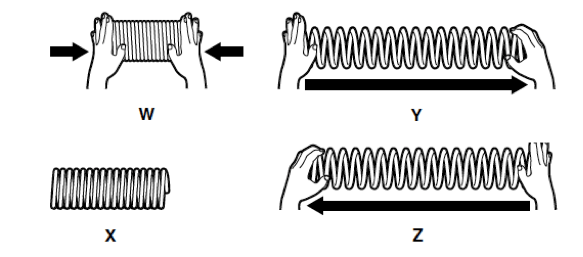
Elastic potential energy is energy stored in an object, such as a spring, due to the object being stretched or compressed. In which position is it most likely that the spring has lost its elastic potential energy?
W
Y
X
Z

What type of energy is the girl storing in the bow?
Light Energy
Elastic Potential Energy
Chemical Potential Energy
Thermal Energy

When an archer fires an arrow from a traditional bow, the string of the bow does not change length. As shown in the diagram, the archer pulls back on the string (Step 1), changing the curve of the bow (Step 2). When the archer releases the string, the bow returns to its original shape (Step 3). How does the elastic potential energy in the bow change as the archer fires an arrow?
It decreases from Step 1 to Step 2, then increases to Step 3.
It increases from Step 1 to Step 2, then decreases to Step 3.
It remains constant from Step 1 to Step 2, then increases to Step 3.
It remains constant from Step 1 to Step 2, then decreases to Step 3.

This type of potential energy can be found in rubber bands and springs.
Chemical energy
Chemical energy
light energy
Elastic energy
When an archer fires an arrow from a traditional bow, the string of the bow does not change length. As shown in the diagram, the archer pulls back on the string (Step 1), changing the curve of the bow (Step 2). When the archer releases the string, the bow returns to its original shape (Step 3). How does the elastic potential energy in the bow change as the archer fires an arrow?
It decreases from Step 1 to Step 2, then increases to Step 3.
It increases from Step 1 to Step 2, then decreases to Step 3.
It remains constant from Step 1 to Step 2, then increases to Step 3.
It remains constant from Step 1 to Step 2, then decreases to Step 3.

Elastic potential energy is the ability to stretch or _________
pull
straighten
compress
stretch
Hooke's Law describes the behaviour of which kind of material under tension?
plastic
metals only
elastic
non-metals only
Elastic potential energy is energy in an object that is compressed or __________.
at rest
stretched
in equilibrium
Hooke's Law fails when a material reaches its:
breakdown
elastic limit
end of tether
fracture stress
A graph of force vs extension/defelction for an elastic material is:
A downward curve
An upward curve
A straight line from any point on the x and y axis
A straight line from the origin

If extension = Stretched length - original length. What is the extension of spring D.
1mm
2mm
3mm
0mm
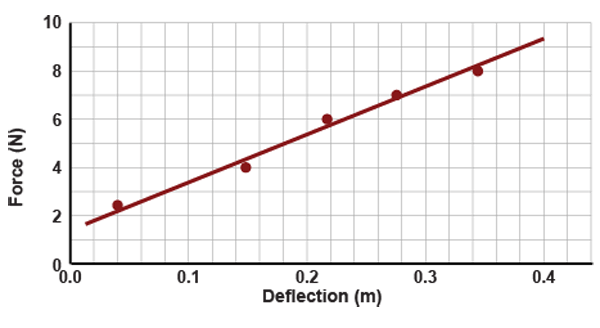
What Quantity can you calculate from the graph and give the magnitude of that quantity.
distance 4.5 m
Force 15 N
spring constant 20 N/m
spring constant 200 N/m
As a spring is stretched, its elastic potential energy
increases
decreases
remains the same
A spring with a spring constant of 68 newtons per meter hangs from a ceiling. When a 12-newton downward force is applied to the free end of the spring, the spring stretches a total distance of
0.18 m
0.59 m
5.7 m
820 m
Which graph best represents the relationship between the potential energy stored in a spring and the change in the spring’s length from its equilibrium position?


The graph below represents the relationship between the force applied to a spring and spring elongation for four different springs.
Which spring has the greatest spring constant?
A
B
C
D
What is the formula for elastic potential energy stored in a spring?
E=21kx2
E=mgh
E=21mv2
E=kx
Which of the following is a real-world application of Hooke's Law?
The operation of a car's suspension system
The flow of water in a river
The generation of electricity in a solar panel
The combustion of fuel in an engine
In an experiment, a spring is stretched by 0.2 meters when a force of 10 N is applied. What is the spring constant?
50 N/m
5 N/m
0.5 N/m
20 N/m
What happens to the elastic potential energy of a spring as it is compressed further?
It increases
It decreases
It remains constant
It becomes zero
Hooke's Law is valid for which type of deformation?
Elastic deformation
Plastic deformation
Permanent deformation
Thermal deformation
What equation is used to calculate elastic potential energy?
Eelastic = m g h
Eelastic = 0.5 k x2
Eelastic = F / E d
Elastic potential energy is energy stored in an object, such as a spring, due to the object being stretched or compressed. In which position is it most likely that the spring has lost its elastic potential energy?
W
Y
X
Z
Robert stretches a spring with a spring constant of 3 N/m until it is extended by 50 cm. What is the elastic potential energy stored by the spring?
0.375J
2.8J
1J
0.0023
How much elastic potential energy does a spring store when it is compressed by 0.2 m if it has a spring constant of 5 N/m?
0.1 J
2 J
0.01 J
5 J
A spring has an extension of 20 cm. Calculate the elastic potential energy stored in the spring (k = 100 N/m).
2 J
5 J
7 J
1 J
Convert 5 meters to centimeters.
50 centimeters
5 centimeters
50,000 centimeters
500 centimeters
Convert 500 grams to kilograms.
0.05
0.5
5
50
Convert 3 liters to milliliters.
300
30
3000
30000
Convert 10 kilometers to meters.
10000
100000
100
1000
Convert 2 kilograms to grams.
200 grams
20000 grams
20 grams
2000 grams
Convert 100 milliliters to liters.
10
0.1
1
1000
Convert 8 centimeters to meters.
0.8
0.008
0.8 meters
0.08
Convert 250 grams to kilograms.
0.0025
2.5
25
0.25
Convert 1 liter to milliliters.
100
500
10
1000
Convert 500 meters to kilometers.
0.5
50
5
0.05

The ability to do work or cause change:
work
energy
momentum
power
A soccer player kicks a ball with 20 Newtons of force causing it to travel 100 meters. How much work is done on the ball?
200 J
80 J
5 J
2000 J
A worker climbs a ladder and does 8 J of work on a 2 N object. What is the distance they lift the object?
18 m
4 m
10 m
6 m
Two workers use 100 N of force to move a sofa 2 meters in 2 seconds. How much power is required?
100 watts
400 watts
104 watts
50 watts

Which of the following is a non-renewable energy resource?
Wind power
Biomass
Natural gas
Hydroelectric
Where did the energy stored in fossil fuels originally come from?
Plants
Sunlight
Animals
Lucozade
What is an advantage of wind power?
It doesn't work unless there is wind
It uses large wind turbines
It is a renewable energy resource
It causes visual pollution
Which of the following is a good way to reduce the use of fossil fuels?
Leaving the lights on when we leave a room
Leaving the TV on standby all night
Walking instead of going in a car
Paying more for electricity
Which of these is a fossil fuel?
Biomass
Coal
Nuclear
Wind
When talking about fuels what does finite mean?
Will run out
Won't run out
Costs a lot of money
Produces lots of energy
What is an explanation for global warming?
Greenhouse effect
Respiration
Combustion
Acid rain
What gas causes acid rain?
Carbon monoxide
Sulphur dioxide
Carbon dioxide
Oxygen
What is a disadvantage of nuclear fuels?
They produce heat
They don't produce carbon dioxide
Disposing of waste
It is cheap
What is a disadvantage of geothermal energy?
It can only be used in certain places
It produces carbon dioxide
It is a non-renewable energy resource
It contributes to acid rain

