
 Worksheets
Final Exam Review Semester 1 - 8
Total questions: 50
Worksheet time: 25mins
Name
Class
Date
1.
The atmosphere and the hydrosphere overlap
a)
True
b)
False
2.
When water vapor loses thermal energy it _____________________ and millions of droplets come together to form clouds.
a)
Condenses
b)
Evaporates
c)
Boils
3.
What is a water reservoir?
a)
A moving river
b)
A storage area where water remains for extended periods
c)
A temporary water collection point
d)
An underground pipe system
4.
How does groundwater typically move?
a)
Randomly
b)
From higher to lower areas
c)
In circular patterns
d)
Against gravity
5.
The process of liquid changing to a gas at the surface of the liquid is called ____.
a)
condensation
b)
melting
c)
boiling
d)
evaporation
6.
A _________ is made up of water droplets or ice crystals that are so small they remain suspended in the air.
a)
Mountain
b)
Cloud
c)
Glacier
7.
Earth is often called the ____________ planet
a)
Blue
b)
Red
c)
Yellow
d)
Green
8.
Sea and land breezes are caused because ______.
a)
the land heats and cools more slowly than the water
b)
the land heats and cools more quickly than the water
c)
air moves more easily over water than over land
d)
air moves more easily over land than over water
9.
Deforestation can lead to _____.
a)
loss of animal habitats
b)
soil erosion
c)
increases in Earth's average surface temperature
d)
all of the above
10.
Why do we need to find an alternative to fossil fuels?
a)
They decrease the effects of global warming.
b)
They decrease the greenhouse effect.
c)
They increase biodiversity.
d)
They increase particulate matter in the air.
11.
Burning fossil fuels produces large amounts of ______________, which is the most abundant greenhouse gas that leads to global warming.
a)
nitrogen
b)
carbon dioxide
c)
ozone
d)
sulfur
12.
The _____________ Protocol is an agreement signed by many countries to reduce the use of CFCs.
a)
CFCs
b)
acid
c)
Montreal
d)
photochemical smog
13.
What is air pollution?
a)
Clean air
b)
Contamination of air by harmful substances
c)
Planting more trees
d)
Making clouds
14.
The study of ____ is called genetics.
a)
heredity
b)
dominance
c)
pea plants
d)
Mendel
15.
Asexual reproduction involves two parent organisms.
a)
True
b)
False
16.
What are the primary ways animals communicate during courtship?
a)
Only through sound
b)
Using sound, light, chemicals, and body language
c)
Exclusively through visual displays
d)
Only through physical contact
17.
What do male terns do to attract females?
a)
Sing complex songs
b)
Change their feather color
c)
Bring fish as gifts
d)
Build elaborate nests
18.
What raw materials does a plant need for photosynthesis?
a)
sugar and carbon monoxide
b)
water and carbon dioxide
c)
water and nitrogen
d)
sugar and water
19.
______________________ are plant structures that are colorful and may have specific odors to attract pollinators.
a)
Flowers
b)
Corn
c)
Beans
d)
Trees
20.
What is the primary difference between sexual and asexual reproduction?
a)
Number of offspring produced
b)
Genetic variation of offspring
c)
Time taken to reproduce
d)
Complexity of the process
21.
What are the sex cells in sexual reproduction called?
a)
Genes
b)
Chromosomes
c)
Eggs and sperm
d)
Zygotes
22.
What is a potential disadvantage of asexual reproduction?
a)
Genetic uniformity
b)
Complex cellular processes
c)
Requirement of a mate
d)
Slow reproduction rate
23.
What happens during fertilization?
a)
A new organism is cloned
b)
A plant grows new leaves
c)
Genetic material is destroyed
d)
An egg and sperm join
24.
During which process do trees remove carbon dioxide from the air?
a)
deforestation
b)
respiration
c)
photosynthesis
d)
both deforestation and respiration
25.
Human populations increase as medical care improves and becomes more available.
a)
True
b)
False
26.
When do populations increase?
a)
when birth rates are smaller than death rates
b)
when death rates are higher than birth rates
c)
when birth rates are higher than death rates
d)
when birth rates and death rates are equal
27.
Carrying capacity refers to the largest _____ an environment can support.
a)
ecosystem
b)
organisms
c)
population
d)
habitat
28.
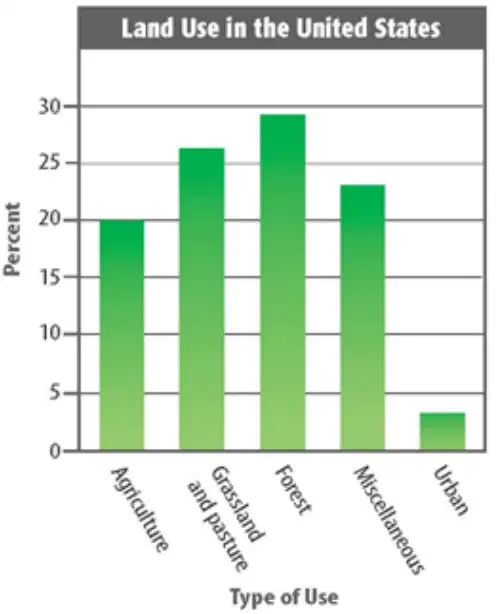
According to the graph, in the United States how much land is used by cities compared to other land uses?
a)
Most land is used by cities
b)
Cities use half as much land as agriculture
c)
Cities use one third as much of the land as forests
d)
Cities use very little land compared to any other category
29.
What is urbanization primarily characterized by?
a)
Decreased population density
b)
Movement of people to city suburbs
c)
Rural population decline
d)
Reduction in city infrastructure
30.
What percentage of Earth's total species does the Amazon rainforest host?
a)
10 percent
b)
15 percent
c)
20 percent
d)
5 percent
31.
What is the definition of an ecological footprint?
a)
Number of trees planted
b)
Total land area owned
c)
Area of Earth's productive land required to support an individual's resource demands
d)
Amount of waste produced
32.
What determines population growth rate?
a)
Death rates only
b)
Birth rates only
c)
Births minus deaths plus migration
d)
Government policies
33.
What defines a natural resource?
a)
Renewable energy sources
b)
Industrial products
c)
Parts of the environment supplying useful materials
d)
Man-made materials
34.
Population explosion refers to the _____.
a)
estimated world population in 2025
b)
number of people who live in poverty
c)
world population in 1810
d)
increased rate at which the population is growing
35.
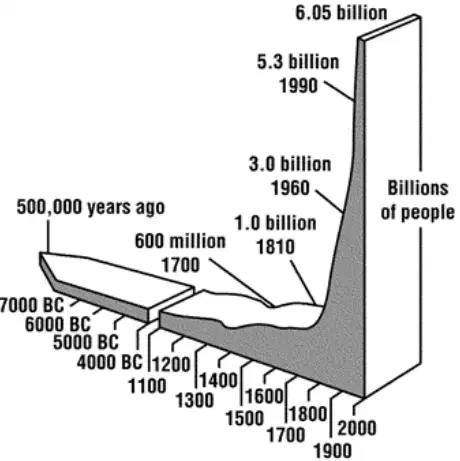
It took _____ years for Earth's population to grow from 1 billion to 3 billion.
a)
15
b)
10
c)
100
d)
150
36.
Human activities have which type of impact on the environment?
a)
positive
b)
negative
c)
neither positive nor negative
d)
both positive and negative
37.
What does the Clean Air Act do in the United States?
a)
Encourages burning more coal
b)
Sets limits on the amount of certain pollutants released into the air
c)
Increases the use of CFCs
d)
Makes air pollution legal
38.
Climate change causes the ice in polar regions to melt. Which describes an effect of polar ice melting?
a)
global warming increases
b)
sea levels rise
c)
greenhouse gas emissions rise
d)
Earth surface temperatures decrease
39.
Which is NOT a positive impact on Earth's water?
a)
fixing a dripping faucet
b)
disposing of chemicals properly
c)
increasing fertilizer runoff
d)
increasing recycling
40.
What does reforestation involve?
a)
Completely removing forests
b)
Planting trees to replace those removed
c)
Stopping all tree cutting
d)
Creating urban landscapes
41.
What is the primary human activity consuming the most water in the United States?
a)
Industrial manufacturing
b)
Residential use
c)
Agriculture
d)
Power plant operations
42.
How do dams impact river ecosystems?
a)
They create reservoirs and block fish migration
b)
They increase water quality instantly
c)
They eliminate the need for groundwater
d)
They have no environmental consequences
43.
How are climate and weather related?
a)
Climate is the weather closer to the equator.
b)
Climate cannot be affected by human activities.
c)
Climate is the average weather over a long period of time.
d)
Climate changes day to day, weather is fairly constant.
44.
What is the primary role of a meteorologist?
a)
To design weather clothing
b)
To build weather stations
c)
To predict and study weather patterns
d)
To collect weather rocks
45.
How is air pressure measured?
a)
With a ruler
b)
With a barometer
c)
With a scale
d)
With a thermometer
46.
What instrument measures wind speed?
a)
Thermometer
b)
Anemometer
c)
Barometer
d)
Psychrometer
47.
How do mountains influence local climate patterns?
a)
By creating wind barriers and rain shadows
b)
By absorbing heat uniformly
c)
By increasing solar radiation
d)
By reducing air pressure
48.
What distinguishes weather from climate?
a)
Weather depends on altitude, climate does not
b)
Weather is predictable, climate is random
c)
Weather is global, climate is local
d)
Weather changes daily, climate represents long-term average conditions
49.
When Earth receives energy from the Sun, ____.
a)
some energy is reflected back into space
b)
some is absorbed by the atmosphere
c)
some is absorbed by land and water on Earth's surface
d)
all of the above
50.
A climate classification system divides regions according to ____.
a)
temperature
b)
the amount of precipitation
c)
vegetation
d)
all of the above
100 %

