

wayground logo

Free Printable Worksheets

Font size

S
M
L
XL
Worksheets

Cell Energy Assessment 25-26

Total questions: 32

Worksheet time: 18mins
Name
Class
Date
1.
In the absence of oxygen, yeast cells can obtain energy by fermentation, resulting in the production of
a)
ATP, CO₂, and ethanol (ethyl alcohol).
b)
ATP, CO₂, and lactate.
c)
ATP, NADH, and pyruvate
d)
ATP, pyruvate, and oxygen
2.
Which of the following is essential to proper functioning of all prokaryotic and eukaryotic organisms?
a)
O2
b)
CO2
c)
ATP
d)
NaCl
3.
Which statement best compares eukaryotic cells and prokaryotic cells?
a)
Eukaryotic cells are smaller than prokaryotic cells.
b)
Prokaryotic cells are more complex than eukaryotic cells.
c)
Prokaryotic cells contain a distinct central organelle, and eukaryotic cells do not.
d)
Eukaryotic cells contain membrane-bound organelles, and prokaryotic cells do not.
4.
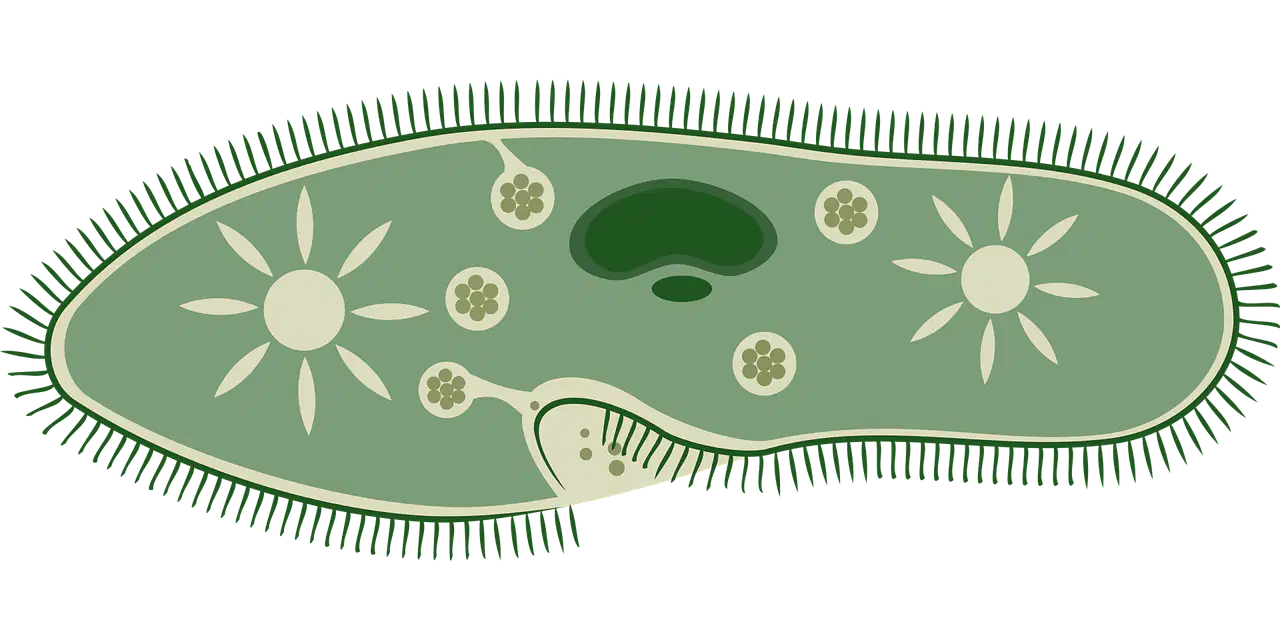
Use the drawing below to answer the question. Paramecium Which statement best describes a direct role of ATP in a paramecium?
a)
ATP provides the energy to move cilia.
b)
ATP stores the genetic code for replication.
c)
ATP signals the presence of other nearby organisms.
d)
ATP senses changes in the surrounding aquatic environment.
5.
How does a mitochondrion facilitate the movement of some materials between cells?
a)
It supplies the energy needed for moving molecules through membranes.
b)
It manufactures the proteins needed to form channels in cell membranes.
c)
It supplies digestive substances that break large molecules into smaller units.
d)
It produces fibers that attach to molecules and move them through the cytoplasm.
6.
A cell in the leaf of a green plant performs both photosynthesis and cellular respiration, often at the same time . Which statement best describes how these processes are related to each other?
a)
Both processes produce carbon dioxide .
b)
Both processes require energy directly from the Sun .
c)
Products of one process are used as some of the reactants for the other process .
d)
Thermal energy from one process is used as the energy source for the other process .
7.
A scientist observed that during the course of a chemical reaction the number of ATP molecules was reduced . What did the scientist most likely learn from the observation?
a)
The reaction produced water .
b)
The reaction consumed water .
c)
The reaction caused an output of energy .
d)
The reaction required an input of energy .
8.
An organism carries out both photosynthesis and cellular respiration. Which statement describes a difference between these two processes?
a)
Only cellular respiration creates chemical energy.
b)
The processes occur in different types of animal cells.
c)
Only photosynthesis changes light energy into chemical energy.
d)
The processes occur at different times during the animal’s life cycle.
9.
Which statement best describes both mitochondria and chloroplasts?
a)
They both contain their own RNA and are involved in transcription.
b)
They both contain their own DNA and are involved in energy conversions.
c)
They both contain their own DNA and are involved in controlling the activities of a cell.
d)
They both contain their own RNA and are involved in storage of nuclear genetic material.
10.
Which of the following produces the most ATP when glucose (C₆H₁₂O₆) is completely oxidized to carbon dioxide (CO₂) and water?
a)
glycolysis
b)
alcohol fermentation
c)
lactic acid fermentation
d)
aerobic respiration
11.
When skeletal muscle cells undergo anaerobic respiration, they become fatigued and painful. This is now known to be caused by
a)
buildup of pyruvate.
b)
buildup of lactic acid
c)
increase in potassium ions.
d)
increase in ethanol.
12.
Which of the following organelles is found only in plants, and some protists(1)?
a)
Chloroplast
b)
Cell membrane
c)
Nucleus
d)
Mitochondria
e)
Ribosome
13.
Which of the following can be compared to a battery in need of recharging? (empty wallet)
a)
ADP
b)
ATP
c)
DNA
d)
RNA
14.
The process carried out by yeast that causes bread to rise is
a)
Lactic Acid fermentation
b)
Alcohol fermentation
c)
Aerobic Respiration
d)
Cellular Respiration
15.
Which organelles evolved from prokaryotes(pick 2)
a)
Mitochondria
b)
Chloroplast
c)
Cell Wall
d)
Cell membrane
e)
Ribosome
16.
What are the products of aerobic respiration?(2)
a)
CO2(carbon dioxide)
b)
O2(oxygen)
c)
C6H12O6(glucose)
d)
H20(water)
17.
What type of respiration produces more atp?
a)
aerobic
b)
anaerobic
18.
Which type of respiration uses oxygen?
a)
aerobic
b)
anaerobic
19.
Which statement best describes both mitochondria and chloroplasts?
a)
They both contain their own RNA and are involved in transcription .
b)
They both contain their own DNA and are involved in energy conversions .
c)
They both contain their own DNA and are involved in controlling the activities of a cell .
d)
They both contain their own RNA and are involved in storage of nuclear genetic material .
20.
According to the theory of endosymbiosis, free-living cyanobacteria moved into some eukaryote cells millions of years ago and evolved into the chloroplasts of plant cells . Which statement correctly compares a cyanobacterium and a chloroplast?
a)
Both have a cell wall .
b)
Both contain a nucleus .
c)
Both perform photosynthesis .
d)
Both are single-celled organisms
21.
A student made an observation about a plant . Which statement is an observation that the student most likely made?
a)
Plants benefit from tilting their leaves toward the Sun .
b)
At 10 a.m. the plant’s leaves were tilted toward the Sun .
c)
Plants that do not tilt their leaves toward the Sun will not survive .
d)
The tilting of plant leaves toward the Sun evolved over a long period of time .
22.
What is the correct equation for cellular respiration?
a)
3O2 + C6H12O6 -> 6CO2 + 3H2O
b)
6O2 + C6H12O6 -> 6CO2 + 6H2O
c)
6CO2 + 6H2O -> 6O2 + C6H12O6
d)
3CO2 + 3H2O + -> 6O2 + C6H12O6
23.

Four students classified the main energy conversions that occur during photosynthesis and cellular respiration. Which student best classified the energy conversions that occur in the two processes?

a)

Student 1

b)

Student 2

c)

Student 3

d)

Student 4

24.

A student made lists of structures observed in cells from two different organisms. Which statement describes the most likely difference in the way that organism 1 and organism 2 obtain energy?

a)

Only organism 1 uses solar energy to make energy-rich compounds.

b)

Only organism 1 stores solar energy until it is needed for its life processes.

c)

Only organism 2 produces molecules for long-term energy storage.

d)

Only organism 2 transforms food energy into ATP during cellular respiration.

25.

Which two statements correctly describe one similarity and one difference between cellular respiration and photosynthesis?

a)

statements 1 and 2

b)

statements 1 and 4

c)

statements 2 and 3

d)

statements 3 and 4

26.

A student made lists of structures observed in cells from two different organisms . Which statement describes the MOST LIKELY difference in the way that organism 1 and organism 2 obtain energy?

a)

Only organism 1 uses solar energy to make energy-rich compounds.

b)

Only organism 1 stores solar energy until it is needed for its life processes.

c)

Only organism 2 produces molecules for long-term energy storage.

d)

Only organism 2 transforms food energy into ATP during cellular respiration.

27.

Which statement below is CORRECT?

a)

Plants only perform photosynthesis.

b)

Plants only perform cellular respiration.

c)

Plants perform both photosynthesis and cellular respiration.

28.

What are the REACTANTS of CELLULAR RESPIRATION?

a)

ATP

b)

Carbon dioxide

c)

Glucose

d)

Oxygen

e)

Water

29.

What are the PRODUCTS of PHOTOSYNTHESIS?

a)

ATP

b)

Carbon dioxide

c)

Glucose

d)

Oxygen

e)

Water

30.

Glucose has 6 Carbon atoms. Based on the equation for photosynthesis, where did glucose get its carbon atoms from?

a)

Water

b)

Oxygen

c)

ATP

d)

Carbon dioxide

31.

Identify the photosynthesis reaction.

32.
The organism in which this process is taking place is
a)
eukaryotic because the cell has an organelle called the mitochondrion
b)
eukaryotic because the cell produces energy
c)
prokaryotic because the cell releases water and carbon dioxide
d)
prokaryotic because the cell has no cell wall