
 Worksheets
Semester 1 Final Exam Review
Total questions: 68
Worksheet time: 34mins
Name
Class
Date
1.
Maintaining a stable internal environment is known as:
a)
Anatomy
b)
Physiology
c)
Homeostasis
d)
Metabolism
2.
The membrane that lines the wall of the abdominal cavity is the
a)
Visceral peritoneum
b)
Parietal peritoneum
c)
Visceral pleura
d)
Parietal pleura
3.
The spinal cord would be found in which body cavity?
a)
Cranial
b)
Pelvic
c)
Abdominal
d)
Thoracic
e)
Vertebral
4.
The correct order of levels of organization would be
a)
atoms, macromolecules, molecules, organelles, organs, cells, tissues, organ systems, organism
b)
atoms, molecules, macromolecules, tissues, cells, organelles, organs, organ systems, organism
c)
atoms, molecules, macromolecules, organelles ,cells, tissues, organs, organ systems, organism
d)
cells, tissues, organs, organ systems, atoms, molecules, macromolecules, organelles, organism
5.
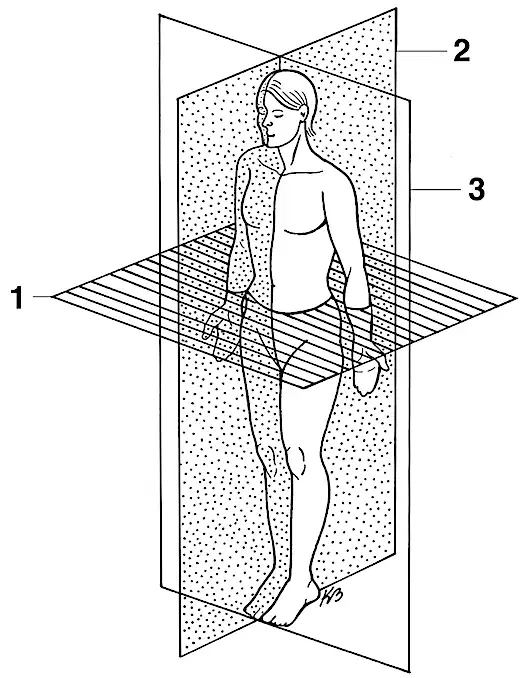
What is the name for body plane #1?
a)
Frontal
b)
Saggital
c)
Transverse
d)
Medial
6.
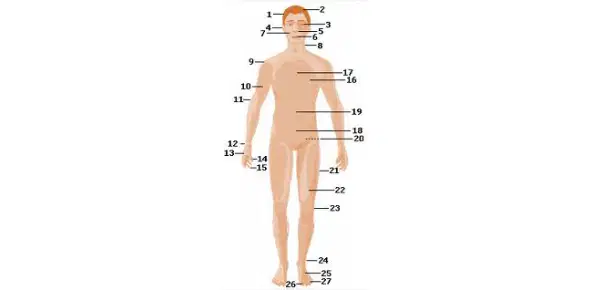
What is the anatomical terminology for #10 in the image?
a)
Brachial
b)
Buccal
c)
Femoral
d)
Crural
7.
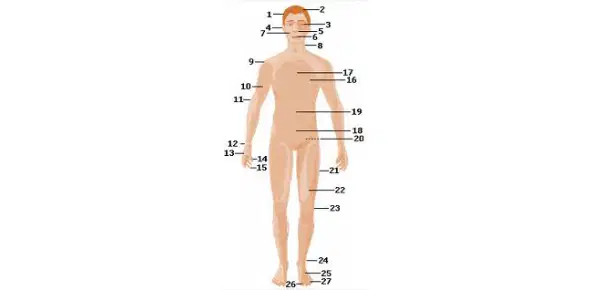
What is the anatomical terminology for #17 in the image?
a)
Pectoral
b)
Sternal
c)
Pelvic
d)
Deltoid
8.
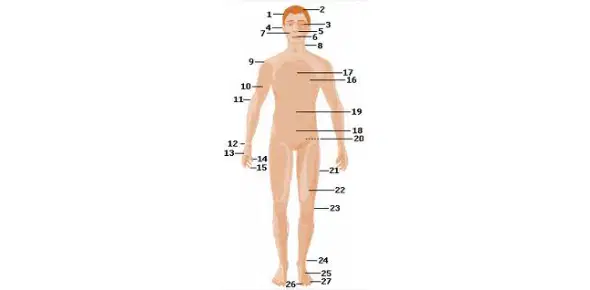
What is the anatomical terminology for #6 in the image?
a)
Buccal
b)
Cranial
c)
Frontal
d)
Oral
9.
Which of the following is a compound?
a)
iron
b)
oxygen
c)
water
d)
carbon
10.
Molecules that have uneven distribution of electrons are
a)
Polar
b)
Nonpolar
c)
Ions
d)
Isotopes
11.
A macromolecule (biomolecule) is made of smaller units called
a)
Macromers
b)
Isomers
c)
Dimers
d)
Monomers
12.
Chemicals that resist changes in pH are called
a)
Acid
b)
Base
c)
Buffer
d)
Salt
13.
A substance that releases hydrogen ions in solution (H+) is called a(n)
a)
Acid
b)
Base
c)
Buffer
d)
Salt
14.
A person has alkalosis if the blood pH
a)
Rises above 7
b)
Drops below 7
c)
Rises above 7.4
d)
Drops below 7.4
15.
Which of the following is inorganic?
a)
Carbohydrates
b)
Proteins
c)
Lipids
d)
Carbon Dioxide
16.
Substances that speed up reactions by lowering the activation energy needed are
a)
Buffers
b)
Electrolytes
c)
Solvents
d)
Catalysts
e)
All of the above
17.
The correct order of sequence of the cell cycle/mitosis is
a)
Prophase, Anaphase, Metaphase, Interphase, Telophase, Cytokinesis
b)
Cytokinesis, Anaphase, Telophase, Prophase, Metaphase, Interphase
c)
Anaphase, Cytokinesis, Interphase, Metaphase, Prophase, Telophase
d)
Interphase, Prophase, Metaphase, Anaphase, Telophase, Cytokinesis
18.

The phase in which the chromosomes line up in the middle of the cell and centrioles are at opposite ends of the cell.
a)
Metaphase
b)
Anaphase
c)
Telophase
d)
Interphase
e)
Prophase
19.
Mutations in these genes result in the "gas pedal sticking" causing the cell cycle to go faster and faster.
a)
Tumor suppressor genes
b)
Brca 1
c)
Brca 2
d)
Oncogenes
20.
When cancer has spread from its original location to other areas of the body.
a)
Metastasis
b)
Immunotherapy
c)
Cytokinesis
d)
Tumor suppression
21.
The process during which embryonic cells begin to take on individual characteristics and reach their mature form and function.
a)
Cell differentiation
b)
Cell cycle
c)
Stem cell generation
d)
Hematopoiesis
22.
Cells with the potential to develop into any different types of cells in the body, including embryonic tissues.
a)
Unipotent stem cells
b)
Cancer cells
c)
Totipotent stem cells
d)
Specialized cells
23.
If a cell is placed in a hypotonic environment the cell will....
a)
Shrink
b)
Grow/Swell
c)
Diffuse
d)
Rupture
24.
Cell membrane transport that requires no energy and molecules move with the concentration gradient is...
a)
Passive transport
b)
Active transport
c)
Endocytosis
d)
Exocytosis
25.
Movement of a substance across the cell membrane from high concentration to low concentration using a transport/carrier protein is....
a)
Diffusion
b)
Osmosis
c)
Sodium/Potassium Pump
d)
Facilitated diffusion
26.
A cell containing 95% water and 5% solute is placed in an environment that has 90% water and 10% solute. What will happen to the cell?
a)
Shrink
b)
Grow/Swell
c)
Diffuse
d)
Rupture
27.
Mode of secretion where the gland ruptures, destroys the cell, and releases the secretion and dead cell with it (ex. sebaceous/oil glands in the skin)
a)
Merocrine gland
b)
Holocrine glands
c)
Mucous membranes
d)
Ceruminous glands
28.
A group of similar cells working together for a common function.
a)
Extracellular matrix
b)
Organelle
c)
Tissue
d)
System
29.
These tissues regenerate and repair quickly.
a)
Muscle
b)
Nervous
c)
Epithelial
d)
Connective
30.
The epithelial tissue that would absorb nutrients in the intestines and produce mucus in the lining of the stomach is:
a)
Stratified squamous
b)
Simple squamous
c)
Simple cuboidal
d)
Simple columnar
31.

Identify this tissue:
a)
Simple Columnar
b)
Simple Cuboidal
c)
Transitional
d)
Simple Squamous
32.
The tissue through which gases are exchanged between blood and alveoli in the lungs is
a)
Stratified squamous
b)
Simple squamous
c)
Simple cuboidal
d)
Simple columnar
33.

Identify this tissue:
a)
Simple Cuboidal
b)
Simple Columnar
c)
Transitional
d)
Pseudostratified Columnar
34.
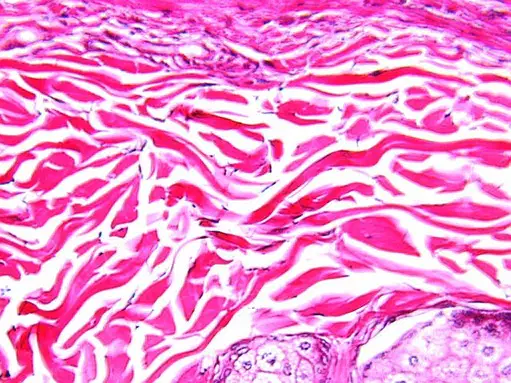
Identify this tissue:
a)
Fibrocartilage
b)
Adipose
c)
Dense Irregular
d)
Reticular
35.
Which of the following type of fiber is the primary fiber type in dense regular and fibrocartilage.
a)
Elastic
b)
Reticular
c)
Collagen
d)
Glandular
36.

Identify this tissue:
a)
Blood
b)
Adipose
c)
Reticular
d)
Bone
37.
Glands that release secretions into the blood inside the body. Example: Thyroid
a)
Exocrine
b)
Holocrine
c)
Endocrine
d)
Apocrine
38.
This tissue forms the outer ear...
a)
Dense Regular
b)
Elastic
c)
Fibrocartilage
d)
Adipose
39.
The bluish, white cartilage that is found at the ends of bones and the nose is...
a)
Hyaline cartilage
b)
Elastic cartilage
c)
Reticular tissue
d)
Fibrocartilage
40.
The protein that makes up our skin, hair, and nails is...
a)
melanin
b)
dermalin
c)
neuromelanin
d)
keratin
41.
Glands that produce sweat, become active at puberty, and are located in the armpits and groin are...
a)
sebaceous glands
b)
ceruminous glands
c)
eccrine glands
d)
apocrine glands
42.
The pigment responsible for giving our skin color and is found in the epidermis.
a)
keratin
b)
carotene
c)
melanin
d)
cyanthinin
43.
Glands that are found with hair follicles and produce oil for the skin and hair are called...
a)
sebaceous glands
b)
ceruminous glands
c)
eccrine glands
d)
apocrine glands
44.
The layer of skin that is composed of dense irregular connective tissue, nerve processes and glands is
a)
subcutaneous
b)
dermis
c)
epidermis
d)
epithelium
45.
The layer of skin that is made up of stratified squamous epithelium and forms the outermost part of the skin.
a)
subcutaneous
b)
dermis
c)
epidermis
d)
hypodermis
46.
The muscle responsible for giving us "goose bumps" is called the
a)
epidermal papillae
b)
thermal papillae
c)
arrector pilli
d)
gluteal pilli
47.
Red/orange pigment that gives the pink areas of our skin their color (like lips and nipples) is called..
a)
Eumelanin
b)
Pheomelanin
c)
Neuromelanin
d)
Keratin
48.
This layer of the epidermis is the most superficial, is avascular, and has dead cells that are continuously shed.
a)
Stratum Granulosa
b)
Stratum Lucidum
c)
Stratum Corneum
d)
Stratum Basale
49.
The general senses are made up of...
a)
sight, hearing, smell, taste
b)
touch, temperature, pressure, pain
c)
smell , pleasure, pain, taste
d)
sight, pressure, hearing, touch
50.
The special senses are made up of....
a)
sight, hearing, smell, taste, balance
b)
touch, temperature, pressure, pain
c)
smell, pleasure, pain, taste
d)
sight, pressure, hearing, touch
51.
Occurs when receptors reach threshold stimulus sending an impulse to the brain....
a)
perception
b)
inception
c)
sensation
d)
causation
52.
The main sensory organ(s) for smell is/are
a)
nose
b)
sinuses
c)
olfactory organs
d)
tympanic membrane
53.
Occurs when the brain interprets sensory impulses
a)
perception
b)
inception
c)
causation
d)
sensation
54.
The main sensory organ(s) for taste (gustation) is/are
a)
tongue
b)
taste buds
c)
mouth
d)
salivary glands
55.
A sheet of tissue that is continuous with the optic nerve that contains visual receptor cells.
a)
Iris
b)
Cornea
c)
Retina
d)
Lens
56.
The organ responsible for dynamic equilibrium when the head and body is moving.
a)
Semicircular Canals
b)
Cochlea
c)
Tympanic membrane
d)
External Auditory Meatus
e)
Ear buds
57.

This image represents a ___________________. The green portion represents the ___________________ that send signals to the gustatory cortex of the brain for processing.
a)
Papilla, taste hairs
b)
Taste bud, taste hairs
c)
Taste bud, cranial nerves
d)
Taste pore, receptor proteins
58.
Which of the following occurs in the middle ear?
a)
Sound waves are pushed through the oval window, sending the amplified vibrations to the snail-shaped cochlea and causing the fluid there to ripple, creating a traveling wave.
b)
Sound waves enter the external auditory meatus and are directed to the tympanic membrane (TM)
c)
Vibrations from the tympanic membrane strike the malleus, then the incus, and then the stapes bones to move in and out, causing the oval window to vibrate
d)
The movement of hair cells in the cochlea stimulates them to convert the vibrations into electrical signals that are transmitted via nerves to the temporal lobes of the brain.
59.
Visual receptor cells that enable us to see in limited light and therefore shades of black and white.
a)
Cones
b)
Rods
c)
Hair cells
d)
Retina
60.
The white portion of the outside eye is the
a)
Lens
b)
Cornea
c)
Iris
d)
Sclera
61.
Functions to focus light that enters the eye.
a)
Lens
b)
Cornea
c)
Iris
d)
Sclera
62.
Vision is processed in this part of the brain.
a)
Occipital Lobe
b)
Temporal Lobe
c)
Parietal Lobe
d)
Frontal Lobe
63.
The external ear is made up of these three parts.
a)
Cochlea, external auditory meatus, ossicles
b)
Tympanic membrane, ossicles, semicircular canal
c)
Cochlea, semicircular canals, vestibule
d)
Auricle, external auditory meatus, tympanic membrane
64.
The part of your eye that flips the image upside down.
a)
Lens
b)
Cornea
c)
Retina
d)
Sclera
65.
Olfactory sensory neurons/receptors are..
a)
Cilia
b)
Papillae
c)
Taste Buds
d)
Epithelium
66.
Which of these steps of smell happens last?
a)
The odor molecules bind to specific olfactory receptors on olfactory sensory neurons (cilia/hairs), triggering electrical signals.
b)
Electrical signals are processed and relayed to the olfactory cortex of the brain for conscious identification and emotional response
c)
Airborne odor molecules enter the nose and dissolve in the mucus lining the olfactory epithelium
d)
Electrical signals travel via the olfactory nerve to the olfactory bulb
67.
The ability of the nervous system to become less responsive to a maintained stimulus is....
a)
Perception
b)
Projection
c)
Sensation
d)
Adaptation
68.
The eardrum is also called the...
a)
Cochlea
b)
Ossicles
c)
Tympanic membrane
d)
Fovea centralis
100 %

