
 Worksheets
GA Studies midterm
Total questions: 74
Worksheet time: 37mins
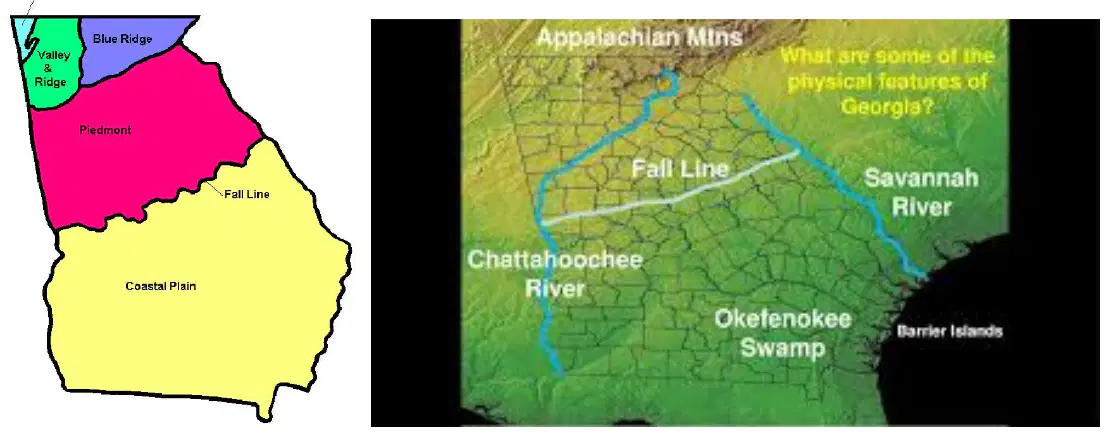
Label the map with the 5 regions of GA and the 6 physical features.
Appalachian Plateau
Ridge and Valley
Blue Ridge
Piedmont
Coastal Plain
Which region of Georgia has a climate described as hot and humid?
Appalachian Plateau
Ridge and Valley
Blue Ridge
Piedmont
Coastal Plain
Which region lists caves, coal and limestone, forestry, and tourism among its resources?
Appalachian Plateau
Ridge and Valley
Blue Ridge
Piedmont
Coastal Plain
Which region’s key physical features include TAG Corner and Lookout Mountain?
Appalachian Plateau
Ridge and Valley
Blue Ridge
Piedmont
Coastal Plain
Which region’s resources include corn, apples, and textile manufacturing?
Appalachian Plateau
Ridge and Valley
Blue Ridge
Piedmont
Coastal Plain
Which region’s key physical features are mountains?
Appalachian Plateau
Ridge and Valley
Blue Ridge
Piedmont
Coastal Plain
Which region is noted for mild climate with most rainfall and cold winters?
Appalachian Plateau
Ridge and Valley
Blue Ridge
Piedmont
Coastal Plain
Which region lists Appalachian Mountains, Brasstown Bald, and Amicalola Falls as key physical features?
Appalachian Plateau
Ridge and Valley
Blue Ridge
Piedmont
Coastal Plain
Which region lists small farms with apples, corn, and grapes; gold; tourism; and timber among its resources?
Appalachian Plateau
Ridge and Valley
Blue Ridge
Piedmont
Coastal Plain
Which region has a climate described as mild with hot summers and mild winter?
Appalachian Plateau
Ridge and Valley
Blue Ridge
Piedmont
Coastal Plain
Which region’s key physical features include the Chattahoochee River, Stone Mountain, the Savannah River, and the Fall Line?
Appalachian Plateau
Ridge and Valley
Blue Ridge
Piedmont
Coastal Plain
Which region lists red clay; granite; businesses and manufacturing; and farming of soybeans, cotton, chickens, and cattle among its resources?
Appalachian Plateau
Ridge and Valley
Blue Ridge
Piedmont
Coastal Plain
Which region lists onions, peanuts/pecans, cotton, pulp and paper industry, tourism, and fish/shrimp among its resources?
Appalachian Plateau
Ridge and Valley
Blue Ridge
Piedmont
Coastal Plain
Which region’s key physical features include the Fall Line, Savannah River, Okefenokee Swamp, and Barrier Islands?
Appalachian Plateau
Ridge and Valley
Blue Ridge
Piedmont
Coastal Plain
What are the 4 transportation systems in GA?
Trains
Planes/airports
Trucks/highways
Ports/ships
Subways
How Georgia's transportation systems help the economy of GA?
Products are shipped domestically and internationally, sometimes using multiple systems
They mainly provide tourism routes with little impact on trade
They are used only within cities and do not connect to international markets
They primarily reduce the need for manufacturing in the state
What industry in GA is growing due to tax incentives, skilled workforce, and diverse locations?
Film industry
Textile mills
Mining
Shipbuilding
What are the other 5 major industries in GA?
Service
Agriculture
Manufacturing
Technology
Entertainment
What were the 3 reasons for Spanish exploration?
God (Catholic Missions)
Gold
Glory
Mercantilism
Religious freedom in the colony
What were the 4 reasons for British exploration?
Mercantilism
Opportunity for new life
New markets for British goods
Religion
Expanding slavery in Georgia
Define mercantilism.
Using a colony to obtain resources, manufacturing goods, and selling them back so exports exceed imports
Allowing colonies complete free trade with all nations without regulation
A system where colonies only grow food for their own use and avoid trade
Replacing money with barter to avoid taxes
How did the Spanish spread religion?
Built missions (churches) on barrier islands to convert natives
Opened schools in inland towns only
Distributed printed materials to settlers
Avoided contact with native populations
Which group in GA is associated with Doctor Nunes as a contribution to the colony?
Jews
Salzburgers
Highland Scots
Malcontents
Which group in GA contributed silk growing, lumber, and churches?
Jews
Salzburgers
Highland Scots
Malcontents
Which group in GA contributed defense, lumber, church, and fought at Bloody Marsh?
Jews
Salzburgers
Highland Scots
Malcontents
Which group in GA is noted for complaining and wanting rules to change?
Jews
Salzburgers
Highland Scots
Malcontents
Which two groups came to GA for religious freedom?
Jews
Salzburgers
Highland Scots
Malcontents
Which group came to GA for protection?
Jews
Salzburgers
Highland Scots
Malcontents
Which group came to GA seeking a new life?
Jews
Salzburgers
Highland Scots
Malcontents
Why did the rules change?
Malcontents complained and the trustee period ended
The colony became independent and removed all rules
Spain took control and enforced new laws
Natural disasters forced temporary changes
Who governed GA after the trustee period was over?
Royal governors; colonists had a voice and could be elected to make laws for the colony
Elected colonial assembly with no royal oversight
Local mayors chosen by towns
Military leaders appointed by Spain
How did GA change during the royal period?
Slaves were allowed
The economy grew
Colonists could own more land
Colonists could make and purchase alcohol
Colonists lost the right to vote
Define loyalist.
A person that supported the King and Great Britain
A person that supported the revolution and wanted independence
A colonist who remained neutral during the war
A soldier hired from another country
Define patriot.
A person that supported the King and Great Britain
A person that supported the revolution and wanted independence
A colonist who remained neutral during the war
A person who avoided all political conflicts
How did the Battle of Kettle Creek impact the war?
It was a British victory that ended fighting in Georgia
The Patriots won, morale improved, and a British stronghold in Georgia was broken
It forced France to leave the alliance with America
It led to immediate independence for Georgia
How did the Siege of Savannah impact the war?
Savannah fell to the Americans and remained under their control
After a failed American and French attempt to retake the city, Savannah stayed under British control until the war ended
The siege destroyed the city and ended all fighting in the South
The siege convinced Britain to recognize American independence
What was the first plan of government created in the newly formed USA?
The Constitution
The Articles of Confederation
The Bill of Rights
The Declaration of Independence
What were the four weaknesses in the first plan of government?
No power to collect taxes, no ability to create an army, no executive branch, and no judicial branch
Too much taxation, overly strong army, too powerful president, and aggressive courts
Lack of a legislature, no states, no elections, and no treaties
No freedom of speech, no freedom of religion, no trial by jury, and no voting
What new document was created that guides America’s government?
The Articles of Confederation
The Constitution
The Emancipation Proclamation
The Mayflower Compact
What were two ways land was distributed in Georgia in the 1800s?
Headright system and land lottery
Yazoo Act and land grants to railroads
Sharecropping and tenant farming
Military land bounties and homesteading
Why was the Yazoo Act considered fraud?
It raised taxes unfairly on farmers
Land speculators bought land cheaply by bribing legislatures to pass the act
It forced Native Americans to leave Georgia immediately
It ended all private land sales
How did land policies impact Georgia?
Population declined and borders shrank
Population grew, borders changed, and more farms and crops were created
Only cities expanded while farms disappeared
Georgia lost land to neighboring states and saw fewer crops
How did land policies impact Creek and Cherokee?
They gained more land and political power
As settlers claimed land, natives were pushed from their homes and forced to resettle
They formed new states within Georgia with full rights
They were unaffected by settlers and land sales
How did the Dahlonega gold rush impact Cherokee?
Gold on Cherokee land caused white settlers to want the land and push Cherokee off
It brought wealth to the Cherokee and preserved their territory
It ended conflicts and secured Cherokee self-governance
It led to a peace treaty that protected all Cherokee lands
How did the cotton gin impact Georgia (positive and negative)?
It reduced cotton production and ended slavery
Positive: faster cotton production and economic growth; Negative: increase in slave population
Positive: fewer farms; Negative: less trade
Positive: more factories; Negative: no change in slavery
How did the railroad impact Georgia?
It slowed trade and isolated cities
It allowed cotton and other resources to be transported and sold to other states and led to many new cities being established through Georgia
It only benefited coastal towns and hurt farmers
It ended the need for roads and waterways
Identify the correct role–impact pair for John Ross.
Chief of Cherokee — Tried to save Cherokee land by going to Washington, D.C.; opposed the Treaty of New Echota; associated with the Trail of Tears
US Supreme Court Justice — Wrote the Fugitive Slave Act
7th US President — Enforced Worcester v. Georgia ruling
Missionary to Cherokee — Led the Indian Removal Act
Identify the correct role–impact pair for John Marshall.
US Supreme Court Justice — Ruled in favor of the Cherokee in Worcester v. Georgia, saying they were a sovereign nation
7th US President — Refused to enforce Worcester v. Georgia
Missionary to Cherokee — Arrested for breaking Georgia law and won his case at the Supreme Court
Chief of Cherokee — Signed the Treaty of New Echota
Identify the correct role–impact pair for Andrew Jackson.
7th US President — Signed the Indian Removal Act to forcefully remove natives from the South and refused to enforce the Worcester decision
US Supreme Court Justice — Declared the Cherokee a sovereign nation
Missionary to Cherokee — Led Cherokee resistance in court
Chief of Cherokee — Negotiated protection for Cherokee lands
Identify the correct role–impact pair for Samuel Worcester.
Missionary to Cherokee — Arrested for breaking Georgia law; took his case to the Supreme Court and won
US Supreme Court Justice — Authored the Indian Removal Act
7th US President — Enforced protection of Cherokee lands
Chief of Cherokee — Opposed removal and kept the treaty
Describe the Trail of Tears.
A peaceful migration within Georgia that improved Cherokee living conditions
A walk from Georgia to Oklahoma where Cherokee were forced to leave their homes and resettle, and many died
A voluntary relocation of settlers seeking gold in Oklahoma
A trade route connecting Georgia and Oklahoma
Which pair best matches the North and South points of view?
North: Against slavery, viewed it as morally wrong and unnecessary for an industrial economy; South: Pro-slavery, wanted to keep slaves for agricultural economy
North: Supported expanding slavery to the West; South: Wanted immediate abolition
North: Neutral on slavery; South: Opposed all slave labor
North: Encouraged slave ownership for factories; South: Banned slavery on plantations
Which pair best matches the North and South points of view?
North: All states should abide by federal laws, and no one can leave the Union; South: States should have more power and make laws that work for them
North: States should control foreign policy; South: Federal government should decide all laws
North: States should set tariffs; South: National government should enforce them
North: States should have sovereignty over the Union; South: No state power at all
Which pair best matches the North and South points of view?
North: Against nullification and wanted the South to buy from northern industries; South: Supported nullification, did not want to pay tariffs or buy from the North
North: Supported nullification to avoid tariffs; South: Opposed all state authority
North: Neutral on tariffs; South: Favored higher tariffs
North: Wanted lower tariffs everywhere; South: Wanted no trade with the North
for the Compromise of 1850, Which pair best matches the North and South points of view?
North: Added California as a free state; South: Favored the Fugitive Slave Act and popular sovereignty in Utah and New Mexico
North: Expanded slavery to all territories; South: Abolished the Fugitive Slave Act
North: Rejected California’s admission; South: Opposed popular sovereignty
North: Demanded secession; South: Accepted immediate abolition
For the Georgia Platform, Which pair best matches the North and South points of view?
North: Supported compromise to preserve the Union; South: Georgia accepted the compromise as long as the North enforced the Fugitive Slave Act
North: Rejected all compromises; South: Demanded immediate secession
North: Wanted popular sovereignty in all states; South: Opposed the Fugitive Slave Act
North: Favored secession; South: Asked for abolition
For the Dred Scott Case, Which pair best matches the North and South points of view?
North: Scott should be given freedom and viewed as a citizen; South: Scott should not get freedom—slaves are property and cannot sue
North: Scott should remain a slave; South: Scott should be freed and granted citizenship
North: Case had no impact; South: Wanted the Supreme Court abolished
North: Supported popular sovereignty; South: Favored California’s admission
For Lincoln’s Election in 1860, Which pair best matches the North and South points of view?
North: Happy because Lincoln was a Republican and against slavery; South: Angry because Lincoln was a Republican and against slavery
North: Wanted Lincoln to resign; South: Supported Lincoln’s platform
North: Neutral about the election; South: Favored Lincoln for preserving slavery
North: Opposed the election results; South: Accepted immediate abolition
For Secession, Which pair best matches the North and South points of view?
North: Against secession—no states can leave the Union; South: Mostly for secession—most southern states decided to separate from the Union
North: Supported secession for western states; South: Opposed any separation
North: Neutral on secession; South: Demanded stronger federal control
North: Wanted immediate dissolution of the Union; South: Called for a stronger Union
Was the Union blockade successful? Choose the best description of its impact based on the wartime results.
Yes, it completely stopped Southern trade and quickly ended the war
No, it had no effect and supplies continued normally
It was partly successful: it limited Southern supplies but did not end the war quickly because blockade runners still got through
Why were slaves not freed despite the Emancipation Proclamation? Select all reasons that explain the lack of freedom at the time.
The proclamation applied only to rebelling states that did not recognize Lincoln’s authority
Most enslaved people did not receive news due to illiteracy and lack of access to newspapers
The Union immediately occupied all Southern territory and enforced freedom everywhere
Southern leaders voluntarily ended slavery after the proclamation
How did the Battle of Chickamauga impact the Civil War? Select all statements that describe its effects.
It was a very bloody battle and among the deadliest of the war
It was the first major battle in Georgia and a Confederate victory
It enabled the Union to advance farther south immediately
It helped the Confederacy gain land and prevent a Union advance
Why did Sherman target Atlanta during the war?
It was a coastal port central to naval operations
It was a railroad hub, and destroying railroads would weaken the South
It was the national capital of the Confederacy
How did Sherman’s March to the Sea impact the war’s outcome?
It strengthened Southern industry and prolonged the war
It destroyed Southern resources, contributed to Confederate surrender within months, and hastened the end of the war
It had little effect on military or civilian targets
What were the issues with Andersonville Prison? Select all problems reported.
Severe overcrowding
Unsanitary conditions
Lack of clean water
Low casualty rates with few deaths
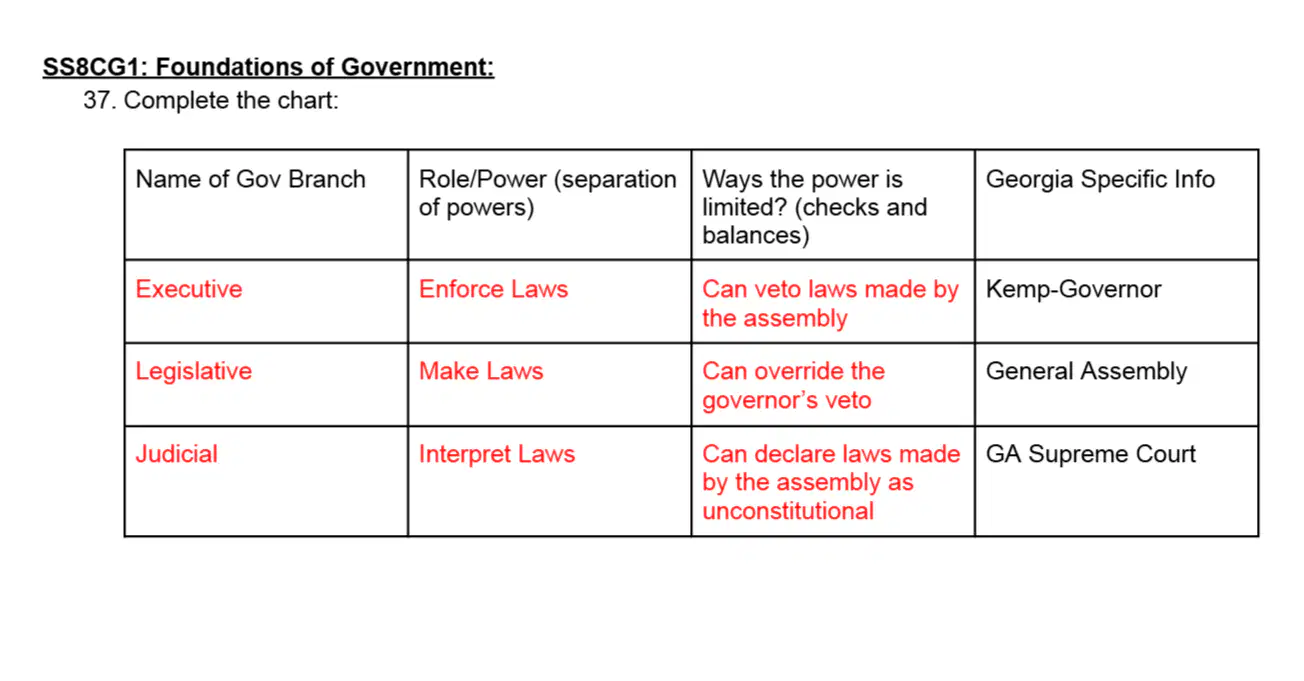
Complete the chart: Which branch of Georgia’s government enforces laws?
Executive
Legislative
Judicial
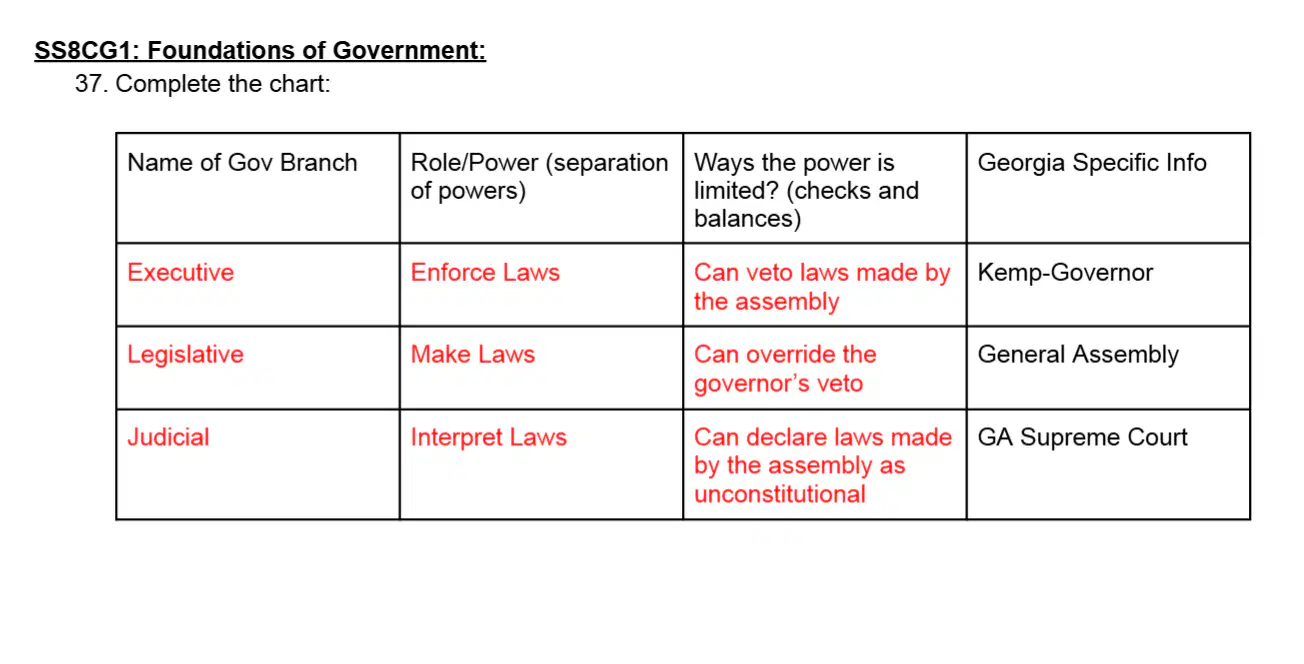
Complete the chart: Which branch of Georgia’s government makes laws?
Executive
Legislative
Judicial
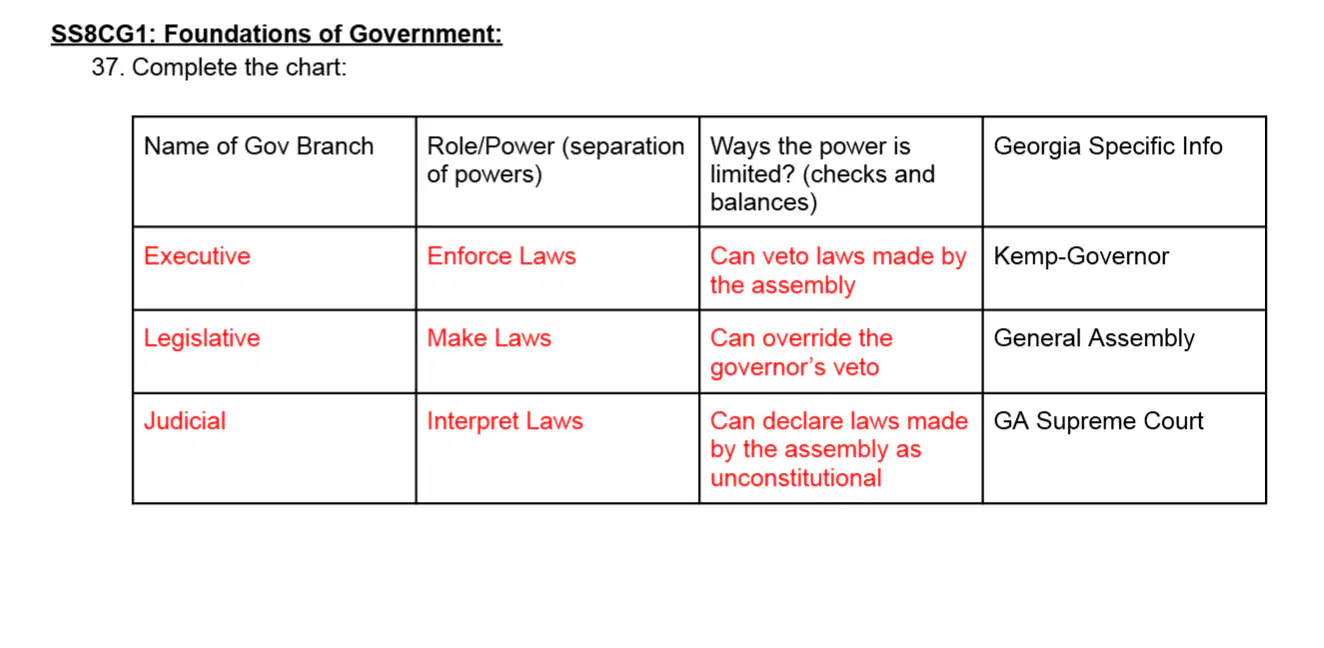
Complete the chart: Which branch of Georgia’s government interprets laws?
Executive
Legislative
Judicial

Complete the chart: Which branch can veto laws made by the assembly?
Executive
Legislative
Judicial
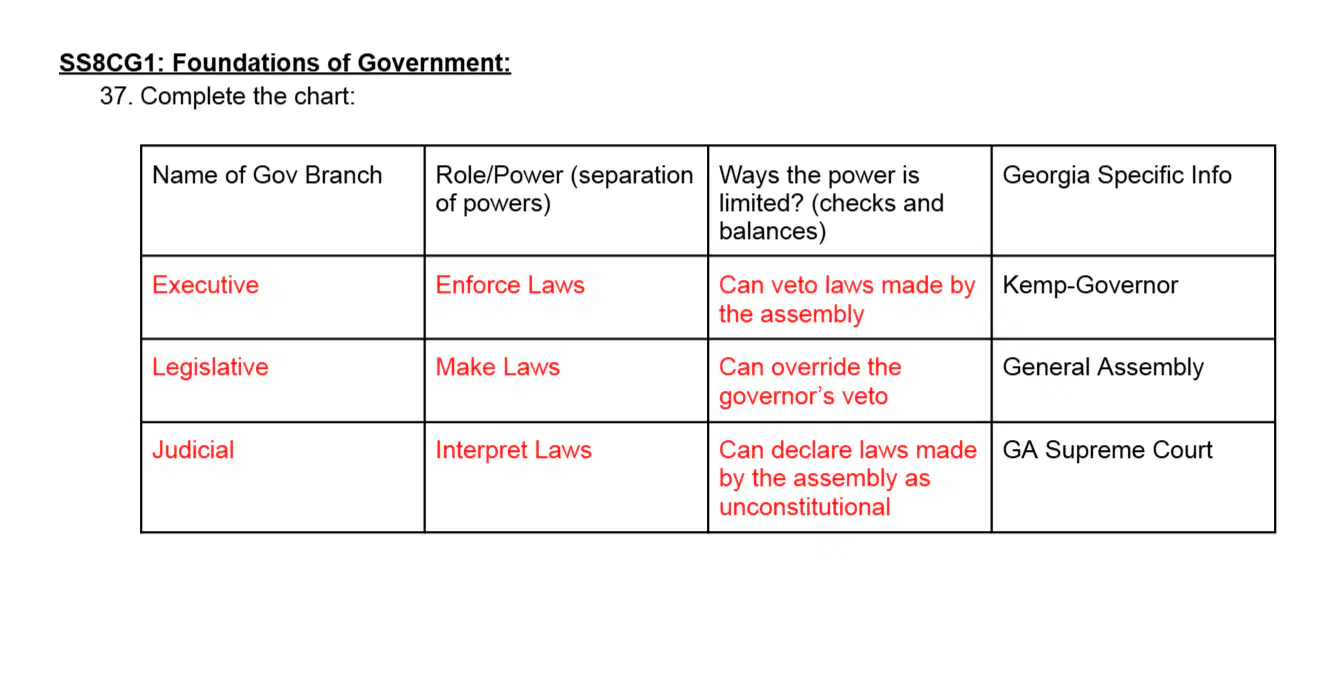
Complete the chart: Which branch can override the governor’s veto?
Executive
Legislative
Judicial
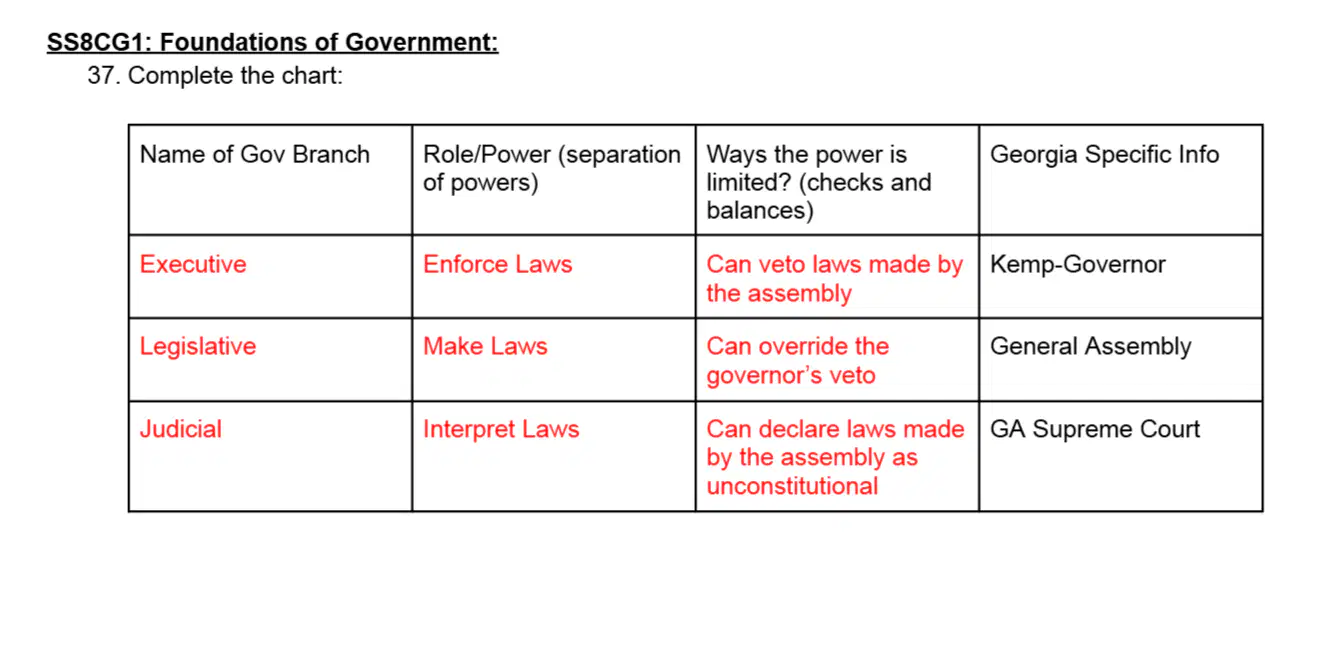
Complete the chart: Which branch can declare laws made by the assembly as unconstitutional?
Executive
Legislative
Judicial
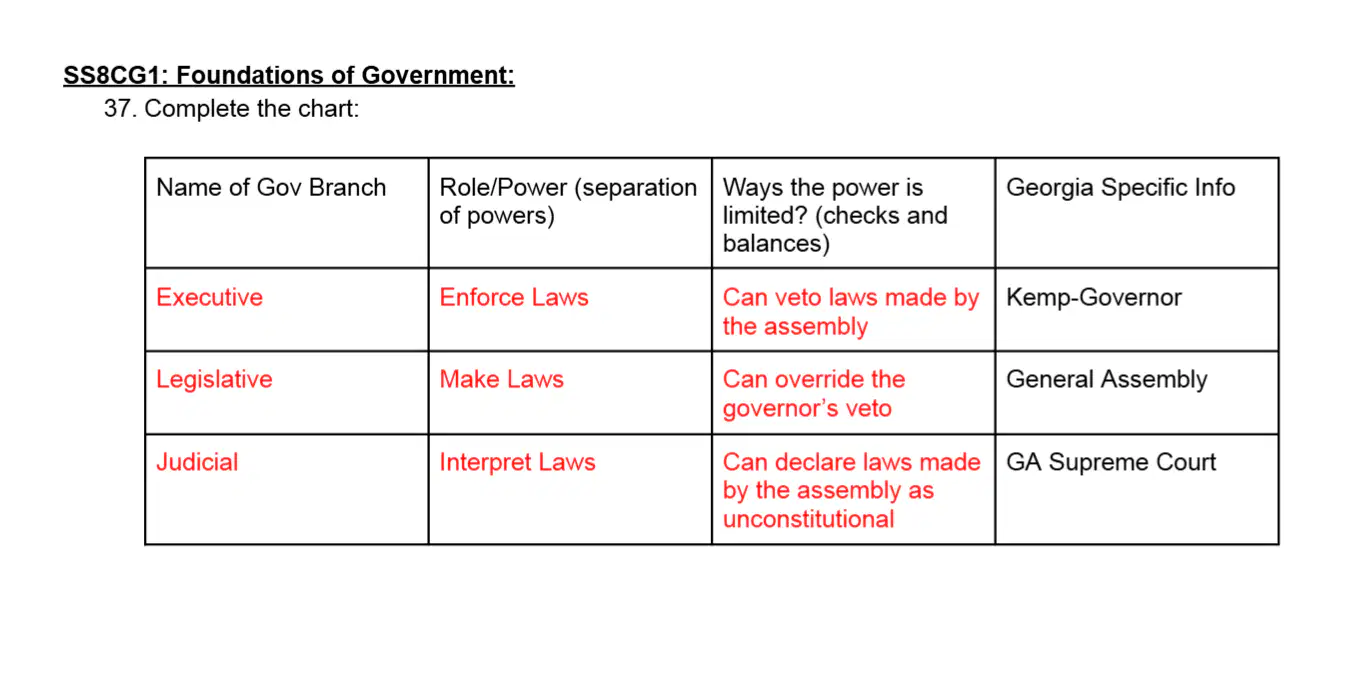
Complete the chart: In Georgia’s specific information column, which entity leads the legislative branch?
Governor
General Assembly
GA Supreme Court
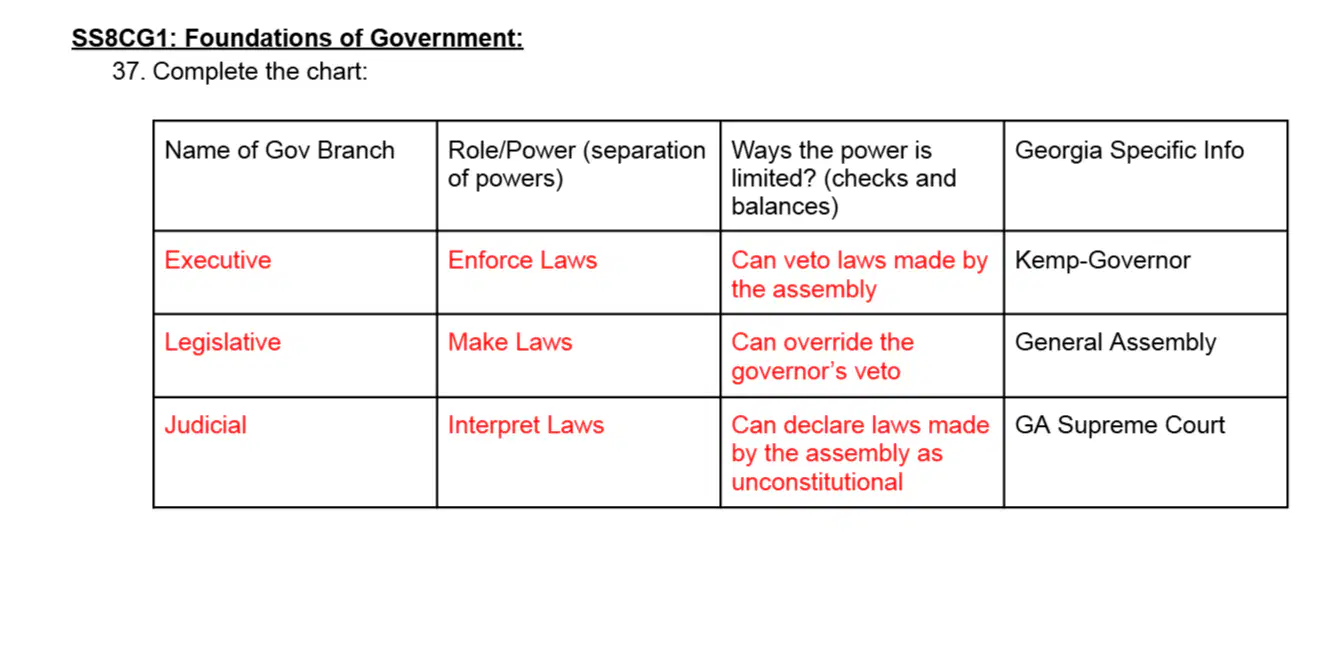
Complete the chart: In Georgia’s specific information column, which entity represents the judicial branch?
Governor
General Assembly
GA Supreme Court
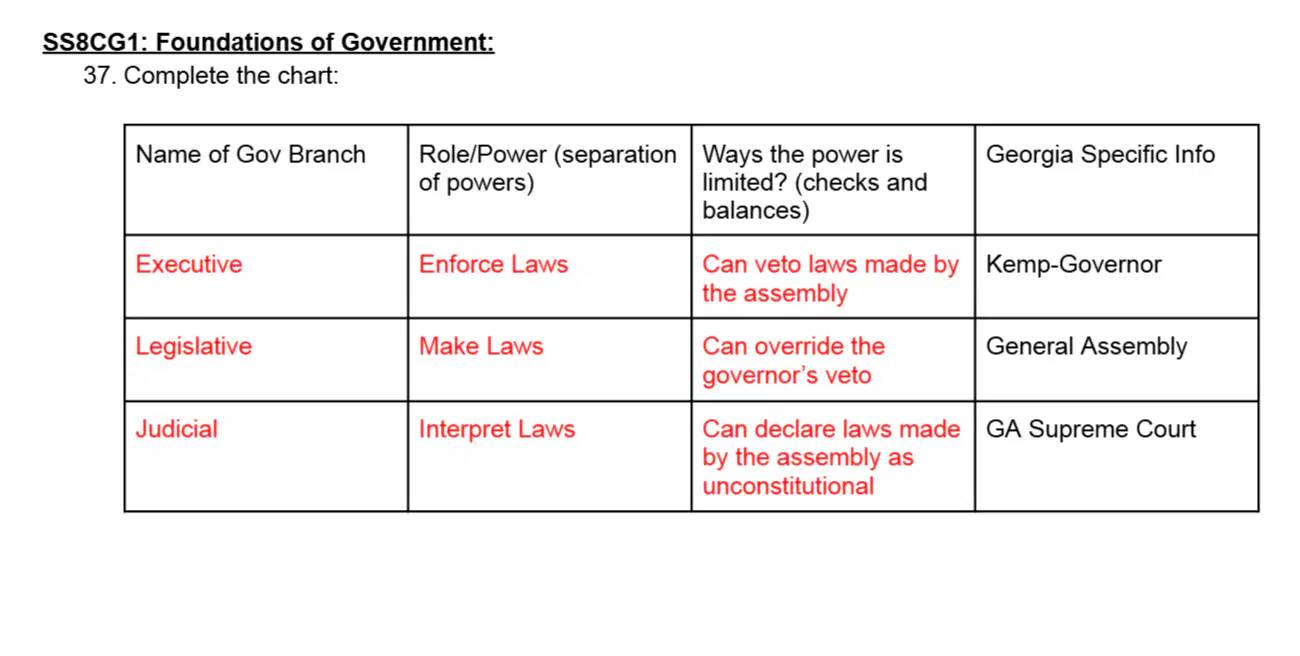
Complete the chart: In Georgia’s specific information column, who leads the executive branch?
Governor (Kemp)
General Assembly
GA Supreme Court

