
 Worksheets
Semester 1 Forensics
Total questions: 151
Worksheet time: 2hrs 55mins
Know the lab safety symbols and rules that were discussed at the beginning of the unit.
Understand the lab safety symbols and rules discussed at the start of the unit.
Ignore the lab safety symbols and rules.
Only follow lab safety rules when reminded.
Lab safety symbols are not important.
Forensic investigators must rely on their ability to observe, interpret and record observations clearly.
observe, interpret, record
analyze, fabricate, ignore
predict, assume, forget
manipulate, distort, conceal
What’s the difference between an observation and a perception?
An observation is information gathered from the 5 senses and comes before perception. A perception is the method of interpreting an observation.
An observation is a guess about what will happen next, while perception is only about the past.
Observation is always incorrect, but perception is always correct.
Observation is based on opinions, while perception is based on facts.
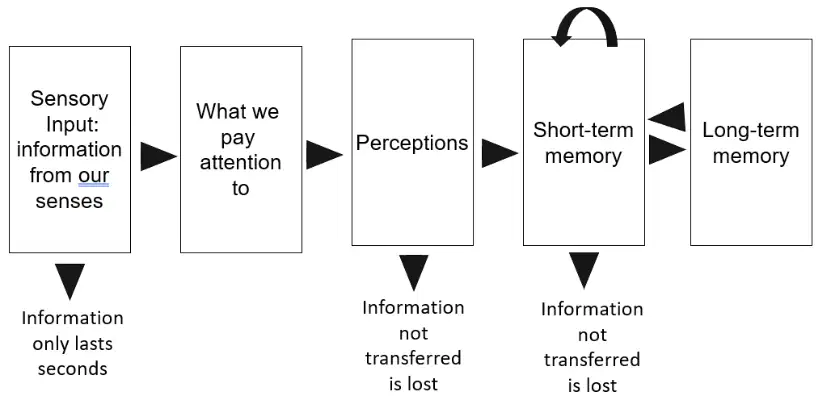
How does the brain take observations and process them? Complete the following graphic organizer to answer this question:
Sensory Input: information from our senses → What we pay attention to → Perceptions → Short-term memory → Long-term memory
Sensory Input: information from our senses → Long-term memory → Perceptions → What we pay attention to → Short-term memory
Perceptions → Sensory Input: information from our senses → What we pay attention to → Short-term memory → Long-term memory
What we pay attention to → Sensory Input: information from our senses → Perceptions → Short-term memory → Long-term memory
What are the 4 lobes of the brain?
temporal lobe, occipital lobe, parietal lobe, and frontal lobe
cerebellum, medulla, pons, and thalamus
amygdala, hippocampus, hypothalamus, and pituitary gland
pons, medulla, midbrain, and cerebellum
What is deductive reasoning?
Deriving consequences from facts using a series of logical steps
Making assumptions based on personal beliefs
Drawing conclusions from random guesses
Accepting statements without evidence
What are 5 criteria for being a good observer?
Make a conscious effort to examine the environment, observe everything slowly, make connections to observations, don’t jump to conclusions, photograph and take notes
Ignore minor details, rely on memory alone, make assumptions quickly, avoid taking notes, focus only on the obvious
Observe only what interests you, avoid making connections, jump to conclusions, never review your notes, avoid asking questions
Only observe when necessary, avoid documenting, make quick judgments, disregard context, focus on one sense only
What is an eyewitness?
A person who has seen someone, or something, related to a crime
A person who investigates crimes
A person who defends the accused in court
A person who writes news articles about crimes
What is eyewitness testimony?
When an eyewitness testifies in court about a crime
A written confession by the accused
A lawyer's closing argument
A judge's summary of the case
What is the problem with trusting eyewitnesses at a crime scene?
Research has shown that their recollection of events is not always accurate.
Eyewitnesses are always biased towards the victim.
Eyewitnesses are trained to mislead investigators.
Eyewitnesses never agree to testify in court.
What do forensic sketch artists do?
Work with police to interview victims or witnesses of crimes in order to recreate a drawing that reflects the image of the perpetrator
Design courtroom layouts for legal proceedings
Collect physical evidence from crime scenes
Analyze handwriting samples for authenticity
List 5 people that might show up at a crime scene.
First responders, crime scene investigators, medical examiners/coroner, detectives, and specialists
Chefs, musicians, athletes, artists, and dancers
Librarians, gardeners, pilots, actors, and bakers
Tourists, lifeguards, teachers, engineers, and students
Who founded the Innocence Project?
Barry Scheck and Peter Neufeld
Johnnie Cochran and Robert Shapiro
Alan Dershowitz and F. Lee Bailey
Bryan Stevenson and Ken Starr
What is the purpose of the Innocence Project?
To reexamine post-conviction cases and exonerate those that are wrongfully convicted
To provide legal advice for divorce cases
To fundraise for prison construction
To train police officers in forensic science
What piece of evidence does the innocence project use to help set innocent people free?
DNA
Fingerprint analysis
Eyewitness testimony
Polygraph results
What percentage of wrongful conviction cases has the Innocence Project helped solve?
87%
25%
60%
45%
What is the name of the document that showcases who has entered/exited the crime scene?
Crime scene entry log
Crime scene sketch
Evidence collection form
Witness statement form
Why is the Chain of Custody important to follow?
It provides documentation about who has come in contact with evidence and helps to maintain the integrity of the evidence.
It allows evidence to be stored for longer periods without any records.
It ensures that only the police can handle evidence at all times.
It makes it easier to discard evidence that is not needed.
What are the 7 steps of crime scene investigation?
Securing the crime scene, separating witnesses, scanning the crime scene, photographing the crime scene, sketching the crime scene, searching the crime scene, and securing and collecting evidence
Interviewing suspects, analyzing motives, arresting the accused, presenting evidence in court, sentencing, releasing the accused, and closing the case
Calling emergency services, treating the injured, cleaning the scene, interviewing the media, filing a report, closing the scene, and notifying families
Identifying the victim, collecting fingerprints, interrogating witnesses, reconstructing the crime, making an arrest, writing a report, and releasing information to the public
Why should eyewitnesses be separated before they are interviewed?
So they can’t influence one another’s observations
To make the process faster
Because it is required by law in all cases
To ensure they remember everything perfectly
How is wet evidence collected?
It must be air dried naturally before it is packaged.
It should be immediately sealed in a plastic bag.
It must be frozen before packaging.
It should be placed in a paper bag while still wet.
How is small, dry evidence collected?
In a bindle
In a plastic bag
In a wet container
In a metal box
If someone receives bagged evidence with a signature on a label, how must they go about opening the bag to get to the evidence?
They have to obtain the evidence without breaking the original evidence label.
They can cut through the signature label to access the evidence.
They must reseal the bag with a new label before opening it.
They can open the bag from any side, regardless of the label.
What happens when a first responder “secures a crime scene?”
They use barrier tape to secure the perimeter and place officers at entry points (with a crime scene log).
They immediately start collecting evidence without any documentation.
They allow bystanders to observe the scene closely.
They begin interrogating witnesses before securing the area.
What is the difference between circumstantial evidence and direct evidence?
Circumstantial evidence is implied, while direct evidence is considered a firsthand observation.
Circumstantial evidence is always more reliable than direct evidence.
Direct evidence is based on assumptions, while circumstantial evidence is a firsthand observation.
Circumstantial evidence and direct evidence are exactly the same.
What is a bindle?
a paper packaging used for small or fragile evidence
a type of fingerprint powder
a forensic light source
a chemical used to detect blood
What is the difference between individual evidence and class evidence?
Individual evidence narrows to one individual person, while class evidence can only narrow to a group of items/people.
Individual evidence is always physical, while class evidence is always biological.
Individual evidence is less reliable than class evidence in court.
Individual evidence refers to evidence found at a crime scene, while class evidence is collected from suspects.
Individual or Class? Skin cells found under the fingernails of a victim (DNA)
individual
class
group
category
Individual or Class? Size 9 Nike shoe found beside a dead body
class
individual
group
unique
Individual or Class? 1990 Ford Explorer seen driving away from an armed robbery
class
individual
group
serial
Individual or Class? A fingerprint left on a soda can found at a crime scene
individual
class
pattern
trace
What is the difference between physical evidence and biological evidence?
Biological evidence is derived from a plant, animal/human, or mineral; everything else is considered physical.
Physical evidence is only found at crime scenes, while biological evidence is always found in laboratories.
Biological evidence refers to any non-living material, while physical evidence refers to living organisms.
Physical evidence is always visible to the naked eye, while biological evidence is always microscopic.
Physical or biological? Jacket fiber
biological
physical
synthetic
mineral
Physical or biological? Bullet casing
Physical
Biological
Chemical
Digital
Physical or biological? Glass fragments
physical
biological
chemical
organic
Physical or biological? Ransom note
physical
biological
chemical
digital
During which two steps of CSI are evidence markers used?
Scanning the scene and searching the scene
Securing the scene and collecting evidence
Interviewing witnesses and packaging evidence
Documenting the scene and releasing the scene
Why is Dr. Edmond Locard known as the father of forensics?
Because he established the first forensics laboratory
Because he invented fingerprint analysis
Because he discovered DNA profiling
Because he wrote the first forensic textbook
What is the procedure for taking photographs at a crime scene?
A minimum of 3 angles at 3 distances
Only one photograph from the front
Photographs only after evidence collection
No photographs are required
What type of photography is used in crime scene investigation?
digital
portrait
wildlife
aerial
According to the justice system, what is the criteria for using photographs in court?
1- they must accurately reflect the true condition of the scene without alteration 2- any manipulations must be documented 3-they must have relevancy (they must either support or undermine the truth of any point at issue)
They must be in black and white only.
Photographs must be taken only by police officers.
Only digital photographs are allowed in court.
What must be included in a crime scene sketch?
true North, scale of distance, date, time, location
weather conditions, witness statements, fingerprints, DNA samples
suspect's confession, police badge number, patrol car number, judge's name
type of crime, number of officers present, police station address, prosecutor's name
What are the different types of crime scene sketches?
Overview, elevation, and exploded/cross-projection
Plan, section, and isometric
Linear, radial, and grid
Perspective, schematic, and abstract
What is triangulation?
Measuring the distance between the evidence and two fixed points on a crime scene sketch
Drawing a triangle around the evidence on a crime scene sketch
Using three witnesses to confirm the location of evidence
Estimating the size of evidence using a triangular ruler
What’s the difference between a primary crime scene and a secondary crime scene?
The primary crime scene is the initial location of the crime. A secondary crime scene is an additional location related to the crime, but not the initial location.
The primary crime scene is always outdoors, while the secondary crime scene is indoors.
The primary crime scene involves only the victim, while the secondary crime scene involves only the suspect.
The primary crime scene is where evidence is collected, and the secondary crime scene is where suspects are interrogated.
What are the 4 goals of the crime scene search?
To recognize, document, collect, and preserve evidence
To arrest suspects, interrogate witnesses, prosecute criminals, and close the case
To photograph, sketch, interview, and release the scene
To secure, clean, reconstruct, and release the scene
What are the 4 crime scene search patterns?
line/strip, spiral, grid, zone/quadrant
circular, zigzag, parallel, random
vertical, horizontal, diagonal, cross
sector, wedge, arc, loop
What is the importance of the Frye Standard?
It ensures fairness and reliability of legal proceedings by mandating that scientific evidence must be based on principles and techniques that are generally accepted by the scientific community.
It allows any scientific evidence regardless of acceptance in the scientific community.
It requires only the judge’s opinion for admitting scientific evidence.
It eliminates the need for expert witnesses in court.
How is the Daubert Standard different from the Frye Standard?
The Daubert standard provides more flexibility to the admissibility of scientific evidence.
The Frye standard allows for more types of expert testimony than Daubert.
The Daubert standard only applies to criminal cases, while Frye applies to civil cases.
The Frye standard requires peer review, while Daubert does not.
48. Forensics has changed over time by:
advancing with new technologies and methods
remaining exactly the same
eliminating the need for evidence
relying only on eyewitness accounts
The first 10 amendments to the US Constitution are called:
The Bill of Rights
The Federalist Papers
The Articles of Confederation
The Emancipation Proclamation
Article 6 in the Bill of Rights ensures citizens of:
the right to a fair trial
freedom of speech
the right to bear arms
protection from unreasonable searches
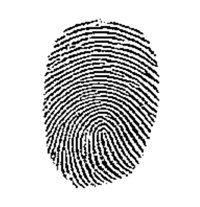
What pattern is this? (Right hand)
Ulnar Loop
Radial Loop
Plain Whorl
Tented Arch
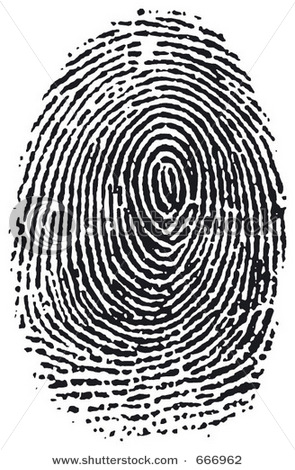
What pattern is this? (Left Hand)
Radial Loop
Ulnar Loop
Plain Whorl
Plain Arch


What pattern is this? (Right Hand)
Tented Arch
Plain Arch
Ulnar Loop
Plain Whorl

What type of fingerprint is this?
Central Pocket Whorl
Plain Whorl
Accidental Whorl
Double Loop Whorl

What type of fingerprint is this?
Central Pocket Whorl
Plain Whorl
Accidental Whorl
Double Loop Whorl

What type of fingerprint is this?
Plain Arch
Tented Arch
Accidental Whorl
Radial Loop

What type of fingerprint is this?
Central Pocket Whorl
Ulnar Loop
Accidental Whorl
Double Loop Whorl

What is the name of this minutiae?
Bifurcation
Splitting Ridge
Delta
Y

What is the name of this minutiae?
Enclosure/Eye
Island
Dot
Bifurcation

What is the name of this minutiae?
Ending Ridge
Spur
Half-Ridge
Partial Ridge

What is the name of this minutiae?
Bridge
Junction
Connector
Zigzag

What is the name of this minutiae?
Island
Speck
Dash
Hyphen

What is the name of this minutiae?
Spur
Hanging Ridge
Overhang
Mini-fork
What is the most common type of fingerprint? (65%)
Arch
Loop
Whorl


What are the red triangles?
deltas
useless
forks
loops
True or False: Blood pattern analysis, is a technique that seeks to piece together the events that caused bleeding.
True
False
Which of the following BEST describes the relationship between free falling blood and the spatter it creates?
The height from which blood falls is inversely proportional to the diameter of the blood stain. As the height increases, the diameter of the blood stain decreases.
The height from which blood falls is directly proportional to the diameter of the blood stain. As the height increases, the diameter of the blood stain increases.
The height from which blood falls is the same as the diameter of the blood stain.
There is no relationship between height and diameter.
Which of the following drops were most likely dropped from a 90º angle? Select from the images labeled a, b, c, and d.


The following passive drops originated from 1 ft., 2 ft, and 3 ft. Which one of the drops most likely fell from 1 ft.? Select A, B, or C from the image.
A
B
C
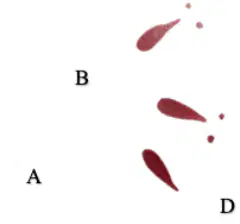
Using the spatter pattern below, determine which point would most likely be the point of convergence.
A
B
C
D
If a person has type A- blood, then they have _____.
only B antigens on their red blood cells
both A antigens and the Rh protein on their red blood cells
only A antigens on their red blood cells
only the Rh protein on their red blood cells
Which of the following is NOT true concerning blood typing?
Blood typing is faster and less expensive than DNA testing.
Blood typing is a source of individual evidence.
Blood typing can eliminate suspects.
Blood typing can be used in forensics as well as in determining parentage.
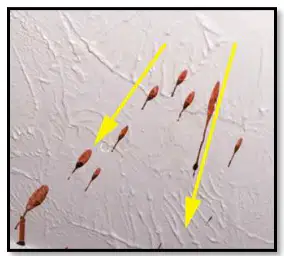
Observe the blood spatter below. How can this blood spatter be classified?
forward spatter from a gunshot wound
drip trail pattern from a bloody weapon
passive drop from body being carried from primary scene
cast-off spatter from blood being slung from a weapon

What is the arrow pointing to?
Spine
Spike
Satellite
Space
Which of the following CANNOT be determined by observing blood spatter?
the DNA of the victim
the position of the assailant at the time of the spatter
the direction that the blood was traveling
the angle of impact
True or False: The higher the energy of impact, the smaller the blood droplets that are produced.
True
False
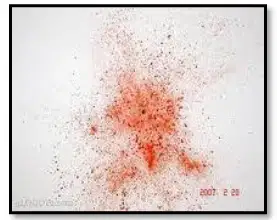
How would a forensic investigator categorize this blood stain?
high velocity spatter (velocity of 100 ft/sec)
medium velocity spatter (25 ft/sec)
low velocity spatter (5 ft/sec)
none of the above
Jenna has been in an accident and needs a blood transfusion. She has been identified as having type B + blood. Which of the following BEST describes who Jenna can receive blood from.
someone with type O + blood
someone with type B - blood
someone with type A - blood
both A & B are correct

Which statement below BEST describes the direction that this blood was traveling when it hit the surface of this paper?
north
south
east
west
Which of the following is NOT a presumptive test that investigators might use to identify blood at a crime scene?
Kastle-Meyer
Luminol
Precipitin test
Gel electrophoresis
Which type of blood spatter is projected outward and away from a source, such as from an exit wound?
back spatter
forward spatter
cast-off spatter
transfer pattern
A victim suffered an injury to a major artery, causing a spray pattern of blood. What type of pattern is this?
drip trail pattern
wipe pattern
pooling pattern
arterial spray
Which blood pattern is created when an object blocks the deposition of blood onto a surface?
void pattern
passive drop pattern
wipe pattern
saturation pattern
True or False: A blood droplet that strikes a surface at an angle will always form a perfectly round stain.
True
False
Investigators find a series of bloodstains with tails pointing in the same direction. What can they infer from this pattern?
The blood fell straight down from a 90° angle.
The victim was lying still when bleeding.
The person who was bleeding was moving in the direction of the tails.
The blood was wiped with a dry object.
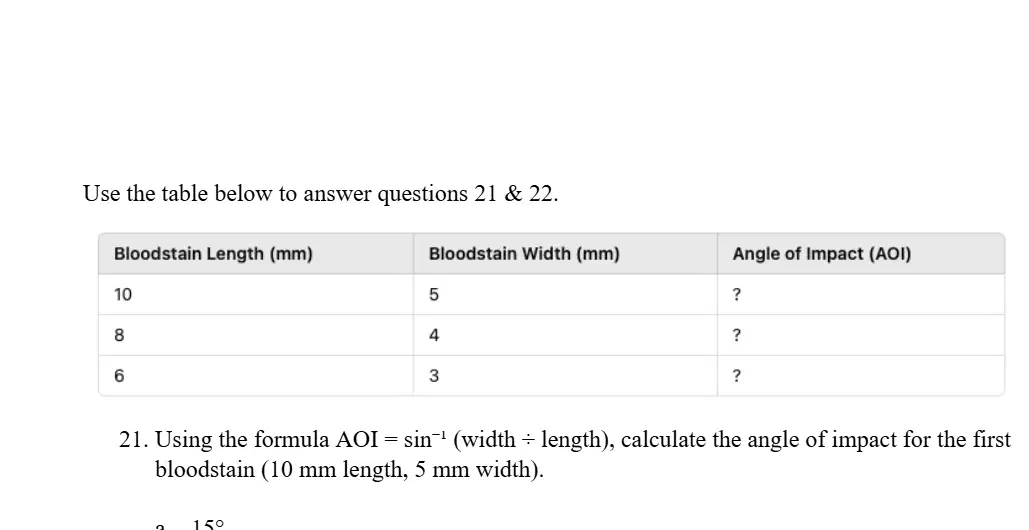
Use the table to answer this question using the formula AOI=sin−1(lengthwidth) . Calculate the angle of impact for the first bloodstain ( 10mmlength,5mmwidth ).
15°
30°
45°
60°
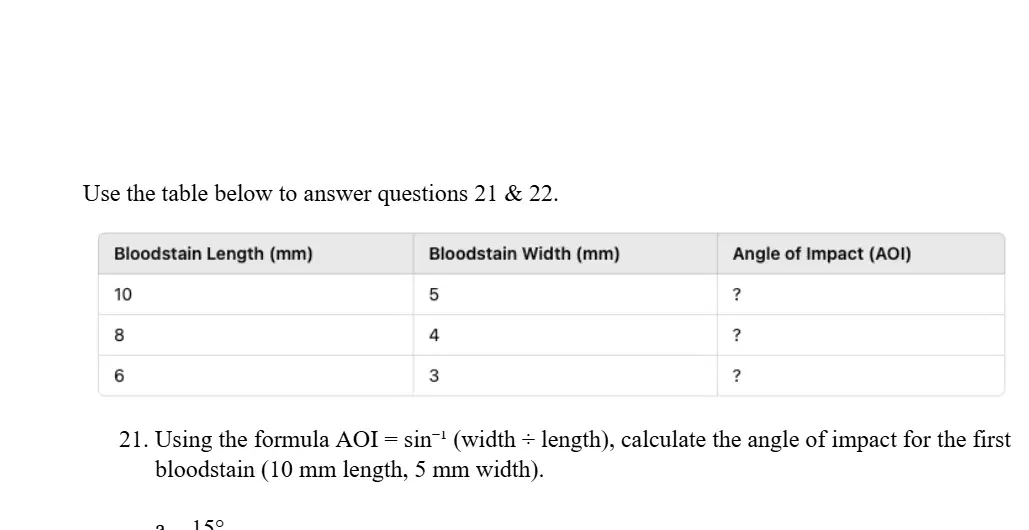
Use the table to answer this question. Based on the values shown, which conclusion can be drawn?
The bloodstains hit the surface at the same angle.
The bloodstains were all dropped from the same height.
The angle of impact increases as the bloodstains get smaller.
The angle of impact decreases as the bloodstains get smaller.
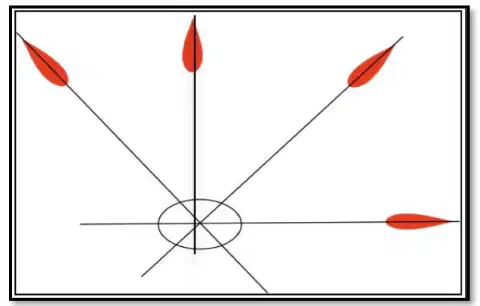
Investigators are performing the stringing method on several bloodstains. After finding the area of convergence and calculating angles of impact for several stains, what additional step is needed to determine the point of origin?
find 5 additional stains
measure the total blood volume
use a protractor to raise strings to the correct AOI
identify the direction of arterial spray
What does the presence of feathering in a wipe pattern indicate?
the direction the object was moved through the blood
the weapon used in the crime
the time of death
that the blood dried instantly
True or False: Blood is a suspension of blood components in plasma, and due to cohesion, falling blood droplets tend to form a perfect spherical shape.
True
False
Can blood typing be used to convict a victim? Why or why not? Explain your answer.
Blood typing is considered what kind of evidence? Why?
What are the 4 main components of blood.
List all the possible blood types.
How might blood typing help a forensic investigator?
Which test is used to detect invisible blood stains using UV Light?
Mackenzie has blood type B+, she can receive blood from which blood donors?
B+, B-, O+, O-
B+, A-, O+, O-
B+
O-
This determines whether a person's blood type is positive or negative...
Rh factor
platelets
D antibodies
plasma
Which blood type is known as the universal recipient? (can receive all types)
AB+
AB-
O+
O-
In the Kastle-Meyer presumptive blood test, which color indicates that blood is present?
Pink
Yellow
Blue
Gold
In DNA, the nitrogenous base Adenine will always bond with
Cytosine
Adenine
Thymine
Guanine
DNA can be collected from all of the following except
Skin
Blood
Hair with Follicle
Hair without Follicle
What process is used to separate fragments of DNA?
Restriction mapping
Polymerase chain reaction
Sanger sequencing
Gel electrophoresis
What size DNA fragments travel through the gel the fastest?
Larger fragments
Smaller fragments
Medium-sized fragments
What percentage of the child DNA came from the mother?
100%
75%
50%
25%

According to the dna evidence, which suspect left DNA at the crime scene?
suspect 1
suspect 2
suspect 3
survivor
none of the people listed
The FBI database that stores DNA profiles
CODIS
AFIS
STRATUS
FEDDNA
What does CODIS Stand for?
Combined DNA Index System
Combined DNA Information System
Covert DNA Index System
Contribution DNA Index System
A section of DNA that codes for a specific trait.
allele
gene
chromosome
trascript
DNA is ______ evidence.
class
individual
transient
conditional
A technique used to identify a person based on analysis of their genetic code.
DNA Fingerprinting
SNP
CODIS
PCR
The backbone of DNA is composed of alternating sugars and
nitrogen-containing bases
nucleic acid
phosphates
hydrogen bonds
A method used to rapidly make multiple copies of a specific segment of DNA.
PCR (Polymerse Chain Reaction)
Electrophoresis
DNA Probe
Parts of the cell where DNA can be found: nucleus and
ribosomes
endoplasmic reticulum
mitochondria
golgi apparatus
What is the STR in the following strand of DNA? AGTCAAGCTCGCTCGCTCGCTCAAT
GCTC
CTCA
AGCT
AGTC
Which of the following is not a nucleotide found in the DNA Molecule?
Thymine
Cytosine
Benzine
Adenine
Guanine
Which differences make your DNA unique and identifiable from everyone and everything else’s?
The shape of the DNA molecule
The color of nucleotides
The order of the nucleotides
All of the above
What is the purpose of polymerase chain reaction (PCR)?
To separate fragments of DNA
To amplify the amount of DNA that is available for testing
To cut DNA into small fragments
To extract DNA from a source
What charge is applied to the end of a gel during gel electrophoresis?
Positive
Negative
Neutral
A technique used to identify a person based on analysis of their genetic code.
DNA Fingerprinting
SNP
CODIS
PCR
The process of DNA Fingerprinting is based on the fact that
everyone has the exact same DNA.
no 2 people, except identical twins, have exactly the same DNA as someone else.
most genes are dominant.
None of the other answer choices are correct.
Openings in agarose gel that DNA is inserted into are/is called
electrophoresis
wells
micropipette
PCR


Which two bear species are most closely related?
Bear 1 and Bear 2
Bear 1 and Bear 3
Bear 2 and Bear 3


The parents of a new baby believe they brought the wrong child home from the hospital. Gel electrophoresis was performed using DNA samples from the parents and the child. A section of the gel electrophoresis results is shown below. Which conclusion is valid based on the gel electrophoresis results?
They have the correct child, because her genetic information is identical to that of the father.
They have the wrong child, because her genetic information does not match that of either parent.
They have the correct child, because her genetic information came from both parents.
They have the wrong child, because her genetic information matches only that of the mother.
Because DNA is composed of alternating sugar and phosphate molecules, DNA is known as a double helix.
True
False
mtDNA is used to trace ancestry through the female line.
True
False
James Watson and Francis Crick received the 1953 Nobel Prize for their work on describing the structure of DNA as
a triple helix that resembles a twisted ladder
a helix that resembles a twisted ladder
a double helix that resembles a twisted ladder
None of these choices
Approximately how many base pairs are in the human body?
6 million
6 billion
6 thousand
6 trillion
Variable regions of DNA that repeat.
PCR
STR
Polymerase Chain Reaction
Gel Electrophoresis
The DNA of every organism on earth is made of the same four
chromosomes
nitrogenous bases
phosphate groups
genes
DNA is considered to be
trace evidence
transient evidence
conditional evidence
physical evidence
DNA is considered to be
direct evidence
transient evidence
conditional evidence
biological evidence
mtDNA is considered to be
individual evidence
transient evidence
conditional evidence
class evidence
Nuclear DNA is considered to be
individual evidence
transient evidence
conditional evidence
class evidence
What did Patsy Ramsey find at the foot of the stairs when she went to the kitchen in the morning?
JonBenet's body
footprints
blood
ransom note
What was the first mistake made when JonBenet was discovered as missing?
the house was not sealed off
the police didn't respond to the call
Patsy Ramsey removed evidence
John Ramsey called his pastor
This type of forensic scientist studies the behaviors/mindsets of criminals...
forensic psychologist
forensic nurse
serologist
forensic anthropologist
The purpose of a Grand Jury is to decide.....
if the DA is doing their job
the guilt or innocence
if there is enough evidence to go to trial
if the evidence is important

