
 Worksheets
Physical Science Semester 1 Review
Total questions: 150
Worksheet time: 1hrs 15mins
What is physical science?
The study of life
The study of matter and energy and its interactions
The general study of all science
The study of Earth and rock and minerals
In the metric system, what unit do we use to measure temperature?
Meter
Gram
Fahrenheit
Kelvin
In the metric system, what unit do we use to measure mass?
Kelvin
Meter
Gram
Liter
In the metric system, what unit do we use to measure force?
Liter
Meter
Gram
Newton
In the metric system, what unit do we use to measure volume?
Meter
Newton
Gram
Liter
In the metric system, what unit do we use to measure length?
Gram
Liter
Meter
Newton
In the metric system, what unit do we use to measure time?
Liter
Newton
Gram
Second
TRUE OR FALSE: The metric system is based on a base-10 system.
FALSE
True
The metric system is based on a base what system?
Base-45
Base-16
Base-10
Base 32
Which variable is the one that we (the scientist) changes?
Independent variable
Dependent variable
Which variable is the one that we are observing/studying and that depends on the variable?
Independent variable
Dependent variable
In an experiment, we are studying the affect of soil type on growth of a pepper plant. We plant 3 pepper seeds each in a different type of soil and then measure the height of the plant each week. What is the independent variable?
Height of the plant
Soil type
In an experiment, we are studying the affect of soil type on growth of a pepper plant. We plant 3 pepper seeds each in a different type of soil and then measure the height of the plant each week. What is the dependent variable?
Soil type
Height of the plant
Where does the dependent variable go on a graph?
x-axis
y-axis
Where does the independent variable go on a graph?
x-axis
y-axis
Which of the following is not a feature of a good graph?
Units
Title
Scales that count up by the same number each time
Dependent variable on the x-axis
I want to create a graph that shows how many percent of people like each type of cats, dogs, and fish. Which type of graph should I use?
scatterplot
Circle graph (pie chart)
Line graph
Bar graph
I want to create a graph that shows the mL of water I gave various plants vs. how grew in cm. Which type of graph should I use?
scatterplot
Line graph
Circle graph (pie chart)
Bar graph
True or False: Scientific reports can help other researchers by suggesting new questions for them to answer.
True
FALSE
Quantitative data is
data that is represented by observations or qualities
data that is represented by numbers
Qualitative data is
data that is represented by observations or qualities
data that is represented by numbers
What is velocity?
acceleration/time
Rate of change in acceleration
Rate of change in position
What is the average of the following numbers: 3, 8, 4
5
3
15
Velocity is ________________.
just speed
Momentum and time
speed and direction
momentum and acceleration
What is acceleration?
acceleration/time
Rate of change in position
Rate of change of velocity
Rate of change in acceleration
What is a force?
change in velocity
None of these
Change in position
push or pull
What is Newton's First Law of Motion?
F = ma
For every action force there is an equal and opposite reaction force
Objects in motion will stay in motion and objects at rest will stay at rest unless acted on by an unbalanced force.
What is Newton's Second Law of Motion?
For every action force there is an equal and opposite reaction force
F = ma
Objects in motion will stay in motion and objects at rest will stay at rest unless acted on by an unbalanced force.
What is Newton's Third Law of Motion?
F = ma
For every action force there is an equal and opposite reaction force
Objects in motion will stay in motion and objects at rest will stay at rest unless acted on by an unbalanced force.
I push both Ball A and Ball B with a 10 N force. Ball A has an acceleration of 5m/s2 . Ball B has an acceleration of 2m/s2 . Based on this, which ball has a higher mass?
Ball B
Ball A
A 13 kg ball has an acceleration of 2 m/s^2 after a force was applied to it. How much force was applied to it?
11 N
6.5 N
15 N
26 N
A 5 kg rock is accelerating at 3 m/s^2. What was the force applied to it?
11 N
15 N
26 N
6.5 N
A 6 N force was applied to an object and it accelerated 3 m/s^2. What is the mass of the object?
2 kg
3 kg
9 kg
11 kg
According to Newton's Third law, for each force there is an equal and opposite reaction force. Since they are equal and opposite, will they cancel out?
No
Yes
What two factors affect force?
mass and velocity
mass and acceleration
acceleration and velocity
What is force measured in?
kg*m/s
N
m/s
kg
What is mass measured in?
kg
N
kg*m/s
m/s
What is velocity measured in?
N
kg*m/s
kg
m/s
What is acceleration measured in?
N
m/s2
kg*m/s
kg
What does it mean to say that momentum is conserved?
The sum total of all the objects momentums stays the same throughout a collision, even if the individual momentums change.
The momentum for each individual object stays the same throughout a collision
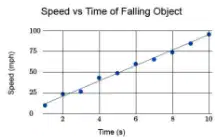
What is the speed of the object at 8 s?
75 mph
100 mph
50 mph
25 mph
What is the equation for speed/velocity?
mass × acceleration
mass × velocity
change in velocity / time
distance / time
What is the equation for acceleration?
mass × acceleration
distance / time
change in velocity / time
mass × velocity
What is the equation for force?
mass × velocity
mass × acceleration
distance / time
change in velocity / time
A car accelerates from a velocity of 50 m/s to a velocity of 70 m/s in 5 seconds. What is the acceleration of the car?
4 m/s2
5 m/s2
70 m/s2
20 m/s2
A ball has a mass of 6 kg and a velocity of 3 m/s. What is its momentum?
9 kg*m/s
2 kg*m/s
3 kg*m/s
18 kg*m/s
A ball has a mass of 12 kg and a velocity of 2 m/s. What is its momentum?
12 kg*m/s
24 kg*m/s
10 kg*m/s
6 kg*m/s
What is momentum described as?
Same as velocity
a measurement of motion calculated by multiplying mass times velocity
acceleration
Does a semitruck or a bicycle have more momentum?
semitruck
They have the same
bicycle
What two factors affect momentum?
acceleration and velocity
mass and acceleration
mass and velocity
What is momentum measured in?
m/s
N
kg
kg*m/s
What does it mean to say that momentum is conserved?
The momentum for each individual object stays the same throughout a collision
The sum total of all the objects momentums stays the same throughout a collision, even if the individual momentums change.
What is the equation for momentum?
distance / time
mass × velocity
change in velocity / time
mass × acceleration
Which of the following is the equation to calculate momentum?
p = mv
p = ma
p = m/v
p = v/a
What is momentum?
amount of motion an object has
push or pull that could cause motion
change in position
A car has a mass of 1500 kg and a velocity of 2 m/s. What is its momentum?
750 kg*m/s
3000 kg*m/s
1500 kg*m/s
1502 kg*m/s
An object has a mass of 2 kg and a velocity of 8 m/s. What is its momentum?
2 kg*m/s
4 kg*m/s
8 kg*m/s
16 kg*m/s
An object moves with a velocity of 7 m/s. Its mass is 4 kg. What is the momentum of the object?
11 kg*m/s
1.75 kg*m/s
28 kg*m/s
7 kg*m/s
What is gravity?
None of these
a repulsive force
an attractive fundamental force
same as acceleration
Do objects with more mass or less mass have more gravity?
Less mass
More mass
Does an object with a larger mass have more or less gravity (a force) than an object with a small mass?
More gravity
Less gravity
The same
Does an object with a smaller mass have more or less gravity (a force) than an object with a larger mass?
The same
Less gravity
More gravity
If two objects are very close together, would their force of gravity be higher or lower than objects that are far apart?
lower
higher
If two objects are very far apart, would their force of gravity be higher or lower than objects that are close together?
higher
lower
Gravity is _____________.
Momentum
nothing
A velocity vector
A force
True or false: All objects being pulled on by gravity on Earth experience the same due to gravity (9.8 m/s^2).
FALSE
TRUE
Newton's Law of Universal Gravitation states that
Only extremely massive objects create a gravitational force
gravity repels two things
all objects with mass have gravity
only objects with very small mass have gravity
What variables affect gravitational force?
mass and distance apart
acceleration and momentum
Mass and velocity
Gravity depends on what two properties (you will select 2).
mass of objects
distance between objects
shape of objects
volume of objects
Will two objects with larger masses have more or less gravity (a force) than two objects with smaller masses?
Less gravity
The same
More gravity
Will two objects with smaller masses have more or less gravity (a force) than objects with larger masses?
The same
More gravity
Less gravity
A 20 kg crate is moving at a speed of 3 m/s. Calculate the momentum of the crate.
60 kg*m/s
6.7 kg*m/s
23 kg*m/s
17 kg*m/s
In a soccer game, a player with a momentum of 300 kg*m/s kicks a ball that is motionless (0) on the ground. After the kick, the player has a momentum of 175 kg*m/s and the ball has a momentum of 125 kg*m/s. Was momentum conserved?
no
yes
A red car with a momentum of 100 kg*m/s collides with a blue car with a momentum of 20 kg*m/s. The red car has a momentum of -10 kg*m/s after the collision. What is the momentum of the blue car after the collision?
80 kg*m/s
100 kg*m/s
130 kg*m/s
What is energy?
The ability to do work
momentum
a force exerted causing displacement
motion
What is potential energy?
stored energy
energy of light
Energy of motion
energy of sound moving
What is kinetic energy?
Energy due to position
Energy of motion
stored energy
Energy stored in chemical bonds
What is gravitational potential energy?
Energy due to position
Energy stored in chemical bonds
energy of sound moving
energy of light
Nuclear energy is ____________________.
energy of light
energy in the nucleus of an atom
Energy stored in chemical bonds
Energy of physical motion
Sound energy is ____________________.
energy of sound moving
Energy due to position
energy of light
Energy stored in chemical bonds
Chemical energy is _____________.
Energy due to position
energy of light
Energy stored in chemical bonds
energy of sound moving
Food stores energy as what type of energy?
gravitational potential energy
Chemical energy
mechanical energy
light energy
What is the kinetic theory of matter?
The ability to do work
theory that says that matter is made up of small particles that are in constant motion
a force exerted causing displacement
theory that says that matter does not move
What is heat?
average kinetic energy
momentum
just stored energy
energy that moves due to a temperature difference; energy in transit
What are the three types of heat transfer (you can select more than one option)
Radiation
Convection
Conduction
Reflection
What is conduction?
Heat transfer through motion of a fluid
Heat transfer at a distance (by waves)
Heat transfer by direct contact
What is convection?
Heat transfer at a distance (by waves)
Heat transfer by direct contact
Heat transfer through motion of a fluid
What is radiation?
Heat transfer through motion of a fluid
Heat transfer at a distance (by waves)
Heat transfer by direct contact
What is thermal equilibrium?
when a higher temperature objects transfers heat to the lower temperature object until they are at the same temperature, but heat is still being transferred
One object is very cold and one is very hot
Temperatures are not the same
when a higher temperature objects transfers heat to the lower temperature object until they are at the same temperature, and heat STOPS being transferred
Does heat transfer ever stop?
No
Yes
Is heat still being transferred at thermal equilibrium?
Yes
No
A skateboarder is at the top of a skate ramp, but not moving. Does he have kinetic energy, potential energy, or both?
Just Kinetic
Both
Just Potential
A skateboarder is in the middle of a ramp, moving down the ramp. Does he have kinetic energy, potential energy, or both?
Just Potential
Both
Just Kinetic
A skateboarder is at the very bottom of a ramp and he is moving. Does he have kinetic energy, potential energy, or both?
Just Potential
Both
Just Kinetic
What does the law of conservation of energy say?
Energy can be destroyed
energy can be created
energy can be create, destroyed, and changed
energy cannot be created or destroyed, only changed
What does it mean that energy can not be created or destroyed?
it means we can only destroy energy sometimes
it means energy is conserved
It means that we can only make energy sometimes
How do particles move when they have a lot of heat energy?
They barely move and just vibrate
The move around a lot and very quickly
They move a bit and slide past each other, but not quick
How do particles move when they only have a little heat energy?
They barely move and just vibrate
The move around a lot and very quickly
They move a bit and slide past each other, but not quick
Which state of matter has particles moving the fastest?
Gas
Solid
Liquid
Which state of matter has particles moving the slowest?
Gas
Solid
Liquid
If I have a pool with water that has a temperature of 80 degrees fahrenheit and I put a rock in it that has a temperature of 40 degrees fahrenheit, what will happen to the temperature of the rock and water?
They will stay the same
The temperature of the pool will decrease and the temperature of the rock will increase until thermal equilibrium is reached
The temperature of the rock will decrease and the temperature of the pool will increase until thermal equilibrium is reached
How does heat move?
From cold to hot
From hot to cold
When food is left out on the counter and cools down, what has happened?
Food spontaneously cools down
Cold heat energy flowed into the food, cooling it down
Nothing
Heat energy from the food was transferred from the warmer food to the cooler air
Which type of energy does the roller coaster have at point A? The diagram shows a roller coaster with labeled points A (0 m/s at the top of the first hill), B (5 m/s on the downward slope), and C (10 m/s near the bottom).
Kinetic energy only
Potential energy only
Both
Which type of energy does the roller coaster have at point B? The diagram shows a roller coaster with labeled points A (0 m/s at the top of the first hill), B (5 m/s on the downward slope), and C (10 m/s near the bottom).
Both
Potential energy only
Kinetic energy only
Which type of energy does the roller coaster have at point C? The diagram shows a roller coaster with labeled points A (0 m/s at the top of the first hill), B (5 m/s on the downward slope), and C (10 m/s near the bottom).
Kinetic energy only
Potential energy only
Both
What type of energy does the ball have in this image? The diagram shows a ball at rest held at a height above the ground.
Potential
Kinetic
What is a disturbance that transfers energy?
Only a mechanical wave
Wave
Only an electromagnetic wave
Pulse
Do waves transfer matter from one place to another?
No
Yes
What is the substance that waves travel through called?
Gas
Liquid
Solid
Medium
Waves transfer __________.
Particles
Matter
People
Energy
Which type of wave require a medium?
Mechanical
Electromagnetic
Which type of wave does NOT require a medium?
Mechanical
Electromagnetic
A wave in which the particles of the medium move parallel to the wave is a ____________ wave
Surface
Transverse
Longitudinal
A wave that travels on the surface of a medium in both transverse and longitudinal resulting in circular movement of the particles of medium through which the wave is traveling is called a __________ wave.
Surface
Transverse
Longitudinal
A sound wave is an example of a __________ wave.
Surface
Transverse
Longitudinal
A wave on a string is an example of a __________ wave.
Surface
Longitudinal
Transverse
What is the highest point on a wave called?
Trough
Crest
Wavelength
Amplitude
What is the lowest point on a wave called?
Crest
Wavelength
Amplitude
Trough
The time for a wave, or one cycle of a repeating wave, to pass a location is called ____________.
Wavelength
Frequency
Period
Amplitude
The number of waves that pass through a point during a specific amount of time is the __________.
Wavelength
Amplitude
Frequency
Period
What is wave speed?
The distance from one point on a wave to the next same point on a wave or the distance of one wave cycle is known as __________.
The number of waves that pass through a point during a specific amount of time is called the __________.
The maximum displacement of a wave from its rest position - that is, distance from rest to crest or rest to trough is known as __________.
the distance traveled by a given point on the wave (like a crest) in a given interval of time
Which of the following is NOT one of the wave speed equations?
Wave speed = wavelength / period
Wave speed = (wavelength)(frequency)
Wave speed = distance / time
Wave speed = wavelength / frequency
A wave has a wavelength of 2 m and a frequency of 4 Hz. What is the speed of the wave?
4 m/s
8 m/s
0.5 m/s
A wave has a frequency of 46 Hz and a wavelength of 1.7 m. Calculate the wave speed.
27 m/s
46 m/s
78.2 m/s
1.7 m/s
The perceived highness or lowness of a sound is called ____________.
Pitch
Period
Wavelength
Frequency
High frequency sounds are associated with __________ pitches.
high
low
Low frequency sounds are associated with __________ pitches.
low
high
Look at the image. What does arrow #1 respresent?
Trough
Wavelength
Amplitude
Look at the image. What does arrow #2 respresent?
Wavelength
Amplitude
Trough
Look at the image. What does letter A respresent?
Wavelength
Trough
Amplitude
Crest
Look at the image. What does letter B respresent?
Crest
Trough
Wavelength
Amplitude
Look at the image. What does letter C respresent?
Amplitude
Wavelength
Trough
Crest
Look at the image. What does letter D respresent?
Amplitude
Trough
Crest
Wavelength
How do we calculate wave speed?
Wave speed = wavelength * frequency
Wave speed = wavelength / frequency
Wave speed = mass x acceleration
Wave speed = force x mass
Is this an image of a longitudinal, transverse, or surface wave?
Transverse
Surface
Longitudinal
Is this an image of a longitudinal, transverse, or surface wave?
Surface
Longitudinal
Transverse
Is this an image of a longitudinal, transverse, or surface wave?
Transverse
Longitudinal
Surface
Which of the following is NOT an advantage of digital communication and storage?
Can store more information
There could be security issues
Less interference
It is more stable
Which of the following is NOT a disadvantage of digital communication and storage?
It can store more information
Info can be easily stolen or deleted
Requires a lot of hardware
Security issues
True or false: Electromagnetic waves can be used for communication
True
False
In visible light, different wavelengths represent different ____________.
brightness
amplitudes
colors
What is light?
both a particle and a wave
just a particle
just a wave
Which type of transmission has more interference?
analog
digital
The flow of electrons or electric charge is called ____________.
Electricity
Magnetic Field
Insulator
Conductor
Opposite poles ____________.
Repel
Attract
Like poles ____________.
Repel
Attract
A magnet pushed through a wire loop creates ____________.
An electric current
An explosion
A nuclear force
A chemical reaction
When a magnet is pushed through a wire loop, mechanical energy is converted to ____________.
thermal energy
electrical energy
None of these
chemical energy
A substance capable of transmitting electric charge is called a ____________.
Conductor
Magnet
Electric field
Insulator

