
 Worksheets
IPC Fall Semester Exam 25
Total questions: 60
Worksheet time: 30mins
Name
Class
Date
1.
Refraction occurs when a wave changes its as it passes through a different medium.
a)
color
b)
frequency
c)
intensity
d)
speed
2.
Which is an example of a compressional wave?
a)
X-ray
b)
gamma ray
c)
sound wave
d)
water wave
3.
Increasing the amplitude of a sound wave will make it ____.
a)
louder
b)
have a higher pitch
c)
travel faster
d)
produce beats
4.
Ocean waves crash on the beach at a velocity of 3.5 m/s. If the distance between the crests
of each wave is 4 m, find the frequency of the waves.
a)
0.88 Hz
b)
1.14 Hz
c)
0.0088 Hz
d)
14.0 Hz
5.
An echo is an example of sound wave
a)
absorption
b)
reflection
c)
diffraction
d)
refraction
6.
What is the velocity of a wave having a frequency of 25 Hz and a wavelength of 10 m?
a)
250 m/s
b)
2.5 m/s
c)
35 m/s
d)
0.4 m/s
7.
A glass prism is able to bend light because
a)
light is refracted as it enters a different medium
b)
the prism creates destructive interference
c)
energy is diffracted when it encounters an obstacle
d)
the glass and the light’s wavelength create resonance
8.
In 1 second, 4 crests of a wave pass a certain point. What is the wave’s frequency?
a)
0.25 Hz
b)
0.25 m/s
c)
4 Hz
d)
4 m/s
9.
Wave A carries more energy than wave B. Wave B must have a smaller_________ than wave A.
a)
frequency
b)
amplitude
c)
wavelength
d)
speed
10.
In order for reflection to occur, the wave must _____ an object.
a)
bend around
b)
pass through
c)
be absorbed by
d)
bounce off
11.
Houses with carpet are much quieter than houses with tile or hardwood floors because of sound wave
a)
absorption
b)
diffraction
c)
reflection
d)
refraction
12.
What is the part of an experiment that serves as a standard for comparison?
a)
Control Group
b)
Constant
c)
Hypothesis
d)
Variable
13.
A testable prediction that predicts a cause and effect relationship between variables is a(n) ___________ .
a)
analysis
b)
observation
c)
hypothesis
d)
inference
14.
Where does the dependent variable go on a graph?
a)
X-axis
b)
Y-axis
c)
In the Title
d)
In the Key
15.
Why is it advisable to use tongs when taking a beaker off a laboratory burner?
a)
It prevents spilling.
b)
It looks cool.
c)
It prevents the beaker from breaking.
d)
It allows you to move it if it is too hot.
16.
A factor in an experiment that changes in response to the independent variable is the ____.
a)
constant
b)
independent variable
c)
control group
d)
dependent variable
17.
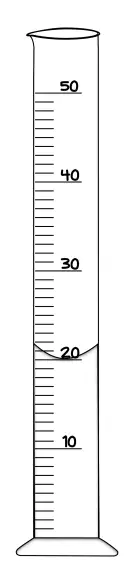
Using the graduated cylinder to the right, pick the accurate AND precise measurement below.
a)
22.0 mL
b)
22 mL
c)
20.0 mL
d)
20 mL
18.
If your lab partner’s clothes catch on fire, you should first ___________.
a)
use a fire extinguisher
b)
do nothing. It will burn out eventually.
c)
panic
d)
tell the teacher
19.
All of the following are steps in the scientific method EXCEPT
a)
observing and recording data.
b)
developing a model.
c)
forming a hypothesis.
d)
discarding data that doesn’t match the hypothesis.
20.
The best type of graph to use to show the percentages of a whole is a
a)
Circle Graph
b)
Bar graph
c)
Line Graph
d)
Scatter Graph
21.
A factor that does NOT change in an experiment is the ______.
a)
constant
b)
dependent variable
c)
control group
d)
independent variable
22.
The “cause” of the experiment, what we are purposefully manipulating or changing is the _______.
a)
constant
b)
control group
c)
dependent variable
d)
independent variable
23.
A group of students is playing tug-of-war. The students on both sides of the rope are pulling with equal force so
that the rope is not moving. This is an example of
a)
unbalanced forces
b)
balanced forces
c)
acceleration
d)
displacement
24.
A firefighter feels the hose pushing backwards onto him as he uses it to put out a fire. What is the most likely
cause of this?
a)
The hose material is very elastic.
b)
Since the hose is at rest, it tends to stay at rest.
c)
The force exerted on the water equals the mass of the water times its acceleration.
d)
The escaping water exerts an equal and opposite force on the hose.
25.
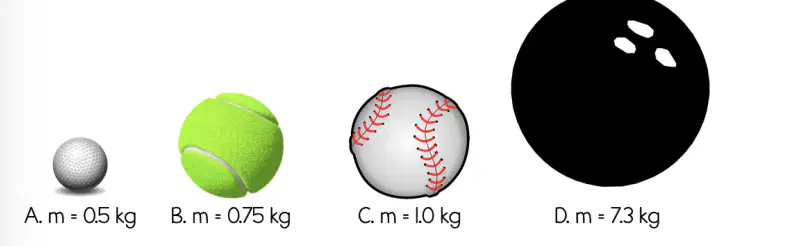
If the same force is applied to each of the balls pictured below, which one will have the LEAST acceleration?
a)
A
b)
B
c)
C
d)
D
26.
Which of the following is measured in Newtons?
a)
weight
b)
momentum
c)
mass
d)
acceleration
27.
Calculate the force on an object that has a mass of 10 kg and an acceleration of 4 m/s2
a)
40 N
b)
8 N
c)
2.5 N
d)
0.4 N
28.
A 500 N force is applied to a 25 m/s2 object. The mass of the object is ____.
a)
12,500 m/s
b)
12,500 kg
c)
20 m/s
d)
20 kg
29.
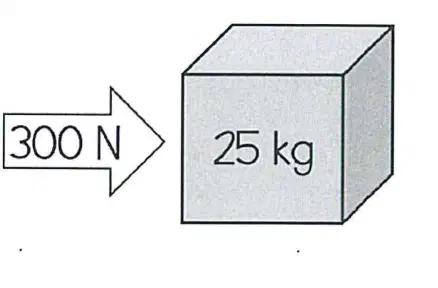
What is the acceleration of the box in the picture to the right?
a)
7,500 m/s2
b)
300 m/s2
c)
25 m/s2
d)
12 m/s2
30.
The upward force on an object falling through the air is ____.
a)
air resistance
b)
momentum
c)
inertia
d)
gravity
31.
The relationship among mass, force, and acceleration is explained by ____.
a)
Law of Conservation of Momentum
b)
Newton's 1st Law of Motion
c)
Newton's 2nd Law of Motion
d)
Newton's 3rd Law of Motion
32.
According to Newton’s laws, for any object, the greater the force that's applied to it, the greater its
____ will be.
a)
acceleration
b)
inertia
c)
gravity
d)
size
33.
The speed you read on a speedometer is ____.
a)
instantaneous speed
b)
average speed
c)
constant speed
d)
velocity
34.
3 m/s north is an example of a(n) _____.
a)
speed
b)
velocity
c)
time
d)
acceleration
35.
A car moves around a wide turn going 45 mi/hr the whole time. The car has a constant _____.
a)
speed
b)
velocity
c)
acceleration
d)
direction
36.
If you ride your bicycle down a straight road for 500 m then turn around and ride back to your starting point,
your distance is _____ your displacement.
a)
greater than
b)
equal to
c)
less than
d)
can’t determine
37.
How long will it take an object traveling at 25 m/s to reach a distance of 125 meters?
a)
5 s
b)
0.2 min
c)
5 m
d)
0.2 s
38.
A high-speed train travels with an average speed of 227 km/hr. The train travels for 2 hrs. How far does the
train travel?
a)
113.5 km
b)
454 km
c)
0.0088 km
d)
225 km
39.
A cross-country runner runs 10 km in 40 minutes. What is his average speed?
a)
30 km/min
b)
4 km/min
c)
400 km/min
d)
0.25 km/min
40.
Find the acceleration of a car that goes from 32 m/s to 96 m/s in 8.0 s.
a)
8.0 m/s2
b)
-8.0 m/s2
c)
12 m/s2
d)
4.0 m/s2
41.
When a car traveling at 30 m/s hits the gas pedal, it speeds up to 65 m/s in 3.5 sec. What is the car’s
acceleration during that time?
a)
5 m/s2
b)
15 m/s2
c)
10 m/s2
d)
20 m/s2
42.
Which statement about the movement of an object with zero acceleration could be true?
a)
the object is speeding up
b)
the object is slowing down
c)
the object is moving at a constant speed
d)
the object is changing direction
43.
The ____ energy of an object increases with its height.
a)
chemical potential
b)
kinetic
c)
thermal
d)
gravitational potential
44.
How much force is required to lift a rock a vertical distance of 8 m if 80 J of work were done?
a)
80 J
b)
80 N
c)
10 J
d)
10 N
45.
A constant force of 2.0 N is used to push a box 4.0 m across the floor. How much work is done?
a)
6 J
b)
8 J
c)
12 J
d)
24 J
46.
The rate at which work is done is ____.
a)
power
b)
force
c)
efficiency
d)
momentum
47.
Temperature measures the average ____ of the particles in a material.
a)
chemical energy
b)
kinetic energy
c)
potential energy
d)
mechanical energy
48.
An object has a velocity of 9 m/s and a mass of 20 kg. What is the kinetic energy of the object?
a)
90 J
b)
180 J
c)
810 J
d)
1,620 J
49.
A 5 kg medicine ball is thrown upward at a speed of 2 m/s. How much energy does it have?
a)
5 J
b)
10 J
c)
20 J
d)
98 J
50.
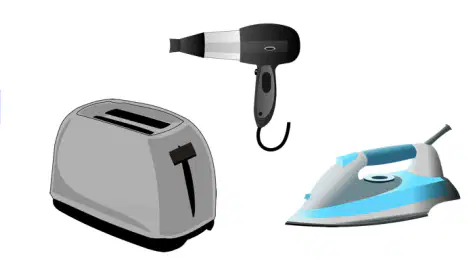
What energy change do the appliances to the right all have in common?
a)
They convert electrical energy to thermal energy.
b)
They convert electrical energy to mechanical energy.
c)
They convert mechanical energy to electrical energy.
d)
They convert heat energy to electrical energy.
51.
What is the potential energy of a 55 kg box that is sitting 8.0 m above the ground?
a)
4,312 J
b)
1,760 J
c)
550 J
d)
400 J
52.
The force or push that causes electric charges to move is called ____________.
a)
resistance
b)
voltage difference
c)
current
d)
static electricity
53.
Electric charges always flow from _______ areas to _______ areas.
a)
positive, negative
b)
negative, positive
c)
positive, neutral
d)
neutral, negative
54.
A material through which electrons do NOT flow easily is a(n) ___________.
a)
insulator
b)
fuse
c)
conductor
d)
circuit breaker
55.
Which of the following statements about electric charge is true?
a)
Objects must be touching on another to exert electrical force.
b)
Electrical forces act at a distance.
c)
Air cannot conduct electricity; it is conducted only by solid materials.
d)
Opposite electric charges always repel one another.
56.
Mr. Robinson and his class are conducting an experiment. The class needs to choose a good insulator. Which of the following could be used as an insulator?
a)
plastic plate
b)
silver spoon
c)
copper wire
d)
gold necklace
57.
Which of the following will increase the resistance of a wire?
a)
using a thicker/wider wire
b)
using a shorter wire
c)
increasing the temperature of the wire
d)
using silver instead of copper
58.
What is the current produced by a 9-volt battery flowing through a resistance of 0.2 ohms?
a)
1.8 amps
b)
45 amps
c)
0.022 amps
d)
8.8 amps
59.
Which two areas of physical science are closely related to the development of electric motors and generators?
a)
sound and light
b)
electricity and sound
c)
light and magnetism
d)
electricity and magnetism
60.
Silver has a resistance of 0.0198 ohms. What voltage would produce a current of 100 amps?
a)
1.98 V
b)
0.000198 V
c)
5,050 V
d)
100.0198 V
100 %

