wayground logo

Free Printable Worksheets

Font size

S
M
L
XL
Worksheets

Atomic and Molecular Structure Review

Total questions: 48

Worksheet time: 1hrs 6mins

Name
Class
Date
1.

What is an atom?

a)

The smallest particle of an element that has lost the properties of that element.

b)

The largest particle of an element that still has the properties of that element.

c)

The smallest particle of an element that still has the properties of that element.

d)

A molecule consisting of two or more elements.

2.

What is the charge of a proton?

a)

Negative

b)

Positive

c)

Neutral

3.

What is the charge of a neutron?

a)

Negative

b)

Positive

c)

Neutral

4.
These will determine what element an atom is. 
a)
number of neutrons
b)
number of electrons
c)
number of atoms 
d)
number of protons 
5.
the central region of an atom where its neutrons and protons are is its 
a)
nucleus 
b)
electron cloud
c)
core 
d)
center 
6.
How many neutrons does the isotope of lithium have?
a)
8
b)
3
c)
4
d)
5
7.

How many protons does the isotope of lithium have?

a)
8
b)
3
c)
4
d)
5
8.
What element has 42 protons?
a)
Ca
b)
Mo
c)
Zr
d)
Po
9.
If an atom of nickel has a charge of +3, how many electrons does the atom have?
a)
28
b)
25
c)
26
d)
31
10.
What atom matches this electron configuration?
1s2s2p3s2
a)
Neon
b)
Magnesium
c)
Aluminum
d)
Potassium
11.

What is the maximum number of electrons that an S sublevel can have?

a)

1 electron

b)

2 electrons

c)

3 electrons

d)

4 electrons

12.
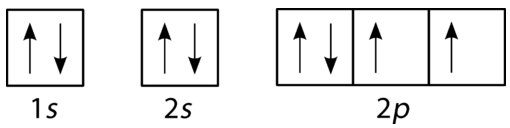
How many valence electrons are represented here?
a)
7
b)
5
c)
2
d)
8
13.
How many electrons can the d sublevel hold?
a)
8
b)
10
c)
2
d)
4
14.
What atom matches this electron configuration?
[Xe] 6s2 4f14 5d9
a)
Mercury
b)
Gold
c)
Platinum
d)
Thallium
15.
Identify the element in Period 5 that has 1 valence electron?
a)
Rb
b)
Nb
c)
Ag
d)
Sb
16.
This orbital diagram represents:  
a)
C
b)
B
c)
N
d)
O
17.
Each orbital will hold ____ electrons
a)
5
b)
4
c)
8
d)
2
18.
What atom matches this electron configuration?
1s22s22p63s23p64s23d10
a)
Zinc
b)
Copper
c)
Nickel
d)
Germanium
19.
Which is associated with more energy? 
a)
2p
b)
2s
c)
3p
d)
1s
20.
An atom becomes _________ when it gains electrons.
a)
Positive
b)
Negative
c)
Neutral
d)
Invinsible
21.

Using the image, how many electrons are in an ion of cesium?

a)

54

b)

55

c)

56

d)

133

22.
What electron configuration matches an oxygen ion?
a)
1s22s22p63s2, 3p64s23d104p5
b)
1s22s22p4
c)
1s22s22p6
d)
1s22s22p63s23p64s23d1
23.
The electron configuration of an atom is 1s22s22p6.  The number of valence electrons in the atom is 
a)
3
b)
6
c)
8
d)
10
24.
Which of the following elements has the smallest radius?
a)
Mg
b)
Al
c)
Si
d)
K
25.

Which element in Period 2 has the greatest atomic radius?

a)

Be

b)

C

c)

Na

d)

Li

26.
As you move across the periodic table from left to right, the atomic radius decreases.  This is because - 
a)
the number of protons increases, so attraction to electrons increases
b)
the number of energy levels increases
c)
the number of electrons increases
d)
the atomic mass increases
27.
Ionization energy is...
a)
the energy required to add an electron to a specific atom
b)
how much energy it takes to remove an electron from an atom
c)
the energy required to shield the outer electrons from the nucleus
d)
a measure of the ability of an atom to attract electrons
28.

The vertical (up and down) columns in the Periodic Table are called

a)

groups

b)

towers

c)

periods

d)

atomic numbers

29.
Francium (Fr) has the lowest ionization energy in Group 1 because - 
a)
it has the smallest number of valence electrons
b)
it has the greatest atomic mass
c)
it has the greatest number of protons, so it attracts its electrons the strongest
d)
its 1 valence electron is very far from the nucleus, so little energy is needed to remove it
30.
Which of the following sequences corresponds to a correct trend in ionization energy?
a)
Cl > S > P > Al
b)
Sr > Ca > Mg > Be
c)
Rb > K > Na > Li
d)
Rb > Sr > I > Xe
31.
What two types of atoms make a covalent bond?
a)
2 Nonmetals
b)
1 Nonmetal and 1 Metal
c)
2 Metals
d)
2 Noble Gases
32.

The octet rule says that all atoms will bond to have _____ electrons, except for H which will have ____ electrons.

a)

8 , 2

b)

7 , 2

c)

8 , 1

d)

5, 1

33.

How many TOTAL electrons are being shared in the triple bond between the two carbon atoms in this molecule?

a)

2

b)

4

c)

6

d)

8

34.

Which is the correct molecular structure for carbon dioxide?

a)
b)
c)
d)
35.

NH3 has how many lone pairs?

a)

0

b)

1

c)

2

d)

3

36.

3. Which is a correct Lewis structure for hydrogen cyanide, HCN?

a)
b)
c)
d)
37.

Which model represents a LOWER Vapor Pressure?

a)

A

b)

B

38.

A weak IMF will result in a

a)

high boiling point

b)

high viscosity

c)

high surface tension

d)

high vapor pressure

39.

Which compound has the strongest IMF

a)

HOH

b)

CH4

c)

C2H6

d)

CH3OH

40.

What is the formula for diphosphorus pentoxide?

a)

P5O2

b)

PO5

c)

P2O5

d)

Po2O5

41.

What is the name of this molecular shape?

a)

Tetrahedral

b)

Trigonal pyrimidal

c)

Bent

d)

Trigonal Planer

42.

What is the molecular geometry of this molecule?

a)

Tetrahedral

b)

Bent

c)

Square Planar

d)

Trigonal Pyramidal

43.

Which of the following is violating the Octet rule?

a)

b)

c)

d)

44.

What is the bond angle?

(a)  

45.

Red light has a wavelength of 700 nm. How much energy do red light have?

a)

2.84 x 10⁻¹⁹J

b)

2.84 x 10⁻²² J

c)

4.26 x 10⁻¹⁶ J

d)

4.74 x 10⁻²⁸ J

46.

Put the following in order of increasing boiling point, starting with the lowest: WC, water, CH4 , SO2, KCl, Au

a)

SO2, KCl, water, CH4, Au, WC

b)

water, CH4, SO2, KCl, Au, WC

c)

KCl, Au, CH4, water, SO2, WC

d)

CH4, SO2, water, Au, KCl, WC

47.
What is an isotope? 
a)
A charged atom
b)
An atom with different amounts of neutrons
c)
An atom with different amounts of protons
d)
A neutral atom
48.
The mass of one proton is greater than the mass of one...
a)
neutron
b)
electron