
 Worksheets
Fall World History Final review
Total questions: 57
Worksheet time: 29mins
Name
Class
Date
1.
This period involved many philosophers using logic and reason to solve societies problems.
a)
Julius Caesar
b)
Punic Wars
c)
Enlightenment
d)
Hellenism
2.
The type of government that was created by and one of the major achievements of the Greeks, that allowed all citizens to vote, was known as:
a)
Divine Right
b)
Democracy
c)
Great Schism
d)
Indulgences
3.
The series of wars that were fought between Rome and Carthage for dominance over the Western Mediterranean region
a)
Julius Caesar
b)
Republic
c)
Punic Wars
d)
Crusade
4.
A system of government, where the citizens elect people to represent them in government
a)
Julius Caesar
b)
Republic
c)
Punic Wars
d)
Inquisition
5.
Soldiers that fight for any nation's army for pay are known as:
a)
Printing Press
b)
Mercenaries
c)
Divine Right
d)
Democracy
6.
One of Alexander the Greats legacies was the blending of many cultures. This is known as:
a)
Protestants
b)
Indulgences
c)
Assimilation
d)
Estates General
7.
Political or military system based on the holding of land with an emphasis on local protection, local government, and local self-sufficiency
a)
Renaissance
b)
Feudalism
c)
Hannibal
d)
Hellenism
8.
A peasant that was bound to the land
a)
Hannibal
b)
Serf
c)
Hellenism
d)
Crusade
9.
A series of wars that brought Christianity and Islam in conflict over the Holy Land, especially Jerusalem
a)
Serf
b)
Hellenism
c)
Inquisition
d)
Crusade
10.
This was a code of conduct for Knights during the Middle Ages
a)
Vassal
b)
Crusade
c)
Chivalry
d)
Convent
11.
This invention led to an increase in literacy for the general population in Europe
a)
Printing Press
b)
Great Schism
c)
Protestants
d)
Estates General
12.
Martin Luther and his followers protested the Catholic practice of selling of:
a)
Great Schism
b)
Protestants
c)
Indulgences
d)
Assimiliation
13.
People that broke away from the Catholic Church
a)
Democracy
b)
Protestants
c)
Indulgences
d)
Assimiliation
14.
The concept that the sun, not the earth, was the center of the universe
a)
Geocentric
b)
Democracy
c)
Heliocentric
d)
Philosophy
15.
The idea that royal power came from God is called:
a)
Mercenaries
b)
Divine Right
c)
Democracy
d)
Estates General
16.
To give up or step down from a position of power, especially by a ruler giving up the throne, is to —
a)
Rule
b)
Abdicate
c)
Conquer
d)
Reign
17.
The supreme power or authority of a state to govern itself or another state is called
a)
Liberty
b)
Sovereignty
c)
Absolutism
d)
Monarchy
18.
Freedom from unfair control by authority or government is known as
a)
Tyranny
b)
Liberty
c)
Equality
d)
Independence
19.
Cruel or oppressive government rule by one person or group is called
a)
Tyranny
b)
Democracy
c)
Ideology
d)
Republic
20.
The legislative branch before the French Revolution where the power resided with the upper class and the clergy
a)
Mercenaries
b)
Democracy
c)
Assimiliation
d)
Estates General
21.
Which of the following below were a factor in developing Greek culture?
a)
The Sea
b)
The climate
c)
The mountains
d)
All of the above
22.
Which of the following would be allowed to participate in Athenian Democracy
a)
Women
b)
Free men who have moved into the city
c)
17 year olds
d)
Free men born in Athens
23.
A group of Senators killed this man because they believed he was too powerful in Rome
a)
Julius Caesar
b)
Republic
c)
Hannibal
d)
Serf
24.
The religions of Judaism, Christianity, and Islam all have this in common:
a)
Are monotheistic
b)
Began in Italy
c)
Began at the same time
d)
Require daily church attendance
25.
Under Pope Urban II, the Christian church called for a Crusade with the goal of:
a)
Regaining the Holy Lands from the Muslims
b)
Regaining the Holy Lands from the Hindus
c)
Regaining the Holy Lands from the Catholics
d)
Regaining the Holy Lands from the Buddhists
26.
All of these were characteristics of the Middle Ages except:
a)
Germanic culture replaced the Roman culture
b)
Loss of strong centralized governments
c)
The growth of education throughout Europe
d)
A collapse of trade and towns
27.
This period was the rebirth of human culture, learning, and science in Europe.
a)
Paleolithic Era
b)
Renaissance
c)
Dark Ages
d)
Cold War Era
28.
This was the result of Luther's 95 Theses
a)
Saxony sent an army to overthrow the Pope
b)
The Germans created a new Holy Roman Empire
c)
led to widespread religious conflict in Germany and the beginning of the Protestant Reformation.
d)
The Pope excommunicated Germany
29.
Sculptor and painter who worked out of Florence and Rome. Two of his greatest works are the “Pieta’ and “David”.
a)
Machievelli
b)
Leonardo Divinci
c)
Michaelangelo
d)
William Shakespeare
30.
An Italian diplomat who served the Medici family and wrote the Prince
a)
Julius Caesar
b)
Amerigo Verspucci
c)
Niccolo Machiavelli
d)
Christopher Columbus
31.
Sailing on behalf of Spain, he was the first modern European to reach the new world.
a)
Magellan
b)
Balboa
c)
Columbus
d)
Cortez
32.
He left Spain in 5 ships, and even though he did not complete the voyage, he is still given credit for being the first to circumnavigate the globe.
a)
Magellan
b)
Balbao
c)
Columbus
d)
Cortez
33.
The Middle Passage the trade route where slaves would be brought to the New World. This route was located between...
a)
Africa to the Americas
b)
Europe to Africa
c)
Europe to the Americas
d)
Asia to Africa
34.
This period saw major developments in mathematics, physics, astronomy, biology and chemistry
a)
The Dark Ages
b)
The Medieval Era
c)
The Middle Ages
d)
The Scientific Revolution
35.
This man argued that people were basically reasonable, moral and that they deserved natural rights at birth.
a)
Thomas Hobbes
b)
John Locke
c)
Machiavelli
d)
Genghis Khan
36.
A cultural movement of intellectuals who emphasized reason and science over tradition.
a)
The Bronze Age
b)
The Enlightenment
c)
The Industrial Revolution
d)
The Age of Rebellion
37.
"We hold these truths to be self-evident, that all men are created equal, that they are endowed by their creator with certain inalienable rights, that among these are life, liberty, and the pursuit of happiness..." The Declaration of Independence
Which enlightenment thinker most directly influenced the notion expressed in this passage?
a)
Thomas Hobbes
b)
John Locke
c)
Jacques Bossuet
d)
Baron de Montesquieu
38.
Near the beginning of the French Revolution, the Third Estate stormed this building with the goal to release prisoners and gain weapons
a)
Eiffel Tower
b)
the Bastille in Paris
c)
Arc de Triomphe
d)
Boston Harbor
39.
Based on the picture above, which statement most accurately interprets this portrayal of the First, Second, and Third Estates of France?
a)
The Nobility controls the other two Estates
b)
The Third Estate supports the top two Estates
c)
The privileged fear the underprivileged
d)
Monarchy is afraid of the people
40.
The era of the French Revolution that was led by Maximillian Robespierre that featured the execution of thousands by the guillotine is often referred to as
a)
the Old Regime
b)
the Age of Napoleon
c)
the Reign of Terror
d)
the Russian Revolution
41.
All of the following were achievements of Napoleon EXCEPT:
a)
Conquering all of Europe including Russia
b)
creating the Napoleonic Code
c)
Stabilizing the French economy
d)
Allowing religious freedom
e)
Expanding French Nationalism
42.
French General who conquered much of Europe, taking power in France after the Revolution.
a)
Renaissance
b)
Feudalism
c)
Napoleon Bonaparte
d)
Hellenism
43.
Before the revolution in France, members of the Third Estate had
a)
a smaller tax burden than the other estates
b)
greater political influence than the clergy
c)
a voice in government equal to that of the First and Second Estates
d)
a high tax burden and little political power
44.
In 1789 (Before the Revolution began), King Louis XVI summoned the Estates-General primarily to
a)
eliminate feudal dues
b)
raise taxes to pay off growing debt
c)
increase the influence of the peasants
d)
protect the privileges of the First and Second Estates
45.
Commoners, the bourgeoisie, professionals, peasants, and urban populace-made up which estate in France?
a)
The First Estate
b)
The Second Estate
c)
The Third Estate
d)
The aristocracy
46.
The Declaration of the Rights of Man guaranteed all of the following EXCEPT
a)
Freedom of speech
b)
Freedom of the press
c)
Freedom of Religion
d)
Equal Rights for Women
47.
The Congress of Vienna
a)
was responsible for democracy throughout Europe
b)
developed France after the war
c)
redrew the map of Europe, and restored the monarchy in France
d)
installed Napoleon back into office after Elba
48.
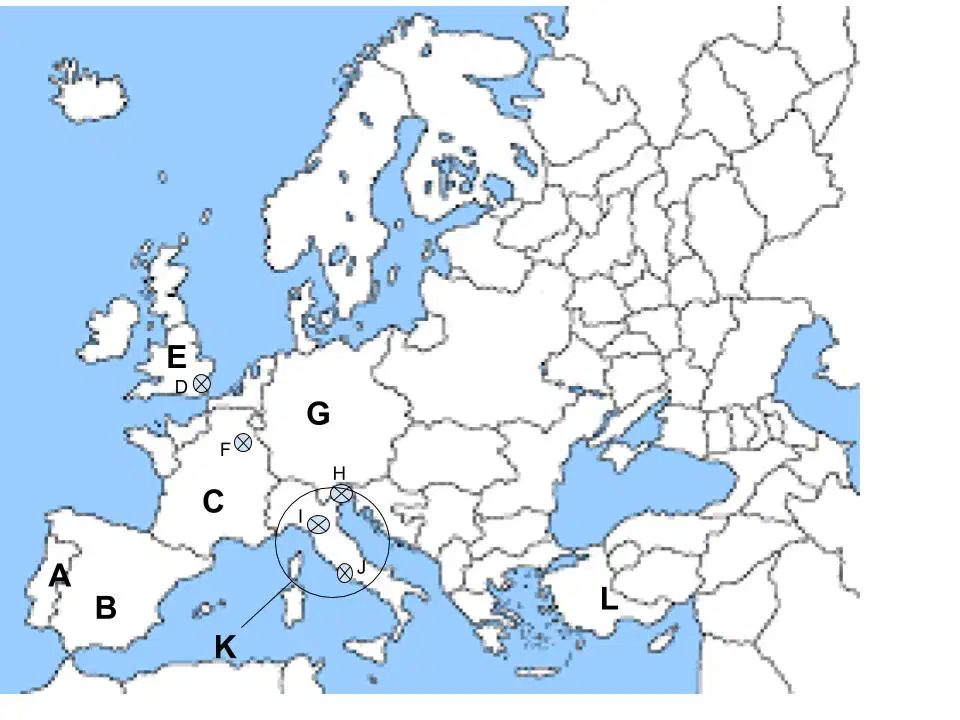
London
a)
A
b)
B
c)
C
d)
D
49.
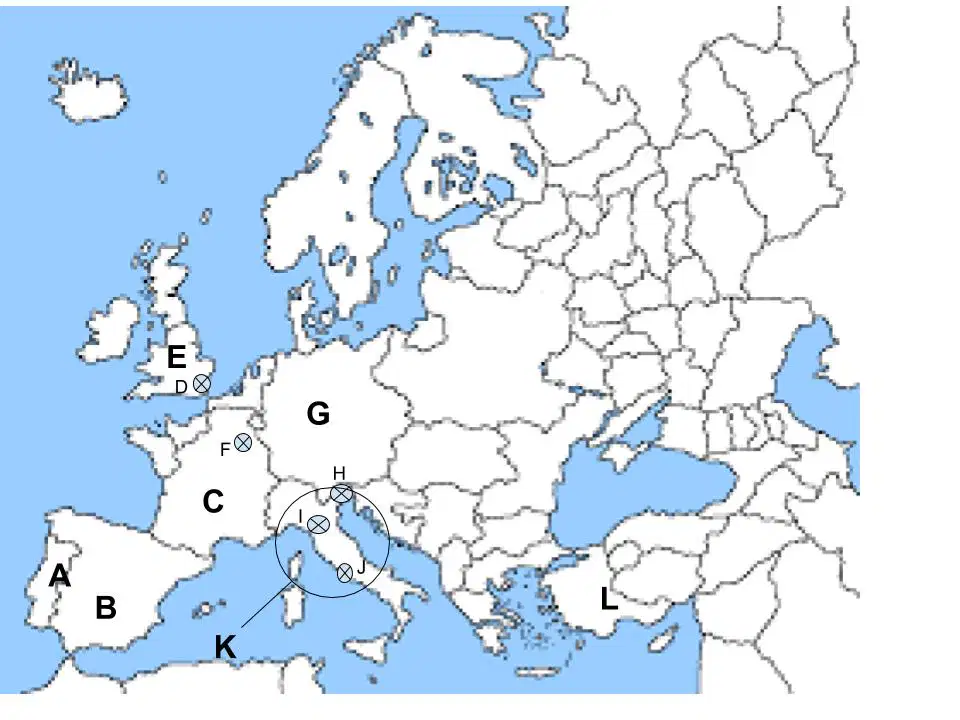
Venice
a)
G
b)
H
c)
I
d)
J
50.
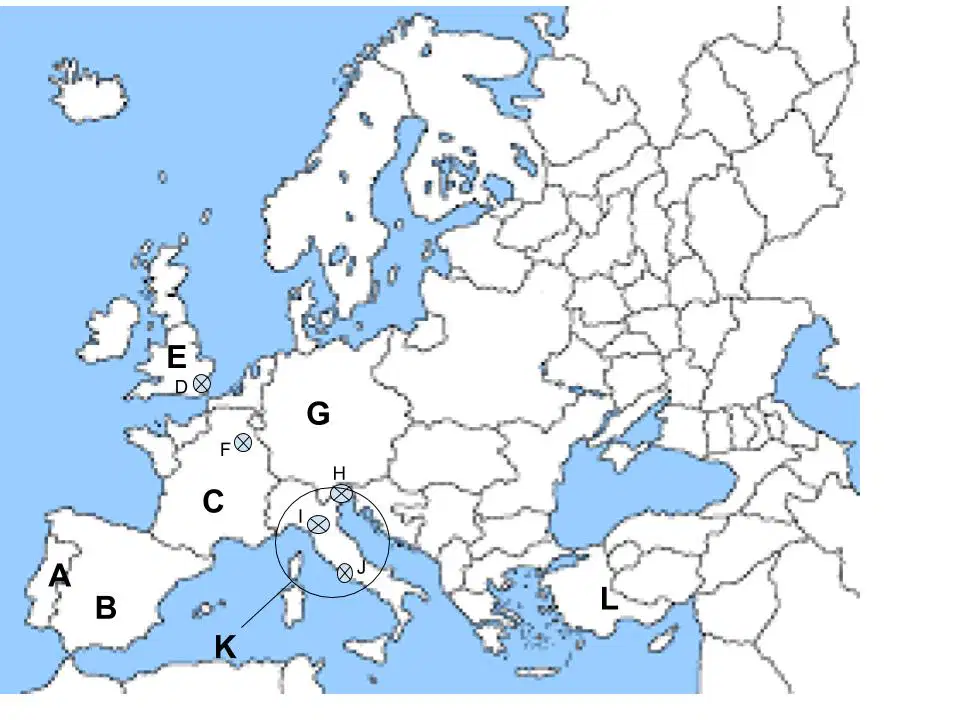
Portugal
a)
A
b)
B
c)
C
d)
D
51.

Holy Roman Empire
a)
G
b)
H
c)
I
d)
J
52.
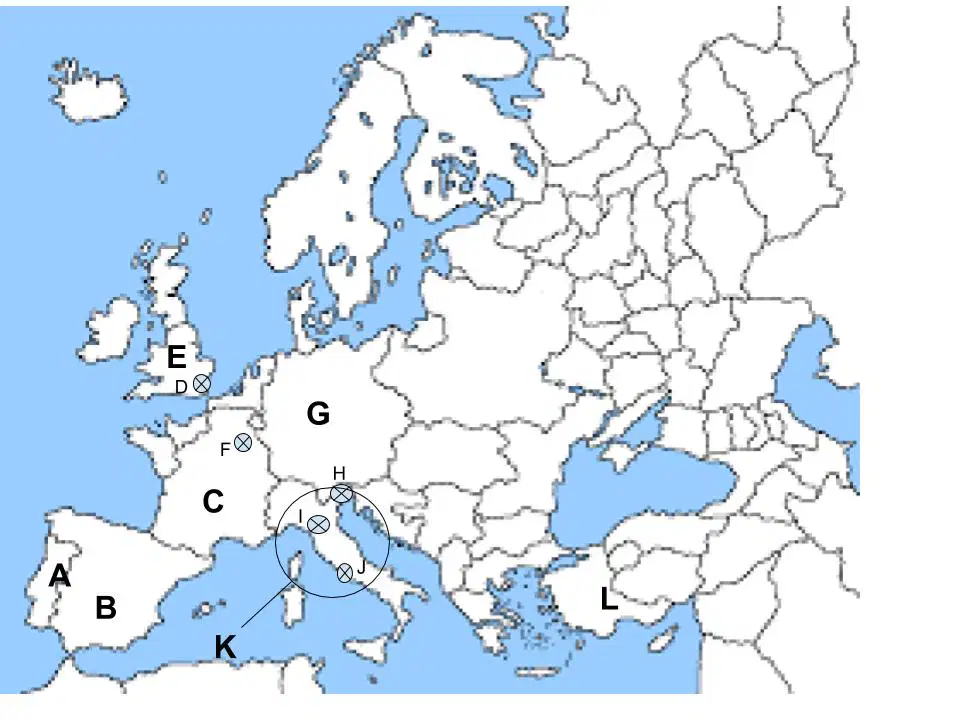
France
a)
A
b)
B
c)
C
d)
D
53.
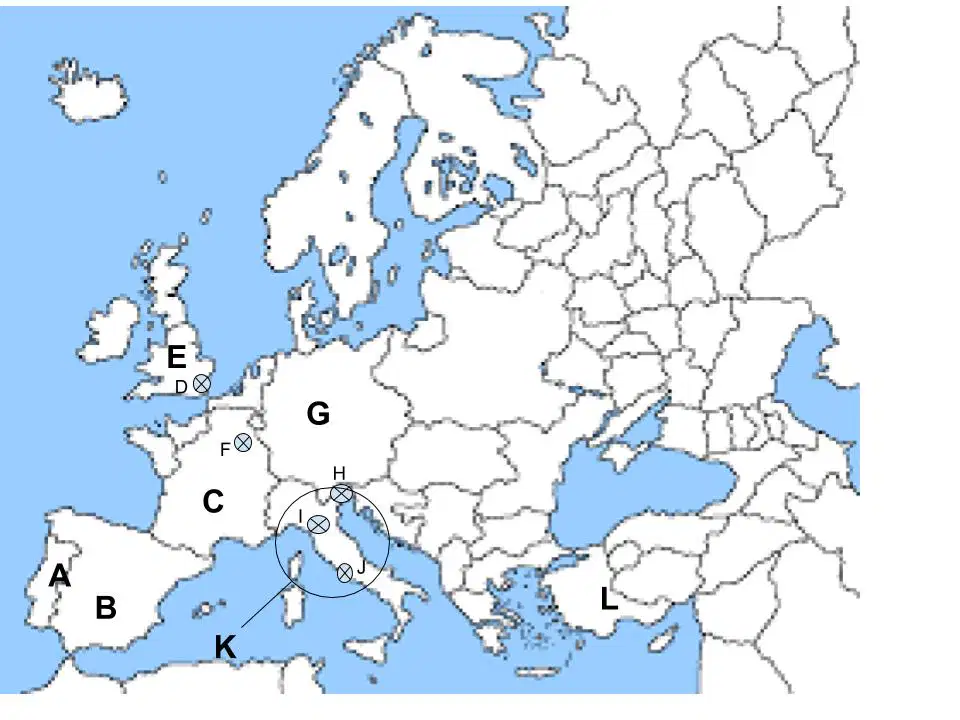
Ottoman Empire
a)
E
b)
L
c)
A
d)
F
54.
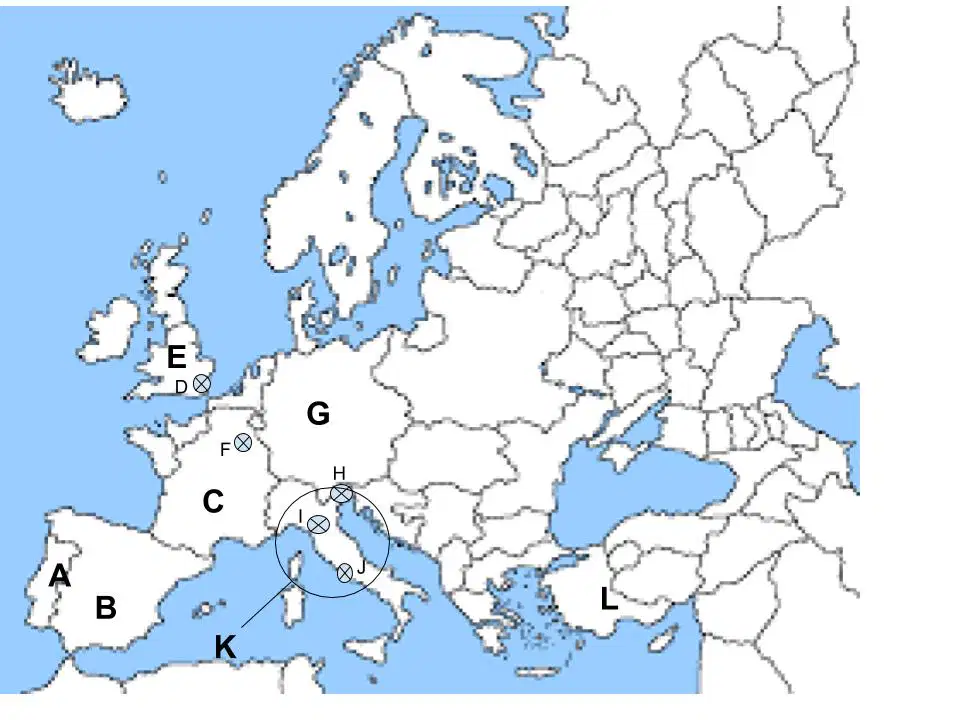
Rome
a)
H
b)
I
c)
J
d)
K
55.
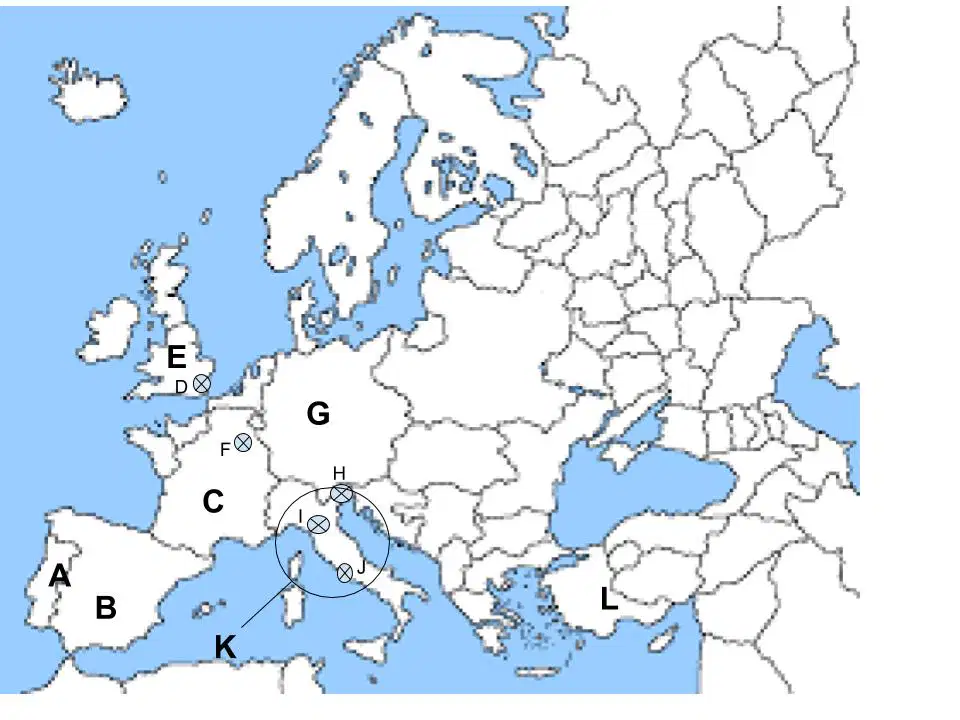
Spain
a)
A
b)
B
c)
C
d)
D
56.
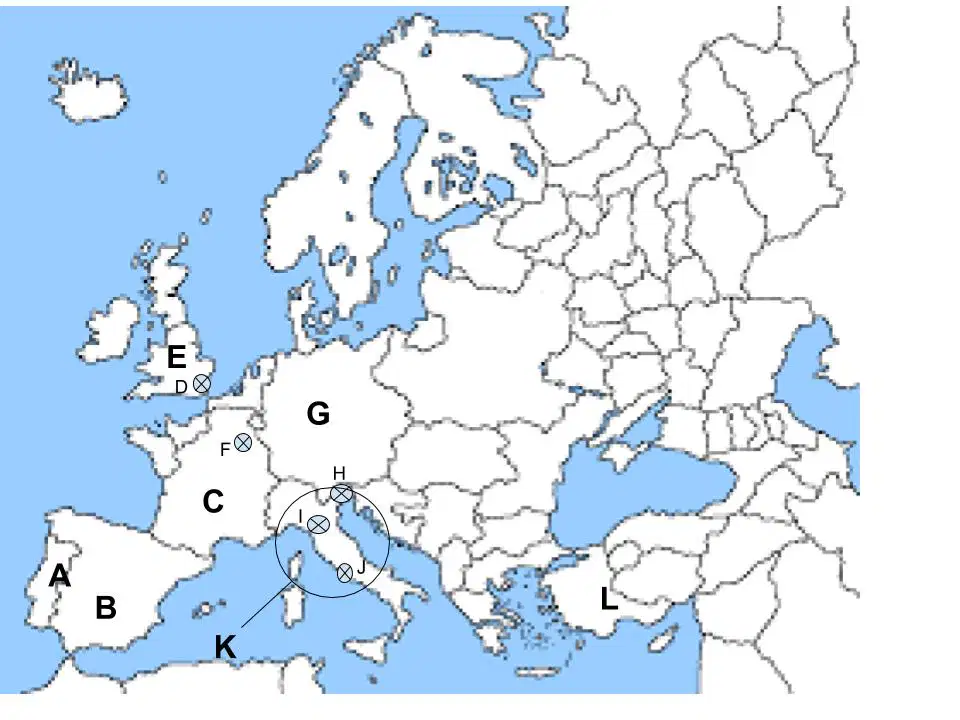
England
a)
B
b)
E
c)
G
d)
M
57.
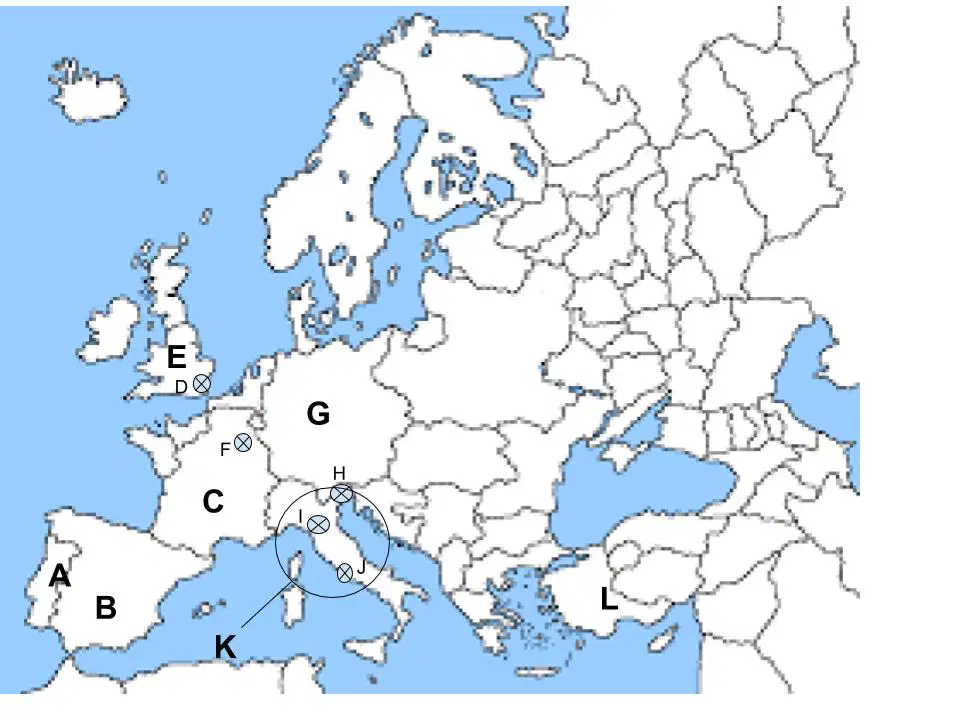
The Papal States
a)
K
b)
J
c)
L
d)
A
100 %

