
 Worksheets
Study Guide- Intro to Polynomials
Total questions: 69
Worksheet time: 2hrs 9mins
Match each polynomial to its factored form:
x2+5x+4
(x+4)(x+1)
x2−5x+4
(x-4)(x-1)
x2+3x−4
(x+4)(x-1)
x2−3x−4
(x-4)(x+1)
Match the following functions with their zeros and multiplicities.
f(x)=(x−3)2(x+1)
x=3 multi 2 touch,
x=-1 multi 1 cross
f(x)=(x−3)(x+1)
x=3 multi 1 cross,
x=-1 multi 1 cross
f(x)=x(x+3)2(x+1)2
x=0 multi 1,
x=-3 multi 2 ,
x=-1 multi 1
f(x)=x2(x−3)2(x−1)
x=0 multi 2,
x=3 multi 2
x=1 multi 1
f(x)=(x−3)(x+1)2
x=3 multi 1 cross,
x=-1 multi 2 touch
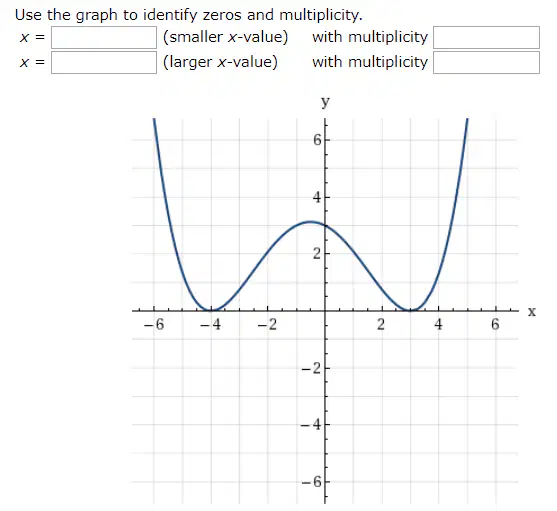
What are the zeros?
x= -4, 3, 4
x= -4, -4, 3, 4
x = -4, 3
x= -4, -4, 3, 3
What is another name for an x-intercept?
Parabola/Quadratic
Root/Zeros
Asymptotes/Zeros
Quadratic/Root
y = x(x - 6)(x + 5)
0, 6, -5
cross cross cross
6, -5
cross cross
0, -6, 5
cross cross cross
1, -6, 5
cross cross cross
zeros of the polynomial
y = 3(x + 4)(x + 1)(x - 3)?
Find and select each real zero and its multiplicity
Zeros: – 5(multiplicity of 3), 9(multiplicity of 2), – 2, 4 with Degree: 7

y = (x + 2)(x - 7)3
Which one of these are not a zero of f(x)=x2(x−1)2(x+5) ?
0
1
-5
-1
What is the multiplicity of the zero x=1 for the function f(x)=x2(x−1)4(x+5) ?
2
1
4
3
What is the multiplicity of the zero x=-5 for the function f(x)=x2(x−1)4(x+5) ?
1
2
3
4
A polynomial function has zeros at -1,2, and 7 (all multiplicity of 1). Write a function rule that could represent this function.
f(x)=(x+1)(x−2)(x−7)
f(x)=(x−1)(x+2)(x+7)
f(x)=(x+1)2(x−2)2(x−7)2
f(x)=(x−1)2(x+2)2(x+7)2
A polynomial function has zeros at 5 (multiplicity 2), 3 (multiplicity 1), and 0 (multiplicity 4). Write a function rule that could represent this function.
f(x)=x4(x−5)2(x−3)
f(x)=x4(x+5)2(x+3)
f(x)=x(x−5)4(x−3)2
f(x)=x(x+5)2(x+3)4
If the graph of a function crosses the x-axis, what does that mean about the multiplicity of that zero?
Even
Odd
None
If the there is a turning point on the x-axis, what does that mean about the multiplicity of that zero?
Even
Odd
None
Find and select each real zero and its multiplicity
Zeros: – 5(multiplicity of 3), 9(multiplicity of 2), – 2, 4 with Degree: 7

Select ALL the zeros of the equation.
-7
0
-5
-6
Even Multiplicities have which of the following effects on the x-axis?
touches and bounces back
wiggle
crosses the x-axis
Which one of these are not a zero of f(x)=−2x(3x+1)2(x+7)7
-2
0
−31
-7
How does a multiplicity of 2 affect the graph?
cross
bounce
wiggle (change direction)
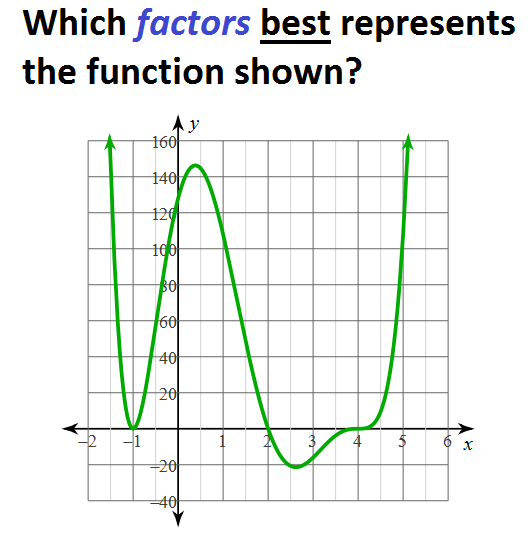
f(x)= x3(x + 3)2(x – 5)
What is the multiplicity of an x-intercept?
The highest exponent of a polynomial
The number of different factors
The exponent of the factor corresponding to that x-intercept
The number in front of a polynomial
Given f(x) = (2x +6)7(x−3)4 ,
what is the multiplicity of the x-intercept x=−3 ?
7
2
6
4

Find the incorrect statement
This function crosses the x-axis at 3
This function is tangent to the x-axis at −4
This function crosses the x-axis at −2
This function crosses the x-axis at 1
State the x-intercepts and whether they will cross or touch the x-axis.
f(x)=3(x–2)(x+5)(x+1)
3 cross, 2 cross, -5 cross, -1 cross
2 cross, -5 cross, -1 cross
3 cross, 2 touch, -5 cross, -1 cross
-2 cross, 5 cross, 1 cross
State the x-intercepts and whether they will cross or touch the x-axis.
y=-4x(x+3)2
4 cross, 0 cross, -3 touch
4 cross, -3 touch
0 cross, -3 touch
4 touch, -3 cross
State the x-intercepts and whether they will cross or touch the x-axis.
f(x)=(x+2)3(x–6)4(x2+3)
-2 cross, 6 touch, -3 touch
-2 cross, 6 touch
-2 cross, 6 touch, -3 cross
-2 touch, 6 touch
y = x(x - 6)(x + 5)
0 cross , 6 cross , -5 cross
6 cross , -5 cross
0 cross, 6 touch, 5 cross
0 cross , 6 touch , -5 cross
Find the incorrect statement
This function crosses the x-axis at 3
This function is tangent to (touches) the x-axis at −4
This function crosses the x-axis at −2
This function crosses the x-axis at 1

Which function might have the given graph?
f(x) = (x - 6)(x + 4)2
f(x) = (x - 6)2(x + 4)
f(x) = (x + 6)2(x - 4)
f(x) = x(x - 6)(x + 4)
How does a multiplicity of 2 affect the graph?
cross
bounce (touches)
wiggle (change direction)
c + 8c3 - 3c7
Match the following End Behavior to their Graphs

Degree is Odd, Leading Coefficient is Negative

Degree is Odd, Leading Coefficient is Positive

Degree is Even, Leading Coefficient is Negative

Degree is Even, Leading Coefficient is Positive


Identify the degree of the polynomial and the sign of the leading coefficient
Leading Coefficient Positive
Degree - Even
Leading Coefficient Positive
Degree - Odd
Leading Coefficient Negative
Degree - Even
Leading Coefficient Negative
Degree - Odd

Identify the degree of the polynomial and the sign of the leading coefficient
Leading Coefficient Positive
Degree - Even
Leading Coefficient Positive
Degree - Odd
Leading Coefficient Negative
Degree - Even
Leading Coefficient Negative
Degree - Odd

Identify the degree of the polynomial and the sign of the leading coefficient
Degree - Even
Degree - Odd
Degree - Even
Degree - Odd

Identify the degree of the polynomial and the sign of the leading coefficient
Leading Coefficient Positive
Degree - Even
Leading Coefficient Positive
Degree - Odd
Leading Coefficient Negative
Degree - Even
Leading Coefficient Negative
Degree - Odd
y = 4x10
y = -6x + 4 + 9x3

As x --> -∞, f(x) --> ____
As x --> +∞, f(x) --> ____
-∞
-∞
+∞
+∞

As x --> -∞, f(x) --> ____
As x --> +∞, f(x) --> ____
-∞
-∞
+∞
+∞

Determine the end behavior of the graph of
f(x) = 3x4 + 2x - 5
As x →∞, f(x) →∞.
As x→-∞, f(x) →-∞.
As x →∞, f(x) →∞.
As x→-∞, f(x) →∞.
As x →∞, f(x) →-∞.
As x→-∞, f(x) →∞.
As x →∞, f(x) →-∞.
As x→-∞, f(x) →-∞.
What is the end behavior of
f(x)=4x5−3x4+6x−3 ?
up, up
down, down
up, down
down, up
What is the end behavior of
f(x) = −3x4+6x3−7x2+3x ?
up, up
down, down
up, down
down, up
What is the end behavior of
y = −4x7−8x4+2 ?
up, up
down, down
up, down
down, up
What is the end behavior of
y = 9x6+x3+3x2−3 ?
up, up
down, down
up, down
down, up
What is the end behavior of
y = −5x3+5x2+3x−7 ?
up, up
down, down
up, down
down, up
What is the end behavior of odd degree polynomial functions?
The ends point in opposite directions
The graph is always a parabola
The ends point in the same direction
The graph is always a straight line
What is the end behavior of even degree polynomial functions?
The graph is always a parabola
The ends point in opposite directions
The graph is always a straight line
The ends point in the same direction
What is the degree of the polynomial:
f(x) = 3x2 + 4x - 5
P(x)=3x4-7x2-2x7-x+4?

The two parts of the equation that determine the end behavior are...(select both)
Degree (even/odd)
Leading coefficient (positive/negative)
X-intercepts (positive/negative)
Number of terms (even/odd)

What is the leading coefficient?
Positive
Negative

What is the leading coefficient?
Positive
Negative

What is the degree?
Odd
Even

What is the degree?
Odd
Even
What is the leading coefficient?
Positive
Negative
Given f(x)=3x2−4x4+2x+1 .
What is the leading term of the polynomial?
3
3x2
-4
−4x4

Which equation MOST LIKELY matches the graph?
y = x4 - x3 + 3x2 + 2
y = -x4 + x3 + 5x + 2
y = x3 - 2x2 + 1x + 3
y = -x3 - 2x2 + 1x + 3

