
 Worksheets
Transformations in Geometry Unit 1 review
Total questions: 66
Worksheet time: 3hrs 19mins

Describe the reflection.
Reflect over the x-axis
Reflect over the y-axis
Reflect 180 degrees
Reflect over the origin

Describe the transformation in the image
Translation
Reflection
Rotation

Zach and Naomi are studying geometric transformations. Zach is able to move the triangle A to A′ using the following sequence of basic transformations:
1. Reflection across the x-axis.
2. Reflection across the y-axis.
3. Translation two units to the right.
Naomi claims that the same three transformations, done in any order will always produce the same result. Zach disagrees. Who is correct?
Zach
Naomi
Both are correct
Both are incorrect

If P is the pre-image and Q the image, select the correct segment that translates P to Q.


Select the correct rotation.
Rotate around the given point 180 degrees.
Rotate around the given point 90 degrees clockwise.
Rotate around the given point 90 degrees counterclockwise.
Rotate around the given point 270 degrees clockwise.
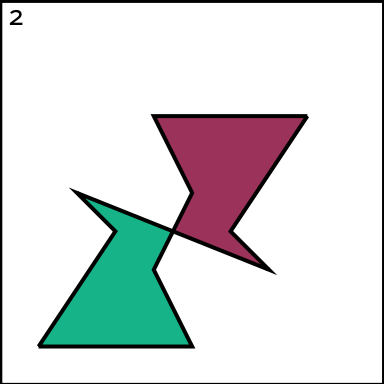
Describe the rotation.
Rotate the figure around the given point 90 degrees counterclockwise.
Rotate the figure around the given point 90 degrees clockwise.
Rotate the figure around the given point 180 degrees.

Identify the transformation from ABC to A'B'C'.
90o clockwise rotation
90o counter clockwise rotation
Reflection across the y-axis
Reflection across the x-axis

Which of the following BEST describes the transformation?
TRANSLATE 5 units down
REFLECT over the x-axis
ROTATE 90 degrees clockwise
None of these

How do you get from the red triangle to the orange triangle?
reflection over the y-axis and then the x-axis
rotate 270 degrees and reflect over y = 2
reflection over the y-axis and translate up 7
rotate 180 degrees and reflect over y = 2
translate up 7, translate right 6, and then reflect over the x-axis

How do you get from the green triangle to the orange triangle?
rotate clockwise 90 degrees
rotate counterclockwise 180 degrees
translate right 11 and up 9, then translate down 3 and left 2
translate right 12 and up 4
reflect over the y-axis then the x-axis

How do you get from the blue triangle to the red triangle?
reflection over y = 2, translate right 5
rotate 180 degrees
rotate 270 degrees
translate right 5 and reflect over the y-axis
do the cha cha slide

Choose the correct transformations
rotate 90 degrees counter-clockwise around the origin, and then reflect over the x-axis
right 1, down 4, and then reflection over the y-axis
right 6, and then reflection over the x-axis
reflection over the line y=x, and then translate up 4, right 2

What is the sequence of transformations?
Reflect over the y then reflect over the x
Reflect over the x then reflect over the y
Translate 4 units then rotate 90˚
Rotate 90˚ then reflect over the x

What is the transformation shown?
Rotation 90 degrees clockwise
Reflection over y= -1
Reflection over x-axis
Reflection over x= -1

Name this transformation
Translation
Rotation
Reflection

Identify the transformation from ABC to A'B'C'.
Reflection across the x-axis
Reflection across the y-axis
90o clockwise rotation
90o counterclockwise rotation


Which answer shows a reflection across the x-axis?
d
c
b
a

If you were to rotate ABCD 90° counterclockwise about the origin, what would the coordinate of A' be?
(-5, 5)
(-3, 5)
(-5, 3)
(-3, 3)

Find K' if the figure is reflected across the x-axis
(4, 1))
(-1, -4)
(1, -4)
(1, 4)

What is the definition of a translation?
To slide up, down, left, or right.
To flip.
To make a circular movement around a point.
To mirror.

Is the quadrilateral a parallelogram?
Yes; one pair of opposite sides are parallel
Yes; one pair of opposite sides are congruent
Yes; one pair of opposite sides are parallel and congruent
No; only one pair of sides are parallel
No; only one pair of sides are congruent

Polygon ABCD is a Quadrilateral which of the following pieces of information would prove that ABCD is a parallelogram?
DB=AC
DA=BC
DA||BC
DA||BC, DA=BC
Which statement best describes a trapezoid?
It is a parallelogram with all sides equal in length.
It is a quadrilateral with three obtuse angles.
It is a quadrilateral with one pair of parallel sides.
It is a triangle with one acute angle.

Trapezoid
Rhombus
Rectangle
Parallelogram


Symmetrical?
Is symmetrical
not symmetrical


How many lines of symmetries does the regular polygon have?
1
3
6
7

What is the smallest degree of rotational symmetry?
90°
45°
60°
120°

What is the smallest degree of rotational symmetry?
90°
72°
60°
40°

Find the value of "c"
c = 8
c = 10
c = √52
c = √20

What is the length of the hypotenuse in the triangle shown?
3
4
5
8


Find the distance.
7.1
7.8
(6, 4.5)
(2.5, 8)

What is the distance between the two points?
6.3
6.5
6.7
16

What is the distance between point A and point B on the coordinate plane?
5
6
10
14

Find the distance between J and K.
8.2
7.7
9
10.2

What is the slope of this graph?
1/2
2
2/2
2/4


Write the equation of the line in slope-intercept form.
y = (-2/3)x + 4
y = (2/3)x + 4
y = (3/2)x + 4
y = (-3/2)x + 4


Which is the correct graph for the equation:


Which is the correct graph for the equation:



