
 Worksheets
Q2 Benchmark 24-25
Total questions: 70
Worksheet time: 2hrs 42mins
Associated with transform boundaries.
Volcanoes
mountains
trenches
earthquakes-faults


At which of these boundaries would you find a deep sea trench?
transform
divergent
oceanic-oceanic convergent
Who proposed the theory of continental drift?
Alfred Wegener
Isaac Newton
Marie Curie
Charles Darwin
What is the name of the supercontinent that existed about 300 million years ago, which later broke apart to form the current continents?
Atlantis
Laurasia
Gondwana
Pangaea
What are the three types of plate boundaries?
Divergent boundaries, convergent boundaries, and transform boundaries
Subduction boundaries, collision boundaries, and sliding boundaries
Tectonic boundaries, fault boundaries, and rift boundaries
Oceanic boundaries, continental boundaries, and island boundaries
Which type of plate boundary occurs when two plates move away from each other?
Transform plate boundary
Divergent plate boundary
Convergent plate boundary
Subduction plate boundary
Which type of plate boundary occurs when two plates collide and one is forced beneath the other?
Subduction plate boundary
Convergent plate boundary
Transform plate boundary
Divergent plate boundary
Which type of plate boundary occurs when two plates slide past each other horizontally?
convergent plate boundary
divergent plate boundary
subduction plate boundary
transform plate boundary
What is the term for the shaking or trembling of the Earth's surface caused by the sudden release of energy in the Earth's crust?
ground shaking
tremor
seismic activity
earthquake
Which layers of the earth make up the lithosphere?
Upper mantle and crust
continental and oceanic crust
Mantle, crust, outer core
Inner core and outer core
Which best describes the relationship between depth into the earth and temperature/density/pressure?
As depth into the earth increases temperature, density, and pressure decrease.
As depth into the earth increases temperature, density, and pressure increase.
As depth into the earth decreases temperature, density, and pressure increase.
As depth into the earth increases temperature and density increases but pressure decreases.

What is the energy source for convection currents in the asthenosphere?
Geothermal heat
Heat from the sun that permeates through earth's crust
Heat from the core
Earth's magnetic field

Which type of crust is denser; continental crust or oceanic crust?
Continental crust
Oceanic Crust

Why does oceanic crust subduct below continental crust?
Continental crust is denser than oceanic crust
Oceanic crust is more drawn to earth's iron core
Oceanic crust is denser than continental crust
Oceanic crust is further below continental crust so it's the first to subduct

Where do volcanoes tend to form?
Hotter area's of the earth
Geothermal vents
Island chains
Subduction zones
Which of these is not a geological event due to the movement of tectonic plates?
Deltas forming
Volcanoes
Earthquakes
Mountain forming
Why do volcanoes form at subduction zones and not other boundaries?
Convergent boundaries produce infant volcanoes that are destroyed before they can release magma.
At subduction zones the dense oceanic crust melts, becomes less dense, and rises to the surface as hot magma
Transform boundaries are when tectonic plates slide past each other creating too much energy that would destroy volcano formation

Why would fossils of the same type of land animal be found on two continents separated by an ocean?
Early humans brought plant and animal specimens between continents
Over time the land animals evolved flippers, gills, and other aquatic body parts to swim to the other continent
The continents were once together in Pangea
The environments the fossils were found in are similar. Therefore they created the same types of animals.
Why does magma rise in convection currents when it's heated up and sink when it cools down?
When magma heats up it become less dense which causes it to rise.
When magma heats up it becomes attracted to the oceanic crust on the surface
When magma cool off it becomes more attracted to earth's core so it sinks
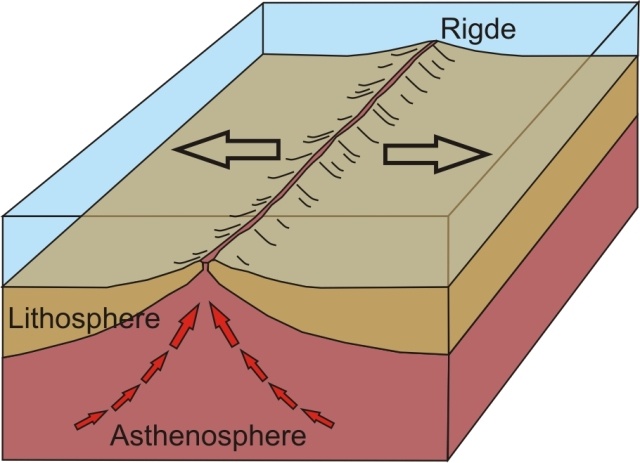


The area around the pacific plate where boundaries form is called...
death ring
fire zone
ring of fire
zone of fire

Why did other scientists have a hard time believing Wegener's theory of continental drift?
He could not explain how the continents moved
He didn't have enough evidence
His evidence was wrong
He didn't use the right technology to gather data
The Appalachian Mountains in the U.S. match up with a similar mountain range in Northern Europe. How does this support Wegener's theory of Continental Drift?
The similarities provide evidence that North America and Europe were connected when the mountains formed.
The similarities show that the continents must have been closer to the equator at some point in time.
This does not provide any evidence to support his theory.

What are the 3 main layers of the Earth?
Atmosphere, Hydrosphere, Biosphere
Crust, Mantle, Core
Rock, Magma, Ocean
Top, Middle, Bottom

What is the thinnest layer of the Earth?
Crust
Mantle
Outer Core
Inner Core

What is the thickest layer of the Earth?
Crust
Mantle
Outer Core
Inner Core

Which layer of the Earth is liquid Iron and Nickle?
Crust
Mantle
Outer Core
Inner Core

Which layer of the Earth is a dense solid ball of Iron and Nickle?
Crust
Mantle
Outer Core
Inner Core

The soft part of the Mantle below the Lithosphere is called the:
Crust
Lithosphere
Asthenosphere
Core

The rigid rocky layer of the crust and upper mantle is called the:
Asthenosphere
Lithosphere
Core

What layer of the Earth is represented by the letter A?
Crust
Mantle
Outer Core
Inner Core

What layer of the Earth is represented by the letter B?
Crust
Mantle
Outer Core
Inner Core

What layer of the Earth is represented by the letter C?
Crust
Mantle
Outer Core
Inner Core

What layer of the Earth is represented by the letter D?
Crust
Mantle
Outer Core
Inner Core

The most dense layer of the Earth is:
Crust
Mantle
Core
The Lithosphere is made up of the ___________.
Crust and Upper Mantle
Inner and Outer Cores
Outer Core and Lower Mantle
Lower and Middle Mantle
What are convection currents?
the cycle of heated rock or metal rising, and cooling rock or metal falling.
the cycle of cooling rock or metal rising, and heated rock or metal falling.
an electric current found in the mantle.
and electric current found in the outer core.
What is the Asthenosphere?
an elastic substance on which the tectonic plates float.
the air that we breathe.
another name for a globe.
the hard inner core

Temperature _____________________ as you go deeper into the earth.
increases
decreases
goes up and down depending on the layer
stays the same
Pressure ______________________ as you go deeper into the Earth.
increases
decreases
goes up or down depending on the layer
stays the same
Density ______________________ as you go deeper into the Earth.
increases
decreases
goes up or down depending on the layer
stays the same
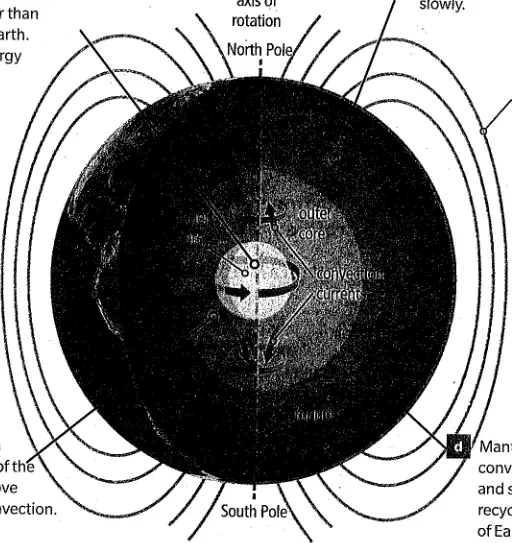
What is the primary reason Earth's magnetic field is generated?
Permanent solid magnet deep inside Earth
Motion of liquid iron in the outer core
Static layers of Earth's interior
Conduction of thermal energy in the mantle
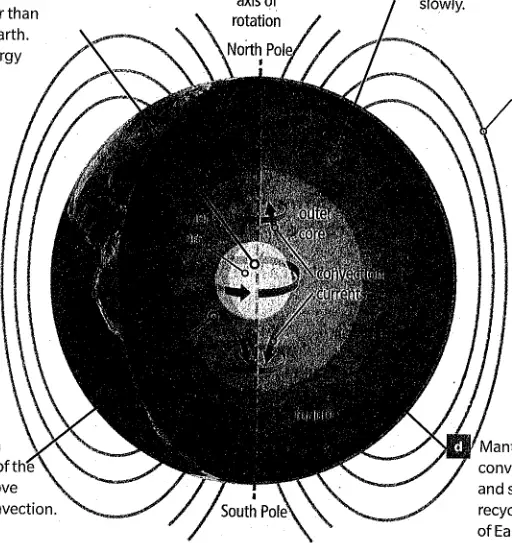
What happens to Earth's magnetic field every few hundred thousand years?
It disappears completely
It reverses orientation
It becomes stronger permanently
It moves to the mantle
Oceanic crust is mostly made of _________________ (type of rock)
Basalt
Granite
Obsidian
Sandstone
Continental crust is mostly made of _________________ (type of rock)
Basalt
Granite
Obsidian
Sandstone
Select a piece of evidence used to support the idea of Sea Floor Spreading. (Select all that apply)
Magnetic Reversals
The shape of Africa and South America
Island Volcanic Arcs (Such as Japan)
Age of the rocks on the Ocean Floor

