
 Worksheets
Quiz on Layered Tasks and Communication
Total questions: 95
Worksheet time: 48mins
What concept is highlighted in the section "Layered Tasks" as being used in our daily life?
Layers
Communication
Postal Services
Complexity
In the example provided, what service is mentioned as simplifying the process of sending a letter to a friend?
Postal mail
Courier services
Telephone
Which topics are discussed in this section of the learning material?
Sender, Receiver, and Carrier Hierarchy
Postal Services and Communication
Layers and Complexity
Communication and Technology
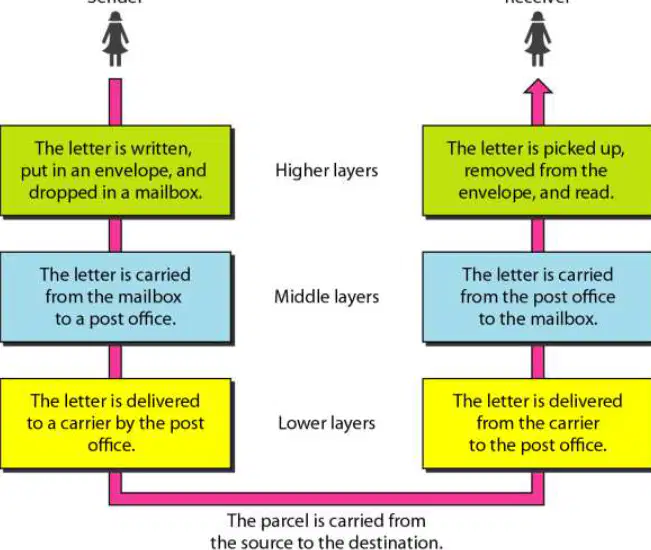
What is the first step in the process of sending a letter?
The letter is carried from the mailbox to a post office.
The letter is written, put in an envelope, and dropped in a mailbox.
The letter is delivered to a carrier by the post office.
The letter is picked up, removed from the envelope, and read.
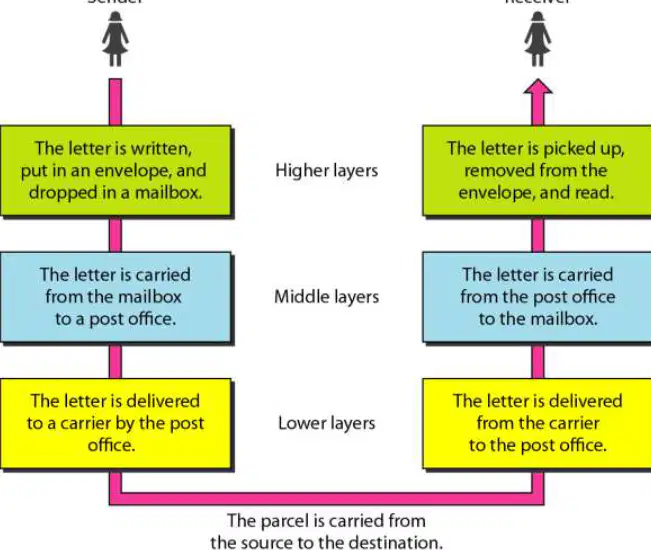
What happens in the middle layer of the process of sending a letter?
The letter is carried from the mailbox to a post office.
The letter is delivered to a carrier by the post office.
The letter is carried from the post office to the mailbox.
The letter is picked up, removed from the envelope, and read.
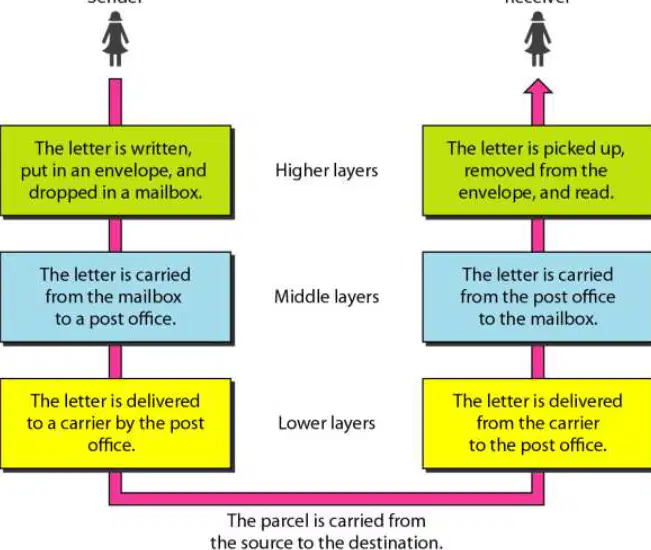
In the lower layer of the process, what happens to the letter?
The letter is delivered to a carrier by the post office.
The letter is carried from the mailbox to a post office.
The letter is picked up, removed from the envelope, and read.
The letter is carried from the post office to the mailbox.
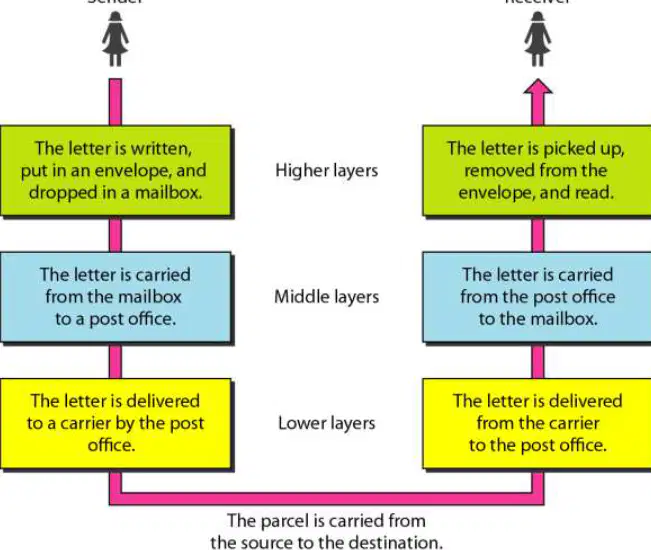
What is the final step in the process of sending a letter?
The letter is delivered to a carrier by the post office.
The letter is carried from the mailbox to a post office.
The letter is picked up, removed from the envelope, and read.
The letter is carried from the post office to the mailbox.
What does the acronym ISO stand for?
International Standards Organization
International Systems Organization
International Security Organization
International Software Organization
What is the purpose of the International Standards Organization (ISO)?
To create software for network communication
To establish worldwide agreement on international standards
To regulate internet usage globally
To develop hardware for communication systems
What does the OSI model stand for?
Open Systems Interconnection
Operational Systems Integration
Online Systems Interconnection
Open Software Integration
When was the OSI model first introduced?
Early 1960s
Late 1970s
Mid 1980s
Early 1990s
Which of the following topics is NOT discussed in this section?
Layered Architecture
Peer-to-Peer Processes
Encapsulation
Network Security
What does ISO represent in the context of networking?
A model for network communication
An organization responsible for standards
A protocol for data transfer
A type of network topology
What does OSI represent in the context of networking?
An organization responsible for standards
A protocol for data transfer
A model for network communication
A type of network topology
Which of the following statements is correct?
OSI is the organization, and ISO is the model.
ISO is the organization, and OSI is the model.
Both ISO and OSI are models.
Both ISO and OSI are organizations.
Which layer of the OSI model is responsible for the physical connection between devices?
Application
Transport
Physical
Network
What is the primary function of the Transport layer in the OSI model?
To manage data formatting and encryption
To ensure reliable data transfer between devices
To establish and terminate communication sessions
To route data packets between networks
At which layer of the OSI model does data encryption typically occur?
Physical
Presentation
Network
Data Link
Which layer of the OSI model is responsible for managing communication sessions between applications?
Session
Application
Transport
Data Link
What is the correct order of the OSI model layers from top to bottom?
Application, Presentation, Session, Transport, Network, Data Link, Physical
Physical, Data Link, Network, Transport, Session, Presentation, Application
Application, Session, Presentation, Transport, Network, Data Link, Physical
Physical, Network, Data Link, Transport, Session, Presentation, Application
Which layer of the OSI model is responsible for establishing, managing, and terminating sessions between applications?
Application layer
Session layer
Transport layer
Network layer
Which layer of the OSI model is responsible for the physical communication between devices?
Data Link layer
Physical layer
Network layer
Transport layer
What is the role of the Application layer (Layer 7) in the OSI model?
Provides user interfaces and application services.
Manages data encryption and decryption.
Routes data packets across networks.
Ensures error-free data transmission.
Which layer of the OSI model is responsible for data formatting and encryption?
Network layer
Presentation layer
Transport layer
Session layer
What is the correct sequence of the OSI model layers from top to bottom?
Application, Presentation, Session, Transport, Network, Data Link, Physical
Physical, Data Link, Network, Transport, Session, Presentation, Application
Application, Session, Presentation, Transport, Network, Data Link, Physical
Physical, Network, Data Link, Transport, Session, Presentation, Application
What does the diagram in Figure 2.4 represent?
The process of data encryption
An exchange using the OSI model
The structure of a computer's hardware
The process of software installation
In the OSI model, which layer is responsible for the physical transmission of data?
Application layer
Transport layer
Physical layer
Session layer
What is the primary purpose of the OSI model in networking?
To define hardware specifications
To standardize communication between different systems
To create software applications
To manage user accounts
Which layer of the OSI model is responsible for ensuring data is error-free and properly sequenced?
Network layer
Transport layer
Data link layer
Application layer
In the OSI model, what does the "H" in the diagram represent?
Hardware components
Headers added at each layer
Host systems
Hexadecimal values
Which of the following is the first layer in the OSI model?
Physical Layer
Data Link Layer
Network Layer
Application Layer
What is the primary focus of the section titled "Layers in the OSI Model"?
To describe the functions of each layer in the OSI model
To explain the history of the OSI model
To compare the OSI model with other network models
To discuss the advantages of the OSI model
Which of the following is NOT a layer in the OSI model?
Transport Layer
Data Link Layer
Encryption Layer
Session Layer
How many layers are there in the OSI model?
5
6
7
8
Which layer in the OSI model is responsible for managing communication sessions?
Session Layer
Network Layer
Data Link Layer
Presentation Layer
What is the primary function of the physical layer in the OSI model?
To manage data encryption and decryption.
To transmit raw binary data over a transmission medium.
To establish logical connections between devices.
To handle error detection and correction.
In the diagram, what type of data is transmitted by the physical layer?
Binary data.
Encrypted data.
Logical addresses.
Application layer data.
Which layer provides data to the physical layer for transmission, as shown in the diagram?
Application layer.
Data link layer.
Network layer.
Transport layer.
What is the primary responsibility of the physical layer in a network?
Managing the logical addressing of devices
Ensuring the delivery of packets to the correct destination
Handling the movement of individual bits from one hop (node) to the next
Managing the encryption and decryption of data
What does the physical layer define in terms of the interface between devices and the transmission medium?
The type of encoding used for signals
The type of transmission medium
The synchronization of sender and receiver clocks
The number of bits sent each second
What is the purpose of the representation of bits in the physical layer?
To define the type of transmission medium
To determine how 0's and 1's are changed to signals
To synchronize the sender and receiver clocks
To connect devices to the medium
Which of the following describes the data rate in the physical layer?
The number of devices connected to the network
The number of bits sent each second
The type of encoding used for signals
The type of transmission medium used
Why is synchronization of bits important in the physical layer?
To define the type of transmission medium
To ensure the sender and receiver clocks are synchronized
To determine the type of encoding used
To connect devices to the medium
What does line configuration in the physical layer refer to?
The type of encoding used for signals
The connection of devices to the medium (point-to-point or multipoint)
The synchronization of sender and receiver clocks
The number of bits sent each second
What does physical topology describe in the physical layer?
How devices are connected to make a network
The type of transmission medium used
The synchronization of sender and receiver clocks
The number of bits sent each second
Which of the following is NOT a transmission mode in the physical layer?
Simplex
Half-duplex
Full-duplex
Multi-duplex
What is the primary function of the Data Link Layer in the OSI model?
To provide end-to-end communication between devices
To format data into frames and handle error detection
To route data packets across networks
To encrypt data for secure transmission
In the Data Link Layer, what are the components of a frame?
Header, Data, and Trailer
Packet, Segment, and Frame
Data, Encryption, and Trailer
Header, Packet, and Segment
Which layer does the Data Link Layer interact with directly above it in the OSI model?
Physical Layer
Transport Layer
Network Layer
Application Layer
What is the primary responsibility of the data link layer in a network?
Managing end-to-end communication between devices
Moving frames from one hop (node) to the next
Encrypting data for secure transmission
Routing packets across multiple networks
What is the purpose of framing in the Data Link Layer?
Controlling the transmission speed of the sender
Dividing the stream of bits into manageable data units called frames
Detecting and retransmitting damaged frames
Defining the sender and/or receiver of the frame
Which function of the Data Link Layer involves defining the sender and/or receiver of the frame?
Framing
Flow Control
Physical Addressing
Error Control
What does flow control in the Data Link Layer manage?
The transmission speed of the sender
The detection of damaged frames
The division of data into frames
The recognition of duplicate frames
Which of the following is a responsibility of error control in the Data Link Layer?
Controlling which device has access to the link
Dividing data into frames
Detecting and retransmitting damaged or lost frames
Controlling the transmission speed of the sender
What does access control in the Data Link Layer determine?
The transmission speed of the sender
Which device has control over the link at any given time
The division of data into frames
The detection of duplicate frames
Diagram showing the functions of the Data Link Layer, including Framing, Physical Addressing, Flow Control, Error Control, and Access Control.
Framing, Physical Addressing, Flow Control, Error Control, and Access Control
Routing, Encryption, Segmentation, Multiplexing, and Compression
Application Management, Presentation Formatting, Session Establishment, Data Translation, and Security
Network Addressing, Packet Forwarding, Congestion Control, Path Selection, and Traffic Shaping
What does the term "hop-to-hop delivery" refer to in the context of the diagram?
The delivery of data from one end system to another end system directly.
The delivery of data between two adjacent nodes in a network.
The delivery of data across multiple networks without intermediate systems.
The delivery of data using only the application layer.
Which layers are involved in hop-to-hop delivery as shown in the diagram?
Application and Transport layers.
Network and Data Link layers.
Data Link and Physical layers.
Transport and Physical layers.
In the diagram, what role does the intermediate system play in hop-to-hop delivery?
It acts as the final destination for data.
It forwards data from one node to the next in the network.
It encrypts data for secure transmission.
It terminates the data transmission process.
What is the primary purpose of the physical layer in hop-to-hop delivery?
To establish logical connections between nodes.
To provide error detection and correction.
To transmit raw bits over a physical medium.
To manage end-to-end communication.
What is the primary function of the network layer in the OSI model?
To provide end-to-end communication and routing of data.
To ensure error-free delivery of data.
To convert data into signals for transmission.
To manage user authentication and encryption.
In the network layer, what is the term used to describe the encapsulated data unit?
Frame
Packet
Segment
Bitstream
What does the "H3" in the diagram represent in the context of the network layer?
The header added by the transport layer.
The header added by the network layer.
The header added by the data link layer.
The header added by the application layer.
Which layer does the network layer interact with to receive data for encapsulation?
Application layer
Data link layer
Transport layer
Physical layer
What is the primary responsibility of the network layer in a network model?
Managing user authentication
Delivering individual packets from the source host to the destination host
Encrypting data for secure transmission
Establishing physical connections between devices
What is the primary purpose of logical addressing in the network layer?
To assign physical addresses to devices
To identify a specific device or host on a network
To route packets to their final destination
To encrypt data for secure communication
How are logical addresses different from physical addresses in networking?
Logical addresses are assigned to hardware, while physical addresses are assigned at the network level
Logical addresses are unique within the network, while physical addresses are not
Logical addresses are assigned at the network level, while physical addresses are assigned to hardware
Logical addresses are used for encryption, while physical addresses are used for routing
What is the function of routing in the network layer?
Adding logical addresses to devices
Encrypting data for secure communication
Routing or switching packets to their final destination
Assigning physical addresses to devices
Which layer of the OSI model is responsible for logical addressing?
Physical layer
Data link layer
Network layer
Transport layer
What does the term "source-to-destination delivery" refer to in the context of the diagram?
The process of delivering data directly between two intermediate systems.
The process of delivering data from one end system to another, passing through intermediate systems.
The process of delivering data within a single physical layer.
The process of delivering data only at the data link layer.
Which layers are involved in the source-to-destination delivery as shown in the diagram?
Network, Data Link, and Physical layers.
Application, Transport, and Network layers.
Data Link, Physical, and Application layers.
Transport, Network, and Physical layers.
What is the role of intermediate systems in source-to-destination delivery?
To directly deliver data to the destination without any processing.
To facilitate hop-to-hop delivery between end systems.
To bypass the network layer and deliver data directly.
To ensure data is delivered only at the physical layer.
In the context of the diagram, what does "hop-to-hop delivery" mean?
Delivery of data from one end system to another without any intermediate systems.
Delivery of data between two adjacent systems in the network.
Delivery of data only at the application layer.
Delivery of data directly to the final destination.
What is the primary function of the transport layer in the OSI model as depicted in the diagram?
To manage the physical transmission of data.
To ensure reliable data transfer between devices.
To define the format of data for presentation.
To establish and terminate sessions.
In the diagram, what does "H4" represent in the transport layer?
A header added by the transport layer.
A data packet from the network layer.
A session layer identifier.
A physical layer signal.
What is the process of dividing data into smaller units called, as shown in the transport layer diagram?
Multiplexing
Segmentation
Encoding
Synchronization
Which layer does the transport layer interact with to receive data for segmentation, as shown in the diagram?
Network layer
Data link layer
Session layer
Physical layer
What is the primary responsibility of the transport layer in a network?
Managing physical connections between devices
Delivering a message from one process to another
Encrypting data for secure transmission
Routing data packets across the network
What is the main function of the transport layer?
To provide reliable data transfer between devices over a network
To manage IP addressing and subnetting
To establish physical connections between devices
To encrypt and decrypt data for security
Which of the following is NOT a responsibility of the transport layer?
Handling flow control
Error handling
Data segmentation
Assigning IP addresses
How does the transport layer ensure reliable data transfer?
By encrypting all data packets
By ensuring data is delivered accurately, completely, and in the correct order
By managing physical connections between devices
By assigning unique IP addresses to devices
What is the purpose of Service-Point Addressing in the transport layer of the OSI model?
To divide a message into segments
To assign a unique port number to each application
To control the flow of data between devices
To ensure error-free communication
Which process involves dividing a message into segments and adding sequence numbers to reassemble it correctly at the destination?
Service-Point Addressing
Connection Control
Segmentation and Reassembly
Error Control
What are the two types of connection control in the transport layer?
Connectionless and connection-oriented
Flow control and error control
Segmentation and reassembly
Service-point addressing and port addressing
What is the primary function of flow control in the transport layer?
To assign unique port numbers
To ensure end-to-end flow control
To divide messages into segments
To reassemble messages at the destination
What does error control in the transport layer ensure?
End-to-end error control
Division of messages into segments
Assignment of port numbers
Connectionless communication
What does the transport layer ensure in the process-to-process delivery of a message?
Host-to-host delivery
Process-to-process delivery
Reliable network connection
Physical data transfer
Which layer is responsible for host-to-host delivery in the given diagram?
Transport layer
Network layer
Application layer
Physical layer
What is the primary role of the network layer as depicted in the diagram?
Process-to-process delivery
Host-to-host delivery
Data encryption
Error detection
In the context of the session layer, what does "syn" represent in the diagram?
Synchronization points.
System notifications.
Session numbers.
Secure network protocols.
Which layer does the session layer interact with directly above it in the OSI model?
Transport layer.
Network layer.
Presentation layer.
Application layer.
What is the role of the session layer in relation to the transport layer?
It establishes, manages, and terminates connections.
It encrypts data for secure transmission.
It determines the best path for data packets.
It compresses data for efficient transmission.
What is the primary responsibility of the session layer in a network?
Managing physical connections between devices
Dialog control and synchronization
Encrypting and decrypting data
Routing data packets across networks
What is the main function of the session layer?
To provide reliable data transfer between devices over a network
To compress data for efficient transmission
To establish physical connections between devices
To manage IP addressing and routing
Which of the following tasks is NOT ensured by the session layer?
Handling flow control
Error handling
Data segmentation
Encrypting data for security

