
 Worksheets
APAH Study P3
Total questions: 99
Worksheet time: 52mins
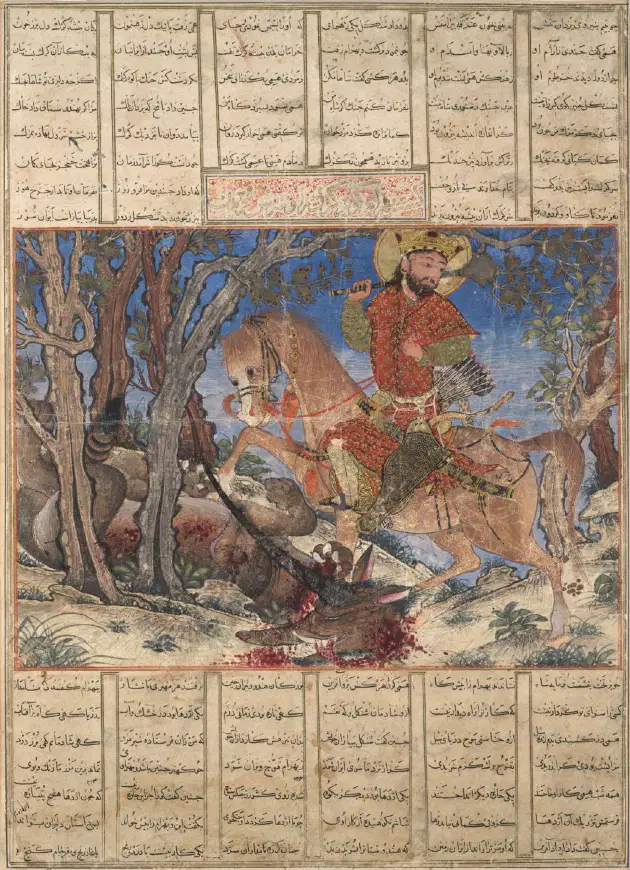
What is the title of the artwork shown in the image?
Bahram Gur Fights the Karg
The Great Ilkhanid Shahnameh
Persian Folio
Ink and Opaque Watercolor

From which manuscript is the folio 'Bahram Gur Fights the Karg' taken?
The Great Ilkhanid Shahnama
Persian Folio
Book of Kings
Shahnameh of Ferdowsi

Fill in the blank: The artwork 'Bahram Gur Fights the Karg' is ______ in origin.
Persian
Greek
Egyptian
Chinese

What is the approximate date of creation for 'Bahram Gur Fights the Karg'?
1200-1250 C.E.
1330-1340 C.E.
1400-1450 C.E.
1500-1550 C.E.

Fill in the blank: The medium used in 'Bahram Gur Fights the Karg' includes ink and opaque watercolor, gold and ______ on paper.
silver
bronze
copper
platinum

What is the title of the artwork shown in the image?
The Court of Gayumars
The Garden of Earthly Delights
The Birth of Venus
The Arnolfini Portrait

Who is the artist of 'The Court of Gayumars'?
Sultan Muhammad
Behzad
Reza Abbasi
Mir Sayyid Ali

Which dynasty is associated with 'The Court of Gayumars'?
Safavid dynasty
Mughal dynasty
Ottoman dynasty
Qajar dynasty
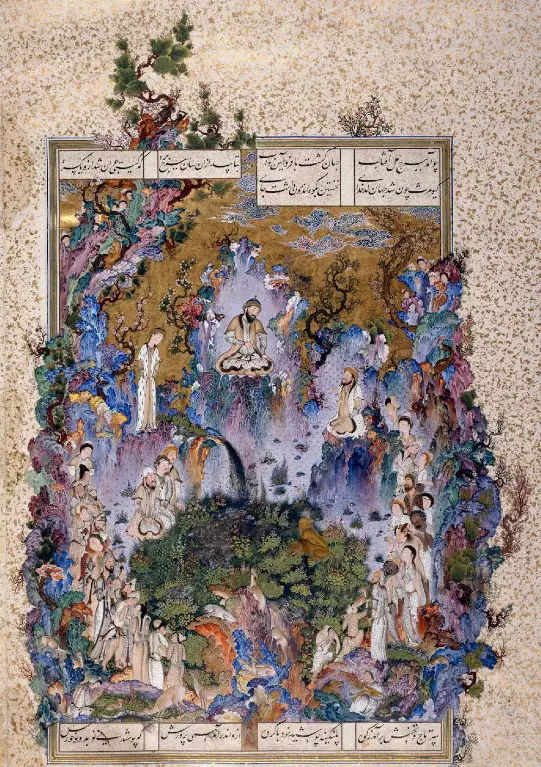
'The Court of Gayumars' is a folio from which manuscript?
Shah Tahmasp’s Shahnama
Baburnama
Akbarnama
Jami al-Tawarikh

When was 'The Court of Gayumars' created?
c. 1522-1525 C.E.
c. 1400-1420 C.E.
c. 1600-1620 C.E.
c. 1700-1720 C.E.
What materials were used to create 'The Court of Gayumars'?
Ink, opaque watercolor and gold on paper
Oil paint on canvas
Tempera on wood panel
Marble and bronze
What is the name of the artifact shown in the image?
Merovingian looped fibulae
Roman brooch
Byzantine necklace
Viking arm ring

In which period were the Merovingian looped fibulae made?
Early Medieval Europe
Renaissance
Ancient Greece
Modern Era

The Merovingian looped fibulae date to the ______ century C.E.
6th
5th
7th
8th
What materials and techniques were used to make the Merovingian looped fibulae?
Silver gilt worked in filigree, with inlays of garnets and other stones
Bronze cast with enamel decoration
Iron forged and painted with tempera
Gold leaf applied over wood with glass beads
What is the title of the illuminated manuscript shown in the images?
Book of Kells
Lindisfarne Gospels
Vienna Genesis
Codex Amiatinus
In which period and region was the Lindisfarne Gospels created?
High Renaissance Italy
Early medieval Europe
Byzantine Empire
Ancient Egypt
The Lindisfarne Gospels were created around the year _____?
700 C.E.
600 C.E.
800 C.E.
900 C.E.
What materials were used to create the Lindisfarne Gospels?
Ink, pigments, and gold on vellum
Papyrus and charcoal
Parchment and oil paints
Wood and tempera
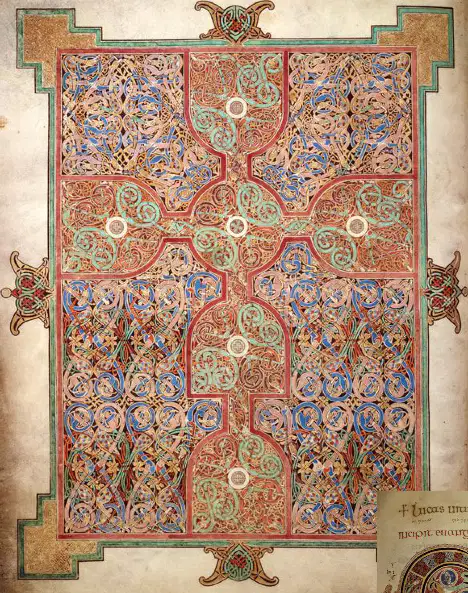
Name one of the specific pages from the Lindisfarne Gospels shown in the images.
The Carpet Page
The Book of Kells Title Page
The Codex Amiatinus Page
The Winchester Bible Illumination

The Church of Sainte-Foy is an example of which architectural style?
Gothic
Romanesque
Baroque
Renaissance

Where is the Church of Sainte-Foy located?
Conques, France
Lyon, France
Rome, Italy
Barcelona, Spain
What is the primary material used in the construction of the Church of Sainte-Foy?
Stone
Wood
Brick
Marble

The Church of Sainte-Foy was constructed around which years?
c. 1050-1130 C.E.
c. 1200-1300 C.E.
c. 900-950 C.E.
c. 1500-1600 C.E.
The Reliquary of Sainte-Foy is made of which materials?
Gold, silver, gemstones and enamel over wood
Bronze, marble, and ivory
Copper, glass, and clay
Iron, wood, and textile
The Reliquary of Sainte-Foy dates to which century?
c. 9th century C.E.
c. 7th century C.E.
c. 12th century C.E.
c. 15th century C.E.

What is the name of the artwork shown in the image?
Bayeux Tapestry
Rosetta Stone
Mona Lisa
Sistine Chapel Ceiling

Which period does the Bayeux Tapestry belong to?
Romanesque Europe
Renaissance
Baroque
Gothic

The Bayeux Tapestry was created around ________ C.E.
1066-1080
800-820
1200-1220
1500-1520

What is the medium used for the Bayeux Tapestry?
Oil on canvas
Embroidery on linen
Fresco
Marble

What is the name of the cathedral shown in the images?
Chartres Cathedral
Notre-Dame Cathedral
Cologne Cathedral
Canterbury Cathedral

In which country is Chartres Cathedral located?
France
Italy
Germany
Spain

Chartres Cathedral is an example of which architectural period?
Gothic Europe
Romanesque
Baroque
Renaissance

What are the primary materials used in the construction of Chartres Cathedral?
Limestone, stained glass
Granite, bronze
Marble, gold leaf
Sandstone, terracotta

When was the original construction of Chartres Cathedral?
c. 1145-55 C.E.
c. 1300-1320 C.E.
c. 900-920 C.E.
c. 1500-1520 C.E.

When was Chartres Cathedral reconstructed?
c. 1194-1220 C.E.
c. 1050-1080 C.E.
c. 1300-1350 C.E.
c. 1400-1450 C.E.
Which famous stained glass window is found in Chartres Cathedral?
Notre Dame de la Belle Verrière window
Rose Window of Sainte-Chapelle
The Tree of Jesse window at York Minster
The Blue Virgin window at Reims Cathedral
What is the title of the artwork shown in the image?
Dedication Page with Blanche of Castile and King Louis IX of France and Scenes from the Apocalypse
The Book of Kells
The Arnolfini Portrait
The Bayeux Tapestry

What type of manuscript is the 'Dedication Page with Blanche of Castile and King Louis IX of France and Scenes from the Apocalypse'?
Bibles moralisées/Moralized bible
Book of Hours
Psalter
Codex Sinaiticus

In which region was the 'Dedication Page with Blanche of Castile and King Louis IX of France and Scenes from the Apocalypse' created?
Byzantine Empire
Gothic Europe
Renaissance Italy
Ancient Egypt

Fill in the blank: The 'Dedication Page with Blanche of Castile and King Louis IX of France and Scenes from the Apocalypse' was created around _________.
1225-1245 C.E.
1100-1120 C.E.
1300-1320 C.E.
1400-1420 C.E.

Which materials were used to create the 'Dedication Page with Blanche of Castile and King Louis IX of France and Scenes from the Apocalypse'?
Oil on canvas
Illuminated manuscript (ink, tempera, and gold leaf on vellum)
Marble
Bronze

What is the title of the artwork shown in the images?
The Book of Kells
Preparation for Passover, Plagues of Egypt, and Scenes of Liberation
The Lindisfarne Gospels
The Vienna Genesis

From which manuscript is the artwork taken?
The Book of Hours
The Golden Haggadah
The Gutenberg Bible
The Codex Amiatinus

In which country was the Golden Haggadah created?
Spain
France
Italy
Germany

Around what year was the Golden Haggadah created?
c. 1320 C.E.
c. 1450 C.E.
c. 1200 C.E.
c. 1550 C.E.

What materials were used to create the Golden Haggadah?
Oil on canvas
Tempera on wood
Pigments and gold leaf on vellum
Ink on papyrus

Who is the artist of the Arena (Scrovegni) Chapel, including Lamentation?
Giotto di Bondone
Leonardo da Vinci
Michelangelo Buonarroti
Raphael Sanzio

In which city and country is the Arena (Scrovegni) Chapel located?
Padua, Italy
Florence, Italy
Venice, Italy
Paris, France

What is the medium used for the artwork in the Arena (Scrovegni) Chapel?
fresco
oil on canvas
tempera on wood
watercolor

What is the approximate date of creation for the Arena (Scrovegni) Chapel, including Lamentation?
c. 1303 C.E.
c. 1200 C.E.
c. 1400 C.E.
c. 1500 C.E.

Which art historical period does the Arena (Scrovegni) Chapel, including Lamentation, belong to?
Proto-Renaissance
Baroque
Impressionism
Romanesque

What is the subject of the fresco depicted in the Arena (Scrovegni) Chapel by Giotto di Bondone?
Lamentation
The Last Supper
The Creation of Adam
The Annunciation

What is the title of the artwork shown in the image?
Röttgen Pietà
Ghent Altarpiece
Arnolfini Portrait
Merode Altarpiece

During which period was the Röttgen Pietà created?
Renaissance
Late medieval Europe
Baroque
Classical Greece

Fill in the blank: The Röttgen Pietà was created around ________ C.E.
1300-1325
1400-1425
1200-1225
1500-1525

What material was used to create the Röttgen Pietà?
Marble
Bronze
Painted wood
Terracotta
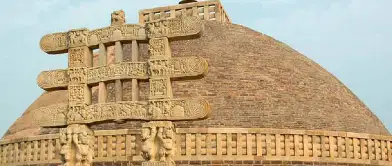
What is the name of the monument shown in the images?
Great Stupa at Sanchi
Taj Mahal
Qutub Minar
Borobudur
Which religious tradition is associated with the Great Stupa at Sanchi?
Hinduism
Buddhism
Jainism
Islam
The Great Stupa at Sanchi was built during which dynasty?
Maurya Dynasty
Gupta Dynasty
Late Sunga Dynasty
Mughal Dynasty
Fill in the blank: The Great Stupa at Sanchi was constructed around _________.
c. 300 B.C.E.-100 C.E.
c. 500 B.C.E.-400 B.C.E.
c. 200 C.E.-400 C.E.
c. 1000 C.E.-1200 C.E.
What materials were used in the construction of the Great Stupa at Sanchi?
Marble and brick
Stone masonry, sandstone on dome
Wood and clay
Concrete and steel
In which country is the Great Stupa at Sanchi located?
Nepal
Sri Lanka
India
Thailand
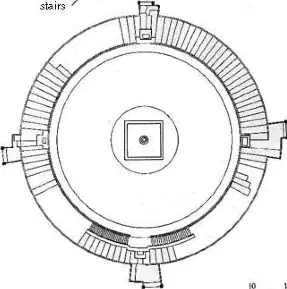
Fill in the blank: The architectural plan of the Great Stupa at Sanchi includes a _______ and a _______ on the dome.
chattra; harmika
mandapa; garbhagriha
shikhara; amalaka
torana; pradakshina patha
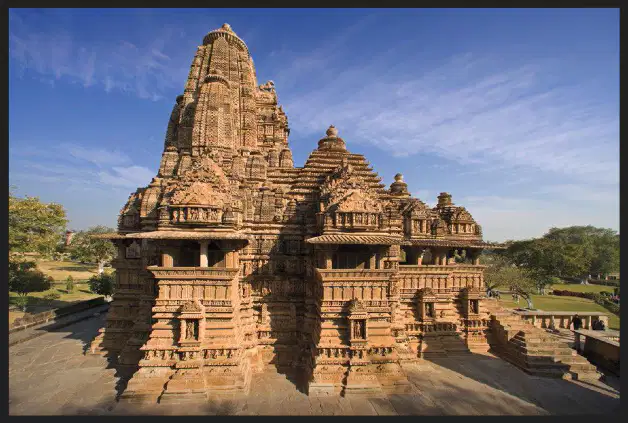
What is the name of the temple shown in the images?
Lakshmana Temple at Khajuraho
Kandariya Mahadev Temple
Brihadeshwara Temple
Sun Temple at Konark
Which dynasty built the Lakshmana Temple at Khajuraho?
In which country is the Lakshmana Temple located?
India
Nepal
Sri Lanka
Bangladesh
What is the primary building material of the Lakshmana Temple at Khajuraho?
Sandstone
Marble
Granite
Limestone
The Lakshmana Temple at Khajuraho was constructed around which years?
c. 930-950 C.E.
c. 1050-1070 C.E.
c. 850-870 C.E.
c. 990-1010 C.E.

What is the name of the artwork shown in the image?
Shiva as Nataraja
Vishnu as Garuda
Buddha in Meditation
Krishna Dancing

Which dynasty is associated with the artwork 'Shiva as Nataraja'?
Maurya Dynasty
Chola Dynasty
Gupta Dynasty
Mughal Dynasty

In which century was the artwork 'Shiva as Nataraja' created?
5th century C.E.
11th century C.E.
15th century C.E.
18th century C.E.

What material is used to make the sculpture 'Shiva as Nataraja'?
cast bronze
marble
wood
terracotta
What is the title of the artwork shown in the image?
Jahangir Preferring a Sufi Shaikh to Kings
Akbar Receiving the Jesuits
Shah Jahan on the Peacock Throne
Babur Supervising the Construction of a Garden
Who is the artist of 'Jahangir Preferring a Sufi Shaikh to Kings'?
Bichitr
Basawan
Mir Sayyid Ali
Ustad Mansur
The artwork 'Jahangir Preferring a Sufi Shaikh to Kings' was created during which period?
Mughal period
Ottoman period
Safavid period
Ming period
Fill in the blank: The artwork 'Jahangir Preferring a Sufi Shaikh to Kings' was created around ________.
1620 C.E.
1750 C.E.
1500 C.E.
1800 C.E.
What materials were used to create 'Jahangir Preferring a Sufi Shaikh to Kings'?
Oil on canvas
Watercolor, gold and ink on paper
Tempera on wood
Fresco

Who was the architect of the Taj Mahal?
Ustad Ahmad Lahori
Shah Jahan
Akbar
Humayun
During which period was the Taj Mahal built?
Mughal period
Gupta period
Maurya period
British period
The Taj Mahal was constructed between _________?
1632-53 C.E.
1600-1620 C.E.
1650-1670 C.E.
1700-1720 C.E.

What materials were used in the construction of the Taj Mahal?
Stone masonry and marble with inlay of precious and semiprecious stones
Red sandstone only
Wood and brick
Concrete and steel

Where is the Taj Mahal located?
Rajasthan
Uttar Pradesh
Delhi
Punjab

The Taj Mahal is located in ________, India.
Uttar Pradesh
Maharashtra
Rajasthan
Punjab
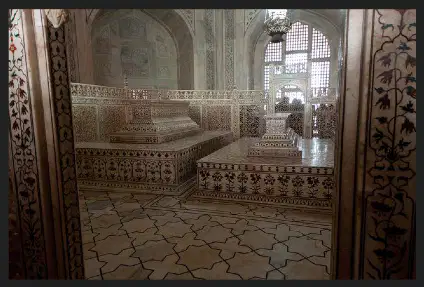
The interior of the Taj Mahal features inlay of precious and semiprecious stones.
True
False

What is the name of the temple shown in the image?
Borobudur Temple
Angkor Wat
Prambanan Temple
Shwedagon Pagoda
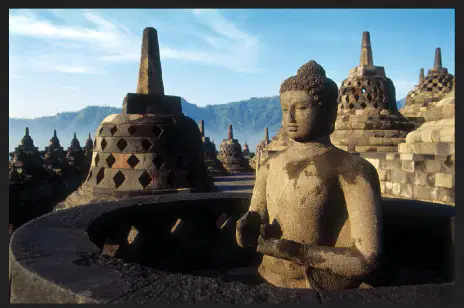
Which religion is associated with Borobudur Temple?
Buddhist
Hindu
Christian
Islam
Which dynasty built the Borobudur Temple?
Sailendra Dynasty
Gupta Dynasty
Majapahit Dynasty
Chola Dynasty
During which period was Borobudur Temple constructed?
c. 750-842 C.E.
a. 1000-1200 C.E.
b. 500-600 C.E.
d. 900-1000 C.E.

What material was used to build Borobudur Temple?
Volcanic stone masonry
Brick and mortar
Wooden planks
Limestone blocks

Where is Borobudur Temple located?
Central Java, Indonesia
Bali, Indonesia
Yogyakarta, Indonesia
Sumatra, Indonesia

What is the name of the artwork shown in the image?
Jowo Rinpoche
Borobudur
Great Stupa at Sanchi
Longmen Caves

Which dynasty is associated with the Jowo Rinpoche?
Ming Dynasty
Yarlung Dynasty
Gupta Dynasty
Maurya Dynasty

Where is the Jowo Rinpoche located?
Lhasa, Tibet
Kathmandu, Nepal
Beijing, China
Thimphu, Bhutan

In which temple can the Jowo Rinpoche be found?
Jokhang Temple
Potala Palace
Samye Monastery
Ganden Monastery

What materials were used to create the Jowo Rinpoche?
Marble and gold
Gilt metals with semiprecious stones, pearls, and paint
Bronze and jade
Wood and lacquer

In what year was the Jowo Rinpoche created?
641 C.E.
750 C.E.
1200 C.E.
900 C.E.

Which dynasty is associated with the Temple of Angkor Wat?
Ming Dynasty
Angkor Dynasty
Gupta Dynasty
Roman Empire
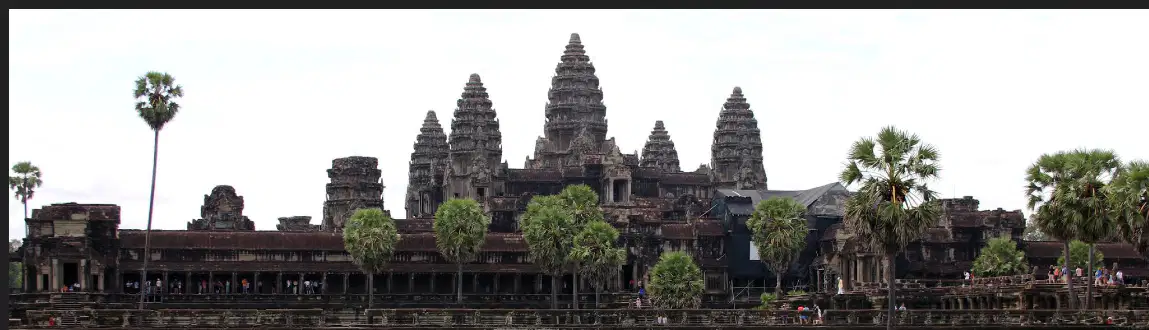
Where is the Temple of Angkor Wat located?
Cambodia
Thailand
Vietnam
Laos

