
Font size
S
M
L
XL
 Worksheets
8th Grade Science STAAR Review: Reporting Category 3 (Part 1)
Total questions: 37
Worksheet time: 19mins
Name
Class
Date
1.
Time it takes for the Earth to rotate on its axis.
(a)
2.
Time it takes for the Earth to revolve around the Sun
(a)
3.
The day and night cycle on Earth is caused by:
a)
the Earth's tilt
b)
the Earth's revolution around the Sun
c)
the Earth's rotation on its axis
d)
the moon's orbit around the Earth
4.
True or False: The Earth is closer to the Sun in winter and farther from the Sun in summer . The varying distance from the Sun to the Earth is the reason for the seasons.
a)
True
b)
False
5.
What causes seasons?
a)
Earth's rotation
b)
Earth's rotation and 23.5⁰ tilt
c)
the distance between the Earth and Sun
d)
23.5⁰ tilt and the revolution around the Sun
6.

The following question has two parts. Students are modeling the Earth, the Sun, and their relative motions. They have a basketball and a tennis ball. Part A: Fill in the blanks: The basketball will represent the ___________. The tennis ball will represent the ____________.
a)
Earth/Sun
b)
Earth/Moon
c)
Sun/Earth
d)
Moon/Earth
7.
Part B: Describe what the students should do in order to accurately model the cause of day and night on the Earth.
a)
lift the tennis ball off the table and rotate the basketball on an axis
b)
rotate the tennis ball clockwise and move the tennis ball around the basketball
c)
lift the tennis ball off the table and rotate the tennis ball counter-clockwise
d)
rotate the tennis ball on an axis and rotate the tennis ball counter-clockwise
8.

The following question has two parts. Students are modeling the Earth, the Sun, and their relative motions. They have a volleyball and a golf ball. Part A: Fill in the blanks: The volleyball will represent the ___________. The golf ball will represent the ____________.
a)
Sun/Earth
b)
Earth/Moon
c)
Earth/Sun
d)
Moon/Earth
9.
Part B: Describe what the students should do in order to accurately model the cause of seasons on the Earth.
a)
tilt the axis of the golf ball and tilt the axis of the volleyball
b)
tilt the axis of the golf ball and move the golf ball counter-clockwise around the volleyball
c)
rotate the golf ball on an axis and move the golf ball counter-clockwise around the volleyball
d)
move the volleyball counter-clockwise around the golf ball and rotate the volleyball on an axis
10.

How much time passes from Position 2 to Position 4?
a)
6 months
b)
12 months
c)
9 months
d)
3 months
11.

How much time passes from Position 2 to Position 1?
a)
6 months
b)
12 months
c)
9 months
d)
3 months
12.
A student explains the movement of Earth in relationship to the sun. Which statements provide the best illustrations?
Select TWO correct answers.
a)
A toy spinning on its axis while traveling around the edge of an oval tray
b)
An amusement park ride with cars turning as they move around the center
c)
A key turning in a lock
d)
A person spinning a soccer ball on one finger while standing in place
e)
A car driving down the road with all wheels rotating
13.
Tokyo, Japan is located in the Northern Hemisphere. Which diagram shows the position of Earth when it is winter in Tokyo, Japan?
a)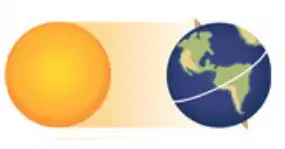
Option 1
b)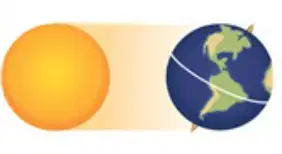
Option 2
c)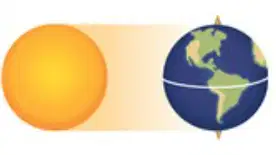
Option 3
d)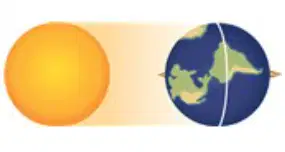
Option 4
14.
Tides are caused by the gravitational pull of the moon and Sun. Why does the moon have a greater effect on tides than the Sun?
a)
The moon is larger than the Sun
b)
They both have an equal effect
c)
The sun is closer to the Earth
d)
The moon is closer to the Earth
15.
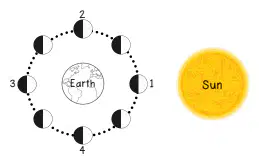
Which two positions bring higher than normal tides?
a)
Positions 1 and 2
b)
Positions 1 and 3
c)
Positions 2 and 3
d)
Positions 2 and 4
16.
At any point on Earth’s oceans, there are 2 high tides and (a) low tides each 24 hour day.
17.
Spring tides occur during the _____________ and ____________moon phases.
a)
full and first quarter moon
b)
new and full moon
c)
new and first quarter moon
d)
first and third/last quarter moon
18.
Neap tides occur during the ____________and ______________moon phases.
a)
full and first quarter moon
b)
new and full moon
c)
new and first quarter moon
d)
first and third/last quarter moon
19.
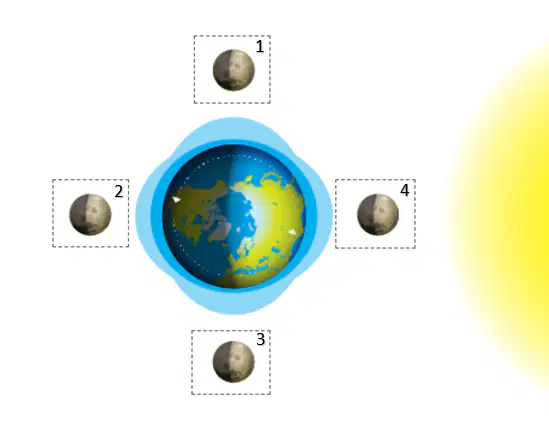
The diagram shows the Sun, Moon, and Earth as the Moon revolves around the Earth. At which locations would a Neap tide occur?
Select the TWO correct answers
a)
Position 1
b)
Position 2
c)
Position 3
d)
Position 4
20.
A ________ is a very large group of stars held together by gravity.
a)
nebula
b)
supernova
c)
galaxy
d)
black hole
21.
A ____________ is a very large cloud of dust and gas.
a)
nebula
b)
supernova
c)
galaxy
d)
black hole
22.
The major characteristic that determines the life cycle of a star is -
a)
The type of nebula that created it
b)
The mass of the star
c)
The color of the star
d)
The density of the star
23.
The _________ magnitude of a star is its actual brightness, if viewed from a standard distance.
a)
apparent
b)
absolute
24.
The ________ magnitude of a star is the brightness of the star as seen from Earth.
a)
apparent
b)
absolute
25.
What star characteristics are used to classify them on the H-R Diagram?
a)
brightness and size
b)
temperature and brightness
c)
size and temperature
d)
brightness only
26.
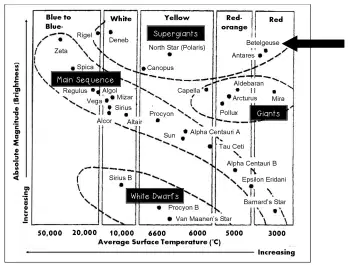
What does the Hertzsprung-Russell diagram tell us about the star Betelgeuse?
a)
It has a low surface temperature and high luminosity
b)
It has high surface temperature and high luminosity
c)
It has low surface temperature and low luminosity
d)
It has high surface temperature and low luminosity
27.
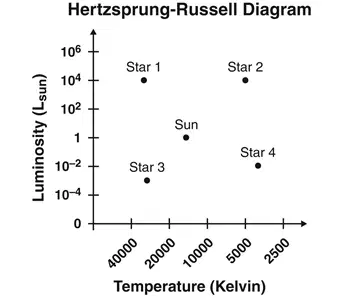
The Hertzsprung-Russell diagram shows the luminosity and surface temperature of the Sun and other stars.
Based on the diagram, select the two descriptions that BEST compare Star 1 to other stars.
a)
hot
b)
cool
c)
bright
d)
dim
28.
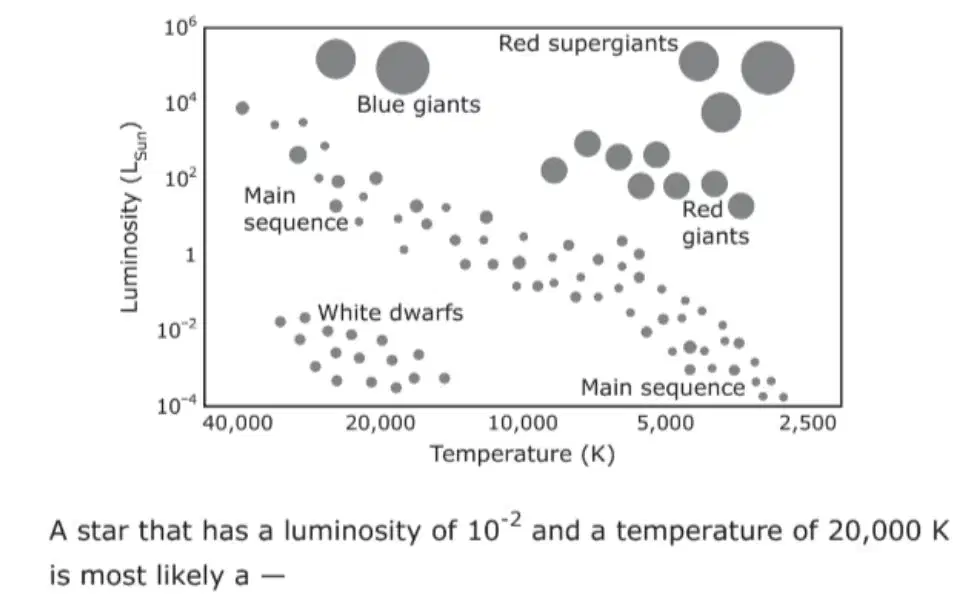
A Hertzsprung-Russell (H-R) diagram is shown.
a)
Main sequence
b)
White dwarf
c)
Blue giant
d)
Red giant
29.
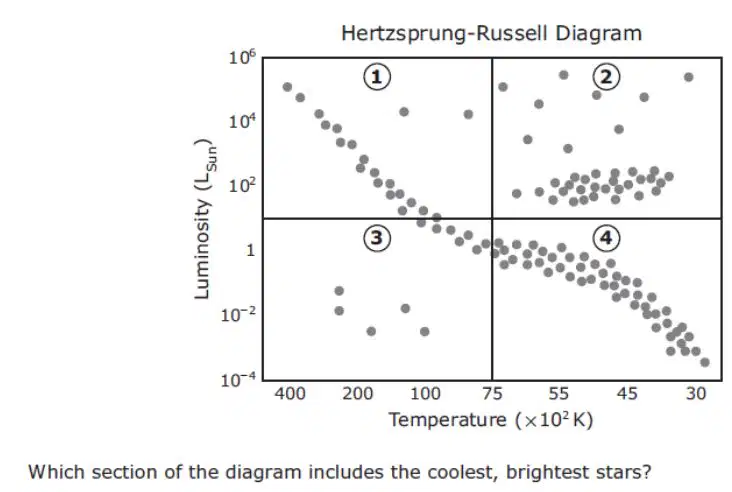
The Hertzsprung-Russell diagram shown is divided into four sections.
a)
Section 1
b)
Section 2
c)
Section 3
d)
Section 4
30.
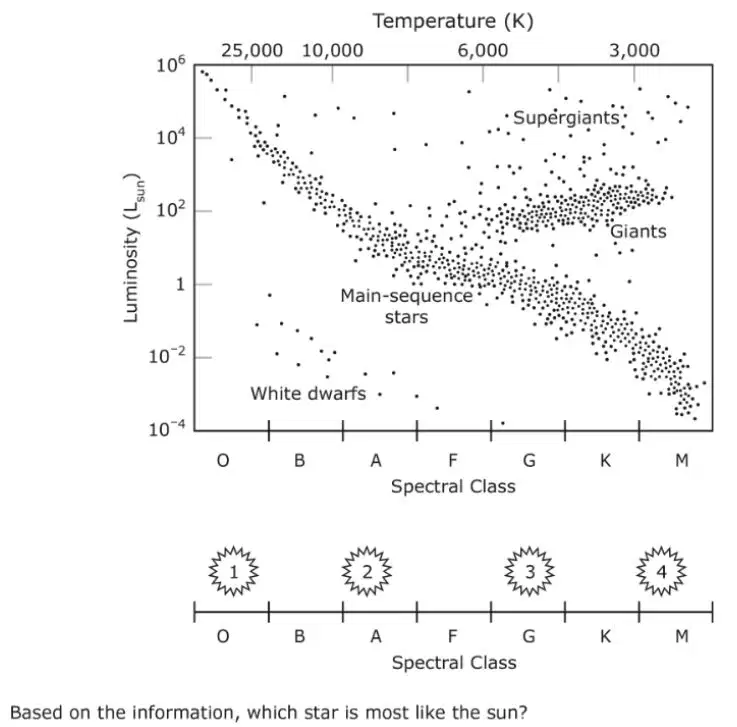
The spectral class of four stars are shown in comparison with a Hertzsprung-Russell diagram .
a)
Star 1
b)
Star 2
c)
Star 3
d)
Star 4
31.
Why is the sun so much brighter than the other stars visible in the sky?
(a)
32.
Which statement best describes the location of the sun in the Milky Way galaxy?
a)
The sun is located in the center of a spiral-shaped galaxy.
b)
The sun is located off the center of an elliptical-shaped galaxy.
c)
The sun is located on an arm of a spiral-shaped galaxy.
d)
The sun is located on an arm of an elliptical-shaped galaxy.
33.
True or False: The size of the sun is average (medium sized), compared to other main-sequence stars.
a)
True
b)
False
34.
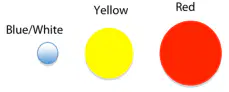
The provided graphic represents a model of three different stars. Which model is the best representation of our sun?
a)
The small blue/white star
b)
The medium yellow star
c)
The large red star
d)
Our sun is not represented here
35.
A student was asked to list facts about the sun and came up with the 5 statements below. Which of the following statements accurately describe characteristics of the sun?
Select TWO correct answers.
a)
The sun is a main sequence star with a luminosity of 1 located on the edge of a spiral-shaped galaxy.
b)
The sun has a higher luminosity than all other stars in our galaxy and provides energy to Earth because it is the hottest star.
c)
The sun is the hottest star in our galaxy and has a luminosity of 10².
d)
The sun is a medium-sized star and provides energy to Earth because it is the closest star to us.
e)
The sun is a supergiant and provides energy to Earth because it is the closest star to us.
36.
The Earth is a member of the (a) galaxy.
37.
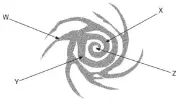
Which position represents the location of the sun in the galaxy?
(a)
Reset

