
 Worksheets
ECONOMICS: Final Exam Review (PART 1)
Total questions: 87
Worksheet time: 44mins
What is the definition of opportunity cost?
Opportunity cost is the value of the next best alternative that is given up when a choice is made.
Opportunity cost is the value of the least valuable option that is ignored when a choice is made.
Opportunity cost is the value of the total money spent on every option when a choice is made.
Opportunity cost is the value of the first option that is chosen immediately when a choice is made.
What are the 3 basic economic questions?
The three basic economic questions are what goods and services should be produced, how they should be produced, and for whom they should be produced.
The three basic economic questions are what goods and services should be consumed, when they should be consumed, and where they should be consumed.
The three basic economic questions are what goods and services should be taxed, how they should be taxed, and for whom they should be taxed.
The three basic economic questions are what goods and services should be imported, how they should be shipped, and for whom they should be shipped.
What is a Command Economy?
A command economy is an economic system where the government makes most economic decisions.
A command economy is an economic system where households make most economic decisions
A command economy is an economic system where all businesses are privately owned
A command economy is an economic system where prices never change
What is a Market Economy?
A market economy is a system where decisions are made by individuals and businesses through supply and demand.
A market economy is a system where the government sets all prices.
A market economy is a system where the government owns everything.
A market economy is a system where production is always equal.
What is a Mixed Economy?
A mixed economy combines elements of both market and command systems.
A mixed economy eliminates trade and competition entirely.
A mixed economy has no government rules at all.
A mixed economy bans buying and selling completely.
Economic Freedom – Command or Market?
A market economy has a great deal of economic freedom, while a command economy does not provide much economic freedom.
A command economy has a great deal of economic freedom, while a market economy does not provide much economic freedom.
A traditional economy has a great deal of economic freedom, while a market economy does not provide much economic freedom.
A barter economy has a great deal of economic freedom, while a mixed economy does not provide much economic freedom.
What is economic equity?
It ensures equal outcomes for all individuals by providing the same resources regardless of circumstances.
It ensures fair access to opportunities and resources so everyone has a chance to achieve economic success, recognizing unique barriers rather than providing identical outcomes
It ensures that markets operate without government involvement or regulation.
It ensures that income and wealth are distributed evenly among all members of society.
Economic Equity – Command or Market?
Economic equity aims for equal access to goods and services for everyone, and a command economy is more capable of pursuing equity, while a market economy cannot guarantee equity.
Economic equity aims for equal access to goods and services for everyone, and a market economy is more capable of guaranteeing equity, while a command economy cannot pursue equity.
Economic equity aims for equal access to goods and services for everyone, and a market economy always guarantees equity, while a command economy never affects equity.
Economic equity aims for equal access to goods and services for everyone, and a barter economy guarantees equity, while a mixed economy cannot affect equity.
Economic Security – Command or Market?
In a market economy, individuals and businesses are responsible for protecting themselves, while in a command economy, the government provides economic protection.
In a command economy, individuals and businesses are responsible for protecting themselves, while in a market economy, the government provides economic protection.
In a market economy, the government guarantees all protection, while in a command economy, nobody receives any protection.
In a traditional economy, individuals receive protection from trade, while in a market economy, protection is not needed at all.
For economic growth, a command economy usually has:
slow but sustainable growth
targeted but unsustainable growth
high levels of competition
market-driven resource allocation
For economic growth, a market economy usually has:
slow but sustainable growth
targeted but unsustainable growth
high levels of competition
market-driven resource allocation
Economic Efficiency – Command or Market?
A market economy is very efficient due to competition and free trade, while a command economy is less efficient because there is little or no competition.
A command economy is very efficient due to competition and free trade, while a market economy is less efficient because there is little or no competition.
A market economy is less efficient because competition is illegal, while a command economy is more efficient because firms always compete freely.
A traditional economy is very efficient due to free trade, while a market economy is less efficient because prices are set by planners.
Which economic system best fits each description? 1. During expansions, it can achieve full employment; during contractions, it experiences high levels of unemployment.
Command economy
Market economy
Which economic system best fits each description? It attempts to achieve full employment, but does so with many flaws and inefficiencies.
Command economy
Market economy
Economic Sustainability – Command or Market?
In a command economy, the government determines sustainability goals, while in a market economy, firms decide whether to pursue sustainability unless regulated.
In a market economy, the government determines sustainability goals, while in a command economy, firms decide whether to pursue sustainability unless regulated.
In a traditional economy, sustainability goals are always determined by global trade, while in a market economy, firms are not allowed to decide sustainability goals.
In a command economy, sustainability is never planned, while in a market economy, sustainability is always required without any regulation.
Investment in which factor of production would lead to a higher standard of living?
Investment in human capital leads to a higher standard of living because education and training increase productivity.
Investment in consumer goods leads to a higher standard of living because entertainment spending always increases productivity.
Investment in natural resources leads to a higher standard of living because resources automatically create skills and knowledge.
Investment in short-term spending leads to a higher standard of living because buying more today always increases productivity tomorrow.
What is meant by specialization and how does specialization increase productivity?
Specialization occurs when individuals or firms focus on a specific task, and it increases productivity by improving efficiency, skill, and output.
Specialization occurs when individuals or firms focus on many different tasks, and it increases productivity by reducing efficiency, skill, and output.
Specialization occurs when individuals or firms avoid specific tasks, and it increases productivity by eliminating practice, training, and output.
What is a rational decision?
A rational decision is one in which individuals compare costs and benefits and choose the option that provides the greatest benefit.
A rational decision is one in which individuals ignore costs and benefits and choose the option that provides the greatest risk.
A rational decision is one in which individuals compare opinions and feelings and choose the option that provides the greatest confusion.
A rational decision is one in which individuals avoid comparison and choose the option that provides the greatest uncertainty.
What is an incentive and how do positive and negative incentives affect outcomes?
An incentive is something that motivates behavior, where positive incentives encourage actions through rewards and negative incentives discourage actions through penalties.
An incentive is something that prevents behavior, where positive incentives discourage actions through penalties and negative incentives encourage actions through rewards.
An incentive is something that changes weather, where positive incentives increase temperatures through rewards and negative incentives decrease temperatures through penalties.
An incentive is something that controls prices, where positive incentives remove all rewards and negative incentives remove all penalties.
What are the determinants that cause the demand curve to shift?
Demand shifts due to changes in income, tastes/preferences, prices of related goods (substitutes/complements), consumer expectations, and the number of buyers (population/demographics).
Demand shifts due to changes in interest rates, money supply, government spending, tax revenue, and the national debt.
Demand shifts due to changes in technology, input costs, producer taxes, weather.
What are the determinants that cause the supply curve to shift?
Supply shifts due to changes in production costs, technology, government policies (taxes or subsidies), future prices, number of sellers, and natural events.
Supply shifts due to changes in income, consumer tastes, prices of related goods, expectations, and the number of buyers.
Supply shifts due to changes in unemployment, inflation, GDP growth, CPI measurement, and monetary policy decisions.
Supply shifts due to changes in consumer confidence, household spending, import demand, export demand, and trade preferences.
What is a price floor and a price ceiling?
A price floor is a legal minimum price, while a price ceiling is a legal maximum price.
A price floor is a legal maximum price, while a price ceiling is a legal minimum price.
A price floor is a voluntary suggested price, while a price ceiling is an unlimited market price.
A price floor is a foreign exchange price, while a price ceiling is a domestic wage price.
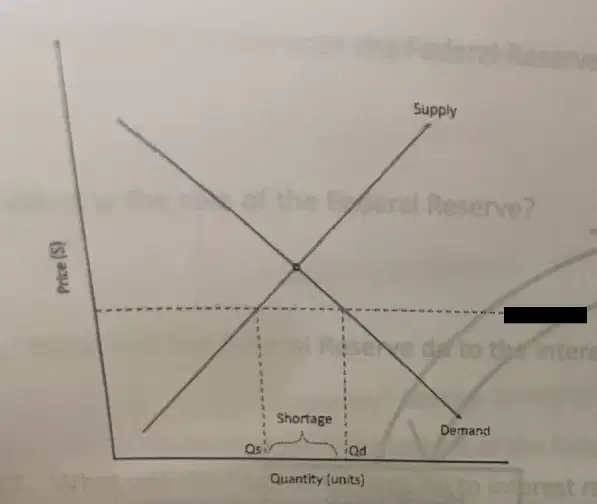
Based on the image above, what belongs in the square box?
Price Ceiling
Price Floor
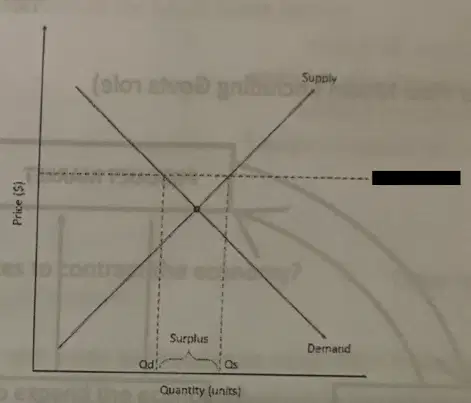
Based on the image above, what belongs in the square box?
Price Ceiling
Price Floor
Price floors cause what? Price ceilings cause what?
Price floors cause a surplus, and price ceilings cause a shortage.
Price floors cause a shortage, and price ceilings cause a surplus.
Price floors cause a shortage, and price ceilings cause equilibrium.
Price floors cause equilibrium, and price ceilings cause a surplus.
What are the three forms of business organizations and how many owners does each have?
A sole proprietorship has one owner, a partnership has two or more owners, and a corporation is owned by shareholders.
A corporation has one owner, a sole proprietorship has two or more owners, and a partnership is owned by shareholders.
A sole proprietorship has many owners, a partnership has one owner, and a corporation is owned by only one shareholder.
A nonprofit has one owner, a franchise has two or more owners, and a trust is owned by shareholders.
Which business organization has the greatest liability? Which has the lowest liability?
Sole proprietorships have the greatest liability, while corporations have the lowest liability due to limited liability.
Corporations have the greatest liability, while sole proprietorships have the lowest liability due to unlimited liability.
Partnerships have the lowest liability, while corporations have the greatest liability due to personal liability for shareholders.
Sole proprietorships have the lowest liability, while corporations have the greatest liability due to shared liability protections.
Which business organization involves shareholders to invest?
Sole proprietorship
Partnership
Corporation
Nonprofit
Which business organization has a slower decision-making process? Which has the quickest?
Corporations have the slowest decision-making process, while sole proprietorships have the quickest.
Sole proprietorships have the slowest decision-making process, while corporations have the quickest.
Partnerships have the quickest decision-making process, while corporations have the quickest decision-making process.
Corporations have the quickest decision-making process, while sole proprietorships have the slowest.
Which business organization has double taxation?
Corporations experience double taxation, where profits are taxed at the corporate level and again when distributed as dividends.
Partnerships experience double taxation, where profits are taxed at the corporate level and again when distributed as dividends.
Sole proprietorships experience double taxation, where profits are taxed at the corporate level and again when distributed as dividends.
Nonprofits experience double taxation, where profits are taxed at the corporate level and again when distributed as dividends.
Market Structure Chart
Perfect Competition: Many sellers, identical products, no price power, low barriers, example: agriculture.
Perfect Competition: Few sellers, unique products, high price power, high barriers, example: agriculture.
Perfect Competition: One seller, similar products, high price power, low barriers, example: agriculture.
Market Structure Chart
Monopolistic Competition: Many sellers, differentiated products, some price power, low barriers, example: restaurants.
Monopolistic Competition: Few sellers, identical products, no price power, high barriers, example: restaurants.
Monopolistic Competition: One seller, unique product, high price power, high barriers, example: restaurants.
Monopolistic Competition: Many sellers, identical products, no price power, high barriers, example: restaurants.
Market Structure Chart
Oligopoly: Few sellers, similar or differentiated products, high barriers, example: airlines.
Oligopoly: Many sellers, identical products, no barriers, example: airlines.
Oligopoly: One seller, unique product, high barriers, example: airlines.
Oligopoly: Many sellers, differentiated products, low barriers, example: airlines.
Market Structure Chart
Monopoly: One seller, unique product, high barriers, example: public utilities.
Monopoly: Many sellers, unique product, low barriers, example: public utilities.
Monopoly: Few sellers, identical product, low barriers, example: public utilities.
Monopoly: Many sellers, identical product, high barriers, example: public utilities.
What is the definition of GDP?
GDP is the total value of all final goods and services produced within a country in a given
year.
GDP is the total value of all intermediate goods and services produced outside a country in a given year.
GDP is the total value of all final goods and services produced worldwide in a given year.
GDP is the total value of all used goods and services traded within a country in a given year.
Which of the following correctly lists the components used to calculate Gross Domestic Product (GDP)?
Consumer spending + government spending + savings + imports
Consumer spending + business investment + government spending + (exports – imports)
Consumer spending + business investment + taxes + exports
Consumer spending + government spending + imports – exports
What is included in GDP?
Final goods and services produced domestically.
Intermediate goods and services produced domestically.
Final goods and services produced only in foreign countries.
Used goods and services produced domestically.
What is not included in GDP?
Used goods, intermediate goods, transfer payments, and illegal activity.
Final goods, domestic production, legal services, and consumer spending.
New goods, government purchases, business investment, and net exports.
Wages, salaries, profits, rents, and interest from production.
What is Real GDP?
Real GDP is GDP adjusted for inflation.
Real GDP is GDP adjusted for exports only.
Real GDP is GDP adjusted for population only.
Real GDP is GDP adjusted for imports only.
What is the definition of unemployment?
Unemployment occurs when individuals who are willing and able to work are actively seeking employment but cannot find a job.
Unemployment occurs when individuals who are unwilling and unable to work are actively seeking employment but cannot find a job.
Unemployment occurs when individuals who are willing and able to work are not seeking employment and cannot find a job.
Unemployment occurs when individuals who are willing and able to work are employed full-time and cannot find a second job.
What is the definition of inflation?
Inflation is the general increase in prices over time, reducing purchasing power.
Inflation is the general decrease in prices over time, increasing purchasing power.
Inflation is the general increase in wages over time, reducing purchasing power.
Inflation is the general decrease in wages over time, increasing purchasing power.
CPI stands for ______ and it measures ______.
Consumer Price Index; changes in the average price of a basket of consumer goods and services
Cost Performance Indicator; the efficiency of project cost management
Corporate Profit Index; the profitability of corporations
Consumer Product Inventory; the quantity of products available for consumers
CPI stands for and measures changes in the average price of a basket of goods and services.
Consumer Price Index and measures changes in the average price of a basket of goods and services.
Consumer Profit Indicator and measures changes in the average profit of a basket of goods and services.
Corporate Price Index and measures changes in the average price of a basket of corporate goods and services.
Consumer Purchase Indicator and measures changes in the average purchases of a basket of goods and services.
What are the four types of unemployment?
The four types are frictional, structural, cyclical, and seasonal unemployment.
The four types are frictional, voluntary, monetary, and seasonal unemployment.
The four types are structural, tariff, cyclical, and fiscal unemployment.
The four types are cyclical, inflationary, structural, and trade unemployment.
What is frictional unemployment?
Unemployment caused by long-term economic decline in an industry
Unemployment caused by seasonal changes in demand
Unemployment that occurs when people are between jobs or entering the workforce
Unemployment caused by a recession
What is structural unemployment?
Unemployment caused by workers voluntarily leaving their jobs
Unemployment caused by a mismatch between workers’ skills and available jobs
Unemployment caused by changes in the business cycle
Unemployment caused by seasonal weather patterns
What is cyclical unemployment?
Unemployment caused by technological changes
Unemployment that occurs during economic downturns or recessions
Unemployment caused by people searching for new jobs
Unemployment caused by seasonal industries
What is seasonal unemployment?
Unemployment caused by a lack of worker skills
Unemployment caused by economic recessions
Unemployment that occurs when industries slow down at certain times of the year
Unemployment caused by workers changing careers
Which of the following scenarios is an example of frictional unemployment?
A factory worker loses their job because machines replaced their work
A construction worker is laid off during the winter
A recent college graduate is temporarily unemployed while searching for their first job
A worker is laid off due to an economic recession
Which of the following scenarios is an example of structural unemployment?
A retail worker quits one job to look for another
A worker loses their job because their skills are no longer needed due to new technology
A ski instructor is unemployed during the summer
A worker is laid off during an economic downturn
Which of the following scenarios is an example of cyclical unemployment?
A worker leaves a job to move to a new city
A farmer is unemployed after the harvest season
A worker is laid off because the economy enters a recession
A worker’s job is replaced by automation
Which of the following scenarios is an example of seasonal unemployment?
A worker is unemployed while searching for a better-paying job
A factory worker loses a job due to declining demand from a recession
A cashier loses their job because of self-checkout machines
A lifeguard is unemployed during the winter months when pools are closed
The Federal Reserve controls which type of policy?
Fiscal policy
Monetary policy
Trade policy
Foreign policy
What is the role of the Federal Reserve?
The Federal Reserve manages monetary policy to promote stable prices, maximum employment, and economic stability.
The Federal Reserve manages fiscal policy to promote stable prices, maximum employment, and economic stability.
The Federal Reserve manages trade policy to promote stable prices, maximum employment, and economic stability.
The Federal Reserve manages tax policy to promote stable prices, maximum employment, and economic stability.
What will the Federal Reserve do to interest rates to contract the economy?
The Federal Reserve raises interest rates to contract the economy.
The Federal Reserve lowers interest rates to contract the economy.
The Federal Reserve freezes interest rates to contract the economy.
The Federal Reserve eliminates interest rates to contract the economy.
What will the Federal Reserve do to interest rates to expand the economy?
The Federal Reserve lowers interest rates to expand the economy.
The Federal Reserve raises interest rates to expand the economy.
The Federal Reserve freezes interest rates to expand the economy.
The Federal Reserve eliminates interest rates to expand the economy.
46. The Federal Funds Rate is defined as:
the interest rate at which depository institutions lend balances to each other overnight
the rate charged by the Federal Reserve to commercial banks for short-term loans
the interest rate paid by the government on treasury bonds
the rate at which consumers borrow from commercial banks
What monetary tool does the Federal Reserve most commonly use and how?
The Federal Reserve primarily uses open market operations by buying or selling government securities.
The Federal Reserve primarily uses price floors and ceilings by buying or selling consumer goods and services.
The Federal Reserve primarily uses tariffs and quotas by buying or selling imported goods and services.
The Federal Reserve primarily uses subsidies and embargoes by buying or selling wages and salaries.
What should the Federal Reserve do with open market operations to increase or decrease money supply?
The Fed buys securities to increase money supply and sells securities to decrease it.
The Fed sells securities to increase money supply and buys securities to decrease it.
The Fed buys securities to decrease money supply and sells securities to increase it.
The Fed never buys securities to increase money supply and always sells securities to increase it.
Who controls fiscal policy?
Fiscal policy is controlled by the federal government, primarily Congress.
Fiscal policy is controlled by the Federal Reserve, primarily the banking system.
Fiscal policy is controlled by private businesses, primarily corporate managers.
Fiscal policy is controlled by households, primarily consumer spending decisions.
What are the two fiscal policy tools?
The two fiscal policy tools are taxes and government spending.
The two fiscal policy tools are interest rates and open market operations.
The two fiscal policy tools are tariffs and quotas.
The two fiscal policy tools are inflation and unemployment.
How can fiscal policy be used to contract the economy?
The government can raise taxes or reduce spending to contract the economy.
The government can lower taxes or increase spending to contract the economy.
The government can raise tariffs or increase exports to contract the economy.
The government can lower interest rates or buy securities to contract the economy.
How can fiscal policy be used to expand the economy?
The government can lower taxes or increase spending to expand the economy.
The government can raise taxes or reduce spending to expand the economy.
The government can increase tariffs or reduce exports to expand the economy.
The government can raise interest rates or sell securities to expand the economy.
What is a national budget deficit and a national budget surplus?
A budget deficit occurs when spending exceeds revenue, while a surplus occurs when revenue exceeds spending.
A budget deficit occurs when revenue exceeds spending, while a surplus occurs when spending exceeds revenue.
A budget deficit occurs when exports exceed imports, while a surplus occurs when imports exceed exports.
Which creates national debt?
A budget deficit creates national debt.
A budget surplus creates national debt.
A balanced budget creates national debt.
A trade surplus creates national debt.
Solve the following budget problem: (30B National Debt; 5B Budget Expenditures (spending), 4B Budget Revenue):
There is a budget deficit, national debt still exists, and the national debt increases.
There is a budget surplus, national debt disappears, and the national debt decreases.
There is a balanced budget, national debt becomes zero, and the national debt stays the same.
There is a budget surplus, national debt still exists, and the national debt increases.
Solve the following budget problem: (20B National Debt; 10B Budget Expenditures (spending), 15B Budget Revenue)
There is a budget deficit, national debt still exists, and the national debt increases.
There is a balanced budget, national debt stays the same.
There is a budget surplus, national debt still exists, and the national debt decreases.
There is a budget surplus, and the national debt increases.
Which of the above best defines comparative advantage?
Comparative advantage is the ability to produce a good at a higher opportunity cost than another producer.
Comparative advantage is the ability to produce a good at the same opportunity cost as another producer.
Comparative advantage is the ability to produce a good without any opportunity cost compared to another producer.
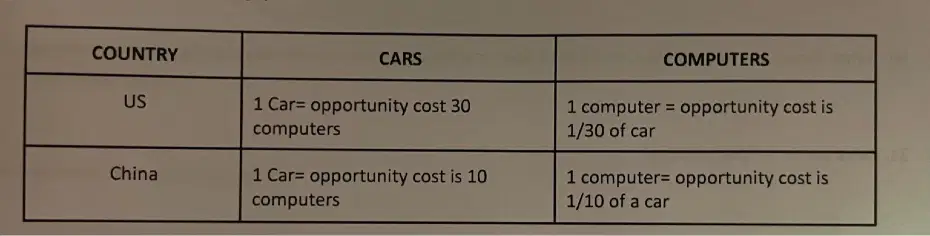
Based on the image above, who has a comparative advantage in cars and computers?
China has comparative advantage in cars, and the U.S. has comparative advantage in computers.
The U.S. has comparative advantage in cars, and China has comparative advantage in computers.
China has comparative advantage in cars, and China has comparative advantage in computers.
The U.S. has comparative advantage in cars, and the U.S. has comparative advantage in computers.
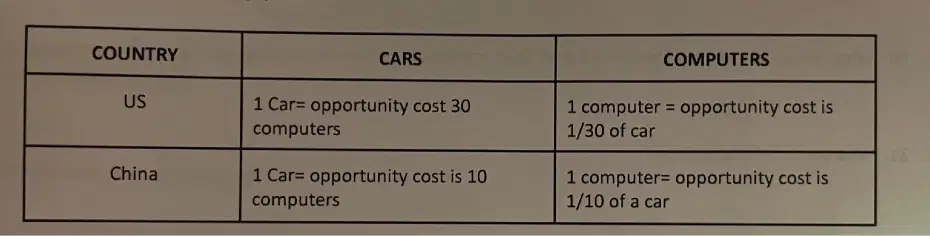
Based on the image above, who should import cars and export computers, and why?
The U.S. should import cars and export computers because its opportunity cost of
producing cars (30 computers) is higher than China’s (10 computers), giving China a
comparative advantage in cars and the U.S. a comparative advantage in computers.
China should import cars and export computers because its opportunity cost of
producing cars (10 computers) is higher than the U.S. (30 computers), giving the U.S. a comparative advantage in cars and China a comparative advantage in computers.
The U.S. should export cars and import computers because its opportunity cost of
producing cars (30 computers) is lower than China’s (10 computers), giving the U.S. a
comparative advantage in cars and China a comparative advantage in computers.
How do nations benefit from trade and specialization?
Trade allows countries to increase total output and consumption beyond what they could produce alone.
Trade allows countries to decrease total output and consumption below what they could produce alone.
Trade allows countries to keep total output and consumption exactly equal to what they could produce alone.
Trade allows countries to eliminate total output and consumption so production is no longer needed.
What are trade barriers?
Trade barriers are government restrictions that limit international trade.
Trade barriers are government rewards that expand international trade.
Trade barriers are private choices that eliminate international trade.
Trade barriers are consumer preferences that guarantee international trade.
What is one cost and one benefit of trade barriers?
A benefit is protecting domestic industries, and a cost is higher prices for consumers.
A benefit is lowering domestic industries, and a cost is lower prices for consumers.
A benefit is increasing competition instantly, and a cost is unlimited product choices for consumers.
A benefit is eliminating domestic jobs, and a cost is decreasing prices for consumers permanently.
What are the five common trade barriers?
Tariffs, quotas, subsidies, embargoes, and non-tariff barriers.
Prices, wages, profits, rents, and interest rates.
GDP, CPI, inflation, unemployment, and interest rates.
Exports, imports, production, consumption, and investment spending.
What is a tariff?
A government tax placed on imported goods to make them more expensive.
A legal limit on the quantity of goods that can be imported.
A payment to domestic producers to lower their production costs.
A complete ban on trade with another country.
What is a quota?
A government tax on imported goods.
A government subsidy paid to domestic producers.
A limit on the quantity of a good that can be imported.
A complete ban on trade with another country.
What is a subsidy?
A tax placed on imports to protect domestic producers.
A government payment to domestic producers to reduce costs and increase output.
A limit on the amount of goods that can be traded.
A restriction that completely bans trade.
What is an embargo?
A tax on imported goods.
A government payment to encourage exports.
A limit on the quantity of imports.
A complete ban on trade with a specific country.
What is a non-tariff barrier?
A direct tax placed on imported goods.
A limit on the number of goods allowed into a country.
Regulations, standards, or rules that make imports harder without using taxes or quotas.
A government payment to domestic producers.
Which of the following is an example of a tariff?
The U.S. government places a tax on imported steel to make foreign steel more expensive.
The government limits the number of foreign cars that can enter the country.
The government gives money to domestic farmers to lower food prices.
The government bans all trade with a hostile nation.
Which of the following is an example of a quota?
The government taxes imported clothing to protect domestic producers.
The government provides financial assistance to local manufacturers.
The government limits the number of foreign automobiles that can be imported each year.
The government requires strict safety inspections for imported goods.
Which of the following is an example of a subsidy?
The government bans trade with another country.
The government places a tax on imported electronics.
The government sets a maximum number of foreign goods allowed into the country.
The government gives payments to domestic farmers to reduce production costs and increase output.
Which of the following is an example of an embargo?
The government limits the number of goods imported from a country.
The government provides financial support to domestic industries.
The government completely bans all trade with a specific country.
The government raises taxes on imported goods.
Which of the following is an example of a non-tariff barrier?
The government places a tax on imported goods.
The government limits the quantity of imported products.
The government bans all trade with another country.
The government requires imported food to meet strict safety and labeling regulations that increase costs for foreign producers.
Does free trade support high or low trade barriers?
Free trade supports low trade barriers.
Free trade supports high trade barriers.
Free trade supports no trade at all.
Free trade supports only domestic trade barriers.
Does protectionism support high or low trade barriers?
Protectionism supports high trade barriers.
Protectionism supports low trade barriers.
Protectionism supports no trade at all.
Protectionism supports only international free trade.
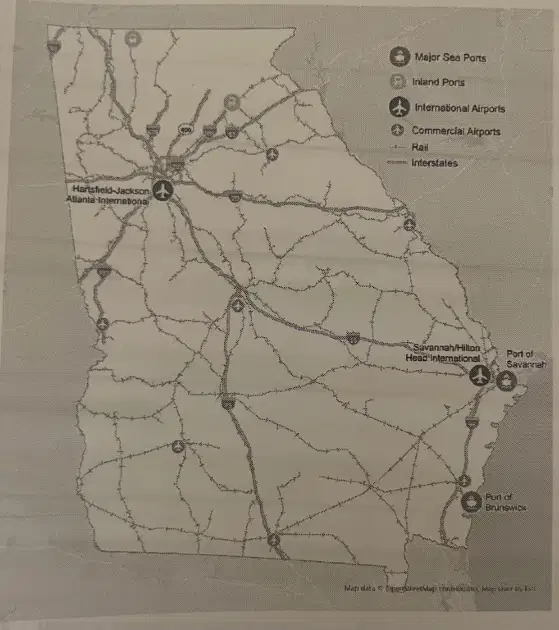
Based on the map of Georgia above, what advantage does Georgia offer international businesses?
Georgia offers major transportation and logistics advantages through ports, airports, and highway access.
Georgia offers major transportation and logistics disadvantages through ports, airports, and highway access.
Georgia offers major transportation and logistics advantages through deserts, mountains, and tundra access.
Georgia offers major transportation and logistics advantages through canals, glaciers, and rainforest access.

