
 Worksheets
Introduction to Highway Engineering
Total questions: 61
Worksheet time: 33mins
What is Transportation Engineering? Fill in the blank: Transportation Engineering is a branch of Civil Engineering that deals with the application of _______ and scientific principles to the planning, functional design, operation, and management of facilities for any mode of transportation.
technology
art
intuition
guesswork
Which of the following is NOT a mode of transportation listed in the text?
Land Transport
Water Transport
Air Transport
Space Transport
Fill in the blank: Road Transport is the movement of people and goods from one place to another on roads by way of _______ and non-motorized carriages.
motorized
mechanical
manual
electrical
Rail Transport involves the conveyance of passengers and goods by means of wheeled vehicles specially designed to run along railways or railroads.
True
False
Which of the following is an example of Inland Water Transport?
Transportation by ship across international waters
Transportation by barge on a canal
Transportation by airplane
Transportation by car
Fill in the blank: Air Transport connects international boundaries and allows people to cross and travel different countries that are not connected by _______.
roads and railways
rivers and lakes
mountains and valleys
deserts and forests
What is Traffic Engineering? Fill in the blank: Traffic Engineering is a subdiscipline of transportation engineering that aims to optimize the performance and efficiency of the movement of _______.
people, goods, and transportation
vehicles only
data packets
animals
Which of the following is NOT a common objective of traffic engineering?
Providing highly efficient traffic flow
To produce free flow of traffic
To increase traffic congestion
Use research to design roadways and highways that increase traffic safety
List any two studies that traffic engineers may execute for traffic optimization.
Traffic volume study and speed study
Rainfall analysis and soil testing
Building design and landscape study
Water quality assessment and air pollution study
Fill in the blank: Highway refers to a facility that can accommodate _______ volumes of traffic.
large
small
average
minimal
Which of the following is NOT included in the scope of Highway Engineering?
Development, Planning and Locations
Highway Design, Geometrics and Structure
Traffic Performance and its Control
Air Traffic Control
Fill in the blank: Road classification relates to the function or _______ of the road.
purpose
length
width
location
Which type of road directly connects Major Cities (at least around 100,000 people)?
National Primary
National Secondary
National Tertiary
Expressways
Which type of road directly connects Major Airports to National Primary Roads?
National Primary
National Secondary
National Tertiary
Bypasses
Expressways are highways with limited access, normally with interchanges; they may include facilities for levying tolls for passage in an open or closed system.
True
False
Bypasses are roads or highways that avoid a built-up area, town or city proper to let through traffic flow without interference from local traffic.
True
False
List one objective of highway planning.
A highway should be planned according to the volume of daily traffic flow from a particular path.
Highways should be planned only for aesthetic purposes.
Highway planning should ignore future traffic growth.
Highways should be constructed without considering safety measures.
What is the first phase of the highway location process?
Reconnaissance survey of the entire area between terminal points.
Detailed survey of the selected route.
Preparation of final plans and estimates.
Construction of the highway.
Which type of planning survey collects data about villagers and has discussions about the project and asks for cooperation during construction?
Social Data
Technical Survey
Environmental Survey
Economic Survey
Which type of road connects Cities and Municipalities without traversing National Roads?
Provincial Roads
Municipal and City Roads
Barangay Roads
Expressways
Highways should be safe and secure.
True
False
The planning must have a forecast for the next several years in order to plan fix periods for maintenance, renewal and widening as well.
True
False
Which type of data is beneficial for the best utilized type of road to be created on the path and includes traffic volume survey, origin destination survey, and vehicles damage surveys?
Traffic Data
Geological Data
Hydrological Data
Environmental Data
What is the main purpose of a highway survey before developing a highway?
To collect adequate amount of data for planning according to the volume of daily traffic flow.
To estimate the cost of construction materials only.
To determine the color of road signs.
To select the type of vehicles allowed on the highway.
Which phase of highway location process includes terrain and soil conditions and serviceability of route to industrial and population areas?
Reconnaissance survey of all feasible routes.
Preliminary survey of selected routes.
Final location and detailed survey.
Construction phase.
What are the two basic functions of a paved surface as described in the introduction to pavement design?
1. To give drivers a visual perspective of the horizontal and vertical alignment of the travelled path, aiding in driving task and steering control. 2. To support vehicle loads.
1. To reduce air pollution and provide aesthetic value. 2. To increase fuel efficiency.
1. To absorb rainwater and prevent flooding. 2. To enhance road lighting.
1. To provide wildlife crossings and reduce noise pollution. 2. To improve pedestrian safety.
Which type of pavement structure is constructed with asphaltic cement and aggregates and usually consists of several layers?
Flexible pavement
Rigid pavement
Composite pavement
Gravel pavement
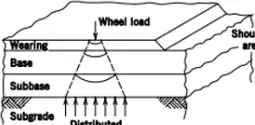
Refer to the diagram showing the structural components of a flexible pavement. Which layer is located immediately above the subgrade and consists of material of a superior quality for subgrade construction?
Subbase course
Surface course
Base course
Wearing course
Which layer of a flexible pavement is usually made of asphaltic concrete and serves to protect the base layer from abrasion and waterproof the pavement structure?
Wearing surface
Subgrade
Base course
Sub-base
The base course of a flexible pavement lies immediately above the subbase and consists of granular materials such as crushed stone, crushed or uncrushed slag, crushed or uncrushed gravel, and sand.
True
False
Which of the following is NOT a function of the wearing surface in flexible pavement?
Protect the base layer from abrasion
Waterproof the pavement structure
Increase the bearing capacity of the subgrade
Provide a skid resistant surface for safe vehicle stops
Fill in the blank: The _______ is the natural material located along the horizontal alignment of the pavement and serves as the foundation of the pavement structure.
subgrade
asphalt
aggregate
bitumen
A 50-kN wheel load has a maximum tire pressure of 0.60-MPa. This pressure is to be uniformly distributed over the area of tire contact on the roadway. Assuming the subgrade pressure is not to exceed 0.16-MPa, determine the design thickness of the flexible pavement. Use the formula: t = 0.564 * sqrt(W / (fs * r)), where W = wheel load, fs = allowable pressure of subgrade, r = radius of tire-pavement contact.
t = 0.564 * sqrt(50,000 N / (0.16 MPa * r)) (The exact value depends on the radius, which is not provided in Problem 1, so the answer is the formula with substituted values except r.)
t = 0.564 * sqrt(50,000 N / (0.60 MPa * r))
t = 0.564 * sqrt(0.16 MPa / (50,000 N * r))
t = 0.564 * sqrt(50,000 N * 0.16 MPa * r)
An asphalt pavement having a modulus of elasticity of 180-MPa carries a static load of 120-kN. The circular contact radius of the tire is 180-mm, and the transmitted load is distributed across a wide area of subgrade having a modulus of 40-MPa at an angle of 45°. The subgrade bearing stress is 30.0-MPa while that of the base is 0.60-MPa. Determine the following: a. Stiffness factor.
SF = sqrt(180 / 40) = sqrt(4.5) ≈ 2.12
SF = sqrt(120 / 30) = sqrt(4) = 2.00
SF = sqrt(180 / 60) = sqrt(3) ≈ 1.73
SF = sqrt(40 / 180) = sqrt(0.222) ≈ 0.47
An asphalt pavement having a modulus of elasticity of 180-MPa carries a static load of 120-kN. The circular contact radius of the tire is 180-mm, and the transmitted load is distributed across a wide area of subgrade having a modulus of 40-MPa at an angle of 45°. The subgrade bearing stress is 30.0-MPa while that of the base is 0.60-MPa. Determine the following:
b. Thickness of pavement.
594.71 mm
420.35 mm
312.50 mm
765.80 mm
An asphalt pavement having a modulus of elasticity of 180-MPa carries a static load of 120-kN. The circular contact radius of the tire is 180-mm, and the transmitted load is distributed across a wide area of subgrade having a modulus of 40-MPa at an angle of 45°. The subgrade bearing stress is 30.0-MPa while that of the base is 0.60-MPa. Determine the following: c. Thickness of the base layer.
30.0 MPa (as given in the problem statement)
15.0 MPa
45.0 MPa
0.60 MPa
The different types of Portland cement specified by AASHTO are the following: a. Type I or 1A (Air-Entraining): This type of cement is for general concrete construction when the specified properties of the other four types are not required. b. Type II or IIA (Air-Entraining): This type is for general concrete construction exposed to moderate action or where moderate heat of hydration is required. c. Type III or IIIA (Air-Entraining): This type is for high strength concrete. d. Type IV is for low heat of hydration. e. Type V for high sulphate resistance. Which type of Portland cement is used for high sulphate resistance?
Type I
Type II
Type III
Type V
What is the main function of fine aggregates in concrete?
Fine aggregates provide hard, strong, and durable particles for concrete.
Fine aggregates increase the setting time of concrete.
Fine aggregates act as a primary binder in concrete.
Fine aggregates reduce the water requirement in concrete.
Water used in concrete must be free from which substances?
Oil, salt, acid, alkali, grass, or other substances injurious to the finished product.
Sugar, flour, and spices.
Plastic, rubber, and glass.
Sand, gravel, and cement.
Joint fillers should be mixed asphalt and mineral or rubber filler.
True
False
Which type of steel is used mainly as load-transfer mechanisms across joints?
Temperature Steel
Dowel Bars
Tie Bars
Temperature steel helps to maintain the shearing resistance of the pavement.
True
False
Tie bars are used to connect two slabs together and are spaced at larger centers than dowel bars.
True
False
What is the main purpose of expansion joints in concrete pavements?
To accommodate the increased length of the slab due to temperature expansion.
To increase the strength of the pavement.
To prevent water seepage into the pavement.
To reduce the cost of construction.
Contraction joints are placed to release some of the tensile stresses that are induced.
True
False
Hinge or longitudinal joints are used mainly to reduce cracking along the centerline of highway pavements.
True
False
Which type of joint is usually placed at the end of a day's pour to provide suitable bonding with the start of the next day's pour?
Expansion Joint
Contraction Joint
Construction Joint
A jointed plain concrete pavement (JPCP) normally has a joint spacing of:
5 to 10 mm
5 to 10 cm
5 to 10 m
Which type of rigid highway pavement contains steel reinforcement spaced about 9 to 12 m apart?
JPCP
JRCP
CRCP
PCP
Continuous reinforced concrete pavement (CRCP) has no regularly spaced transverse joints and contains more steel reinforcement than JRCP.
True
False
Pre-stressed concrete pavements are designed to bear tensile forces caused by external loads.
True
False
Determine the thickness of the pavement from the following conditions: a. The pavement is rigid and to carry a maximum wheel load of 60-kN. Neglect the effect of dowel. Use f'c' = 20 MPa and the allowable tensile stress of concrete pavement is 0.60f'c'. What is the required thickness of the pavement?
18 cm
22 cm
15 cm
25 cm
Determine the thickness of the pavement from the following conditions: The concrete pavement has an expansion pressure of 0.15 kg/cm² and the pavement density of 0.0025 kg/cm³.
6 cm
12 cm
9 cm
15 cm
Determine the thickness of the pavement from the following conditions: A rigid pavement is to carry a wheel load of 53.50 kN. Use allowable tensile stress of concrete of 1.38 MPa. Sufficient dowels are used across joints. What is the required thickness of the pavement?
180 mm
220 mm
150 mm
200 mm
Compute the radius of relative stiffness for a 15-cm slab with modulus of elasticity of concrete of 2.1 × 10^5 kg/cm² and Poisson's ratio of 0.15 over the subgrade with modulus of subgrade reaction of 3.5 kg/cm².
54.2 cm
38.7 cm
62.5 cm
47.9 cm
Compute the radius of relative stiffness for a 15-cm slab with modulus of elasticity of concrete of 2.1 × 10^5 kg/cm² and Poisson's ratio of 0.15 over the subgrade with modulus of subgrade reaction of 7.0 kg/cm².
Problem 5. An 18-cm thick rigid pavement is subjected to a wheel load of 5,200 kg. The Poisson's ratio is 0.15, the modulus of concrete is 3.0×10⁵kg/cm2 and the modulus of subgrade reaction is 6.0kg/cm2 . If the radius of contact area is 15−cm , what is the radius of relative stiffness?
85.2 cm
42.6 cm
18.0 cm
65.4 cm
Determine the equivalent radius of resisting section given the parameters: wheel load of 5,200 kg, Poisson's ratio of 0.15, modulus of concrete of 3.0 × 10^5 kg/cm², modulus of subgrade reaction of 6.0 kg/cm², radius of contact area of 15cm , and thickness of rigid pavement of 18cm . What is the equivalent radius of resisting section?
18.5 cm
22.0 cm
15.0 cm
20.3 cm
Determine the interior stress using the formula σi = (0.3162P/h²)[4 log(ℓ/b) + 1.069], where P = 5,200 kg, h = 18 cm, ℓ and b as calculated above. What is the value of σi?
1,120 kg/cm²
2,340 kg/cm²
980 kg/cm²
1,560 kg/cm²
Problem 5. An 18-cm thick rigid pavement is subjected to a wheel load of 5,200 kg. The Poisson's ratio is 0.15, the modulus of concrete is 3.0×10⁵kg/cm2 and the modulus of subgrade reaction is 6.0kg/cm2 . If the radius of contact area is 15−cm , what is the edge stress?
45.2 kg/cm²
32.8 kg/cm²
56.4 kg/cm²
21.7 kg/cm²
Problem 5. An 18-cm thick rigid pavement is subjected to a wheel load of 5,200 kg. The Poisson's ratio is 0.15, the modulus of concrete is 3.0×10⁵kg/cm2 and the modulus of subgrade reaction is 6.0kg/cm2 . If the radius of contact area is 15−cm , what is the corner stress?
45.2 kg/cm²
32.8 kg/cm²
58.6 kg/cm²
21.4 kg/cm²

