
 Worksheets
Levitating Orb Final
Total questions: 49
Worksheet time: 2hrs 13mins
The force of attraction between all matter; pulls objects toward each other
Gravity
Magnetism
Electricity
Friction
A force that attracts certain materials (like iron) or can push/pull other magnets
Magnetism
Electricity
Gravity
Sound
The invisible area around a magnet where magnetic force can be detected; stronger at the poles.
Magnetic field
Electric current
Gravity
Sound wave
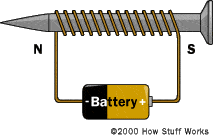
A temporary magnet created when electric current flows through a coil of wire wrapped around an iron core
Electromagnet
Permanent Magnet
Bar Magnet
Solenoid
To float in the air without support
Levitate
Elevate
Float
Rise
The ends of a magnet where the magnetic force is strongest; every magnet has a north pole and a south pole.
Pole (magnetic)
Core (magnetic)
Field (magnetic)
Axis (magnetic)
To pull together; (N-S).
Attract
Repel
Separate
Divide
To push apart; like poles; (N-N or S-S).
Repel
Attract
Combine
Connect
The amount of matter in an object; stays the same everywhere
Mass
Volume
Length
Temperature
The measure of gravitational force on an object; changes depending on gravity.
Weight
Mass
Volume
Density
A positively charged particle
Proton
Neutron
Electron
Photon
A negatively charged particle
Electron
Proton
Neutron
Photon
A particle with a neutral (no) charge
Neutron
Proton
Electron
Photon
Can be positive, negative, or neutral
Charge
Current
Voltage
Resistance
The three particles that make up an atom are: ________.
Proton, Neutron, Electron
Proton, Electron, Positron
Neutron, Electron, Photon
Proton, Neutron, Photon
Which particle has a positive charge?
Proton
Neutron
Electron
Photon
Which particle has a negative charge?
Electron
Proton
Neutron
Alpha particle
Which particle has no charge?
Neutron
Proton
Electron
Alpha particle
When electrons flow through a wire, this creates an ______ current.
Electric
Magnetic
Thermal
Optical
Magnets have a ______ pole and a ______ pole.
North, South
East, West
Up, Down
Left, Right
When two north poles or two south poles come close together, they will ______ each other.
Repel
Attract
Ignore
Combine
When a north pole and a south pole come close together, they will ______ each other.
Attract
Repel
Ignore
Collide
The strongest parts of a magnet are at the ______.
Poles
Center
Edges
Surface
A magnetic field is invisible.
True
False
What material is attracted to magnets?
Metals like iron
Plastic
Wood
Glass
Gravity depends on two things: • The ______ of the objects • The ______ between the objects
Mass, Distance
Size, Speed
Weight, Volume
Shape, Temperature
The greater the mass of an object, the ______ its gravitational pull.
Stronger
Weaker
Shorter
Slower
The closer two objects are to each other, the ______ the gravitational force between them.
Stronger
Weaker
Constant
Zero
The difference between mass and weight is:
Mass is the amount of matter in an object, while weight is the force exerted by gravity on that object.
Mass and weight are always equal regardless of location.
Weight is measured in kilograms, while mass is measured in newtons.
Mass changes depending on gravity, while weight remains constant.
How is an electromagnet different from a regular magnet?
An electromagnet can be turned on and off (when electricity flows, it's magnetic; when electricity stops, it's not magnetic). A regular magnet is always magnetic.
An electromagnet is always magnetic, while a regular magnet can be turned on and off.
Both electromagnets and regular magnets require electricity to work.
A regular magnet can be made stronger by increasing the electric current, while an electromagnet cannot.
To make an electromagnet, you need three things:
1. IRON core 2. WIRE 3. BATTERY or power source
1. PLASTIC core 2. STRING 3. SOLAR PANEL
1. WOOD core 2. ROPE 3. GENERATOR
1. COPPER core 2. TAPE 3. LIGHT BULB
PART 5: ELECTROMAGNETS
Which of the following best describes a simple electromagnet?
An iron nail with wire coiled around it, connected to a battery in a circuit
A wooden stick with wire coiled around it, not connected to anything
An iron nail with a magnet attached to it, no wires
A battery connected directly to a magnet with no wire
How can you make an electromagnet stronger?
************(PICK TWO)************
Add more coils of wire around the core
Use a wooden core instead of iron
Add more batteries
Use a plastic core
You can turn an electromagnet on and off.
True
False
When electric current (moving electrons) flows through the wire coil, it creates a _________?
MAGNETIC FIELD
ELECTRIC CHARGE
SOUND WAVE
LIGHT RAY
What forces were acting on the orb to make it levitate?
Gravity & static electricity caused the orb to levitate.
Only gravity was acting on the orb, causing it to levitate.
Friction and air resistance were the main forces making the orb levitate.
Electric force alone was responsible for the orb's levitation.
Which force pulls all objects toward Earth?
Gravity
Magnetism
Friction
Electricity
What natural phenomenon on Earth is caused by the Moon's gravity?
Ocean tides
Earthquakes
Volcano eruptions
Auroras
What happens when electric current flows through a coil of wire wrapped around an iron core?
The iron core becomes magnetized.
The iron core melts.
The coil stops conducting electricity.
The iron core produces light.
If you had a levitating orb at home and the power went out, what would happen? Why?
The orb would stop levitating because it needs power to stay afloat.
The orb would continue levitating due to its use of static electricity.
The orb would glow brighter in the dark.
The orb would start spinning rapidly.

Which three parts combine to form a scientific explanation?
Claim, Evidence, Reasoning
Question, Hypothesis, Data
Observation, Model, Prediction
Law, Theory, Experiment
In space, a paper clip equally spaced between you and your textbook would move toward:
The textbook, because it has less mass
You, because you have a greater mass
Neither object; it stays still
Whichever object is warmer
When you go to the Moon, your weight will:
Increase because you are farther from Earth
Decrease because the Moon’s gravity is weaker
Stay exactly the same
Become zero because there is no gravity anywhere


What do the lines around this magnet represent?
North Pole
South Pole
Magnetic Declination
Magnetic Field
Iron filings form this when sprinkled on a piece of paper over a magnet.
temporary magnet
visible magnetic field
magnetism
invisible magnetic field


