
 Worksheets
Unit 7 Test Review
Total questions: 44
Worksheet time: 23mins
Name
Class
Date
1.

Why do the feather and the ball fall at the same speed in a vacuum?
a)
There is no air resistance or drag to slow a feather in a vacuum
b)
The ball will move faster when powered by electricity
c)
The ball and the feather would still move at different speeds in a vacuum
d)
The movement of the objects depends on the poles of a magnet
2.

The woman in red is on the train, which is moving from right to left. Which statement is true about the frame of reference of the woman in yellow on the ground?
a)
The woman in red appears to be moving from right to left.
b)
The woman in red appears to be standing still.
c)
The woman in red appears to be moving left to right.
d)
The woman in red appears to be laughing at the woman in yellow.
3.
A place or object used for comparison to determine the location of another object OR to determine whether something is in motion is called a:
a)
frame of reference
b)
object in motion
c)
reference point
d)
object at rest
4.
What two factors determine the gravitational force between two objects?
a)
mass and weight
b)
mass and distance
c)
distance and weight
d)
charge and distanc
5.
An object at rest tends to stay at rest, and an object in motion tends to stay in motion unless acted on by an outside force. Netwon's first law describes the property known as:
a)
inertia
b)
gravity
c)
electricity
d)
force
6.
When the forces acting on an object are balanced,
a)
there is always change in motion
b)
there is no change in motion
c)
there is slowing down of motion
d)
there is acceleration of motion
7.
Electromagnets are often used in industrial settings. What advantage does an electromagnet have over a regular magnet in moving heavy objects?
a)
It can move heavy objects made of iron
b)
It also creates light so workers can see better
c)
It can be turned off by cutting off the current
d)
It is always very magnetic regardless of current
8.
Which of the following is an example of a non-contact force?
a)
A foot kicking a soccer ball
b)
Drag working against an airplane
c)
Sun's gravitational pull on planets
d)
Air resistance working against gravity
9.

Which 2 factors determine the strength of a gravitational field?
a)
Distance and mass
b)
Distance and time
c)
Mass and weight
d)
Electricity and magnetism
10.

Which of the following is true about an electrical field?
a)
It is weaker if the object making the field is very charged
b)
It is stronger if the object making the field is very charged
c)
It doesn't matter how charged the object making the field is
d)
Objects cannot have different charges
11.

Which statement is true about gravity?
a)
It is an attractive force that pulls all objects toward each other
b)
It is an attractive force that pulls everything toward the center of the Earth
c)
It is an attractive force that pushes all objects away from each other
d)
It is a repelling force that pushes all objects away from each other
12.

We all know that inertia is a property of matter. What is the definition of inertia?
a)
The tendency of objects to resist a change in motion
b)
The tendency of objects to change motion without outside forces
c)
The tendency of objects to never move
d)
Bill! Bill! Bill! Bill! Bill!
13.

Why does the first sphere have a stronger gravitational force than the second sphere?
a)
The first sphere has more mass
b)
There is very little distance between them
c)
Both spheres actually have the same gravitational force
d)
The second sphere actually has more gravitational force
14.

What is the net force acting on this object?
a)
2 N to the right
b)
2 N to the left
c)
5 N to the right
d)
3 N to the left
15.

Tommy is pulling the boat and Billy is pushing the boat in the same direction. Which boy is applying the force that has greater magnitude?
a)
Tommy is pulling with 70 N of force.
b)
Billy is pushing with 90 N of force.
c)
Tommy and Billy are applying the same amount of force.
d)
Tommy and Billy are applying force in opposite directions.
16.
Mr. Smith warned his students not to have hair dryers plugged in near a bathtub full of water because of the risk of electric shock. What type of material is water?
a)
An insulator that does not allow charges to move easily
b)
A conductor that allows charges to move easily
c)
A semiconductor that can be used to control the flow of a charge
d)
A discharge that rapidly loses charge
17.

This image shows three pairs of circular objects. Which statement is true about the top two pairs?
a)
The objects in these pairs are moving away from each other because like charges repel.
b)
The objects in these pairs are moving toward each other because like charges repel.
c)
The objects in these pairs are moving away from each other because like charges attract.
d)
The objects in these pairs are moving away from each other because unlike charges repel.
18.
The principle of conservation of charge states that:
a)
Electrons can be destroyed in order to change charges.
b)
Only negatively charged objects have any electrons.
c)
Charging objects involves moving electrons from one object to another.
d)
Electrons can be created in order to change charges.
19.
Gravitational, electric, magnetic, and electromagnetic forces are considered non-contact forces. Which statement is true of all of these non-contact forces?
a)
As distance between objects increases, the force decreases.
b)
As amount of charge of objects increases, the force decreases.
c)
As the amount of iron in the objects increases, the force decreases.
d)
Objects must touch in order to be affected by these forces.
20.

The arrows in this diagram represent groups of atoms. What are these groups of atoms called?
a)
Domains
b)
Poles
c)
Ferromagnets
d)
Nuclei
21.

A coil of wire (like the one around the nail in this picture) that carries and electric current and therefore produces a magnet field is called a:
a)
solenoid
b)
electromagnet
c)
armature
d)
commutator
22.
Electromagnetism is defined as:
a)
the interaction between gravity and magnetism
b)
the interaction between electricity and magnetism
c)
the interaction between gravity and solar power
d)
the interaction between any non-contact forces
23.
In terms of non-contact forces, a field is:
a)
A region of influence where a non-contact force can be measured
b)
The area around the south pole of a magnet where all non-contact fields are measured
c)
A way of measuring the electric current in all objects
d)
A form of kinetic friction that slows the motion of all objects.
24.
When a neutrally charged object gains electrons, what type of charge does it take on?
a)
Positive charge
b)
Neutral charge
c)
Negative charge
d)
It isn't charged any more
25.

During lightning storms, the a positive charge is induced in the ground. Why does this happen?
a)
Positive charges in the ground are attracted to the negative charges in the storm clouds
b)
Positive charges in the storm clouds fall from the sky into the ground, which becomes positively charged
c)
The positive charges in the cloud and ground are attracted to each other
d)
The negative charges in the clouds are destroyed as soon as discharge occurs in the form of lightning
26.

F1 and F2 are acting on the toy car in the same direction. What would you do with these forces to calculate the net force acting on the car?
a)
Add them together because they are acting in the same direction
b)
Subtract them because they are acting in the same direction
c)
Add them together because they are acting in different directions
d)
Subtract them because they are acting in different directions
27.
An object's gravitational potential energy depends on which two factors?
a)
mass and height from a surface
b)
height from a surface and charge
c)
the bonds between atoms and distance
d)
distance between poles and height from a surface
28.

Billy makes a bad life choice and flings a rubber band across the classroom when he thinks his teacher isn't looking.
Which describes the energy conversion that occurred as he releases the rubber band?
Which describes the energy conversion that occurred as he releases the rubber band?
a)
Elastic potential energy to kinetic energy
b)
Kinetic energy to mechanical potential energy
c)
Elastic potential energy to electrical energy
d)
Chemical potential energy to kinetic energy
29.

Which statement is true of the pendulum at position 3?
a)
PE = 0
KE = max
KE = max
b)
KE = max
PE = max
PE = max
c)
PE = KE
d)
KE = 0
PE = 0
PE = 0
30.
________ is a property of matter that is related to the amount of mass an object has.
a)
inertia
b)
electric charge
c)
magnetic pole
d)
friction
31.
Which of the following forces cannot act from a distance?
a)
magnetism
b)
electricity
c)
kinetic friction
d)
gravity
32.
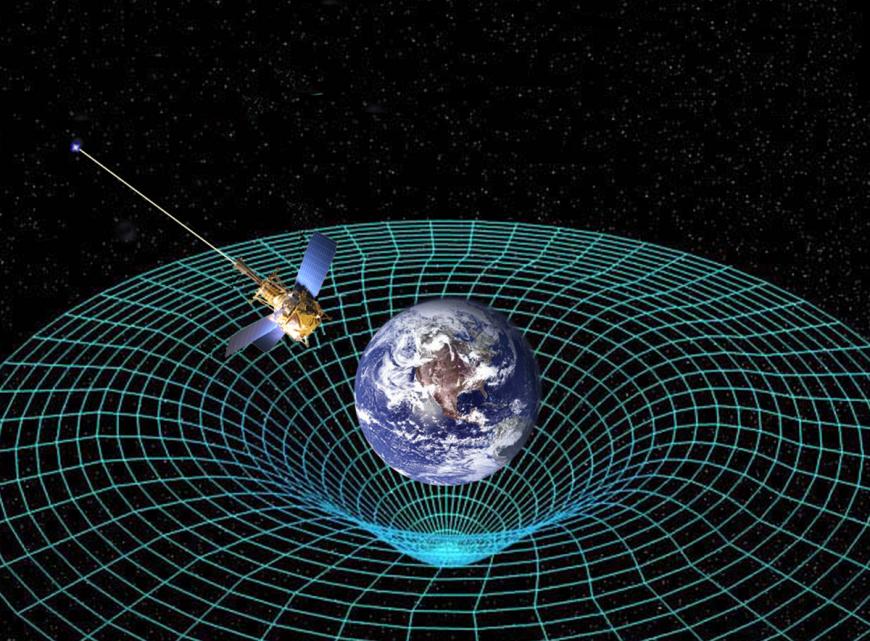
When a satellite is sent into space, what causes it to orbit a planetary body?
a)
The satellite enters the planet's gravitational field and falls into orbit around it
b)
The force of thrust sends it into orbit around the planet
c)
The planet's magnetic pull attracts the object into the field
d)
Satellites do not orbit a planet they only pass near planets on their journey through space
33.
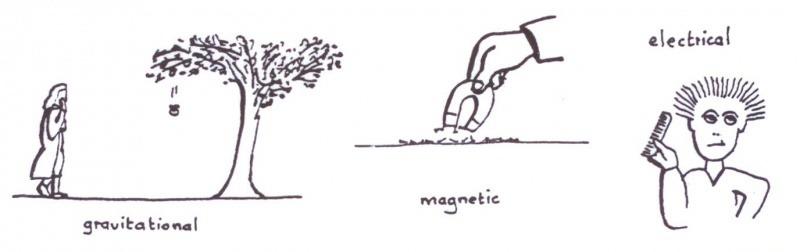
Each non-contact force has an area of influence surrounding it. What is this area called?
a)
gravitational attraction
b)
influence center
c)
field
d)
attraction
34.

If iron filings are sprinkled around the magnet, what will happen?
a)
The filings will move away from the magnet's field.
b)
The filings within the magnetic field will show an attraction between the north and south poles.
c)
The filings will not create a pattern.
d)
The filings within the magnetic field will show how the 2 ends of the magnet are repulsive.
35.

The diagram below shows that ______________________.
a)
As distance increases, the electric force increases.
b)
As distance decreases, the objects become less attractive.
c)
Electric forces are only slightly affected by distance.
d)
As distance increases, the electric force decreases.
36.

Which answer best describes this image?
a)
The positive charge is repelling the negative charge.
b)
The blue charged object will repel the negatively red charged object.
c)
The positively charged red object will be attracted to the negatively charged blue object.
37.
Which of the following statements is true?
a)
When an object gains electrons, its positive charge increases.
b)
When an object gains electrons, its negative charge increases.
c)
When objects gain protons, they become positively charged.
d)
When objects transfer neutrons, the charge increases.
38.
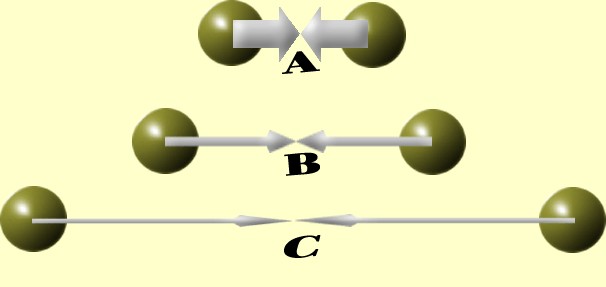
If each object has the same mass, which pair has the strongest gravitational attraction?
a)
The first, because it appears to weigh the most.
b)
The first, because the arrows are thickest.
c)
The second, because it has an even balance of weight and distance.
d)
The first, because the objects are closest together.
39.
What does the law of universal gravitation describe?
a)
Objects are attracted to one another based on the distance between them and their masses.
b)
Objects repel each other if their mass is too small or their distance is too great.
c)
All objects experience gravity based on the amount of magnetism they encompass.
d)
An object's gravitational pull is determined solely by the amount of mass it contains.
40.
Which of the following names the interaction of electric fields and magnetic currents?
a)
electromagnetism
b)
electric field lines
c)
magnetic and electric stations
d)
magnetism and gravity
41.

What is one advantage of the electromagnet pictured below
a)
The magnet can be turned off when the electric current is switched off
b)
The magnet is permanent so it is more reliable
c)
The magnet is turned off when the domains align
d)
It would be more of an advantage if the magnet was permanent
42.

What causes an object to become magnetic?
a)
scientists do not know why an object is magnetic but they can determine which materials are likely to become magnetic
b)
An object is magnetic based on its number of north and south poles
c)
The atoms within a magnet align in the same direction creating a magnetic domain
d)
it is simply based on the element of the object
43.

The image shows a generator. How does it work?
a)
The generator is plugged in to create light in a power outage.
b)
The electricity attracts magnetism to produce light.
c)
The generator uses electricity to create mechanical energy.
d)
The generator converts mechanical energy into electricity.
44.

The picture shows a simple motor created by a student. The motor works because________.
a)
The magnet on the bottom produces an electric current for the wires.
b)
The electric current flows through the conductors on the left and right sides, creating a magnetic field around the object on top.
c)
The object is able to convert mechanical energy into electrical energy.
100 %

