
 Worksheets
Film Terminology and Camera Rules Worksheet
Total questions: 67
Worksheet time: 34mins
What is the Establish Shot (ES)?
An establishing shot is a scene-opening shot that clearly displays the location of the action.
An end shot is a scene's initial shot that clearly indicates the location of the action.
A medium shot is a scene-setting shot that clearly shows the location of the action.
What is the Extreme Long Shot (ELS)?
A very tight shot can make your subject appear small in comparison to their surroundings.
An extremely long shot makes your subject appear small against their location.
A very wide shot can make your subject appear normal size in comparison to their surroundings.
What is a Full Shot (FS)?
A shot that captures a subject from head to toe, filling the frame while leaving minimal space around the subject and no surroundings visible.
A shot that captures a subject from head to midsection, filling the frame while leaving minimal space around the subject and no visible surroundings.
A shot that captures a subject from head to toe, filling the frame while also leaving space for the surrounding environment.
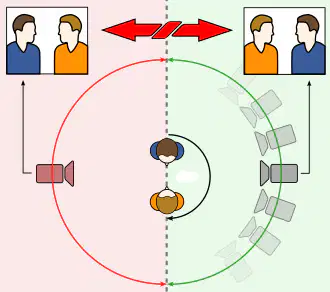
What rule is this image showing?
90-degree Rule
270-degree Rule
180-degree Rule
360-degree Rule
What is a Long Shot (LS)?
Utilize a close shot to effectively highlight your subject in confined surroundings, minimizing the space both above and below it.
Use a medium shot to effectively emphasize your subject in open environments, minimizing the space above and below it.
Use a wide shot to clearly showcase your subject in expansive surroundings, allowing ample space above and below it.
What is a Medium Wide Shot (MWS)?
The shot captures the subject from about the waist up.
The shot captures the subject from about the toes up.
The shot captures the subject from approximately the knees up.
What is a Close-Up shot (CU)?
When you want to reveal a subject’s emotions and reactions.
When you want to reveal a subject’s eyes.
When you want to highlight an individual's hairs on their skin.
What is a COWBOY SHOT (CS)?
This frames the subject from approximately mid-thigh up.
This frames the subject from approximately the knees up.
This frames the subject from approximately the toes up.
What is Camera Shot Framing?
Shots are fundamentally about composition. It's not just about pointing the camera at the subject.
Shots are primarily about the location and not just the background.
Shots are primarily influenced by the time of day, not just the lighting conditions.
What is a Static Shot or Fixed Shot?
When the camera is locked in place and there is no movement.
When the image is edited to correct a blurring issue.
When the camera is unlocked and there is movement, adjustments are needed to fix the image output.
What is a Dolly movement?
A dolly shot involves moving the camera forward or backward toward the subject.
A dolly shot involves moving the camera either left or right from the subject.
A dolly shot involves moving the camera up or down from the subject.
What is a Pan moment?
The pan movement involves moving the camera up or down from the subject.
The pan movement involves turning the camera either left or right from the subject.
A pan movement involves moving the camera forward or backward toward the subject.
What is a Pedestal movement?
A pedestal movement involves moving the camera forward or backward toward the subject.
The pedestal movement involves moving the camera either left or right from the subject.
The pedestal movement involves moving the camera either up or down from the subject.
What is a Truck moment?
The truck movement involves moving the camera up or down from the subject.
A truck movement involves moving the camera forward or backward toward the subject.
The truck movement involves moving the camera either left or right from the subject.

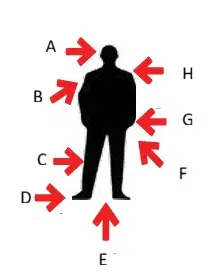
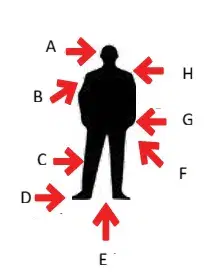
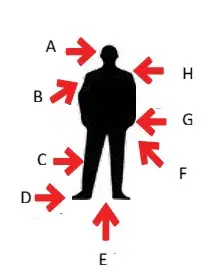
What is item "A" in the image showing?
Aerial Angles
Top Angles
High Angles
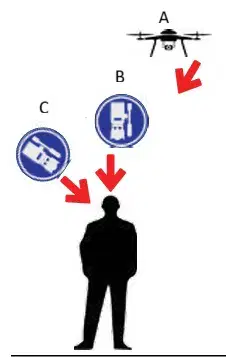
Refer to the diagram showing three labeled items (A, B, C) and arrows pointing to a person. What is item "B" in the image showing?
Aerial Angles
Top Angles
High Angles
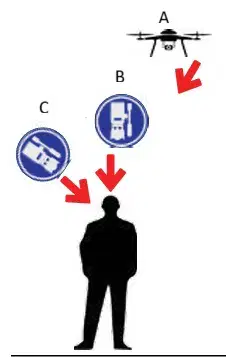
Refer to the diagram showing three labeled items (A, B, C) and arrows pointing to a person. What is item "C" in the image showing?
Aerial Angles
Top Angles
High Angles
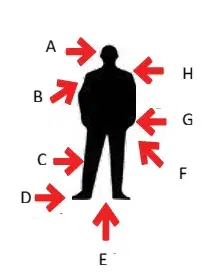
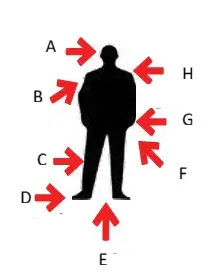
What is item "A" in the image showing?
Shoulder Level
Eye Level
Low Angles

What is item "B" in the image showing?
Shoulder Level
Eye Level
Low Angles
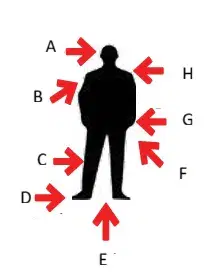
What is item "H" in the image showing?
Shoulder Level
Eye Level
Low Angles
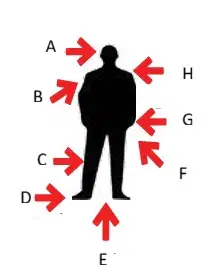
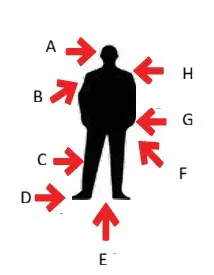
What is item "D" in the image showing?
Cowboy Shot
Bottom Angles
Ground
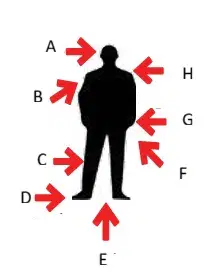
What is item "E" in the image showing?
Cowboy Shot
Bottom Angles
Ground
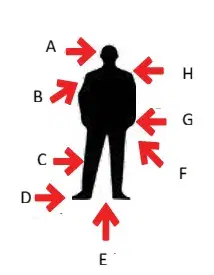
What is item "F" in the image showing?
Cowboy Shot
Bottom Angles
Ground
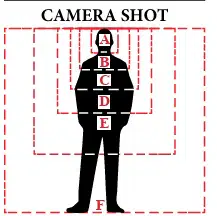
Refer to the CAMERA SHOT diagram. What is item "A" in the image showing?
Closeup (CU)
Medium Close up Shot (MCU)
Full Shot (FS)
Extream Closeup (ECU)
Medium Full Shot (MFS)
Refer to the CAMERA SHOT diagram. What is item "B" in the image showing?
Medium Shot (MS)
Full Shot (FS)
Closeup (CU)
Medium Close up Shot (MCU)
Medium Full Shot (MFS)
Refer to the CAMERA SHOT diagram. What is item "C" in the image showing?
Medium Full Shot (MFS)
Full Shot (FS)
Closeup (CU)
Medium Close up Shot (MCU)
Extream Closeup (ECU)
Refer to the CAMERA SHOT diagram. What is item "D" in the image showing?
Medium Full Shot (MFS)
Extream Closeup (ECU)
Closeup (CU)
Full Shot (FS)
Medium Close up Shot (MCU)
Refer to the CAMERA SHOT diagram. What is item "E" in the image showing?
Medium Close up Shot (MCU)
Closeup (CU)
Medium Full Shot (MFS)
Full Shot (FS)
Extream Closeup (ECU)
Refer to the CAMERA SHOT diagram. What is item "F" in the image showing?
Medium Close up Shot (MCU)
Medium Full Shot (MFS)
Closeup (CU)
Full Shot (FS)
Medium Shot (MS)
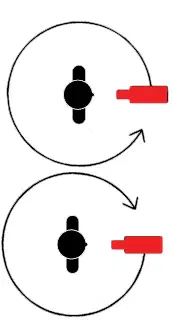
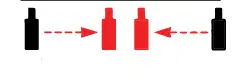
What camera moment is showing in this image?
Tilt
Pan
Dolly
Truck
Arc
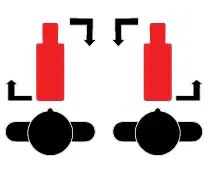
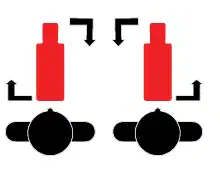
What camera moment is showing in this image?
Arc
Truck
Pan
Tilt
Dolly
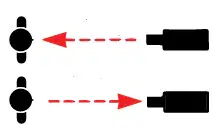
What camera moment is showing in this image?
Arc
Truck
Pan
Tilt
Dolly
What camera moment is showing in this image?
Arc
Truck
Pan
Tilt
Dolly
What camera moment is showing in this image?
Arc
Truck
Pan
Tilt
Dolly
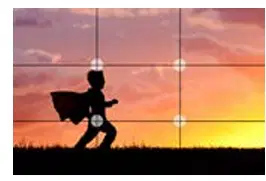
What image composition is shown in this image?
Balance light and dark shadows
The Rule of Thirds
Color balance

What is item "A" showing in this image?
Resolution
Conflict
Falling Action
Exposition
Falling Action

What is item "B" showing in this image?
Resolution
Conflict
Falling Action
Falling Action
Exposition

What is item "C" showing in this image?
Rising Action
Falling Action
Resolution
Conflict
Exposition

What is item "D" showing in this image?
Climax
Conflict
Exposition
Falling Action
Resolution
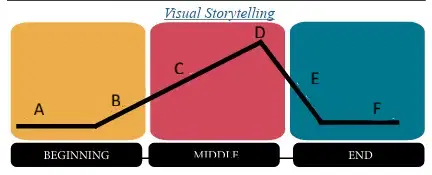
What is item "E" showing in this image?
Conflict
Falling Action
Exposition
Resolution

Refer to the diagram labeled 'Visual Storytelling'. What is item "F" showing in this image?
Falling Action
Conflict
Exposition
Resolution
Climax
What is "A-Roll"?
Footage used alongside narration provides visual context, covers edits, and adds visual interest by showcasing the environment or illustrating the subject matter of the ?-roll.
On-camera talent for interviews – Main audio and video combined – includes the primary narrative, such as dialogue or key actions.
Audio and video can pause and hold on a single frame at a specific point in the film.
What is "B-Roll"?
Footage used alongside narration provides visual context, covers edits, and adds visual interest by showcasing the environment or illustrating the subject matter of the ?-roll.
On-camera talent for interviews – Main audio and video combined – includes the primary narrative, such as dialogue or key actions.
Audio and video can pause and hold on a single frame at a specific point in the film.
What is "Freeze Frames"?
Footage used alongside narration provides visual context, covers edits, and adds visual interest by showcasing the environment or illustrating the subject matter of the ?-roll.
On-camera talent for interviews – Main audio and video combined – includes the primary narrative, such as dialogue or key actions.
Audio and video can pause and hold on a single frame at a specific point in the film.
What is Music used for in videos?
To distract the audience and confuse the pace of the storytelling.
To influence the audience's emotional response, establish the pace, and enhance storytelling.
Music is not important when used in videos; it often serves merely as a filler.
What is "NATS?"
Natural sound recorded using the camera microphone.
It stands for "Need Audiences to Speak.","It stands for "National Association of Teachers of Singing."
What is "NATS Bridge?"
It stands for "Need Audiences to Speak" near a bridge.
It stands for "National Association of Teachers of Singing" near a bridge
Natural sound captured using a camera's microphone.
What is "SFX?"
Stands for "Safe For Crossing."
Sound Effects
Stands for "Stand From the Center."
What is a "Super?"
A Video crew is doing an excellent job with the video creation. "SUPER JOB!"
B Superimpose text on the screen
C The video crew created a "SUPER FAST" production.
What is "SOT?"
"Start-over taping typically refers to restarting a recorded interview."
"Stand-only taping typically refers to waiting to start an interview."
"Sound On Tape usually refers to an interview."
What is "TC?"
Total Control of a video production and its team.
Time Code is used to identify video clips and interviews
Total compression of a video format
What is "VO?"
Variation Order
Volume Oscillator
Voice Over
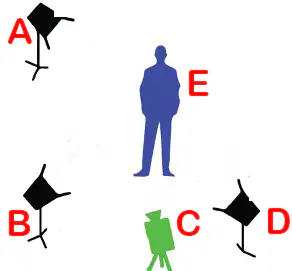
What is this image called?
Two (2) point lighting
Three (3) point lighting
Stage lighting
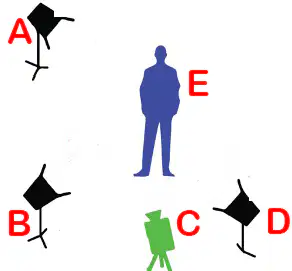
What is item "A" showing in this image?
Fill Light
Key Light
Back Light
Camera
Subject and or Talent
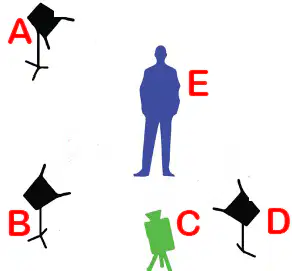
What is item "B" showing in this image?
Fill Light
Key Light
Back Light
Camera
Subject and or Talent
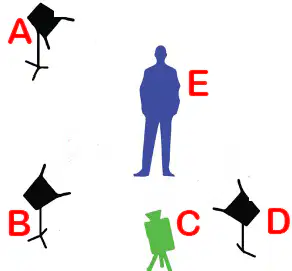
What is item "C" showing in this image?
Fill Light
Key Light
Back Light
Camera
Subject and or Talent
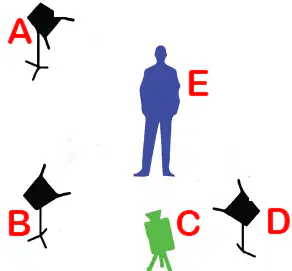
What is item "D" showing in this image?
Fill Light
Key Light
Back Light
Camera
Subject and or Talent
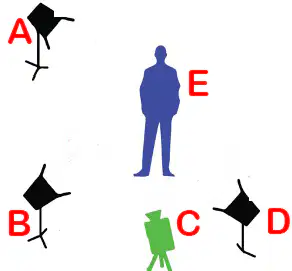
What is item "E" showing in this image?
Fill Light
Key Light
Back Light
Camera
Subject and or Talent
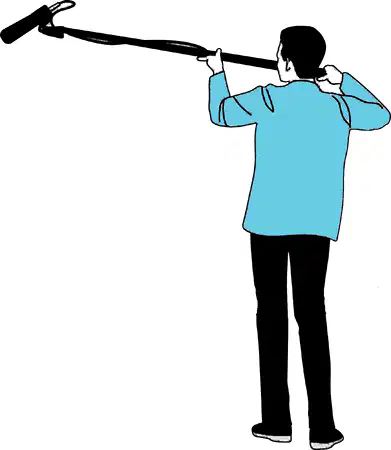
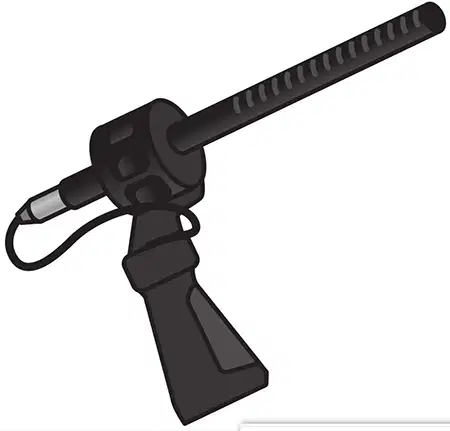
What type of microphone is illustrated in this image?
Shotgun microphone
Boom microphone
Lavalalier microphone
Hand microphone
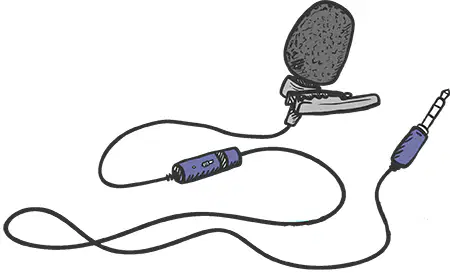
What type of microphone is illustrated in this image?
Shotgun microphone
Boom microphone
Lavalalier microphone
Hand microphone
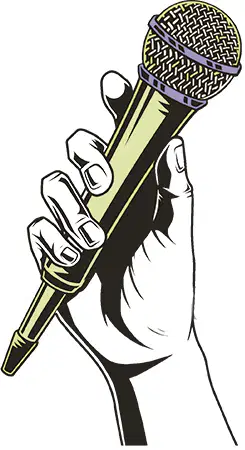
What type of microphone is illustrated in this image?
Shotgun microphone
Boom microphone
Lavalalier microphone
Hand microphone
What type of microphone is illustrated in this image?
Shotgun microphone
Boom microphone
Lavalalier microphone
Hand microphone
What is a "Hot Mic?"
The microphone is activated and may stay on, often without the speaker realizing it.
The microphone has a short in its wiring and can shock the speaker when used.
The microphone becomes hot when used for a long time.
What is a "Single Shot?"
When your shot captures one subject, it’s known as a single shot.
When your shot captures the first image, it’s known as a single shot.
When your last shot captures the background, it’s known as a single shot.
What is "Three Shot or 3-Shot?"
A three-shot combines three images into a single shot, serving a dual purpose as one cohesive image.
Three images are taken, and one is chosen for a video project.
A three-shot features three characters in the frame.
What is an Over-the-Shoulder Shot (OTS)?
An over-the-shoulder shot shows your subject from behind the shoulder of another character.
An over-the-shoulder shot captures the subject from the front of their shoulder, with a second subject positioned behind them.
An over-the-shoulder shot captures the subject from above their head, with a second subject positioned in front of or behind them.
What is "Two Shot or 2-Shot?"
A two-shot is a camera shot with two characters featured in the frame.
A two-shot combines two images into a single shot, serving a dual purpose as one cohesive image.
Two images are taken, and one is chosen for a video project.

